New Aconex SVP EMEA

Aconex logo 2014Melbourne, Australia-based international SaaS construction collaboration technology vendor Aconex has appointed a senior vice president with responsibility for Europe, Middle East and Africa (EMEA) and Global Accounts (see news release).

Reporting to Aconex CEO Leigh Jasper, Henry Jones has 20 years of experience in management, sales, marketing, and business development, gained most recently at legal services provider Axiom Global. Prior to Axiom, Jones was at Satmetrix Systems, a provider of cloud-based enterprise feedback reporting solutions.

Permanent link to this article: https://extranetevolution.com/2014/09/new-aconex-svp-emea/

Conject UK reports 16% growth

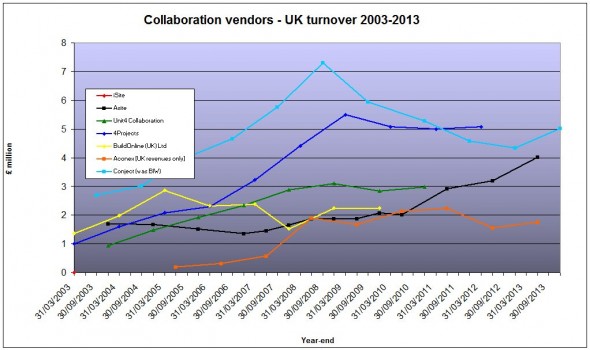
ConjectWoking, Surrey-based SaaS construction collaboration vendor Conject UK, a subsidiary of the Munich-based Conject Group, enjoyed a better 2013, reporting turnover up 16% on the previous year, to £5.028m, finally ending the downward drift that began during the global financial crisis in 2009.

The revenue performance is in line with the expectations set in October last year, when Conject UK CEO Steve Cooper told me UK revenues up to the end of September had grown15% (clearly, the improvement continued through to the year end). The firm’s order book position also improved, with “future recognisable revenues” at 31 December 2013 up 8% to £11.69m.

Conject UK still made a small operating loss. At £164k, this was a marked improvement on the previous year’s £596k, and even if the exceptional costs were stripped out, the 2013 results remain better than 2012’s (while still constituting a fourth straight loss).

vendorsturnoverSept2014

These results, of course, need to be assessed as part of a bigger picture. The Conject Group employs over 150 people as against the UK business’s 50, and total Group revenues last year passed €20m (£16.6m), having grown 14% during the year, so UK growth was slightly ahead of the rest of the group, perhaps due to the different strengths of the group’s regional operations and product portfolios.

Looking at Conject’s main UK rivals, the revenue growth rate still lags behind that of London-based Asite, whose income grew 25.6% in the year to 30 June 2013 (post). It will be interesting to see what Asite’s latest numbers are, as it could conceivably overtake Conject, though I reckon Asite will still lag behind 4Projects – which talked about double-digit growth in recent trading updates but is seemingly less forthcoming with numbers these days following its acquisition by US-owned Viewpoint.

UK market moves

The Conject directors report:

“During the year the company experienced increased confidence returning to a number of its larger markets. Whilst there was still a degree of nervousness there was an increase in orders received from both the UK and Middle East property markets.”

They say the business opened a new office in Singapore (securing five projects in that market) during 2013. Other successful international markets included Qatar, New Zealand, Malaysia, Denmark, north America, Saudi Arabia and Azerbaijan.

Domestically, Conject flagged several new project and enterprise engagements, and highlighted as “significant” a deal with National Grid in the UK. “In London the company is working on three of the capital’s largest redevelopment programmes, at King’s Cross, Earls Court and Elephant & Castle.”

Looking at the product portfolio, the report says:

“The UK team are playing a lead role in helping the group enhance its range of applications to service the contractor market, a market not serviced by the group outside the UK. Two of the key projects are focused on supporting mobile working and Building Information Modelling….”

nationalgrid logoUpdates (2 and 5 September 2014) – Conject has issued a news release and a 5 September blog post regarding its selection by National Grid (mentioned above) to administer contracts with their delivery partners on [I’m told, a five-year] programme of UK energy infrastructure projects.

The Conject platform has been configured to integrate National Grid and its contractor supply chain, ensuring that all project stakeholders are kept informed about what actions and responses are required to ensure compliance with the specified terms, timescales and options of the various engineering contracts used (NEC, FIDIC). Selection involved a two-day process including real-life test scenarios with National Grid and contractor employees to test capabilities. Conject won the project because its software could be tailored to the needs of all users.

Permanent link to this article: https://extranetevolution.com/2014/09/conject-uk-reports-16-growth/

Webforum enters UK AEC market

Webforum’s characteristic clean Swedish design interfaces to rich functionality that may interest larger SMEs managing staff across multiple projects.

Webforum logoAt a COMIT (Construction Opportunities for Mobile IT) community day earlier this summer, I met Colin Payne of Sweden’s Webforum and we subsequently met up so that he could show me the company’s Software-as-a-Service (SaaS) platform. While it is not a construction-focused collaboration product, it is aimed at teams engaged in projects and so could easily be adapted to manage both modest internal projects as well as construction projects requiring cross-company collaboration.

The company’s origins can be traced back to the late 1990s and the formation of a research group at the Royal Institute of Technology  in Stockholm, which aimed to develop user-friendly IT tools for planning and implementing technical projects, and for publishing information on the internet. The core product is used by some 700 public and private customers in over 20 countries, with some major Nordic building projects, including universities and urban transit schemes, deploying the system.

Building on the construction usage (see this Tyréns case study, for example), Colin is now working to raise Webforum’s UK profile, particularly among small and medium-sized construction businesses, where he thinks the platform might appeal to firms put off by the relatively high cost and apparent complexity of some sophisticated SaaS collaboration systems (we also talked about others in the SME market, including Collabor8online – June 2013 post – and Clouds UK 2011 post). Beyond the entry level product, it also provides some good project and time management and reporting tools.

Competitively priced

Webforum is provided in three versions: Teamwork, Project, and Professional. Prices for the Teamwork edition, covering document management and collaboration essentials, start at a competitive £8 per user per calendar month. The Project option offers more functionality, including strong project management functionality (ie: Gantt charts, work breakdown structures, etc – MS Project plans can be imported) and issue management, with prices from £12/user/month. Project-based prices are also available upon request, with a small project (under €1m) charged at €75/month (including up to 3GB of storage).

Drawing and project management

Webforum Viewer_withMarkups_MeasurementsWhen it comes to viewing drawings, Webforum uses v14 of the Rasterex viewer, which supports over 200 file types, enabling CAD mark-up and measurements. The platform is regularly updated, and Colin told me the Autumn release will see an upgrade to Rasterex v15 and provision of a HTML5 version making Webforum available for all browsers.

I was particularly struck by the project management capabilities (not always well covered in other SaaS systems) and by Webforum’s capabilities for time management – Colin showed me how staff time-sheets could be managed, reported and then used for invoicing purposes. This makes the platform potentially attractive to firms looking to enable staff self-reporting across a portfolio of projects, and who need to enable access for employees wherever they are working; as a SaaS web-based solution, it can also be accessed via mobile devices onsite (one of the reasons Colin attended the COMIT event), and its red-amber-green traffic-light reporting interface is particularly user-friendly.

Webforum, therefore, neatly combines back-office functionality found in some intranet systems (eg: Union Squaresee March 2014 post) with extranet capabilities for cross-company collaboration. Moreover, information published to the system can also be selectively reused for public access – useful if a project team wants to, say, populate a public-facing website with up-to-date information about the project. It may take time to configure the platform as a construction-oriented – rather than a generic – platform, but it is an attractive (and attractively priced) example of Swedish Software-as-a-Service.

A Projectplace note

Incidentally, in Scandinavia Webforum’s Stockholm-based rival Projectplace has long been prominent in the generic project collaboration market (I seem to recall that it was also extensively marketed in the UK during the early 2000s, though it never really gained traction in the UK construction sector). It may become even more prominent worldwide following ProjectPlace’s acquisition (for an undisclosed amount) by US enterprise resource management firm Planview. This deal will help Projectplace push more easily into the US, and Planview into Europe, while combining the former’s project-based collaboration with Planview’s executive dashboard tools.

Permanent link to this article: https://extranetevolution.com/2014/08/webforum-enters-uk-aec-market/

Five problems with SaaS construction collaboration?

QICpostAug14London-based Quality in Construction blogger Paul Inglesis has written a post entitled “5 Problems With Online Collaboration and Document Management Tools in Construction Industry” (19 August) which is worth a read. The article (which mentions this blog) suggests some major obstacles that are “holding the market back”. Drawing on his contractor experiences working on projects in Greece, Qatar and in east London, Paul (who I’ve met for a couple of beers) sees the following (summarised) problems:

  1. Partial collaboration means… no collaboration – Paul cites contractors’ suspicions over client-mandated systems that they don’t control, and where they are reluctant to add new users.
  2. Need for speed – poor network performance and slow cloud downloads
  3. Changes halfway through the life-cycle of a project – Changing from one Software-as-a-Service (SaaS) system to another midway through a project
  4. “Simplicity is the ultimate sophistication” (Leonardo Da Vinci) – The need for tools to be well configured and well implemented so they work simply and reliably from day one.
  5. Windows ’95 – Not the operating system, but a reflection that, in Paul’s view, aesthetically many of the solutions are ugly and so visually old-fashioned.

I have tried to summarise his points (read the original article to get his full view), but I have observations to make on them all. Let’s take a more detailed look at them….

  1. Partial collaboration or dual systems – First, these problems are not the fault of the systems, but of the contractual mindset – too often based on adversarial, risk-averse and/or litigious attitudes. The issues can be avoided if clients and teams work more collaboratively, in a spirit of mutual trust and co-operation, rather than adopting a “Knowledge is power” approach. Second, there will always be parallel systems, not least because firms will publish information originally authored on separate internal systems. Further duplication and issues with version control can, though, be overcome if firms can integrate the SaaS platform with their internal systems (using Revit plugins, for instance – see previous post) and if they enforce robust project protocols. Third, where a SaaS platform is licensed – as most UK ones are (excluding Asite) – on a project-based license, there is no additional cost for new users to be created.
  2. Speed – Paul admits network speed is becoming less of a problem, but the speed of a SaaS platform will only be as good as the end-user’s connection to the internet. Most of the SaaS vendors’ experience predates broadband, and they are expert at optimising information delivery through a browser even over slow connections (building information models can be viewed in seconds as SaaS platforms stream just an image of the file). The upload and download of native files will always be more time-consuming if the internet connection is poor or over-contended (one reason that many firms schedule file transfers out-of-hours); the YouTube comparison is inappropriate – uploading the initial video file will be just as slow.
  3. Half-way changes – Again, such changes can be avoided if the client and project team work collaboratively and agree on one system for the duration of the project (better still, if the platform incorporates a tendering system so that users from successful bidders can then be added). In my experience, a midpoint change is very rare – most project teams recognise the training and learning curves involved in switching during an ongoing project. Also, major contractors are increasingly entering into enterprise agreements with SaaS vendors so that the chosen system becomes standard for all their projects and across all their supply chains, reducing issues when people move between projects.
  4. Simplicity – Adoption is more likely when a system is intuitive to use and its interface reflects common industry terminology and workflows (including those specific to a company). Paul is right to highlight the need to carefully plan and ensure sufficient resources during the configuration and roll-out of technology; most reputable SaaS collaboration vendors will focus on the ‘service’, not the software, and work with project teams to ensure it works how they expect it to so that “work-arounds” are avoided.
  5. Old-fashioned – I would agree with Paul on this, though an outdated interface may not be solely the fault of the vendors. The typical document register column-based interface reflects the spreadsheets and forms commonly used for many years in the construction industry, and vendors also test the acceptance of new designs extensively with users before roll-out. While the interfaces might not win awards among the web-savvy, they provide familiarity and continuity to many current users, and have been incrementally improved over the past decade or so. However, there are companies that are breaking the mould and developing almost radical new interfaces which adapt approaches from mobile (even wearable) devices and from social media – see my recent posts on Bridgit (21 August), Avollio (1 August) and on Plangrid (18 June), for example. The current crop of collaboration providers will need to adapt if they are not to see their market taken by the new generation.


Permanent link to this article: https://extranetevolution.com/2014/08/five-problems-with-saas-construction-collaboration/

4Projects adds Revit plugin

Watching the SaaS construction collaboration vendors adding building information modelling (BIM) capabilities to their platforms, it’s clear some have been moving more quickly than others.

As regular readers may recall, Asite was one of the first to champion what it called collaborative BIM (cBIM) and, recognising the high market penetration of Autodesk’s Revit BIM authoring software, it added a Revit plugin when it launched its v15 release in July 2012 – an enhancement then somewhat overshadowed by the product’s rebranding as Adoddle. Aconex added a third party Revit plugin (developed and supported by Queensland-based XRev) in early 2013 (see Matt Rumbelow’s blog), and now there is a Revit plugin for 4Projects (or Viewpoint for Collaboration, as it is known in the US and Australia).

4Projects by Viewpoint - blue[27 August 2014 – Remainder of post was temporarily removed pending receipt of official 4Projects news release, and video – finally issued 8 September] According to Viewpoint, the Revit Plugin also addresses the challenge of creating IFCs from Revit models, as well as improving the quality of the exported IFC file, refining the way entire project teams collaborate on the right data, when they need it. Senior VP, Strategy and Corporate Development, Matt Harris says:

“We understand that a large majority of our customers use Revit by Autodesk to create building information models. By integrating Revit outputs in OpenBIM formats with Viewpoint’s project collaboration and management systems, we ensure that distributed project teams can effectively share and collaborate on models and BIM project information.”

Additional benefits of the new plugin include the ability to automatically authenticate team credentials to Viewpoint from Revit, the ability to export models, sheets and schedules from Revit to Viewpoint in one quick step, and users can now easily define which file formats they want to export to Viewpoint including RVT, IFC, PDF, DWG, XLS and CSV.

Permanent link to this article: https://extranetevolution.com/2014/08/4projects-adds-revit-plugin/

Asite adds US reseller

Asite logo 2012London, UK-based SaaS construction collaboration provider Asite has a new US reseller of its Adoddle platform: Microsol Resources, which has offices in New York, Boston and Philadelphia and is an Autodesk Platinum Partner. Emilio Krausz, president of Microsol Resources, says:

“We are thrilled to be able to partner with Asite to provide our customers with a superb product for project information, data management and collaboration. Our customers have been voicing the need for this type software, especially as BIM workflows demands an easier way to collaborate on project portfolios of all sizes. Asite finally addresses all of these needs and more.”

Asite CEO Tony Ryan says:

Tony Ryan (Asite CEO)“We are excited to welcome Microsol Resources to the Asite partner community. Together, we will provide leading digital services to the AECO industry in North America in an effort to simplify the complex challenges they face every day.”

Microsol Resources is hosting a four-week webinar series (on Tuesdays at 11 am, on 23, 30 September and 7, 14 October) on “Introducing Asite for Cloud-Based Project Management and Data Collaboration”.

Asite opened a New York office and another in San Francisco in April 2012, having earlier relied on resellers sourced via reprographics networks. It appointed a VP for US Sales, Alex Severino, in August 2013, and I met another US representative, Paul Seletsky, at the London launch of Adoddle 17 in March, when Tony Ryan highlighted Asite’s strategy to raise its US profile and finally crack the US market.

two attempts, the company still “needs to crack the US”. The Goldman Sachs deal was highlighted as a major step forward in raising their profile in north Amer – See more at: http://www.extranetevolution.com/2014/03/asite-cocial-and-mocial/#sthash.89KN7VnX.dpuf
US representative, AEC industry veteran Paul Seletsky) – See more at: http://www.extranetevolution.com/2014/03/asite-cocial-and-mocial/#sthash.89KN7VnX.dpuf
US representative, AEC industry veteran Paul Seletsky – See more at: http://www.extranetevolution.com/2014/03/asite-cocial-and-mocial/#sthash.89KN7VnX.dpuf

Permanent link to this article: https://extranetevolution.com/2014/08/asite-adds-us-reseller/

Bridgit launches Smartglass push

Bridgit combines armband, smart glasses and mobile construction applications to speed up site-based data capture and workflow.

Bridgit logoI haven’t previously covered Ontario, Canada-based construction software startup Bridgit (though I have exchanged a few tweets with them). Co-founded in 2012 by a construction engineer, Lauren Hasagawa, and an e-commerce entrepreneur, Mallorie Brodie, the company has much in common with several other recent startups (eg: Basestone, Cadbeam, Plangrid, FieldLens and GenieBelt), being focused on creating mobile-first Software-as-a-Service applications for construction users. Its first application, Close-Out (available on iOS, Android and Blackberry), supports ‘deficiency management’ processes (aka: punchlists, snagging, defects, quality control).

Wearable technologies

This week, Bridgit announced the launch of beta testing programme, Groundbreaker, harnessing the latest in wearable technologies (see this TechCrunch article). The scheme is aimed at bringing together technology evangelists and early adopters from across the construction industry and giving them access to the newest technologies and integrations such as wearable gesture control devices and smart glasses.

Bridgit’s flagship product, Close-Out, has been integrated with Thalmic Labs’s Myo armband. This armband recognises hand and finger gestures, offering a more efficient and effective use of applications on Google Glass. According to Bridgit, by integrating the Myo armband with the Close-Out smartglass application on-site, users can eliminate smartphone manipulation and voice commands that slow down access to information and multiple-step processes to input or retrieve data. Mallorie Brodie says:

“The construction industry has already seen some basic examples of smartglass, such as Google Glass, being used as an input device for existing applications. However, up until now, the standard for smartglass input has been the built in audio commands. As we continue to place our primary focus on ease of use, audio input just doesn’t cut it in terms of usability. The Myo armband provides us with the ability to optimize smartglass in a way that makes sense for our users.”


Construction technology leaders interested in participating in the Groundbreaker programme are encouraged to apply online at gobridgit.com/groundbreaker. Space is limited and admission to the programme will be granted on a rolling basis.

Update (21 October 2014) – Bridgit has been recognised as one of the Canadian Innovation Exchange’s top 20 list for 2014 – ie: one of Canada’s best innovations of the year.

FieldLens

FieldLens - logoIncidentally, keeping my eye on what else is happening in the north American construction software market, I was pleased to be able to drop into FieldLens‘s New York office during a recent trip to the US. Unfortunately, I missed meeting CEO Doug Chambers, but I had a long chat with marketing guy Daryl Lang about the company, its competitors, its funding (see post) and product differentiation.

Permanent link to this article: https://extranetevolution.com/2014/08/bridgit-launches-smartglass-push/

No SaaS ‘Safe Harbor’?

Will US-owned vendors of collaboration services be shunned by clients wanting to keep their intellectual property safe from prying US eyes?

I recently had an email conversation with someone who was trying to choose between different SaaS construction collaboration technology vendors. His initial focus was on the functionality of the various platforms, but he then began to consider other service aspects, including licensing models and the availability of mobile tools, and then got particularly concerned about the location and security of providers’ hosting.

It is not unusual for SaaS collaboration customers to want their project data to be securely managed nearby. Middle Eastern clients, for example, might want their data hosted in the region, not in Europe or the USA (equally, some US businesses have not wanted their data hosted outside the US). Several of the vendors have therefore created hosting outposts to serve customers in particular regions, and to provide scalability, flexibility, increased redundancy, and more predictable uptime (in June, Viewpoint opened up an Australian hosting environment for Asia-Pacific customers of its 4Projects/ Viewpoint for Collaboration service, augmenting locations in the UK and US, the latter established in August 2013).

My correspondent, working on a sensitive UK infrastructure project, was particularly concerned that the US Patriot Act, Act of 2001 and Section 362 and others in place, might mean providers such as ViewPoint/4Projects information could be accessed by US Intelligence anywhere globally. (This para updated 1330hrs BST, 6 August)

Is he right to be that concerned? While the 2013 Edward Snowden US National Security Agency revelations have sent rippled round the world about the role of US intelligence, this Legal Week article by Neil Cameron suggests he could also have grounds for concern in civil court proceedings. Microsoft was recently ordered by a US Federal Court judge to provide details of emails, even though the data was hosted outside the US, in Ireland, by a Dutch-owned subsidiary. It seems that the Safe Harbor Privacy Principles created to extend the EU Data Protection Directive regarding data privacy,and so facilitate US-EU trade and commerce, may no longer be effective protection (though Cameron does point out it’s early days and the decision may well be appealed).

I would be interested to hear the comments of any vendors on these issues.

(Update: 7 August 2014) – Aconex joins Cloud Security Alliance

In an unrelated announcement, Melbourne-based construction collaboration technology provider Aconex has announced that is has joined the Cloud Security Alliance, a not-for-profit broad coalition promoting best practices for providing security assurance within cloud computing.

The CSA published a sponsored white paper – What Rules Regulate Government Access to Data Held by US Cloud Service Providers – in February 2013, followed by a July 2013 survey on Government Access to Data.

(Update: 18 August 2014) – In addition to some interesting comments on this post, I have received the following from Alun Baker, managing director EMEA, 4Projects by Viewpoint:

Alun Baker… Viewpoint has been (and still is) looking at implementing localised data centres in various geographies in accordance with our commitment to provide the best service possible for customers.  As you would expect, we have extensive data security protocols driven by both best practices and global privacy laws and in any case would be considered a low risk target for governmental data seizure given the minimal data we collect.  It’s worth noting that we have never actually had an official request for information and if one were served upon us we would expect, within the bounds of the law, to challenge such a request.   As far as disaster recovery is concerned these systems are kept in the same jurisdiction as the main data centre so if your project is using a UK data centre the information will never leave UK soil.

In terms of protecting information globally from the US, remember that the lack of any law such as the Patriot Act in the majority of non-western countries means that information can be seized without restriction or judicial oversight – meaning data could arguably be considered safer in the US or UK than most other geographies lacking specific protocols and judicial oversight.

We are growing rapidly and are seen as the market leader in the collaboration and BIM space across the globe.  As a result, such policies have been rigorously scrutinised by some of our most risk averse customers”.

Permanent link to this article: https://extranetevolution.com/2014/08/no-saas-safe-harbor/

Cadweb goes bust

cadweb-logoA clutch of broken link alerts, a website now longer accessible, emails bouncing…. It seems that west London, UK-based construction collaboration technology provider, Cadweb, has ceased trading, weeks after UK rival Woobius did the same.

Cadweb crash

Formed in 1995, Cadweb launched its first commercial product in 1998 (I wrote an IT Best Practice Programme case study about its use on a project at Green Park, Reading in 1999); its Cadweb.net SaaS solution followed in March 2002, and the company claimed to be one of the longest-established UK project collaboration providers, delivering collaboration services to several long-standing customers (including Land Securities, PRUPIM, Gardiner & Theobald, Chapman Taylor Architects, and Sweett Group).

Its CEO Francis Newman often attended meetings of the short-lived Network of Construction Collaboration Technology Providers (NCCTP) trade grouping, and I occasionally bumped into business development director Tony Dodd (briefly a BIW colleague of mine before he joined Cadweb in 2002), though he left the company in late 2013 – which was roughly when I last met Francis. The Cadweb team carefully guarded information about the company’s financial performance (see my January 2009 post), sometimes making a virtue that it had not required external funding (the company, always one of the smaller collaboration vendors, was 99% owned by a Newman family trust). However, during the late 2000s (when the global financial crisis adversely affected the revenues of several collaboration vendors) and judging from the limited information made available via Companies House returns, its liabilities grew and its net assets declined, and it seems it’s eventually ended in insolvency.

On 15 July 2014, the London Gazette published a notice regarding a meeting of creditors to be held last week on Wednesday 29 July at the Wheathampstead, St Albans offices of insolvency practitioners Maidment Judd.

rapier logoMeanwhile, in October 2013, Francis became a director of a new business, Rapiere Software, which is developing a web-based decision support tool for design of low impact buildings. Apparently based in Architype‘s London office, the new company’s backers include Sweett and BDSP Chapman.

Reaction

It comes as little surprise that Cadweb has closed down. It rode the wave of interest in SaaS-based construction collaboration in the early 2000s and benefited from early adopters testing out the various solutions, and it gained some loyal customers. However, rivals say they rarely encountered Cadweb in client competitions in recent years, and as these rival solutions developed stronger capabilities, Cadweb’s relatively simple platform had less appeal.

After Woobius closed down recently, I used a UK football analogy to describe the gradual polarisation between the “Premier League” of leading providers and a “Championship” level tier who support loyal long-term customers, but who compete at a product and price level below that of their more successful rivals. If a business can’t manage customer ‘churn’, if its premium services can’t be adjusted to attract the SME market, and if it doesn’t have other services in its portfolio, it will struggle – and this appears to have been Cadweb’s fate. (Long-time Yorkshire-based rival Sarcophagus, for example, offers e-tendering and email management solutions as well as SaaS collaboration.)

Permanent link to this article: https://extranetevolution.com/2014/08/cadweb-goes-bust/

Avollio targets property asset managers

Elegantly designed to be easily intuitive to use, Avollio - logoAvollio describes itself as an online property asset management and collaboration platform. It provides tools to:

  • share, manage and improve properties
  • to manage tenants, rentals and leased assets and coordinate building projects, and
  • to collaborate with clients, colleagues, suppliers and contractors.

In short, Avollio, created by a southwest London, UK team co-founded by architect Ian Thompson and developer Pascal Rieger and released in a Beta version in April 2014, promises to cover two or three areas that were previously managed through largely separate online solutions.

For example, UK professional users have long used cloud-based collaboration platforms to manage their projects, and there has been a gradual push to offer similar but simpler solutions at the SME end of the market (I wrote two weeks ago about UK providers such as Woobius – now seemingly discontinued – Collabor8online and CloudsUK). Equally, I have talked about solutions which are more asset-focused – Kykloud, for example, or iSite’s ‘Assetology’ hub.

While Kykloud has made a virtue of being predominantly a tablet-accessed system, most of the other systems have tended to be computer browser-based. But in the last year or so, I have started to watch several mobile-first and social media-savvy development efforts to create new platforms (for example, US firms such as FieldLens, FluidCM and PlanGrid, Copenhagens’ GenieBelt, and UK startups such as Basestone, HandS HQ and Cadbeam).

Ian says the Avollio platform interface has been developed so that users can seamlessly transfer between desktop, laptop, tablet or mobile, accessing visual and text information on any interface without limitation on functionality; it is currently a web-based platform, with no apps for offline access – Ian envisages it becoming part of an ecosystem of complementary “satellite” tools (SaaS, mobile, back office – he mentioned integrations with Xero and Free Agent cloud-based accounting services, for example), rather than trying to do everything in one platform. We also talked about eventual integration of BIM capabilities into the platform.

Retail potential

Ian Thompson (Avollio)Ian’s 22-year architectural career, covering South African and the UK, includes includes design projects for Cafe Rouge, Bella Italia, Strada and Vivat Bacchus across the UK in airports, railway stations, shopping centres and high streets. Using feedback from customers who had used other applications he’d developed, Ian and Pascal are now developing Avollio as a configurable cross-platform cloud-based solution (“We’ve had restauranteurs and retail outlets tell us it’s the perfect platform to stay in touch with staff as well as manage inventory bought for fit-outs”). As well as the outlet owners, the platform clearly also has potential for the interior designers, architects and others involved in designing and delivering store and restaurant environments (this might pitch Avollio against established AEC intranet providers such as Union Square – post).

Incidentally, mention of retail asset management also reminds me of Leicestershire, UK-based, ICON (in early 2012, they were looking at mobile use of QR codes for asset-tracking; coincidentally, I met up with ICON’s Chris Lovelock again at a recent London reception hosted by Newforma).

Polished user interface

Avollio’s design polish and simplicity aspirations remind me of Woobius: “designed by architects for architects”. As well as architecture and retail, Avollio’s website includes user cases for property managers, holiday lets and home-owners – implying this may also be a great solution for the SME user. Users can navigate around their workspaces by Portfolios (the company’s name was chosen for its similarity to “folio”), Properties, Projects and People, and from each view, users can drill into increasingly detailed levels of information. The platform also delivers easily created reports across all the views.

avollio projectSome capabilities – documents, notes, calendar and address book (and integration with Gmail and Outlook is coming soon), for example – are common to all views; others are specific to particular requirements (for instance, Property management includes tools to manage acquisition and leasing, while Projects includes tools to manage asset inventories and regulatory compliance). Avollio is also pleasing to look at – it uses familiar tools such as Google Maps and Street View in its navigation, while photographs of projects and users help accelerate navigation; Ian was keen to implement a Pinterest-like look and feel, reflecting the visual-first approach of many design professionals.

As you might expect of a Beta application, there are still areas to develop. Some functionality has been created to address particular customer needs and has now been ‘parked’, while there is also a development roadmap – one feature on this is provision of templates to simplify the creation of new customer portfolios, properties or projects.

To date, the company has been funded by its founders, and Ian is planning to find seed investors in 2015 to help it grow further. Currently, the product is free to use for up to five properties, five projects and 500Mb of storage – over these starting points, the Avollio website has an elegant slider-controlled pricing tool charging per property or project and storage space over this limit.

Permanent link to this article: https://extranetevolution.com/2014/08/avollio-targets-property-asset-managers/

Load more