Viewpoint’s 4Projects acquires MCS Priority1

Viewpoint subsidiary 4Projects expands its mobile functionality by acquiring ‘best-in-class’ Mobile Computing Solutions Priority1.

Priority1 logo4Projects, the Newcastle, UK-based SaaS construction collaboration subsidiary of Viewpoint Construction Software, has acquired, for an undisclosed amount, Swansea-based construction mobile technology specialist Mobile Computing Systems, developer of the Priority1 site solution. The acquisition was announced to staff and customers yesterday (1 December 2014) and made public today (see 4Projects news release).

The deal may come as little surprise to many of Priority1’s current customers, particularly those who have attended MCS’s last two user conferences. At the November 2013 conference, after hearing how MCS was building a SaaS reporting capability, 4Projects commercial director Steve Spark talked warmly about how the two companies were looking to develop complementary capabilities to satisfy mutual customers. And at the 2014 user event, on 13 November, Steve spoke again, describing the convergence of desktop SaaS and mobile computing environments and how the future would see richer data sharing from the ‘common data environment’ (CDE) to and from the field.

4Projects by Viewpoint - blueThe two companies share several customers (Carillion, for example) so integration of what ViewPoint’s EMEA MD Alun Baker called MCS’s “best in class” site functionality strengths (quality, health & safety and environmental reporting forms, site permits, daily logs, etc) with 4Projects’ information management and project control functions will be a logical step forward for them. And, as with other complementary technology acquisitions, there will be scope for 4Projects to extend its reach to MCS’s other customers and for the MCS technology defects management (aka: ‘snagging,’ ‘punch-listing’) and form-creation technologies to become more widely used across 4Projects’ user base.

This will also potentially put the MCS toolset in the hands of users well beyond its existing UK heartland, with Viewpoint also extending the product’s reach to North America and Australia. Longer term, the anticipated expansion of BIM to support future asset management will also underline the value of mobile tools for planned preventative maintenance and other asset-related tasks. Currently MCS’s core customers are mainly main contractors, but, over time, Viewpoint will be putting its mobile data-sharing technologies into the hands of more and more owner-operators, and aiming to help them extract business intelligence from their aggregated data (MCS had started doing this in 2013 using Yellowfin reporting tools hosted on its recently developed SaaS back-end, but with 4Projects’ SaaS know-how I think we can now expect this capability to grow more rapidly).

In an email to customers, Viewpoint CEO Jay Haladay said it will be “business as usual”:

“You will not see changes in the people, quality of product or support you receive from MCS. In fact, I would say with confidence, you can expect more product opportunities and enhancements to Priority1 now that MCS and Viewpoint have joined force.”

He also said:

Jay Haladay“… By combining another UK based best-in-class construction software company under the Viewpoint umbrella, Viewpoint is further reinforcing its commitment to the UK market for construction software. When 4Projects first became part of Viewpoint, we knew the UK market was an area ripe for our investment and expansion, and this is further evidence of our plans.”

4Projects plans to invest in and build the Swansea-based team – Steve said it will become Viewpoint’s “mobile centre of excellence for collaboration” – with MCS MD Richard Scott taking on a new role as director of market development. Richard said:

Richard Scott (Priority1)“… It has been clear from the beginning of the endeavour that our principles and values are aligned and after seeing the vision, energy and passion shared by everyone within the Viewpoint Team I have no doubt that this is a unique opportunity to join an exceptional organisation. Viewpoint are committed to the roadmap we have set out for Priority1 and by working together we gain access to unprecedented, industry leading technical capability, resource and experience that will allow us to accelerate the delivery of the products and services that our customers want.”

The Priority1 product itself will be rebranded as Viewpoint Field View, helping 4Projects expand the workflow and document sharing capabilities of its current 4Mobile solution so that it will eventually be able to offer complete integration with the 4Projects BIM CDE, enabling data capture, aggregation and reporting in the field. In terms of future user adoption, it helps that there are some strong similarities between 4Projects and Priority1 in terms of user interface and user experience, and Windows users will soon be catered for. Priority1 is currently offered only as an Android app, but the product roadmap revealed on 13 November showed a Microsoft app is in development.

My analysis

This is the second mobile acquisition by a SaaS construction collaboration technology vendor in the past 12 months, following Conject’s deal to buy the French mobile business WAPP6 which was signed at the end of 2013 and announced in January 2014. However, the two deals differ in at least three respects:

  1. 4Projects already offered some mobile functionality, having launched its 4Mobile app in July 2013, whereas Conject had none until the Wapp6 purchase.
  2. The Priority1 application already has an established user base in the the UK market, and shares several customers with its new parent (as well as some of 4Projects’ competitors). The Wapp6 apps had little traction outside of France, and it was four months before the first English app was shown to UK Conject customers, and another four weeks before ConjectMI became commercially available.
  3. The Wapp6 acquisition did mean Conject was catching up with key SaaS rivals 4Projects, Asite, Aconex, plus less well-known names such as Dome Connect/iSnag (February 2014 post) and Newforma (April 2014 post) – all of whom had their own mobile or field apps, but none of these, in my view, offered comparably diverse functionality to Priority1. This deal means 4Projects pulls ahead of its competitors again.

This deal also adds further substance to 4Projects and Viewpoint product roadmaps aired at its May 2014 user conference. Then I heard much about BIM, about a gradual shift to enable even ERP “in the cloud”, and mobile was a third strand. I thought then that Viewpoint/4Projects might be eyeing a strategic acquisition to enable a step change in its mobile data delivery capabilities, and so it’s proved.

In addition to this deal and Conject’s Wapp6 buy, 2014 has seen the announcement of several acquisitions involving SaaS vendors (Trimble acquired GTeam in September; Newforma bought SmartUse in October and Nemetscheck bagged BlueBeam, also in October), an MBO at Business Collaborator last week, and the folding of Cadweb, Woobius and SmartBuilder during the summer. So, while there is clearly strong investor support for some AEC SaaS businesses, others have not shared the same appeal. There appears to be some polarisation between those offering a robust and diverse portfolio of capabilities to support future AEC and asset owner needs, and those offering narrowly-based document collaboration or related ‘point solutions’.

A bigger test is coming soon – next week (9 December), in fact. Aconex’s long-anticipated IPO (covered repeatedly in this blog) will be watched very carefully by existing and potential competitors, investors, acquirers, aspiring startups, and customers. The initially optimistic flotation was downsized, and last week investors were being advised (by Tim Boreham in Australian Business Review) to judge the IPO “on its merits”, not expect sentiment to deliver “stag profits,” and “given the signs of IPO fatigue, … see how it fares on debut.”

 

Permanent link to this article: https://extranetevolution.com/2014/12/4projects-acquires-mcs-priorty1/

Recent ExtranetEvolution outages

Apologies to anyone affected by recent downtime at ExtranetEvolution.com (and my other sites) on two days last week and earlier today.

Last week’s outages (on Tuesday and Thursday) were due to problems in migrating my sites to a new server at my hosting provider, while this morning’s was due to a problem with an updated plugin affecting my networked WordPress.org installation. The bug has affected other WordPress-based sites and blogs deploying multiple domains, and I understand the developer is working on a fix. In the meantime, the plugin has been temporarily disabled (the main effect seems to be a change in how the site handles cookies).

Permanent link to this article: https://extranetevolution.com/2014/12/recent-extranetevolution-outages/

New to me: Wrench and Expo-Net

Monitoring the web and social media for international construction collaboration providers, I was recently alerted to two different systems of which I was previously unaware, both of which appear to be offered in SaaS-based and locally-hosted versions.

Wrench

Wrench logoI saw Wrench Solutions mentioned twice in a fortnight. First, the company was named in the Aconex IPO prospectus, and then someone tweeted to me about the company during the recent Construction Computing Awards dinner. Aconex included Wrench in its competitor review, identifying it as its only Asia-based competitor.

According to its history, the Bangalore, India-based company was founded in 1994, but was primarily a provider of locally-hosted engineering information management software until December 2013, when it launched a cloud-based service (followed by mobile-based services this year). However:

  • Wrench remains largely a locally deployed system, not a pure SaaS platform – Wrench works on what it calls a Multiple Server Vault (MSV) model deployed across geographically separated enterprise.
  • Wrench has four main products each targetting a different market: aerospace and defence, industrial machinery and equipment, new product development and EPC (engineering, procurement and construction). Wrench EPC is not purely focused on construction; it also serves customers in the marine/offshore, oil & gas, power, water and process sectors. Its construction customers include Habtoor Leighton, Murray & Roberts and Megawide

Expo-Net

Expo-NetTel Aviv, Israel-based ICS (Internet Commercial Services), founded at the turn of the century, developed Expo-Net as a building solution for construction and infrastructure project management. It says Expo-Net has been: “involved in infrastructure and construction projects on a large scale for many years worldwide. Our satisfied clients can be found in the USA, Russia, South Africa, and several countries in Asia.”

Expo-Net is offered in two variants: Expo-Net Clouding and Expo-Net Localized. These support budget planning, project planning, bids and purchasing and contractor information requirements. Sectors include residential, hotels, infrastructure, hospitals and transportation; all the case studies on the website appear to relate to projects in Israel.

Permanent link to this article: https://extranetevolution.com/2014/12/new-to-me-wrench-and-expo-net/

New era for Business Collaborator after MBO

SaaS construction collaboration pioneer Business Collaborator is set for a new lease of life as a £4m management buy-out changes its relationship with UNIT4 and promises a new push on BIM.

buscoll-logoAfter years of working as a subsidiary of other businesses, the management team at Software-as-a-Service vendor Business Collaborator, led by MD Sanjeev Shah and largely funded by private equity firm YFM Equity Partners,* has finally taken the company independent.

BC: a brief history

Business Collaborator is one of UK construction collaboration’s oldest brands, having been commercially launched in the late 1990s, when the Reading, Berkshire, UK-based company was part of the software solutions arm of the Enviros environmental consulting and software group. It subsequently went through several changes of ownership and branding:

Thus, in November 2014, the Business Collaborator company name is being resurrected. YFM is investing £3.35m into the £4m MBO (see YFM news release). Business Collaborator already powers what we will increasingly call ‘common data environments’ for the likes of Thames Water, Balfour Beatty and Costain and has over 160,000 users of its services.

BC targeting BIM for growth

According to Business Collaborator’s news release today, the business is planning to continue its developments in support for building information modelling (BIM) – a field it has been actively pursuing for some years.

At UNIT4 user conferences in 2012 and 2013, BIM was highlighted – by Stephen Crompton (CTO of the new BC business) – as as a key opportunity for the Unit4 Collaboration business and for customers of the wider Unit 4 group. In 2012, I heard UNIT4’s UK MD Anwen Robinson say UNIT4 had identified an opportunity to integrate the ERP-based processes involved in procuring built assets with project teams’ BIM-based collaboration processes through BC. The big picture for UNIT4 was (eventual) integration of ERP, collaboration and BIM in the cloud, already looking at what is sometimes termed in the UK ‘Level 3’ data management.

The BC management team returned to this theme at the 2013 conference. Users heard about a “massive focus on BIM” within Unit4, enabling a significant tie-in with UNIT4 ERP and financial applications, partly through the use of “linked data” and the adoption of semantic web principles to deliver asset information.

Product roadmap briefings this year reiterate these themes and forecast BC delivering all the requirements of a ‘Level 2′ common data environment in 2015, with BC used to securely manage and version-control ‘federated’ models, and manage workflows. This will put BC firmly alongside UK rival 4Projects which I saw demonstrate its federated model merging capabilities at Priority1’s user conference recently.

Unit4 relationship retained

As one might expect following a six-year association with UNIT4, the new BC business will retain some close links with its former parent. BC says:

“Business Collaborator Ltd will be a global partner of UNIT4.  UNIT4 will continue to use Business Collaborator both internally and with their partners and will continue to offer best in class integration with the Agresso Document Library.  Furthermore, Business Collaborator Ltd will exclusively provide the BIM platform for UNIT4 customers in the UK as part of this ongoing partnership.

Business Collaborator is hosted in UNIT4 Cloud – a robust and secure offering located at NGD in the United Kingdom.  The companies will continue to share an office in Reading.”

The two businesses also shared several common customers – in 2012, BC customers Halcrow, EC Harris, MVA and WSP were all using other UNIT4 solutions as well as its collaboration platform, while UNIT4’s AEC industry clients included Wessex Water, local authorities, retailers Debenhams, IKEA, Greggs, Monsoon and Selfridges, and developer Crest Nicholson (see post). I understand some overlap remains.

The MBO had been a long and drawn-out process absorbing a lot of management time, MD Sanjeev Shah told me. It had also delayed some project announcements – with the BC branding being resurrected, the company had not wanted to hold a further user conference under the UNIT4 banner. Instead, it will be investing more in sales and marketing to reinvigorate existing BC customer and end-user relationships, and to win new customers. He says:

Sanjeev Shah“Business Collaborator is the right product at the right time for the construction industry which is now seeing a revival. With the UK Government insisting from 2016 that projects must use BIM, our business is at the forefront of this development and with YFM Equity Partners we can capitalise on this market demand.”

YFM and Eque2

Richard Beaton will join the business as chairman. Richard has successfully grown and sold a number of software businesses in the construction and other sectors, including Boldon James (sold to Qinetiq) and Tekton (sold to Sage). He is also currently chairman of Eque2, a leading ERP software company serving the construction sector, and with BIM “reinvigorating the existing collaboration software market” says “Business Collaborator is well placed to capitalise on this opportunity.” Giles Whitman, investment director at YFM Equity Partners, who led the deal said:

YFM logo“YFM has a strong track record of working with market leading businesses in specialist areas that have transformational growth opportunities. With this experience, Richard’s credentials in the sector, and management’s strong track record, we are confident that Business Collaborator has an exciting future ahead of it.”

The chairman’s shared interests in Eque2 mean that BC now has two partners with strong interests in the ERP sector, one more general and one more focused on the construction sector.

Mid-market advisory firm Clearwater International advised BC on its sale. Partner Carl Houghton said:

“Whilst it has taken some time to mature, we are very bullish about the growth of quality BIM assets and we are delighted to help the team to carve out Business Collaborator from its corporate parent. We have seen a number of BIM related software businesses go for strong valuations recently and private equity interest in the sector is at an all time high.”

Clearwater advised BIM experts CSC World in four transactions including an exit to US giant Trimble in 2013, Eque2 in seven separate deals over a seven-year period, and Danish player Byggeweb (aka Docia) on its July 2014 sale to RIB Software AG.

My view

I had been initially concerned about first CodaSciSys and then UNIT4’s stewardship of the Business Collaborator business, as it seemed a poor ‘fit’ with the parents’ existing product portfolio. However, they continued to actively support research and development of the BC capabilities, particularly recently with respect to BIM, and the product retained strong loyalty from its customers, earning annual revenues of around £3m up to 2010 (as part of UNIT4 Business Software it then stopped reporting separately).

(A note: Once financial reporting resumes, recent BC revenues will not be strictly comparable with previous years’ performances. Sanj told me BC will focus on a SaaS subscription approach, believing it be a more sustainable and customer-friendly model showing greater predictability and transparency of future revenues.)

There is a precedent for MBOs at UK-based SaaS construction collaboration providers. In July 2007, 4Projects’ management team, supported by August Equity, bought the company from its previous owners for a undisclosed sum (later revealed to be around £21.6m). Two years later in September 2009, as the global financial crisis devastated its revenues, rival BIW Technologies was forced to recapitalise in a transaction worth around £3.8m, before eventually being acquired by Conject and rebranded.

The BC MBO is different. This is not a profit-maximising trade sale, nor is it a distress move. It is clearly an amicable deal between Unit4 and the management team (and its backers) designed to offload a non-core asset for a fair return while also helping the business move forward as an independent partner.

The deal also resurrects one of the key UK SaaS construction collaboration brands (BIW, Cadweb, Woobius, and BuildOnline [later CTSpace] are among the names to have already disappeared, while 4Projects is being progressively phased out in favour of Viewpoint – see post). During the mid-late 2000s, Business Collaborator was the ‘third force’ in UK collaboration behind BIW and 4Projects and ahead of Asite and others in revenue terms, but the brand’s visibility dwindled once it become ‘product-ised’ at UNIT4. With the MBO deal providing new funds for sales and marketing, Business Collaborator will hopefully become more familiar to potential customers and end-users, and in an increasingly BIM-focused market, BC’s BIM strategy will also heighten interest.

[* Disclosure: I was commissioned by YFM to join an advisory team undertaking ‘due diligence’ on the Business Collaborator technology offering.]

Permanent link to this article: https://extranetevolution.com/2014/11/new-era-for-business-collaborator-after-mbo/

My Bigstep interview: SaaS attitudes are changing

“When it comes to SaaS, there are the early adopters and those who need some more convincing. There are plenty in the construction industry who still view SaaS with suspicion, preferring to keep their information on premise and behind their firewall. This attitude is eroding, but it’s still there.”

BigstepThis is the opening to an expert interview I recently did for the BigStep blog, where I went on to say: “SaaS businesses need to show construction people that they offer a secure, reliable, scalable, and – above all – cost-effective alternative to in-house IT.” I also talk briefly about Big Data, BIM and wearables (Bigstep provide infrastructure-as-a-service, IaaS, Big Data solutions in the cloud, by the way).

Incidentally, the interview first appeared just as Aconex shelved their IPO. As I said this was one of the most significant developments in our market at the moment, I am glad they revived it to keep my interview relevant. 🙂

Permanent link to this article: https://extranetevolution.com/2014/11/my-bigstep-interview-saas-attitudes-are-changing/

Could an app improve the image of construction?

Could a construction app, helping improve project communications, help change the image of construction?

constructing excellenceLast week’s Constructing Excellence national members convention attracted about 90 people to talk about “The Image of Construction“. The event was curated by CE’s early career movement, G4C, and they invited speakers from the Considerate Constructors Scheme, the Construction Clients Group, Women in Construction, Turner & Townsend… and me.

As well as being a long-time supporter of Constructing Excellence (I sit on CE’s steering group and am a CE Collaborative Working Champion), I am also chair of the UK Chartered Institute of Public Relations Construction and Property Special Interest Group, and it was in that role that I spoke to the conference. Earlier in the week, I had asked advice from Chief Construction Advisor Peter Hansford and from Liz Male, chair of Trustmark (also a former CAPSIG chair) – and the feedback I got from both was similar:

  • General perceptions of construction are often heavily influenced by negative experiences as consumers at the SME level
  • We have some landmark projects (the Shard, the 2012 London Olympic games infrastructure, Crossrail, etc) that are world-leading, but which are often overlooked in favour of “cowboy builder” stories and other negativity.

Communicate, campaign, collaborate!

I reflected these themes back to Constructing Excellence’s audience, highlighting some of the initiatives already under way (some of them cited in the government/industry Construction 2025 strategy), but underlining – as any good PR professional would – that the industry’s reputation is the result of what it does, what it says and what others say about it. It can’t control the latter – it can only control what it does and what it says.

And, in keeping with CE’s collaborative working ethos, I said the industry needed to stop thinking of itself as a monolithic entity and start to identify changes it could make across its many disciplines, and then get them communicating, running long-term, integrated, pan-sector campaigns, and working collaboratively with partners, trade bodies and (most importantly, perhaps) its customers. Using social media is also increasingly vital (why doesn’t the Considerate Constructors’ Scheme include its Twitter handle, @CCScheme, on its site notices?).

ProjectEasy App

After lunch, Ben Pritchard and Antonio Pisano presented a G4C perspective on the “Image of Construction” incorporating many of the points raised by previous speakers, but also – like me – highlighted the role that social media and new technology could make. They showed a short video outlining an app concept….

GenieBelt - construction, here we comeI watched this with particular interest as I have seen and written about more than a few mobile construction applications over the past year or so. Since the conference, I have suggested to the G4C guys that, rather than seeking to build an entire app from the ground up, they should talk to existing developers who have already created apps that do almost everything they envisage – mentioning FieldLens and GenieBelt, in particular.

Incidentally, since GenieBelt launched on 5 November, it has gained users in 200 locations across 50 different countries.

[Disclosure: I have provided PR consultancy services to GenieBelt.]

Permanent link to this article: https://extranetevolution.com/2014/11/could-an-app-improve-the-image-of-construction/

Aconex’s IPO prospectus reviewed

Aconex’s IPO prospectus delivers a wealth of information, but there are some omissions too.

Aconex prospectus coverI have been browsing through the IPO Prospectus (sent to me – thanks! – by an Australian contact) published on 17 November to support SaaS construction collaboration vendor Aconex‘s on-off-on-again flotation. The exit of private equity partner Francisco Partners is significant, I think, but the document also gives some useful facts and figures about the company, its market, and industry and technology trends:

  • Over 50,000 user organisations use Aconex worldwide, of whom approximately 1,070 were fee-paying customers using the Aconex platform over the course of FY14.
  • Aconex offers the option for customers to pay on a per-user basis; however, greater than 90% of customers prefer to pay a fixed subscription fee for unlimited users. For the conservative purposes of its prospectus forecasts, Aconex suggests the revenue opportunity represents 0.08% of project value; on average, it has been charging 0.096% of the total construction value.
  • Aconex is forecasting global revenues of Au$76.5m in the financial year to 30 June 2015 (Au$84.8m in the calendar year ending 31 December 2015). Revenue visibility is high, with approximately 75% of
    FY15 revenue and 56% of CY15 revenue to be generated under contracts relating to committed and operating projects. 48% of FY14 Aconex revenues come from Australasia, 25% EMEA, 16% Americas and 11% Asia.
  • It estimates the global construction collaboration solutions market to be worth US$5.6 billion (citing an undated report by Frost & Sullivan).
  • It highlights the BIM opportunity and the role of SaaS-based collaborative ‘Common Data Environments’ to support BIM.
  • The UK market is (rightly, IMHO) cited as the most mature “due to its high acceptance of SaaS and the presence of at least five domestically based vendors of cloud construction collaboration solutions”. Australia shares similar characteristics, while Germany is “also well-penetrated, with two significant German-based vendors.” (I would say Germany has three: Think Project!, Conject and the acquisitive RIB.)
  • Aconex has started a two-year process of migrating most of its hosting infrastructure from various third party data centres to one new (unnamed) third party providing a managed hosting service, with data centres located in each of Aconex’s operational regions.

However, the company also makes some assertions or omissions that jar with my view of the construction collaboration market. For example:

  • It dismisses some enterprise content management solutions (eg: SharePoint), or engineering design and document management solutions (eg: ProjectWise) as internal systems not used project-wide and/or being expensive and cumbersome. This may be true of some ECM and EDM systems, but Bentley has been extending the connect-ability and reach of its ProjectWise solution, including launching a SaaS alternative, ProjectWise Essentials.
  • Its assessment of the UK market says Conject and 4Projects are Aconex’s major direct competitors, and, while mentioning “ASite” [sic], omits Business Collaborator, which before its acquisition by Unit4 was earning higher revenues than Asite, has some major industry customers and has also been strongly investing in its BIM capabilities.
  • In the US, it says “The major competitors to Aconex in the United States are e-Builder and Procore.” There are several other smaller indigenous players, but UK rivals are also marketing in north America, with the 4Projects platform strongly placed to target US contractors through its parent ERP vendor Viewpoint, and I saw numerous US case studies regarding adoption and use of Bentley’s ProjectWise at its recent conference. Newforma’s hybrid cloud, on-premise and mobile portfolio also has some strong US AEC traction, and the recently launched Trimble Connect provides another SaaS alternative from an expanding US-based software group.
  • And no mention of Autodesk at all…


Permanent link to this article: https://extranetevolution.com/2014/11/aconexs-ipo-prospectus-reviewed/

Aconex IPO signposts VC exit

Aconex’s private equity partner Francisco Partners will exit the business comforted by a US$23.5 million cash compensation payment.

Aconex logo 2014The Australian Business Review (see also report by Reuters) underlines one impact of the resurrected Aconex IPO: US private equity firm Francisco Partners will terminate its involvement in the Melbourne-based SaaS construction collaboration technology business, just over six years after it headlined a potential AU$107.5m (£48.8m) private equity investment into Aconex in September 2008.

Aconex later reported that this new equity was in two tranches: an initial $57.5m (Au$44.85m), and an additional ‘acquisition tranche’ – though this was rarely dipped into (if at all): Aconex’s only deal was to acquire Grazer in June 2012.

The ABR says:

Francisco Partners is finally able to realise its investment in Aconex worth more than $62 million, after the construction software company relaunched the float today after slashing the deal size.

Aconex is raising $140m at $1.90 per share, according to its prospectus lodged earlier today. That includes $50m through the issue of new shares and $90m by the sale of shares held by existing shareholders.

The offer size has been slashed from a previous target of $230m. Vendors were previously attempting to raise that amount at $2.20 a share, but had to shelve the plan recently due to concerns about post-IPO performance.

Francisco Partners, a PE firm focused on technology investment, holds a 23.9 per cent stake in Aconex and will sell all of its shares through the IPO, worth about $62.4m based on the new issue price.

Aconex founders Leigh Jasper and Rob Phillpot, non-executive directors and executive management will retain a majority of their existing holdings in the company and hold a combined 55.2% stake after the IPO, expected on 9 December 2014. The revised price suggests an Aconex market value of around $312m.

On the face of it, it looks like Francisco Partners’s investment in Aconex hasn’t yielded a huge return. However, the Aconex prospectus (p.20) says: US$23.5 million will be paid to Francisco Partners as a cash compensation payment in consideration for agreeing to the conversion of the Class A Preference Shares” (21 November 2014 update: in comments on a previous post, Francisco Partners total profit was calculated as around US$32.4m – “equivalent to a touch over 9% p.a. compound interest over 6.2 years” – thanks, Bob).

Of the rest of the proceeds of the flotation, Au$16.2 will be retained by the company.

Permanent link to this article: https://extranetevolution.com/2014/11/aconex-ipo-signposts-vc-exit/

Basestone wins €10k startup prize

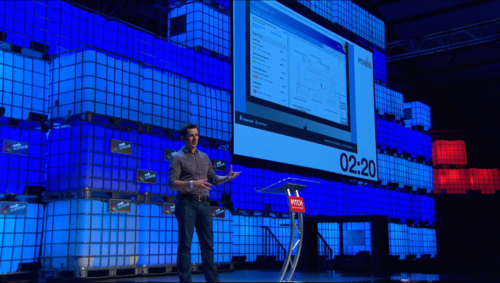
BasestoneBasestone, the London-based construction SaaS and mobile start-up which I first profiled in January, and which upgraded its solution to Basestone 2.0 in September, recently celebrated another landmark. It was crowned Best Startup at Web Summit, Europe’s biggest technology conference, in Dublin, beating 1500 startups to a €10,000 prize, plus mentorship from sponsors Coca Cola and a trip to their Atlanta headquarters (read their blog-post).

imageAfter two initial rounds of pitching, Basestone faced world-leading technology experts and investors as well as executives from Coca Cola in the third and final round, on the main stage, in front of a 5,000-strong audience

Basestone growing

In January, Basestone had three employees, but now has six UK staff, plus a trio of developers in Slovenia, and has clearly benefitted from its experience of working with the Costain/ Skanska joint venture employed on three ongoing Crossrail projects in London.

I met up again with civil engineer CEO Alex Siljanovski and his colleagues last week (now based at IDEALondon in Wilson Street), and he showed me how the product had matured into a stronger PDF drawing review toolset, divided between a web application and an iPad app (he told me support would be extended to Android and Windows apps once the iOS app was “nailed”). The web application is being constantly updated, while new versions of the iOS app are made available about every 3-4 weeks.

For site use, a useful feature is an automatic alert if the user opens a drawing for which a new version has since been issued. When drawings are uploaded, Basestone also scans and extracts metadata from the file which can then be used to help users search for drawings. If issues are identified on-site, associated documents (eg: photographs) can be permanently linked, and the navigation has been refined so that more data is displayed full-screen.

Update (18 December 2014) – Basestone has won an award in south-east Asia – for best Smart Cities application in a competition organised during a UKTI trade mission to Malaysia and Singapore.

Permanent link to this article: https://extranetevolution.com/2014/11/basestone-wins-e10k-startup-prize/

Aconex resurrects IPO plans

Aconex IPO reportedly downsized but back on track for a December 2014 ASX listing.

Aconex logo 2014Just a couple of weeks after postponing a planned Au$230m initial public offering (IPO) just 24 hours before it was due to publish its prospectus, Melbourne-based Software-as-a-Software construction collaboration technology vendor Aconex is (according to a report by Sally Rose in The Age; see also The Australian) to be back on track to float after a revised IPO secured $140 million from cornerstone investors. (17 November Update: Read also Aconex’s news release).

Joint lead managers Macquarie and UBS have now completed the institutional book-build for the re-engineered Aconex IPO, raising $140 million at $1.90 per share. Macquarie head of equity capital markets origination Mark Warburton explained:

“We had covered the book for a $230 million raising, but then the market came off, risk aversion was on the rise, investors were displaying a bit of IPO fatigue, and we wanted to make sure it traded well.

“The pipeline of technology companies coming to market is stronger than it has ever been. We are developing a really good local tech sector, but for that to work out this deal has to trade up.”

Macquarie and UBS returned to institutional investors that had supported the original Aconex IPO deal to cornerstone the new smaller, more competitively priced raise. An updated prospectus is expected to be lodged with the regulators shortly, with the listing slated for 9 December 2014. Aconex founders Leigh Jasper and Rob Phillpot were reportedly persuaded to give up $90 million in value so the float could be re-priced.

Sally Rose adds: “Aconex will be the biggest float of an unprofitable technology company in the history of the local market. At listing the company will have a market capitalisation of $312 million,” showing Australian investors are prepared to accept valuations based on revenue multiples, rather than the traditional emphasis on profit. A month ago, market talk was about an Aconex valuation between $350m and $410m.

Permanent link to this article: https://extranetevolution.com/2014/11/aconex-resurrects-ipo-plans/

Load more