OpenBuilt sees major IT players including IBM and Red Hat combining to develop a connectivity and automation platform for the built environment industry.
 OpenBuilt is positioned as “a connectivity and automation platform that enables businesses to work faster and more accurately with their existing software“.
It has been launched by a group of businesses including global IT giant IBM, open source software leader Red Hat, international construction materials supplier Cemex and Oslo, Norway-based construction product data specialist Cobuilder. The OpenBuilt website says it “combines industry expertise and big tech credentials with the agility of a startup.” It is “building trusted data pipelines and low code development tools that will enable anyone to automate their business processes without complex software integration”:
“Through integration of previously siloed systems, enabling standardisation of data and providing tools to automate processes the OpenBuilt platform will bring the connectivity needed to unlock latent innovation – from industry 4.0 to the circular economy – that is required to meet the industry’s productivity gap.”
CDE … ecosystem … environment …?
OpenBuilt was launched yesterday (14 April 2021) and immediately sparked considerable debate on social media about exactly what it is.
“IBM has just entered the CDE market,” tweeted BIMlauncher’s John Egan (who has history in this platform field with his 2016 Jenca Cloud; post). Edify’s Martin McDonell tweeted that IBM and Red Hat “seem to be making a big play as a CDE”. Cobuilder’s Antony Brophy insisted it wasn’t a CDE but a “connected ecoysystem”. BuroHappold’s Alain Waha felt it was “certainly more Common Data Ecosystem than any other system proposed so far by CDE vendors.” His colleague Shaun Farrell felt it was “more a component in the ecosystem … reliant on platforms being connectable.”
Some were more sceptical. One observer described OpenBuilt as “a ‘Johnny-come-lately’ lash-up grouping of reputable but less well-known names, which is trying to belatedly get a slice of what promises to be big action.” Also underlining it’s not a CDE, IBM’s Paul Surin was quick to defend the platform saying it was “not trying to muscle on the market”, adding “OpenBuilt is an independent company owned and led by a consortium of industry partners”.
BSI’s Dan Rossiter was “intrigued”: “The CDE process is about portability and QC, this appears to be more about retaining the syntactic and semantic relations as information is exchanged.”
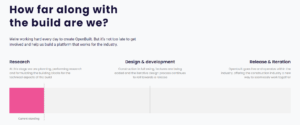 According to OpenBuilt’s website, it’s not too late to get involved and help to build an automated exchange platform that works for the industry. The project is still at an early research stage, but its principles include “trusted data” and being “truly interoperable”, with the capability to “manage complex technical product data.”
“Take the edge off opaqueness … break down the deep silos and fragmentation …”
 As part of the launch, one of the UK’s major champions of the need for change, Mark Farmer (author of the 2016 UK construction industry report “Modernise or Die), was interviewed for an IBM blog post. He said:
“Cloud platforms that enable people to collaborate in an open-source manner, such as OpenBuilt, could take the edge off the culture of opaqueness by enabling people to build interconnected ecosystems. It could build more trust in how we do construction and commercially contract.”
And in Designing Buildings, Farmer said:
“In pursuing the broad goal of construction industry transformation, there is a critical need to break down the deep silos and fragmentation that exists in how we organise and operate design, manufacture, construction and operation processes.
“This is equally true in the emerging digitalisation challenge. To create more strategic and scalable intelligent workflows, we need data and software to be part of a fully connected ecosystem. The concept of digital platforms is nothing new, but if construction is ever going to realise the full potential of some of the technology solutions that are now proliferating, and if those solutions are ever going to be given the chance to scale to maturity, then there is a need for market leadership in creating a unifying platform that can host these solutions and enables interoperability.
“What IBM and partners are offering through OpenBuilt is the opportunity to act as a digital integrator at an international and industry wide level, gluing together what is becoming an increasingly fragmented digital marketplace for construction technology solutions. This is an important step forward which has great potential to make our industry more efficient”.
OpenBuilt product development
 According to Designing Buildings, OpenBuilt’s collaborative product development will initially focus on three areas:
- Establishing OpenBuilt using Red Hat OpenShift running on IBM Cloud to enable cconstruction companies to adopt a hybrid cloud approach and connect their supply chain. To maintain consistent technical language, OpenBuilt will use Cobuilder’s data templates to structure all data in a way that allows for machine-readability and interoperability with existing and future systems.
- Integration of independent software vendors to make an array of software and services accessible. IBM solutions and Salesforce open APIs will be integrated into the platform during the development to enable users to build functionality into their intelligent workflows.
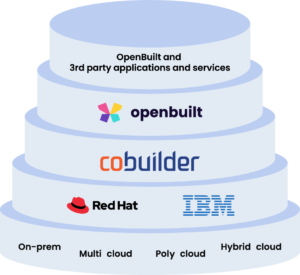 Development of new applications including a solution that will enable organisations to search, filter and sort building product technical data. Cobuilder’s data dictionary solution Define will be among the fundamental technologies enabling the use of a common language within the initial OpenBuilt flagship applications.
Echoes of the dot.com boom?
Reading about OpenBuilt and watching the social media conversations was reminiscent of similar conversations more than 20 years ago during the dot.com boom. That wider digital explosion sparked some major changes, but construction proved somewhat resistant to any significant digital transformation. During 2000, various major industry companies set out to create new construction trading platforms (eg: Mercadium, AECVenture, Arrideo, EU-supply, B2Build, etc – plus Asite, see update below), but competing construction materials giants or major contractors rarely wanted to work with each other. Sellers were concerned about aggregated spending driving down profit margins; buyers didn’t want their purchasing habits potentially visible to competitors; and the costs and technical challenges involved in channelling high volumes of data through centralised online marketplaces were beyond the budgets and technical competencies of largely traditional and highly cost-conscious construction businesses.
Only time will tell if OpenBuilt succeeds in its efforts to persuade partners to join its research and product development activities. Now that the initial partners have broken cover, will OpenBuilt attract a critical mass of other partners? (A couple of Paul Surin’s tweets mentioned a handful of UK independent software vendors including 3D Repo, SpecifiedBy and Asite – are they targets or already involved?) Or will it – like the dot.com era e-commerce platforms – spawn some competing platform players? IBM is certainly a big name backer, but there are other major generic IT players – Oracle, Microsoft, etc – who might also see the current, highly fragmented built environment industry as a potentially lucrative market.
OpenBuilt – “basically rebuilding Asite”
 Update (2.30pm BST, 15 April 2021) – Extranet Evolution talked to Nathan Doughty, CEO of London-based Asite since January 2020 (read Nathan Doughty’s new Asite era), about OpenBuilt. He said he had been contacted by OpenBuilt to participate in late 2020 but had only had occasional contacts as they moved toward launch; there had been no concrete involvement by Asite so far. Following yesterday’s launch and reading more about OpenBuilt’s ambitions, he felt OpenBuilt was “basically rebuilding Asite”, recalling the early history of his firm.
As mentioned above, Asite was one of several ventures heavily backed by industry heavyweights looking to corner part of the construction B2B e-commerce marketplace in 2000-2001. In June 2001, Asite’s backers included British Land, Stanhope, Mace, Laing O’Rourke; technology partners included Microsoft, Compaq, Commerce One, BIW Technologies and Bidcom. However, after the dot.com bubble burst, Asite retrenched and refocused (with Doughty heavily involved then as CTO).
In-house, it began to build a web-based integration platform in the “cloud” on open source technology (Asite Exchange): an open and interoperable platform for system-to-system exchange of structured data. Doughty says:
 “Since 2003 we’ve connected 100s of disparate systems for our construction clients, including pretty much every major ERP, document management system, and CAD/BIM package. We’ve been powering a decent portion of the UK construction B2B purchasing transactions using structured product catalogue data on our open platform for years and years. Asite Exchange powers our ‘CDE’, our supply chain (procurement and product data) and asset management functionality and the Asite ecosystem.”
He says Asite would be pleased to engage with OpenBuilt – or any similar venture:
“There’s obviously no rule saying there should only be one Asite. On the contrary, there should be as many as needed in the market – all underpinned by open-standards-based data interchange. So, of course, we’re happy to partner and lend our experience as this new project takes shape. The same goes for other players in our market. The endgame for me is open systems connecting up to serve the needs of the built environment. The more the merrier.”
 Visualisation and simulation are increasingly important in the architecture, engineering and construction (AEC) sector, but the costs and manpower needed to develop really sophisticated and powerful capabilities demand that AEC incumbents work with more generic hardware and software experts. This week,
  Bentley Systems says it has extended its
  Munich, Germany-based construction collaboration SaaS technology provider
 In the architecture, engineering and construction (AEC) sector, access to complex logic, calculations and validation can be critical. New data may need to be captured and validated in environments where there is often limited or no internet connectivity, or where security measures make it difficult to use technology to capture and collect the data needed. Formworks can quickly solve data collection challenges by providing users with a low-code environment in which they can build their own custom applications to capture, validate and share complex field data.
 “Since its launch, Formworks has won numerous awards and is used by clients in construction, financial services, real estate, utilities, training, social care, maintenance and manufacturing. We are delighted to welcome the Digital Field Solutions team to Thinkproject and look forward to continuing to enhance and develop Formworks for both existing and new customers with a specific focus on the AECO lifecycle. We see significant potential for customers to combine dynamic forms creation and data integration to Thinkprojects application portfolio to drive their digitisation efforts.”
 Following the EQT investment,the management team has been expanded, with chief marketing officer Karolin Beck (ex Sauce Labs and Microsoft, right) the first woman to join the company’s executive team, and CTO Michael Bischoff (ex eFront and Sage) leading development of thinkproject’s construction intelligence platform. The business’s new board is chaired by Patrik Heider, who has been joined by ex-Siemens executive Janina Kugel and CCO of IFS AB Michael Ouissi, as well as private equity executives Florian Funk, Morgan Seigler and Stefan Dandl.
 Stuttgart, Germany-based
  Revenues are increasingly global. Until 2016, the company drew more than half its revenues from the German market. Today, this delivers over a third (34.4%) of group revenues. Just over a fifth of 2020 revenues comes from the rest of Europe (22.8% – down from 30.5% in 2019), with revenues from north America up from 19.1% in 2019 to 26% in 2020, while APAC revenues remained relatively static.
 E7 is designed to help firms better utilise resources on site through mobile and web interfaces that transform manual, site-based tasks into digital workflows. It includes capabilities specifically designed for heavy civil construction, including daily diaries, unplanned event tracking, timesheets, dockets, daily costs, and quantity progress measurement. which enable managers to produce daily progress measurement reports.
 Dustin Parkman, vice president, project delivery, Bentley Systems says:
 E7’s CEO Hugh Hofmeister and CTO Adrian Smith are joining Bentley as director of product management and director of product development, respectively. Hofmeister said:
 Atlas CEO David Harper, right, has 20 years’ experience in the healthcare construction industry as a construction project manager, having worked in building technologies for major hospitals in the UK (including Birmingham’s Queen Elizabeth Hospital) and in Qatar (including the US$7. 9 billion Sidra Medical & Research Centre). Maha Harper, below right, Atlas’s COO, is a corporate lawyer with a strong background in corporate and real estate transactions. Both are convinced that the construction sector’s poor productivity and inability to deliver complex projects on budget and on programme (with the resulting legal disputes) can be overcome.
 “One of the main issues holding the industry back is the so-called ‘silo effect’ – the linear nature of information being passed from silo to silo – plus the variety of different information formats involved. While the industry has started to move more towards digital solutions, they are mostly ‘point solutions’ which, in effect, digitises those silos. This doesn’t, effectively enough, do away with the delays and cost inefficiencies.”
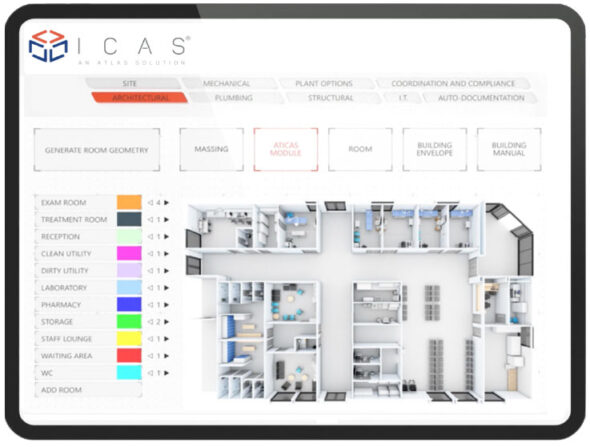 A software-as-a-Service platform, ICAS starts by defining the customer’s needs, and then developing designs to meet those needs. Maha Harper says:
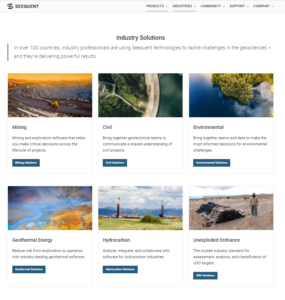
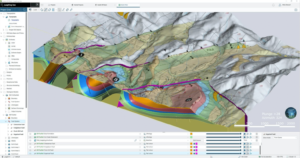 Seequent’s products include Leapfrog, its leading product for 3D geological modeling and visualization, Geosoft for 3D earth modeling and geoscience data management, and GeoStudio for geotechnical slope stability and deformation modeling. Bentley’s complementary geotechnical engineering software portfolio, including PLAXIS, gINT, and OpenGround, will be integrated in due course to support open digital workflows from borehole and drillhole data to geological models and geotechnical analysis applications.
 “We can be very confident about Seequent’s contribution to our shared future not only because of our product synergies, but because we recognize in Seequent’s trajectory an echo of the playbook that made Bentley Systems successful—except they have grown faster! They have made farsighted decisions to benefit the future at every stage: identifying and then laser-focusing on the 3D “vertical” opportunity in earth modeling, institutionalizing a subscription commercial model from the outset, directly populating the appropriate global markets, acquiring and consolidating the best software for adjacent disciplines, and bringing it all together with cloud services, ready for digital twins advancement together.”
 VisualLive’s technology is complementary to
  Unity says the current process of job site walkthroughs for construction and facilities management is fraught with human errors, and the promise of reality capture (the process of replicating the physical world and putting it into virtual reality) is time-consuming and expensive. VisualLive ensures users can instantly inspect and validate designs to prevent costly mistakes.
 The Microsoft Mesh launch was preceded by a video keynote from Microsoft CEO Satya Nadel, presented somewhat conventionally as a 2D video, but embedded in a virtual auditorium that also resembled an aquarium (a bit like being immersed within Finding Nemo.). After that, the event was largely run within Microsoft Mesh, which is hosted in the company’s Azure platform and enables people in multiple locations to deploy various devices to join and collaborate in a shared holographic space.
 Bentley has long featured strategic inputs from Microsoft at its annual Year in Infrastructure events. In 2013, for example, it announced its Connect strategy to extend project and asset information mobility through the Windows Azure cloud (
 Gaming and enterprise technologies are converging to create new ways to deliver and visualise data. UK-based
  “Over the past two years we’ve seen a gradual shift from BIM to Digital Twins, with more and more clients requesting high visual fidelity for both engineering and client presentation purposes, and the ability to explore vast 3D scenes in real-time.
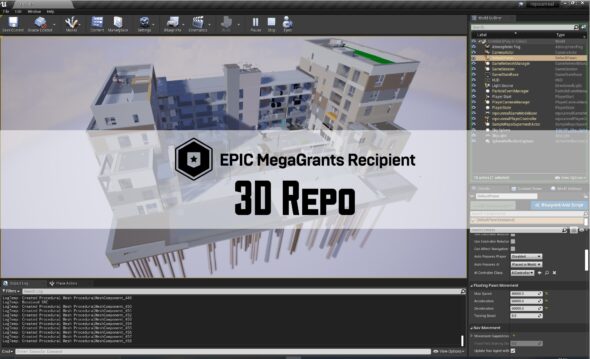 Via open APIs, the 3D Repo version control cloud connects with Unreal Engine, where pre-optimised assets are dynamically loaded directly into a running game, giving users the ability to log-in via their 3D Repo credentials and seamlessly retrieve any of their assets on the fly.