Causeway secures £120m to expand

UK construction technology vendor Causeway plans strategic acquisitions and accelerated organic growth following £120 million Rothschild private equity injection.

Causeway, the Buckinghamshire, UK-based construction technology group, has secured a £120 million (c US$166m or €139m)  investment from Five Arrows Principal Investments (the European corporate private equity arm of Rothschild & Co). The company says the investment will fund strategic acquisitions and accelerate its organic growth strategy to digitally connect the construction supply chain through further development of its cloud platform.

Causeway logoThis investment follows a period of strong and consistent growth at Causeway, resulting in an earnings compound annual growth rate of 31% since 2015, driven by increased industry adoption of digital solutions and acquisitions that have broadened its product portfolio.

Established in 1999, Causeway Technologies has over 2,500 customers and more than 350 employees. It provides enterprise and cloud software solutions to the construction and infrastructure maintenance industries and spans the full value and supply chain. Its product portfolio spans a wide range of activities from specialist design, tendering and procurement (it has a transactions management platform, Tradex), through construction cost and site management to applications supporting operation and maintenance activities.

During the early 2000s, it offered a SaaS construction collaboration platform powered by OpenText, but this became a relatively minor part of its offering amid a series of industry transactions (Elstree Computing in 2007, Connect in 2008), and so received less Extranet Evolution attention – though Causeway LiveLink did get a passing mention in NBS’s 2019 Construction Technology Report (post). In 2017, Causeway agreed a £40.5m refinancing package with Guggenheim Investments (TCI report). In the year to 31 December 2019, Causeway Technologies Ltd reported an annual turnover of £32.6 million (c US$45m or €38m) and an annual profit of £1.8m.

Investing in AEC digitalisation opportunity

Causeway says the investment reinforces the opportunity in the construction sector and the need for solutions that address both the pace of digitalisation and productivity issues caused by complex supply chains, and the transient nature of construction projects. It says its solutions connect the construction ecosystem, providing solutions that transcend functional and organisational boundaries.

CEO perspective

Phil Brown, chief executive and executive chairman of Causeway, said:

Phil Brown, CEO of Causeway“This investment marks another leap forward for our business and for the value we can add to our customers. Our core purpose and passion is to digitally enable the global construction industry – the support of Five Arrows allows us to accelerate our work to help solve our customers’ challenges.

“Our ambition is to ensure that data flows seamlessly across the construction process, making our customers more efficient and their data more useful and actionable. That is the only way to drive better project outcomes, especially around value and quality.

“While cloud-based tools and mobile connectivity have helped put solutions into people’s hands, much is still very fragmented in this industry. We are building a persona-based platform with relevant applications and data delivered to each member of the construction supply chain via their desktop or mobile devices. The platform will be open, making it easy to integrate with both third-party applications and any bespoke, customised applications that customers might have had developed. This approach will help break down silos and give businesses large and small, in all parts of the construction ecosystem, complete visibility and control over their projects and supply chains.”

Five Arrows

Five Arrows Principal Investments have made this investment in return for a significant minority stake in Causeway. Following completion of the transaction, Vivek Kumar (partner) and Sacha Oshry (managing director) of Five Arrows Principal Investments will join the board of Causeway.

Five Arrows focuses on investing in middle-market companies with highly defensible market positions; strong management teams; business models with high visibility of organic unit volume growth and strong free cash flow conversion; and multiple operational levers that can be used to unlock latent value. Sectors are limited to data and software, technology-enabled business services and healthcare.

The EE perspective

Update (noon BST: 29 June 2021) – Over the past 20 years, Causeway has grown primarily through merger and acquisition activity relating to numerous, often niche technology vendors in the architecture, engineering and construction sector. As a result it has a portfolio covering a wide and somewhat disparate range of activities, though few are covered in depth.

In an Extranet Evolution interview in 2017, then Aconex CEO Leigh Jasper talked about “not … being a mile wide but an inch deep”, talking about building deep functionality that complements core strengths. The Causeway approach appears to be different: covering as wide a range of construction activities as possible, with a view to creating a platform that connects them all. One of Causeway’s most recent acquisitions – the May 2021 purchase of telemarketing specialist Enhance Consultancy (Causeway news) – was justified on the grounds it would improve intelligence and processes between tendering phase and project delivery, integrating pre-construction and procurement. T

Causeway’s Tradex B2B transaction exchange was used by some 60,000 companies to exchange approaching £10bn in invoice value in 2020. In the UK, Tradex faces competition from, among others, the COINS Construction Cloud (now boasting over 100,000 users), and the recently launched COINS Construction Marketplace (15 June 2021), which augments its deep construction ERP expertise and its e-Xact Online technologies (acquired in 2011).* Also in this space is the Asite Marketplace supply chain management platform; Asite recently appointed former Laing executive Jas Mann to lead the development and growth of the Asite SCM solution (Asite news release). Extranet Evolution has also looked at the UK’s OpenECX, developed by former COINS executive Matthew Jones (OpenECX targeting subcontractors).

The Five Arrows investment clearly gives Causeway a warchest to make further acquisitions, and to invest in its existing applications. It has invested in an R&D centre in Middlesbrough that is focused on building new platform services and refactoring existing products so that they are all capable of serving customers from the Google Cloud platform – it clearly sees the cloud as the future. Will Causeway continue its previous approach of relatively modest acquisitions, or will it perhaps look to strike a major deal to cement a strong foothold in one of its sectors? Will it continue to focus on the UK (96% of its revenues are attributed to the UK), or will it look to diversify geographically?

COINS update

* Update (1 July 2021) – David Bullock of COINS writes:

COINS logo“The COINS Construction Marketplace augments its … construction ERP with an innovative eProcurement platform, providing … end-to-end procurement process for construction and home building businesses.

“Yes, we are building into the Marketplace the capability for manufacturers’ product data to be available, to supplement the information held within the Marketplace (bringing across the e-Xact product data), but first and foremost its purpose is to provide a simple, efficient, touch-less procurement process for construction and home building businesses.”

Permanent link to this article: https://extranetevolution.com/2021/06/causeway-secures-120m-expand/

Bentley Systems’ busy buying spree

Since buying Seequent in March, Bentley Systems has added several more software businesses to its portfolio, including an India-based mobile project controls business, Nadhi, and two IoT specialists.

Bentley logo 2017Bentley Systems has continued to expand its portfolio in recent months. Since investing around $900m in New Zealand-based geoscience modelling software provider, Seequent (post) in March 2021, it has acquired five smaller businesses. The deals concern:

  • a Canada-based specialist in transportation planning
  • an India-based mobile project controls business
  • two Internet of Things (IoT) tech specialists – one from the US, the other from Iceland – and
  • a US specialist in utility pole management

Bentley buys INRO Software

On 14 April 2021, Bentley announced its acquisition [no terms disclosed] of INRO Software, a specialist in multimodal transportation planning, traffic simulation, and mobility visualisation software, based in Montreal, Canada.

INRO's Emme softwareINRO has over 40 years experience in mobility simulation and modeling for metropolitan, regional, and national transport and transit operators and planning agencies. Its customers include Transport for London, Transport for New South Wales, the Washington State Department of Transportation, Sweden’s Transport Administration Trafikverket, and the public transport system of São Paulo SPTrans.

INRO’s products include Emme, a multimodal transportation planning system for urban, regional, and national transportation forecasting; Dynameq, a vehicle-based traffic simulation platform for city-wide traffic planning; and CityPhi, a mobility visualization solution providing data visualization and visual analytics of large-scale mobility and geospatial datasets.

Bentley buys India-based Nadhi

On 28 April 2021, the group’s internal investment incubator Bentley Acceleration Initiatives announced the acquisition [no terms disclosed] of Chennai, India-based Nadhi Information Technologies, a 30-strong specialist in cloud-based project controls, analytics, and decision support for construction supply chains. Bentley said “Nadhi brings … a critical mass of field-experienced professionals in construction automation, attuned to their region’s specific challenges and project dynamics,”

Nadhi nPulseWhile China and the US will remain the two highest-value construction markets globally, India is set to become the third highest-value market by 2029. However, Asian project teams are often held back by conventional construction methodologies, poorly coordinated schedules and lack of visibility into project status. Project managers want to interconnect their data silos—spanning documents, schedules, budgets, issues and risks, resources, and materials—all in one environment. Some are using Nadhi’s services to solve these challenges and improve their project delivery using digital workflows. Since offering lean construction consulting services in 2008, Nadhi has pioneered cloud-based and mobile-enabled project controls.

Its offering is explicitly configured for the needs of project teams in Asia. Integrated project controls in Nadhi’s nPulse software combines data-driven decision support and predictive analytics to give engineering and construction projects early warning of schedule risks and potential delays in milestone completion, advancing project planning and execution from reactive to proactive. Referring to Bentley’s acquisition of SYNCHRO in June 2018 (post), Bentley Systems’ Ashit Gandhi says:

Combining Nadhi’s proven project controls and analytics capabilities with Bentley’s SYNCHRO 4D construction modeling and field-based construction delivery will enable more integrated and efficient digital workflows, tailored specifically to Asian needs.

Bentley builds IoT ‘digital twin’ capability

Also in April 2021, Bentley Systems announced its acquisitions of California’s sensemetrics and Iceland’s Vista Data Vision, both providers of software for Internet of Things (IoT) applications in infrastructure. The deals, together adding 40 employees, will expand the scope of the Bentley iTwin platform to support infrastructure digital twins by incorporating real-time sensor data. Bentley says they are both “particularly complementary” to its recently completed Seequent acquisition.

Sensemetricssensemetrics

Founded in 2014 in San Diego, California, sensemetrics provides a platform used extensively for real-time safety and risk monitoring in infrastructure, mining, and construction activities. It enables measurement and visualisation of civil structural movement, for condition assessment, and to help detect and prevent damage.

Its modular design provides a flexible platform for developers to build their own applications to meet specific infrastructure IoT needs. The Sensor Integration Builder uniquely enables asset owners, engineers, and risk managers to choose their own sensors – with assurance that they can be seamlessly integrated into digital twin solutions in minutes. And sensemetrics’ Thread and Strand connectivity devices can optionally accelerate “plug and play” deployments for wireless sensor devices, even for “off-grid” infrastructure locations.

Vista Data VisionVista Data Vision

Based in Reykjavik, Iceland, Vista Data Vision, spun out of Vista Engineering, provides remote, real-time monitoring of power, traffic, and sanitation systems. Its solutions have been used in more than 2,000 projects in more than 70 countries, collecting millions of data points daily from hundreds of thousands of sensors.

… and Bentley adds utility capability with SPIDA

Finally (for now), on 14 June 2021, Bentley announced its acquisition [again, no terms disclosed] of Ohio, US-based SPIDA Software, developers of software for the design, analysis, and management of utility pole systems for electricity and communication services providers in the US and Canada. Its customers include Ameren, EPCOR, Nashville Electric Service, and Southern California Edison.

Permanent link to this article: https://extranetevolution.com/2021/06/bentley-systems-busy-buying-spree/

Reflecting on the Procore IPO

US AEC SaaS player Procore raised over $600m in its May 2021 IPO, but its global ambitions face significant competition.

Procore logoIn February 2020, US-based construction Software-as-a-Service (SaaS) provider Procore filed its intention to make an initial public offering of its shares on the New York Stock Exchange. But the onset of the global COVID-19 pandemic forced a postponement (read March 2020 EE post: Procore IPO in for prolonged coronavirus lockdown?).

On 20 May 2021, however, Procore pressed ahead with an IPO of 9.47 million shares (leaving a further 128 million shares outstanding). It initially had a target price range of $60-65. Achieving a midpoint IPO was forecast to generate net proceeds of around $553 million. If IPO underwriters (Goldman Sachs, JP Morgan, Barclays and Jefferies) exercised their right to purchase additional shares, Procore was potentially going to raise $608.5 million. The midpoint deal would have valued the company at $8.9 billion.

Doubled valuation

However, it sold the shares for $67 each, raising $634.5 million (Yahoo!Finance). On the first day of trading, Procore shares opened at $84 per share, and closed at $88, indicating a market capitalisation of $11.3 billion (Forbes; on 10 June 2021, they were trading at $87). This was a significant step up, effectively doubling previous valuations.

An April 2020 funding round raised $150 million, giving a valuation of $5 billion, up from a September 2019 raise ($94.9 million) where Procore was valued at $4.77 billion. Before the IPO, the company had raised over $450 million in venture capital funding. Investors included D1 Capital Partners, Tiger Global Management, Dragoneer Investment Group, ICONIQ Capital, Bessemer Venture Partners, Lead Edge Capital, Lumia Capital and Scop Venture Capital. Pre-IPO, entities associated with ICONIQ held around 44% of the company’s shares, while entities associated with Bessemer Venture partners held  almost 15%. Post-IPO, they hold approximately 37% and 13% respectively.

Procore: deepening losses

According to its updated IPO prospectus (S1 filing), Procore has seen its revenues growing but it has also seen deepening losses. Prior to the pandemic, the company generated revenue of $112.3 million in 2017, $186.4 million in 2018 (up 66% year-on-year), and $289.2 million in 2019 (up 55%). In pandemic-affected 2020 it generated revenues of $400.3m (up 38%). Up to the end of 2020, it had accumulated 1.6 million users through 10,166 customers – of which 843 each contributed annual recurring revenues of over €100,000.

However, it had mounting net losses: $55.5 million in 2017, $56.7 million in 2018, $83.1 million in 2019, and $96.2 million in 2020. The company was blunt about its history of losses and the uncertainty about future profitability:

“As of December 31, 2020, we had an accumulated deficit of $397.0 million. We are not certain whether or when we will be able to achieve or sustain profitability in the future.”

In the first quarter of 2021, Procore had a net loss of $14 million on revenue of $114 million, compared to a $19 million loss on revenue of $92 million for the same (pre-pandemic) period a year ago.

Capitalising upon construction’s continued digital transformation

Procore platform pitch

Procore aims to become the dominant construction management platform in the world, with a suite of products supporting workflows from pre-construction – it launched Procore Preconstruction yesterday (10 June 2021) – to project completion (outside its July 2019 acquisition, post, of Honest Buildings, it largely ignores the opportunity to host asset owner-operators’ whole life data). However, as its prospectus made clear, there are substantial risks in delivering technology to a notoriously fragmented, volatile, low-margin, short-termist, traditional and historically low-tech industry.

Construction businesses have tended to under-invest in information technology. Procore sees a big opportunity to capitalise as construction’s digital transformation continues. It quotes a Deloitte 2017 estimate that construction currently invests in IT at half the rate of other industries – 1.5% of revenues versus a 3% pan-industry rate. A 2020 McKinsey report suggests industry spending on software and infrastructure could double, and investors have been pouring money into construction tech businesses over the past decade (AEC TechTV Episode 16: Investment in construction software is booming).

Procore says the total addressable market is large and significantly under-penetrated. It estimates the global construction industry spends approximately $9.2 billion per annum on software.

The COVID-19 dividend

While the global pandemic delayed Procore’s IPO, it may also have helped accelerate technology adoption, including use of platforms such as Procore (Procore: Lockdown accelerates demand for digital transformation).

The architecture, engineering and construction (AEC) sector has historically been reliant upon exchanging drawings and documents, and managing numerous, often fragmented and disconnected workflows. Despite significant adoption of Software-as-a-Service information management platforms since the late 1990s onwards, many projects – particularly at the smaller end of the scale – continue to be managed using email and generic file-sharing solutions. The pandemic prompted many businesses to rethink their approaches, increasing use of various construction-oriented solutions (desktop, web, mobile), alongside expanding use of video-conferencing applications, some of which were quickly integrated with AEC platforms (read: Coronavirus, construction and software, and Coronavirus construction impacts (and software offers) continue).

International ambitions and competition

Procore is running projects in over 125 countries. This sounds impressive, but just 12.2% of its 2020 revenues was generated from customers outside the United States. It faces significant competition from longer-established and now well-entrenched SaaS businesses offering largely similar functionality, plus additional applications. Mature and more widely distributed players include Autodesk, Aconex (now part of Oracle), Trimble and Bentley Systems.

The latter’s September 2020 IPO suggested a market valuation of $5.5 billion (post). It is perhaps bizarre that Procore has already achieved double this valuation despite only having a construction management platform, while Bentley’s portfolio includes the widely deployed, enterprise-grade ProjectWise SaaS platform and UK-based Business Collaborator (post), plus design authoring and other solutions. Similarly, Trimble then also had a market capitalisation of around $11 billion, despite a portfolio including multiple SaaS products – e-Builder (post), the former 4Projects (post), Meridian, GTeam (post) later relaunched as Trimble Connect, and a mobile-oriented platform, Trimble ProjectSight.

Oracle acquired Australia-based Aconex for $1.2 billion (around ten times revenue) in late 2017 (post). The SaaS platform joined a construction portfolio that included the widely-deployed Primavera programme management application. The deal made Oracle the first major B2B software giant to make a concerted play in the construction SaaS vertical market (“they know data, they know SaaS”).

Outperform Autodesk?

Autodesk BuildAutodesk has a market capitalisation of around $60 billion. In the 2000s, it learned some painful lessons about trying to export US-oriented AEC SaaS platforms – remember Buzzsaw and Constructware (post)? –  to new geographies. And, like Bentley and Trimble, Autodesk’s biggest AEC revenue-generators are not its SaaS collaboration tools (for example, BIM 360, now part of the Autodesk Construction Cloud; post). Its cash cows are its design authoring tools (AutoCAD, Revit), among others (though there are tensions with some of its architect customers – post). And, while we are talking about BIM, Procore also lags other vendors in its detailed support for BIM process capabilities.

There are also some strong regional SaaS players in Europe (thinkproject, Hexagon/Bricsys, RIB, Asite). And the Germany-based Nemetschek group also has a well-embedded base of AEC design, BIM and related authoring tools.

Caveat emptor

In short, Procore investors need to look realistically at the global competitive landscape. If Procore is serious about becoming the major global player, it will have to shift from its reliance on the US market. International expansion will need to accelerate. This won’t be easy. Across many countries, their AEC sectors remain highly fragmented, volatile, low-margin, short-termist, low-tech, parochial and often change-resistant. And if these sectors embrace digital working enthusiastically, other players already have local resources in place to service their needs. US stock market sentiment towards Procore is clearly positive. However, it faces some critical competitive challenges over the next three to five years to retain and reward the confidence of its VC-based backers.

Permanent link to this article: https://extranetevolution.com/2021/06/reflecting-procore-2021-ipo/

Script & Go relaunches in the UK with housebuilder focus

Rennes, France-based Script & Go is looking to establish itself in the UK with a new focus on the house-building sector, capitalising upon its strong experience in this sector in France.

Script&Go logo 2018Based in Rennes in north-west France, Script & Go, previously best known in the UK for its Site Diary application (Script&Go’s Site Diary revamped – May 2019), has developed a new product for the UK construction market. It is looking to capitalise upon its customer experience with French housebuilders. Its latest offer is a Software-as-a-Service defects management platform to manage the reporting and rectification of issues during the initial handover to new residents in the post-construction warranty period.

Site Diary product owner Khaldon Evans told Extranet Evolution that Script & Go had been developing new products to support its largely France-based customers. They include contracting giants Vinci and Bouygues, automotive manufacturer Renault, aerospace manufacturer Dassault, rail operator SNCF and infrastructure provider Suez. Its solutions support a wide range of assets, from conventional buildings and infrastructure to aircraft and railway assets.

Since its UK launch in 2017, UK customers for Site Diary have included contractors Costain, Alun Griffiths and ISG, but Evans said Site Diary had struggled to expand more widely. Similar to Checkd’s ‘excuses’ experience in Scandinavia (post), he said “Expansion has been slow for two reasons: either the managers don’t want to pay for the app, or managers want to pay but field workers don’t want to use it. We have never lost any deals yet due to any competitors – at least, prospects didn’t tell us that.”

The company has recently taken strategic decisions to drop the UK Site Diary corporate branding, instead use its Script & Go name, and focus on its core French strengths.

Script & Go housing focus

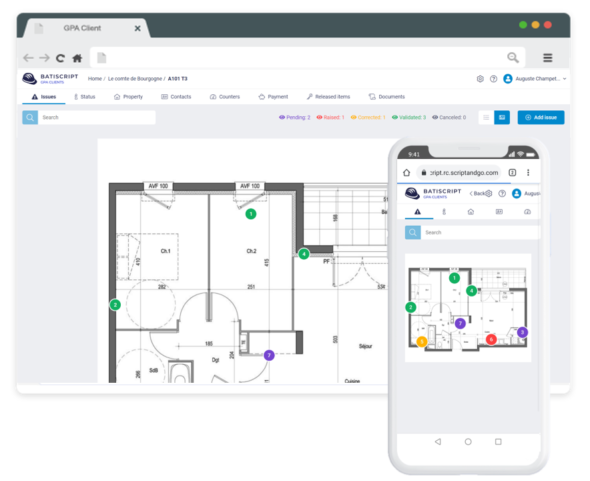
Script&Go checklistOne profitable market has been products for French home-builders. Evans said that in some parts of northern France its platform is being used by 80% of home-builders. The French business initially grew through collaboration with a local house-builder. Adoption of its technologies then gradually extended to other house-builders in the region. As in the UK, few French house-builders operate nationally, instead specialising in particular house types that suit their local regions. Script & Go developed a platform to manage the final stages of construction, where house-builders need to capture and remedy defects with their subcontractors
Home warranty management

The 60-strong company recently (May 2021) launched a new Site Warranty product for the UK (see also this blog post), and is looking to get some early traction in the UK and then build out its market. Using its application on a mobile device, users capture defects. They can combine text entry, photographs, associated markups, documents and drawings, plus links – where necessary – to any related defects, and location information on building floorplans. These are then notified to the relevant subcontractor for rectification while providing residents with process visibility. The platform also provides reporting functions to house-builders helping them manage progress and identify persistent quality issues across their supplier base.

Script&Go Site warranty product

Script & Go is also migrating its technologies to an integrated platform to help support more deployment options – key to the roll-out of its warranty product. Currently, Evans said, its ‘back-office’ platform (offering unlimited storage and use across an enterprise) is available for a one-off perpetual licence fee of £490. Individual field users are then enabled for a one-off fee of £300. In September 2021, the company will launch a subscription-based system priced at £20 per month per user. The Site Warranty application is to be offered at a standard £30 per residence to cover the period of a typical two-year warranty period.

Permanent link to this article: https://extranetevolution.com/2021/06/scriptgo-relaunch-uk-housebuilder/

Checking in with Checkd

Now a subsidiary of a VC-backed Swedish ERP business, Checkd enjoyed its best ever year in 2020, and is looking to continue its 50% year-on-year growth.

Checkd logoSince first featuring in Extranet Evolution in January 2015 (Checkd mobile checked out), the Norwegian mobile-first and Software-as-a-Service (SaaS) construction application provider Checkd has, despite BIM advances, continued to capitalise on the use of visual and PDF-based information for site-based project reporting and collaboration.

Checkd now VC-backed

Tom-Erik von Krogh Martinsen, founder and CEO at Checkd.By 2018, the Oslo-based company was looking to expand beyond its then 90-strong corporate customer base in Norway and was considering marketing in the UK and Germany. However, founder Tom-Erik von Krogh-Martinsen, right, told EE that expansion into Sweden – a construction market twice the size of Norway’s – proved a vital stepping stone. By early 2021, it had more than doubled its customer-base, having, in December 2020, been acquired by Next One Technologies, a Swedish provider of cloud-based ERP solutions for small- to medium-sized construction businesses (news release).

Gunilla Åberg, CEO at Next One, said:

“We’re pleased to merge with Checkd, They have grown quickly in Norway and we see great possibilities to grow together both within the Nordics and in Europe. Our joint solution should be the natural choice for European construction and maintenance companies that want a professional, modern, industry-specific business and project system.”

Martinsen had launched Checkd in 2013, after developing a ‘proof of concept’ mobile reporting tool for a Norwegian construction trade body, and, without seeking additional investment or venture capital backing, the now 15-strong company’s initial growth was a bit slow. With parent Next One Technologies supported by Nordic software investor Monterro, “now we are not building stone by stone – we have more money to scale faster,” Martinsen told EE.

COVID-19 removes excuses

Checkd floorplanAs in many other countries’ construction markets, Martinsen said Scandinavia is dominated by SME contractors and subcontractors. They are also, in his view, often resistant to change, with a culture of making excuses to avoid adopting new technologies. However, the COVID-19 pandemic had helped “remove their excuses”. It has convinced construction businesses about the need to digitise, he  said. Companies were holding more digital meetings, and could not do field or site inspections in groups. Instead, they were using Checkd to capture problems and issue notifications, which could then be discussed online (the Checkd task-handling workflow is identify, notify, fix, check, close).

And it’s not just about marking things up on a PDF. Martinsen says: “Importantly, our users can use any drawing or picture to pin the tasks/observations: Google Map for roofers, facade pictures for EWS1 [external wall survey] inspections, even a sketch.” (And, in light of ongoing post-Grenfell cladding concerns, he is keen to talk to potential UK partners interested in capturing EWS inspection outputs.)

In 2020, Checkd achieved annual recurring revenues of around €1 million, after 50% year-on-year growth, Martinsen said. The customer base now includes some prominent names (SWECO, for example), and its application is also being used in the UK by FK Group, a building envelope specialist in northwest England.

Despite continued BIM advances, he says 95% of Scandinavian construction projects still use 2D documentation for inspection purposes. However, anticipating increased demand for BIM integration, Checkd has also been working with another Norwegian business, Oslo’s Catenda (June 2017 post), to create a module using its BIMSync API (application programming interface), though it has only been used on a few pilot projects so far.

Permanent link to this article: https://extranetevolution.com/2021/06/checking-checkd/

FARO acquires Holobuilder

California-based Holobuilder, a pioneer in AEC 360-degree photogrammetry, has been acquired by FARO Technologies in a US$34 million deal.

HoloBuilder LogoFARO Technologies has invested $US34 million to acquire HoloBuilder, the San Francisco, US-based 360-degree reality capture technology developer. The Florida, US-based corporation known for its 3D measurement, imaging, and realisation solutions for architecture, engineering and construction, says: “HoloBuilder brings to FARO its leading photogrammetry-based 3D platform, which delivers hardware agnostic image capture, registration and viewing to the fast-growing Digital Twin market.” (7 June 2021 news)

Holobuilder: the back story

Holobuilder provides contractors with a solution to efficiently capture and virtually manage construction progress using off-the-shelf 360° cameras. It has strong connections with Germany; soon after its 2014 launch, it raised US$665,000 in seed funding from High-Tech Gruenderfonds. It then raised a further US$2.25m in an investment round in early 2017, backed by VC Brick & Mortar Ventures and Tandem Capital.

First featured in Extranet Evolution in March 2017, Holobuilder soon had some 3,000 construction projects on its platform and its customers included 40% of the top 100 general contractors in the US (Holobuilder launches 360 Construction Documentation Solution). In 2018, it began to expand in Europe (post) and added an Artificial Intelligence solution, “SiteAI”, to automate progress control (HoloBuilder launches SiteAI progress control). This application calculated progress reports from capturing weekly 360° progress photos, helping contractors to detect discrepancies and accelerating progress payment processes.

HoloBuilder JobWalk PlannerIn April 2019, Holobuilder added a “JobWalk Planner” feature enabling off-site stakeholders to pre-plan construction documentation sequences for their teams. By facilitating team management and planning of job walks, it meant more perfectly executed site documentation with less room for error or forgotten site images.

After establishing an EU hosting base, Holobuilder received investments from German energy business E.ON, a Berlin-based construction technology investor, Foundamental (an investor in early 2019 too), and NRW.BANK, the promotional bank of Germany’s North Rhine-Westphalia (August 2019 post). The company’s R&D facility was located in the high-tech cluster of Aachen in Germany, and was where HoloBuilder’s SiteAI solution was developed.

Digital Twin hype

At the time of that investment, EE questioned the company’s use of the term ‘Digital Twin’. The Gemini Principles developed by the UK’s Centre for Digital Built Britain talk about: “A realistic digital representation of something physical. What distinguishes a digital twin from any other digital model is its connection to the physical twin”. (Update – 8 June 2021 – The UK BIM Alliance* has just published a positioning statement on Digital Twins; this reiterates that static BIM deliverables are augmented by “the addition of dynamic ‘right-time’ data“). However, Holobuilder and its new owners continue to stress their own view of the Digital Twin opportunity.

FARO says the deal means that HoloBuilder’s Software-as-a-Service (SaaS) platform will add fast and easy reality-capture photo documentation and added remote access capability to its 3D point cloud-based laser scanning. FARO it says it will create “the industry’s first end-to-end Digital Twin solution“—all without leaving the FARO ecosystem. The combined solution will provide comprehensive scanning and image management capabilities for the Digital Twin market including robotic assembly 3D simulation, construction management, facilities operations and management, and incident pre-planning.

Holobuilder deal views

Michael Burger, FARO president and CEO, says:

FARO logo“The high-value that digitalization brings to the AEC and Operations & Maintenance industries creates significant market opportunity for FARO. The addition of HoloBuilder to our offering accelerates the reality of a true end-to-end Digital Twin solution and advances our strategic objective of increased recurring revenue through market share gains in this large and growing segment.”

HoloBuilder president and founder Mostafa Akbari-Hochberg says:

“HoloBuilder and FARO together furthers our vision of digitizing the physical world to enable process automation and workflow optimization. The powerful combination of high accuracy laser scanning with real-time 360° photo capture and collaboration will empower both companies’ customer bases with a comprehensive Digital Twin solution.”

As of 30 April 2021, HoloBuilder had US$4.0 million in annual recurring revenue with a compounded annual growth rate of nearly 75% since 2019. It is one of several ambitious players in the photogrammetry field – in July 2020, Israeli startup Buildots raised £12m to fund its own expansion (post).

[* Disclosure: I am a member of the executive team of the UK BIM Alliance.]

Permanent link to this article: https://extranetevolution.com/2021/06/faro-acquires-holobuilder/

Corecon upgrades project team portal

US-based Corecon Technologies has continued upgrading its cloud-based construction estimating, project management and job cost software suite.

Corecon logoCalifornia, US-based construction software-as-a-service (SaaS) provider Corecon Technologies has completely rebuilt its TeamLink Portal for use with its cloud-based construction estimating, project management and job cost software suite. For Corecon subscribers, the portal connects internal and external project team members by providing secure, real-time access to project information. Corecon says this 2021 release is part of Corecon’s phased platform change to Angular.

President Norman Wendl says:

“With this latest update, we are rounding the corner on completing major upgrades to Corecon that give subscribers even more functionality to win bids, manage projects and collaborate more closely with the project team. A distinctive offering for Corecon subscribers, our TeamLink Portal now makes it easier than ever before to streamline project management, harness important information and create lasting relationships that lead to future work for all project stakeholders.”

The updated portal improves the user interface (UI), and simplifies navigation for external team members not familiar with the software. Corecon says it other enhancements help deliver reliable information more efficiently across the project team, including:

  • a new Allowance feature for client selections
  • ability to view Daily Logs when permission is granted by the portal administrator
  • ability for subcontractors to create pending subcontractor invoices

Corecon graphicTeamLink Portal supports all browsers. Once an internal or external team member logs in to the solution, navigation and access to all phases of the project is quick, easy and secure. Team members can access, respond to and store project information. And the portal delivers value after project completion. All documentation through the life of the project is stored on the portal, so the building owner can download final project documentation such as product manuals and as-built drawings.

Corecon’s cloud-based construction software provides business development, estimating, document control, contract administration, job cost control, scheduling and collaboration functionality, as well as integrations with popular generic business accounting systems including Intuit QuickBooks, Sage 50, SAP Business One or Xero.

Permanent link to this article: https://extranetevolution.com/2021/06/corecon-upgrades-project-team-portal/

Nemetschek invests in Sablono

The Nemetschek Group has participated in a series A financing round of the fast-growing German contech startup Sablono, while also expanding its own SaaS operations.

Sablono logoBerlin, Germany-based Sablono, described by Nemetschek as a “market leader in digital lean technology for construction enterprises”, raised €5.3 million, and plans to accelerate its international growth (read news release). The company has for some years marketed itself outside Germany including in the UK, where it has exhibited at trade shows and presented at events (see The future of project controls, November 2018).*

Thomas Bachmaier was lead investor in the round. Bachmaier was the founder and, until May 2019 (post), the CEO of Munich-based SaaS vendor thinkproject. (In April 2021 – post –  thinkproject appointed former Nemetschek executive Patrik Heider as its latest CEO, succeeding Gareth Burton). Update: Bachmaier told EE: “It‘s a pure venture investment from my side and Nemetschek – not a strategic investment of Nemetschek. Sablono is 100% independent.”

Matt Wheelis, VP Industry Strategy Build & Construct Division at the Nemetschek Group, and Bachmaier will join Sablono’s advisory board.

Sablono investment perspectives:

Sablono graphicWheelis said:

“I am extremely excited to join Sablono’s Advisory Board and provide the company with my construction industry expertise and international network. We will support Sablono to enter the next phase of growth and execute on its vision of becoming a leading platform for real-time project controls across time, quality and costs”

Dr. Axel Kaufmann, Heider’s successor as CFOO and spokesman of the executive board of the Nemetschek group, said

“Our investment in this young and innovative high-growth company fits perfectly with our strategic goal of shaping the future AEC market and driving innovation. With this step we will enrich our vast experience in this industry with new ideas and approaches, leading to an even higher customer value.”

Lukas Olbrich, CEO of Sablono, said:

“Having Nemetschek continue to back the business and add experienced leadership to Sablono’s board creates a powerful combination of entrepreneurial and international spirit. We really look forward to the next phase of Sablono and reaching the next level with this team.”

[* Sablono is a participant in Glimpse of the Future this Thursday, 10 June 2021.]

Sablono in the UK

Update (11 June 2021) – Olbrich told EE that Sablono has established a solid position in the UK.

Lukas Olbrich - Sablono CEO“We started out in Germany in 2013, brought our first solution to market in 2014, had the first major project in Dubai in 2015 and started marketing Sablono on the back of that in October 2015 in the UK. Since then, our home event has always been the Digital Construction Week and we are attending it every year. We have grown our business in the UK and won major UK construction companies like Lendlease, Ballymore, Bouygues UK, McLaren Construction. The UK is our core market for Sablono and with the new investment, we are doubling down on this market, opening our office and hiring key business personnel in the UK.”

Nemetschek building SaaS strength

Nemetschek GroupThe Nemetschek AEC software group includes Allplan, Vectorworks, Graphisoft, SCIA, Maxon, Bluebeam (a 2014 deal), Solibri (2015) and dRofus (2016 post), and is a strong advocate of open BIM.

Despite the industry impacts of the COVID-19 pandemic, the group achieved its 2020 financial targets, growing overall  revenues 7% to €596.9 million (c. £512m or US$706m), with an EBITDA of €172.3 million (c £148m or US$210m). Within these numbers, Nemetschek’s recurring revenues from subscription and Software-as-a-Service increased by 19.9% to €359 million – over 60% of total revenues – and it plans to expand its SaaS growth. Conversion to a cloud-centric subscription model of its global, but highly US-focused Build division brand Bluebeam will start in the second half of 2021.

Nemetschek graphicIn April 2021, Nemetschek Group reported a strong start to 2021 with revenue growth in the double-digit percentage range and an over-proportional increase in the operating result (EBITDA). The main growth driver was recurring revenues from software service contracts and rental models; revenues from subscription and SaaS alone grew by 44% to €8.3 million.

Permanent link to this article: https://extranetevolution.com/2021/06/nemetschek-invests-sablono/

NBS Summit: accelerating digital transformation

April 2021’s NBS Construction Leaders’ Summit focused on the Construction Playbook, the climate emergency, building safety and the role of digital technologies across all three.

NBS logoFollowing its successful online Construction Leaders’ Summit in October 2020, Newcastle, UK-based technology and information services provider NBS (now owned by Byggfakta) held a follow-up event, again over two days, on 21-22 April 2021.
As before, it attracted some top-notch speakers, including UK construction minister Anne-Marie Trevelyan, Simon Rawlinson of Arcadis and the UK Construction Leadership Council, and his CLC colleague Ann Bentley of Rider Levett Bucknall. Over 2000 people registered to join the event, which covered the accelerating digital transformation of construction, including new UK Government guidance, the pandemic, the climate emergency and building safety regulation. And since the event, further detail has emerged regarding the proposed ‘Golden Thread’ element of building safety regulation.

Construction Playbook

Trevelyan highlighted key developments since the previous Summit, including the December 2020 publication of the government’s Construction Playbook – it “resets the relationship between construction and government,” she said – as well as highlighting the urgent need to respond to climate change challenges (the UK is hosting the COP26 climate change conference in Glasgow in November 2021). Energy efficiency and accelerating commercialisation of low carbon approaches were recurring themes. Post-Grenfell, she also touched on building safety in high-rise buildings and the establishment of a national regulator for building products, and echoed the Playbook‘s endorsement of the UK BIM Framework at the heart of efficient project delivery.

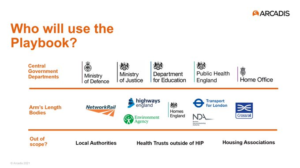
Who will use the playbookAcknowledging the ongoing COVID-19 pandemic, Rawlinson noted previous industry calls to “Never Waste a Good Crisis” (the title of the 2009 Wolstenholme Report). He expanded on Trevelyan’s  keynote, highlighting the Playbook‘s core themes: accelerating industry innovation, improving certainty of outcome, defining and driving value more effectively, and making better use of data and insight. The Playbook is set to be used by several of the UK construction industry’s biggest government and infrastructure customers.

Ann Bentley said government policy changes are aligned to how money is to be spent on construction, with increased focus on value for money, and on transformational change. Indicating the importance of the Playbook, she described it as “Perhaps the most significant construction document I’ve seen in my career“. As one of the leader’s of the CLC’s value workstream, including the Construction Innovation Hub‘s Value Toolkit, Bentley said the UK government’s value-based approach is also being taken up by private sector clients.

Digital acceleration

After a presentation by Crawford Wright from the UK Department for Education, this first group of speakers responded to questions, with digital transformation a key strand. Bentley said the COVID-19 lockdown had really helped industry workers utilise and appreciate digital tools; Rawlinson was optimistic about “industry data democratisation” enabled by cloud-based technologies for businesses large and small, and said aspects of the Playbook such as data transparency are desirable and easy to adopt by non-gov clients.

How deployment of technology could help deliver better buildings more efficiently was then described in the next session which included a presentation from Bryden Wood’s Jaimie Johnson, leader of the CIH’s Platform for Design for Manufacture and Assembly programme (“the Playbook provides more impetus and momentum to the platform programme, … the start for ‘harmonisation, digitisation and rationalisation’”). And Matt Hallissey of modular housing provider TopHat talked about opportunities for mass customisation to meet local authority planning needs as well as home-buyers’ requirements.

The climate emergency, and building safety

The Summit’s second day (which was partially sub-divided into two streams for NBS’s primary targets, one for designers and specifiers, and one for manufacturers)  focused more on the climate emergency and building safety. Gary Clark, chair of the RIBA Sustainable Futures Group opened the day talking about ‘Building Sustainably’; sustainability in design is now also being encouraged in the RIBA Awards where judging criteria demand information about energy in use, embodied carbon and water use (read more).

Golden Thread initiativeOnce the event split, the specifiers stream heard from housing association L&Q speakers Johnny Furlong and Kirsty Villiers, and from Rebecca Thompson, an advisor to the Ministry of Housing, Communities and Local Government. They talked about their ongoing work to flesh out the detail of the post-Grenfell Hackitt Report recommendations concerning the ‘Golden Thread’. Their aim was to pilot production of a standardised digital Golden Thread of building safety information for higher risk residential buildings. And an information management platform group is looking at how technology can support the process (I believe Nottingham, UK-based technology vendor ActivePlan is involved).

The ‘Golden Thread’ defined

Summit attendees effectively got a preview of emerging UK safety guidance. Since the summit, MHCLG and the BIM4HAs group has produced a formal definition, comprising five key criteria, backed by a nine-point annex.

According to a 28 May 2021 BIMplus article, the ‘Golden Thread’ covers the information, documents and information management processes used to support building safety (relating to both the building itself and people in and around it). The guidance highlights that “information could be held in a common data environment, but that there is no requirement for such,” with information held in a “structured way”, and will “likely align with the rules around open source data – so that information can be handed over in the future and still be accessed”.

The summit for specifiers continued with an overview, of the NBS Chorus specification platform (NBS Building, Landscape, and Create, are set to retire on 30 June 2021) and NBS Source (now combining NBS’s Product Selector, National BIM Library and NBS Plus), delivered by Stephen Hamil. He referred back to earlier presentations, stressing the key role of specification (apparently the Playbook mentions specification 38 times), while suggesting digital tools and standard processes are allowing better collaboration, more coordinated information and heightened transparency on audit trails. Carlos Muriel of Atkins then talked about digital design of internal spaces, and Alastair Kell described BDP’s adoption of BIM.

In the day’s final Q&A, the need for an industry culture change was discussed, and Hamil echoed the opportunity outlined earlier by Rawlinson: “We need to get away from decisions made in emails and telephone calls to decisions captured in shared spaces and platforms“.

Presentations and videos from the NBS summit are available via the NBS CLS webpage. NBS has also been promoting follow-up webinars reprising content from the summit – see events. And the 2021 NBS digital survey was also launched at the conference.

[* Disclosure: As a paid consultant, I supported NBS efforts to promote and to share content from the NBS Construction Leaders’ Summit. #CLS2021]

Permanent link to this article: https://extranetevolution.com/2021/06/nbs-summit-accelerating-digital-transformation/

thinkproject appoints new CEO

thinkproject logoGerman SaaS construction technology vendor has appointed former Nemetschek executive Patrik Heider as its CEO and further strengthened its board.

Former Nemetschek executive Patrik Heider has been appointed as the new CEO of Munich, Germany-based construction collaboration SaaS technology provider thinkproject

Patrik HeiderHeider, right, has held roles at PwC and the Hoffman manufacturing group, and spent five years (2014-2019) as spokesman of the executive board and CFO/COO at the Nemetschek construction software group, and 16 months as CEO of riskmethods (a supply chain risk management software vendor based in Munich). Under Heider’s tenure at Nemetschek, say thinkproject, “the company experienced impressive organic revenue growth and executed multiple group and brand level acquisitions – expanding the presence of the group from its core in building design and construction into building management.”

Heider replaces Gareth Burton who was succeeded thinkproject founder Thomas Bachmaier as CEO in May 2019 (post), having previously been the CIO of UK contractor Laing O’Rourke and, from January 2018, a non-executive director and member of thinkproject’s board of directors.

Perspectives

In late 2020, Swedish international investment group EQT took a majority stake in the German business (read: EQT takes majority stake in thinkproject). Florian Funk, a partner at EQT and member of thinkproject’s board says:

“Patrik is an inspiring leader with deep industry knowledge and a strong business acumen. He was a natural choice and an excellent successor for Gareth. He will continue the strategic focus on driving sustainable growth and further increasing the market position. I’m delighted to welcome Patrik to the company as he will play a key role in establishing Thinkproject as the leader in construction intelligence.

Heider says:

“I’m excited yet humbled to take on the responsibility of leading Thinkproject forward into the next phase. Digitalisation of the AECO industry is still at the beginning and there are a lot of opportunities as well as challenges ahead, both for us and the industry. I’m looking forward taking these challenges on with the talented employees, our customers and partners to help construct a better world.”

Gareth Burton (think project! CEO)Burton, right, told Extranet Evolution that he had agreed with EQT that now would be the right time for a transition.


“Life is like that in private equity – the soccer coach analogy is a good one: high passion, high intensity, but it can be over very quickly. Last year was exceptional … and I feel I am leaving on a high. …. The FY20 results were well ahead of budget [thinkproject achieved 40% revenue growth in 2020] and the business is in a great shape this FY.”

Further ex-Nemetschek representation on thinkproject board

Malou AamundSean FlahertyMeanwhile, Malou Aamund, left, is the new chair of thinkproject’s board of directors. Aamund is the managing director for Google Denmark, and has previously held international leadership positions at Microsoft and IBM in Europe, EMEA and the Americas. She is a board member for several companies and also chair of the Board of Ecoinnovation.

Sean Flaherty, right, also joins the board. Flaherty is an AECO industry veteran with over 30 years of experience in creating design software and working in BIM. He has held various leadership positions including spells as CTO then as CEO of Vectorworks; later, he was on the board at Nemetschek Group as CSO and chair of several of its brand companies.

Permanent link to this article: https://extranetevolution.com/2021/04/thinkproject-appoints-new-ceo/

Load more