Asite reports 17% growth

Asite logo 2012In the year to 30 June 2014, London, UK-based SaaS construction collaboration technology vendor Asite grew its revenues by 17% to £4.715m (2013: £4.011m), generating a profit of £0.635m, up from £0.511m in 2013 (download Asite’s annual report here).

vendors turnover March 2015

That 17% growth lags a little behind that recently reported for the half-year to December 2014 by global leader Aconex – it reported revenues up 19% last month – but, of course, the two companies’ exposure to different market conditions varies considerably (and they also offer subtly different product portfolios, though Asite’s report, again, gives no clues regarding breakdown of revenues from the company’s collaboration activities and those relating to its procurement/transaction hub).

vendors profit March 2015

Last year, Asite tripled its revenues from the Australasian market, but this year they’ve fallen back a little, down from £0.557m to £0.536m. Next week Asite relaunches in the US (post), so it will no doubt be highlighting US revenues up by over a third from £0.150m to £0.218m. The other big bright spot is the UK market where Asite revenues were up 20% year on year. Staff numbers also grew during the year: the average monthly headcount over the year was 139 employees, up from 104 the previous year, once again mainly due to expansion of the India-based technical team.

In the report, Asite CEO Tony Ryan says:

Tony Ryan (Asite CEO)Our efforts to promote Asite’s products in the North American market are starting to bear fruit with significant new customers in the Facilities Management (FM) and collaborative Building Information Modelling (cBIM) sectors. We intend to build on our operations in this region and expect to see substantial grown in the near future.

The release of our new platform Adoddle17 has brought greater functionality and improved user experience. Combined with AppBuilder, which allows our customers to build their own business applications on the Adoddle platform in the cloud, this has enabled Asite to become the technological leader in its sector. Our focus on maintaining this technological edge and prudent cost control have put the business in a prime position for future growth and profitability.


Permanent link to this article: https://extranetevolution.com/2015/03/asite-reports-17-growth/

OnShape – CADaaS lives!

The Beta launch of a new SaaS-based manufacturing CAD application, OnShape, has excited a few bloggers and tweeters recently, although the concept is nothing new (I recall US CAD writer Brian Seitz wondering Is SaaS the Killer App for the CAD Industry? in 2008, and it stimulated some CADaaS posts from me – firstsecond – and later some BIMaaS posts – the first was in 2008 and there has been a steady stream since).

Onshape logoOnShape, from a Boston, US-based company of the same name, is not a CAD tool expressly for most architectural, engineering or construction users. Three years and US$64m in the making, it is a feature-based model authoring tool for mechanical designers (so it could be used, for example, by construction product manufacturers), but – and this was the area that particularly interested me – it works like Google Docs insofar as all files are stored on the web, are available to anyone with Internet and file access, can be co-edited, and run in nearly all modern web browsers (read Ralph Grabowski’s blog post; also TechCrunch).

And perhaps even more radical, it is free. The OnShape commercial model offers the complete software package free, but after the first five models, users have to pay for private storage of their files (cost US$100/user/pcm). Otherwise, other users can view the files, make copies and develop their own versions of the models.

OnShape uses a container file format to organise and store all files and data (including PDFs, videos, and spreadsheets) related to a project in a single document. The container file format is also used to unify versioning control and to help it run in web browsers. Ralph’s Initial user experience suggests it runs like an installed application; model files can also be viewed and edited on mobile devices (iPhone and iPad initially, Android coming soon); and users can work on a file simultaneously if they wish (a collaborative feature of Google Docs that I really like).

Industry reaction

Industry observers like Adam OHern have made comparisons between OnShape, Autodesk’s Fusion 360 product (which started as a browser-based tool, but now requires software installation) and Solidworks (featured in one of my 2009 CADaaS posts – which also mentions Onshape’s CEO Jon Hirschtick). Having two players in the cloud CAD space makes things interesting, says Adam; the game has changed:

“It’s no longer enough for The MCAD Syndicates to sell CAD by the “seat” with complex bundling restrictions, bizarre and arbitrary licensing schemes, and pricing that was dreamed up in a backroom sales negotiation at Boeing or GM. Even if Onshape is only moderately successful as a product in itself, it will force the industry to re-examine regressive revenue models in favor of simpler, more straightforward, customer-oriented value propositions.” (my emphasis)

Autodesk President and CEO Carl Bass has also blogged about OnShape, prompting some predictable comments from both the CAD cloud fans and those who think the cloud is a security risk, but also a sense that competition in this sector can only be a good thing.

My take

Although it is not strictly in the AEC sector, the launch of OnShape interests me because it challenges preconceptions about how software for complex design challenges can be delivered, and it offers new scope for collaborative co-creation and design development.

It also offers a different take on per-seat up-front license payment approaches, preferring instead to offer all functionality free, but charging for enhanced levels of security. Denmark-based GenieBelt is another company that has launched a free forever online product, designed from the ground up for access on mobile devices and in web browsers (5 November 2014 post; I had a brief chat at Ecobuild last week with GenieBelt founder Gari Nickson who is excited about the imminent launch of new document management functionality on the platform).

Just as the SaaS collaboration vendors (among others) challenged existing approaches to software delivery and licensing and heralding the wider adoption of pay-as-you-go computing, it appears pricing approaches have evolved still further to the point where we can now get software free, but pay for additional components such as private storage, advanced analytics, etc. Some software and services are rapidly becoming commoditised, barely distinguishable from one another in their core functionality, with users now able to pick and choose between the added value options offered by vendors.

Permanent link to this article: https://extranetevolution.com/2015/03/onshape-cadaas-lives/

On good (collaborative) behaviour

Once again, it’s not just about technology, it’s people and processes – behaviours – that support successful collaboration.

constructing excellenceI have been involved with, and enthusiastic about, Constructing Excellence almost since its foundation and have been a CE collaborative working champion for about 10 years. CE is, I think, the only pan-industry membership body in the UK built environment sector, drawing its members from industry client organisations, contractors, consultants and manufacturers and suppliers, which underlines its core purpose: promoting integrated collaborative working across every part of the supply chain.

At the London offices of multi-disciplinary consultant Pick Everard yesterday, the CE CWCs held their quarterly meeting, and the agenda stimulated a lot of conversation about collaborative behaviours. I talked to the group about the Behaviours4Collaboration group (see my December 2014 post), updating my presentation a bit to include an example page from the prototype profession map (tabled at a stakeholders meeting at Bath University in January), and noting that the recently published Digital Built Britain document (post) also highlights the need for behaviour changes to achieve Level 3 BIM.

There was also discussion of an update to the Strategic Forum for Construction’s Integration Toolkit, first released in 2003, but now being refreshed as a by-product of a Technology Strategy Board-funded project focused on integrated project insurance.* Kevin Thomas then described how the first IPI project had been successfully tendered, relating to a college project in Solihull in the West Midlands.

The CWCs then heard from two guests: David Hawkins of the Institute for Collaborative Working, talking about BS11000, and Dale Evans of the Infrastructure Clients Group and Anglian Water talking about alliancing. Neither of these speakers had been present during the earlier discussion of Behaviours4Collaboration, but both reiterated key points about collaboration needing to be reflected in people’s behaviours on projects.

BS11000

David stressed that many organisations often just pay lip service to ideas such as partnering or integration, and make little or no effort to change their cultures accordingly. Achieving BS11000 certification, he said, will require businesses to show that they have the right behaviours enshrined in their processes (he particularly highlighted HR) and to demonstrate how those processes contribute to the relevant business relationships.

Alliancing

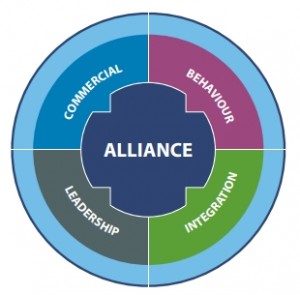
AlliancingDale presented a really interesting case study about Anglian Water’s @OneAlliance relationship (he also referenced an ICG project initiation routemap, and tabled a copy of a guide, Alliancing Best Practice in Infrastructure Delivery), whereby a consortium of contractors and consultants manage an asset management progamme (AMP5 is just drawing to a close) delivering 800 projects worth some £2.4bn. Set some stringent ‘stretch targets’, @OneAlliance team members have to work effectively as a single business in partnership with the client and are incentivised by a gain/pain-sharing pool to deliver innovations. A tough target of reducing embodied carbon by 50%, for example, had been particularly powerful in stimulating innovation, Dale said, with the team adopting off-site construction approaches and other efficiency improvements, reducing the benchmark cost of some £10m projects to £7m in the process. Behavioural change was a strong characteristic of the Anglian alliance process, he said, and the Alliancing guide underlines the importance of behaviours:

To ensure success an emphasis has to be placed on the behavioural aspects of both the organisations and individuals involved.

[* Disclosure: pwcom.co.uk has been providing consultancy services to help develop the new integrated collaborative working toolkit.]


Permanent link to this article: https://extranetevolution.com/2015/03/on-good-collaborative-behaviour/

Asite (re)launches in USA

Asite logo 2012A year after launching its v17 Adoddle update at a St Patrick’s Day event in London (post), London-based SaaS construction collaboration technology provider Asite is staging what it describes as its official launch in North America in New York on 17 March 2015 (news release).

The event will include an open bar and traditional Irish music and canapes, at Tribeca Cinemas, 54 Varick Street, New York City, 6.30pm on 17 March. Asite CEO Tony Ryan says:

“Adoddle will bring the huge benefits of advanced cloud-based BIM to many more US projects, enabling seamless collaboration between disciplines. Internationally, Adoddle is at the forefront of major changes in the way we work together and manage information. We’re excited to bring this innovation to the US.”

Asite is not new to the US. It has previously cultivated marketing networks through print group ReproMAX, in April 2012 it announced it was opening an East Coast office in New York, and a West Coast office in San Francisco (post), in July 2013, it appointed a VP Sales for the US, and a year ago was aiming to build on its client relationship with Goldman Sachs.

BuildEarthLive, and Big Data

Meanwhile, the latest Asite-sponsored international collaborative BIM competition, BuildEarthLive (this year focused on Newcastle-on-Tyne) is being held on 16 March 2015, organised in collaboration with BIM4SME and WYG.

A month later (16 April 2015), Asite is a sponsor, with the CIOB and ConstructIT, of a Big Data: Opportunities and Challenges in Construction event at Google Campus in London.

Update (4 March 2015) – And, to return to the US theme, there will be another BIM collaboration event, Build New York Live, starting 25 September 2015 (Note: date changed from 21 September).

Update (26 March 2015) – “Asite launches the Adoddle platform in New York!

Permanent link to this article: https://extranetevolution.com/2015/03/asite-relaunches-in-usa/

For Level 3 BIM, read Digital Built Britain

DBB-Level 3 coverLast week saw the “launch” of Digital Built Britain, the preferred branding for the UK’s Level 3 Building Information Modelling (BIM) programme. The work is apparently intended to “build on the standards and savings delivered by the BIM level 2 initiative which has been central to the £840M savings achieved on central public spend in 2013/14,” and core to this is a new strategic plan.

(Unless I missed something, it was an oddly low-key launch for a document that is intended to continue the BIM transformation process – did it get overrun by the push towards a UK General Election in May?).

Open Data

The report says the UK wants to make fully computerised construction the norm, ensure that the benefits of these technologies are felt across the UK, and support the export of these technologies and the services based on them. A new round of investment will “enable us to continue and extend the work that began in 2011” with funding enabling:

  • the creation of a set of new, international ‘Open Data’ standards which would pave the way for easy sharing of data across the entire market
  • the establishment of a new contractual framework for projects which have been procured with BIM to ensure consistency, avoid confusion and encourage, open, collaborative working (‘collaboration’ is mentioned 20 times in the report, ‘collaborative’ is used 16 times; together, as they should, these outnumber the 33 mentions of ‘technology’).
  • the creation of a cultural environment which is co-operative, seeks to learn and share
  • training the public sector client in the use of BIM techniques such as, data requirements, operational methods and contractual processes
  • driving domestic and international growth and jobs in technology and construction

Social media

On a first read, I was also struck by an explicit endorsement (p.25) of the value of social media (mentioned six times, more than ‘software’) in the report, and the talk of toolkits:

Normal lay users are mostly conversant with applications such as email and social media, both of which perform complex processes, yet manage to present the user with clear simple interfaces. Our aim must be to present the day to day user with useful easy to consume and interact with information and knowledge.

With an industry so keen to enable collaboration of diverse people, the uptake of social media in the supply chain has been relatively slow. Where uptake has taken place it has been with tools such as LinkedIn which have a more business focus. Lessons should be learnt from this and the patterns of social media uptake to create an appropriate toolkit to encourage very wide adoption and usage.

I have bemoaned the lack of social-savvy approaches to collaboration for some years, and finally it seems others share my views.

Permanent link to this article: https://extranetevolution.com/2015/03/for-level-3-bim-read-digital-built-britain/

Rapiere to launch at Ecobuild

Rapiere screen grabUK-based Rapiere’s cloud-hosted software “calculates embodied carbon, whole-life energy use, and creates live cost models and comparisons”

Rapiere, “a unique system designed by the industry for the industry and [representing] the next generation carbon, energy and cost modelling platform for the built environment which runs in the cloud” is being launched at this week’s Ecobuild exhibition in London, 3-5 March 2015.

The email I received mentions the involvement of Architype, Chapman BDSP, GreenSpace Live and the Sweett Group. The product will be demonstrated on stand N7011 and there are also two presentation sessions scheduled for Wednesday 4 March (potential attendees are urged to email sales@rapiere.net).

Information about the system on the website is currently sparse (Update [3 March 2015] – more information is now available on the website); Architype’s website gives a little more background. The current one-page Rapiere website says:

Rapiere Software came out of a research project. Designed by the AEC industry for the industry, it is the only next-generation, early design stage, BIM compatible solution that simultaneously performs cost, energy and carbon analysis in the cloud.

rapier logoSome readers may recall I mentioned Rapiere last year. Prior to the closure of SaaS construction collaboration Cadweb in July 2014, CEO Francis Newman was one of five founding directors of Rapiere Software, incorporated in October 2013, which was developing a web-based decision support tool for design of low impact buildings. Environmental issues have been a recurring theme for Francis; while at Cadweb, he devised the company’s ‘Football pitch’ reporting tools showing how much paper was being saved by using an online document collaboration system.

Permanent link to this article: https://extranetevolution.com/2015/03/rapiere-to-launch-at-ecobuild/

KA’s Knowledge Management Survey

Chris Parsons, CEO and founder of US-based Knowledge Architecture, provider of AEC intranet solutions and organiser of the annual US conference, KA Connect (post) – 2015’s is in San Francisco in May – is running a knowledge management survey. He writes:

KA connectWe believe this survey is the first of its kind and is the logical next step in fulfilling KA Connect’s mission of “Advancing the Practice of Knowledge Management in the AEC Industry”.

The statistics from the survey will help AEC firms evaluate their use of knowledge management in comparison to peer firms and competitors, as well as implement new strategies for managing knowledge.

The survey will cover the following areas:

  1. Strategic Priorities for Knowledge Management
  2. Core Knowledge Management Processes
  3. Supporting Activities for Knowledge Management
  4. Knowledge Management Leadership
  5. Successes, Challenges, and the Year Ahead

You’ll be able to review your results in two ways:

  1. Personal Summary and Detail: See your responses with KM performance gaps highlighted.
  2. Benchmarking Summary: See side-by-side highlights of your responses and what others in the AEC industry said.

The deadline for participating is Friday, April 3, 2015.

Who should participate? Architecture, engineering, planning, or environmental consulting firms; construction contractors and construction managers; speciality AEC contractors and consultants.

The survey should be completed by the individual with the highest responsibility for knowledge management issues or any firm leader who can accurately answer questions about the firm’s KM priorities, processes, and people. And you do not need to be a Knowledge Architecture client or KA Connect attendee to participate.

Permanent link to this article: https://extranetevolution.com/2015/03/kas-knowledge-management-survey/

A rosy Aconex financial update

Aconex logo 2014Aconex, which listed on the Australian Stock Exchange in December, has just reported results for the half-year to 30 December 2014. The Melbourne-based SaaS collaboration software business saw total revenues climb 19%, ahead of forecasts, to Au$38.1m (£19.4m or US$29.8m). The company was also ahead of break-even, reporting a Au$0.5m EBITDA, again ahead of its forecasts. Growth varied across regions: 14% in Australasia, 29% in the Americas, 37% in Asia, with EMEA the most sluggish at a, still encouraging, 13%.

CEO Leigh Jasper said:

Leigh Jasper“First half results showed how the Aconex unlimited collaboration model is driving the growth of our global user network. Owners and contractors delivering the world’s largest projects are increasingly trusting Aconex to provide project-wide information and process control for their project teams. Our key financial metrics of revenue and EBITDA for 1H FY15 exceeded our IPO prospectus forecast and confirmed our outlook for FY and CY 15. We saw continued strong growth and profitability in Australia, while further increasing our international revenues and rapidly improving our regional operating contribution. We’re successfully replicating our Australian operating model on a global scale, and we’ve launched new products to continue expanding market penetration worldwide. ”

Aconex shares closed at Au$1.92 on Friday, having spent all of February to date above Au$1.90, and the company’s cash position looks rosy after the IPO, with a balance of Au$25.8m. Updates (23, 24 February 2015) – Not surprisingly, its performance is pleasing analysts: in Aconex puts early runs on the boardFNArena‘s Eva Brocklehurst describes the positive response of Macquarie, for example, while the Herald Sun‘s John Beveridge rates Aconex a “buy”.

The numbers will make sobering reading for some of Aconex’s rivals, particularly those like McLaren Software whose revenues have hardly grown at all, while Aconex’s growth pushes it further ahead of others also claiming double-digit revenue growth. Still, it’s a big market, and even Aconex as the biggest specialist provider reckons overall market penetration for collaboration solutions is still only around 4%, so there’s still plenty of growth to come.

Permanent link to this article: https://extranetevolution.com/2015/02/a-rosy-aconex-financial-update/

CodeBook getting a little SaaS-y

Surrey, UK-based software developer CodeBook International has started to offer cloud-based data hosting for its solutions, which complement most well-known BIM authoring applications.

A little CodeBook background

CodeBook logoCodeBook was founded in 1993 by architect Peter Mann who developed an application to help those involved in brief preparation, design, construction, fitting-out and operation of large, complex buildings to work with coordinated graphical and textual information. While CAD and BIM authoring tools are adept at managing graphical data, they are less efficient at managing non-graphical information and metadata, and CodeBook was devised to help project teams efficiently produce schedules, themed graphical views and room data sheets.

The company’s core database application has been widely used by UK, Australian and north American design firms engaged in healthcare projects, where the data management challenge requires client teams to coordinate vast quantities of information about the building and its fixtures, furnishings and equipment (CodeBook CEO Andy Hamer cites the example of a large hospital project comprising six buildings, 14,000 rooms, 500,000 items of equipment, 27,000 doors and 100,000 power outlets – over 50 million pieces of data!).

Room data collation and management
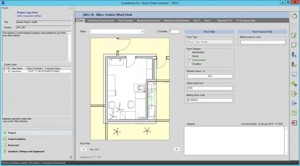
Codebook RDCAt Autodesk University 2014 in Las Vegas, CodeBook launched a new product, Room Data Collector, which is aimed at clients wanting to specify their needs at the level of individual rooms. CodeBook has long been used to manage room-level data (room data sheets), but RDC provides an initial tool to capture and collate that information (from existing documents, spreadsheets, photos, CAD images, sketches, etc) and store it in a centralised database rather than in, say, an Excel spreadsheet. (The RDC tool is currently a download but I am told a web-based edition is in development.)

The original core CodeBook Pro application, now named Project Room Data Manager, can then be used by teams to produce schedules, graphical views, room data sheets and BIM outputs. As an information repository and gateway, CodeBook RDM complements all the leading architectural and engineering design authoring tools. A change in one system can then be reflected across all systems relevant to a project, with information fully related, analysed for consistency, and synchronised, helping validate and maintain a ‘single version of the truth’.

And to complete the CodeBook toolset, Asset Data Collector allows users in the post-construction and pre handover phase to complete conformance and compliance programmes, do snagging, collect warranty, serial and asset numbers, and then synchronised this data with that already stored in the CodeBook Project Database for reuse in facilities management.

CodeBook ecosystem

CodeBook Cloud

CodeBook product linePreviously, CodeBook was a locally-hosted application sitting on a user’s computer, perhaps with a database behind the firewall of a designer’s IT system. With BIM placing increased emphasis on multi-company information sharing and collaboration, this was less than optimal, so the company now offers its own hosted instances of CodeBook Project Databases, freeing customers from having to procure, manage and maintain their own hardware and software

CodeBook offers a wide area network option for those still wishing to host the system in-house, and an option for customers wanting to use their own third-party hosting. But for those content to outsource the service to Codebook, the company offers Microsoft Azure hosted facilities. In each case, CodeBook Project Databases run on enterprise-strength SQL servers, helping customers achieve high levels of data security and multi-user access (particularly important when sharing federated models), and reducing database/BIM authoring integration issues. CodeBook also takes on responsibility for support and for maintaining adequate back-ups.

CEO Andy Hamer told me:

Andy Hamer“We believe our hybrid offering of Cloud-hosted data and desktop clients means users won’t sacrifice functionality. Hosting allows customers to take advantage of SQL’s superior performance (up to 75% faster than Access) but without the costs and hassles of buying servers, etc. The managed option is useful to clients working on federated workflows with multiple collaborators, and we have projects where teams are spread across different continents – all connected to the same CodeBook Project Databases.”

Update (14 January 2016) –  I understand that Andy Hamer left CodeBook at the end of 2015 to set up his own BIM data consultancy business. Update (31 October 2017) – Hamer was appointed director of customer success at Invicara (post) in April 2017.
(Disclosure: CodeBook International was a pwcom.co.uk client between from mid-2011 to early 2013.)

Permanent link to this article: https://extranetevolution.com/2015/02/codebook-getting-a-little-saas-y/

No post-recession bounce for Idox EIM

McLaren SoftwareMcLaren-logo, the engineering information management (EIM) division of Berkshire, UK-based Idox plc, had a fairly flat financial performance in the year to 31 October 2014, according to Idox’s annual report and accounts published last month. McLaren’s EIM division is best-known in this blog as the provider of FusionLive (formerly CTSpace and, before that, BuildOnline – among several other brands), acquired from Sword by Idox in November 2011 (post).

Idox chairman Martin Brooks’s statement  notes EIM “only saw marginal growth in a challenging year in its global markets,” and “we have been challenged again by a fall in activity in the Oil & Gas sector”. CEO Richard Kellett-Clarke said the EIM division’s focus in 2014 had been on customer care and delivery of solutions, while the sales focus had shifted more towards the USA and an attempt to expand in infrastructure and utilities. EIM revenues grew 1% to £19.5m (2013: £19.2m), with 52% generated in the US (2013: 46%). The level of recurring revenues in the EIM business from maintenance and Software-as-a-Service (“SaaS”) were 49% (2013: 51%; no further information was given on the breakdown between maintenance and SaaS). Nonetheless, it remains profitable; EBITDA for the EIM division was flat at £4.4m (2013: £4.4m), with margins held at 23%.

The financial year also saw CEO Paul Muir exiting the business amid various personnel changes at McLaren (see my May 2014 blog post). It has sought to become more responsive to customers and focus on three key markets: on-premise engineering document management, Software-as-a-Service construction project collaboration, and facilities management (it acquired CAFM vendor, FMx, in October 2012).

But while other businesses in the SaaS construction sector have been enjoying post-recession double-digit growth – Conject UK reported 16% growth (September 2014); 4Projects reported 12% growth (October 2014) – it seems McLaren’s mixed portfolio of on-premise and SaaS solutions covering a more disparate range of markets has led to it falling even further behind. The energy also appears to have disappeared from McLaren’s BIM push: barely a mention of its BIM capabilities since October 2013.

Permanent link to this article: https://extranetevolution.com/2015/02/no-post-recession-bounce-for-idox-eim/

Load more