Conject fleshes out its mobile defects offering

European SaaS collaboration and infrastructure lifecycle management vendor Conject presented its construction mobile defects management solution to London audiences today.

ConjectSome four months after acquiring Paris, France-based mobile AEC software developer Wapp6, Munich- and Woking-based Conject presented its defects management solution, OPR6, to audiences attending two seminars at London’s Thames-side National Theatre this morning. The events attracted some 170 registrations, underlining the growing interest in mobile construction solutions, though pouring rain and the after-effects of a two-day London tube strike may have affected attendance. Still, I estimated over 100 customers and prospects attended (I tweeted from the events – all on Storify here).
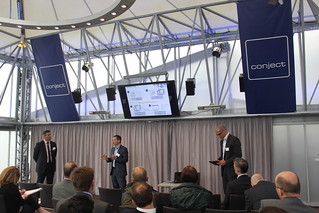
Conject defect management seminar at The Deck, LondonThe seminars were co-hosted by Conject sales director Duncan Kneller and Wapp6 CEO Franck Meudec, with audiences including construction client (ie: owner/operator) representatives, consultants and contractors. Many were familiar with the Conject SaaS application, and it was clear from questions that existing users were looking for close integration between the mobile application and the web-based Conject system. Fortunately, the OPR6 system is not restricted to one platform; the mobile defects solution (aka ‘snagging’, punchlists, etc) was demonstrated on an Apple iPad, but is also available on MS Windows and on Android (subject to identification of suitable devices, recognising the profusion of different functional capabilities available in Android).

Research

Conject acquired Wapp6 partly because of its cross-platform capabilities, and because it immediately gave it a mature product with a substantial track record and user base – Franck said OPR6 had so far been used to capture some seven million defects. Aggregating and analysing this volume of use, he estimated that typical construction projects generally have around one defect per square metre of development, and yet much of construction remains reliant on paper-based processes.
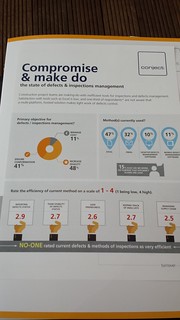
Compromise and make do - Conject defect management studyEven where projects use IT for defects and inspections management, Conject’s research (based on responses from 340 industry professionals in March 2014) showed generic office software remains commonplace: 47% used Excel, 32% used email; desktop or mobile defects solutions were used by just 21%, with Word also used by 15%.

Franck said it was focused on delivering user-friendly construction-oriented applications that enabled secure* cross-platform access to data anywhere, anytime, 24/7. Conject’s OPR6 is currently provided in four languages, and each project is logically presented as a series of zones, phases and processes. Among the stand-out features he showed was the ability to ‘favourite’ a defect type so that common defect types could be quickly recalled and swiftly added to the project project. As with most mobile solutions, these could be marked on a drawing and be associated with photographs (marked-up, if required). With the app, Franck said, a user could capture as many as 500 defects in a half-day inspection.

The company was clearly keen to show OPR6 is more than a point solution focused on defects. It demonstrated the current web-based reporting back-end, with data summarised in statistical, listing and drawing views, and then previewed a forthcoming release (available from the end of May) which showed a much richer graphical dashboard. Bar- and pie-charts could be quickly created, and from each graph, users could drill into the segment of the bar or pie to see the supporting data. Workflows can be quickly configured via a drag-and-drop flow-chart tool, and – bearing in mind Conject’s experience with complex contract management processes – it is clear the company sees the mobile platform as supporting more than defects management in the future.

My view

Having looked at other mobile defects management/snagging/punchlist solutions, Conject’s AEC mobile solution is immediately mature and user-friendly. Compared to point solutions, it has strong web-based reporting functionality (not just another Excel export), and there is a strong drive to reflect the needs of the ultimate owner/operator of a built asset. Expanding on the functionality of the core SaaS platform, it can be used, for example, to help benchmark the quality performance of suppliers both on their initial work, and/or their efficiency in closing-out defects.

The presentation was timely – I visited a contractor using a competing solution last week – so I could contrast and compare the depth of process support. Conject still has some way to go in terms of the depth and range of its field capabilities, but my initial impressions of the integration of the newly acquired platform with the core system were very positive, and the previews of what will be in future software releases were encouraging.

By the way, I still have no idea what “OPR6” stands for (even the UK Conject staff I spoke to were unsure). From a marketing perspective, perhaps the product needs to be rebranded for the Anglophone market so that it is clearer what the solution does and which market it serves.

* (Note: I understand the sudden appearance of a ‘not safe for work’ video in the first seminar was due to sharing the venue’s wifi network; Conject’s iPad inadvertently auto-connected to content being accessed by another user on the same network.)

Permanent link to this article: https://extranetevolution.com/2014/05/conject-fleshes-out-its-mobile-defects-offering/

NexTenders targeting UK construction

India-based NexTenders is targeting the UK architecture, engineering and construction market with its e-tendering and e-procurement applications.

I have written about e-tendering in the construction industry several times since the mid-2000s when several of the SaaS construction collaboration technology vendors (eg: 4Projects, Asite, Conject, Sarcophagus) all launched online tendering services which were integrated with their core document collaboration and workflow platforms, all looking to capitalise upon widely recognised inefficiencies in the then conventional paper-based process.

The Royal Institution of Chartered Surveyors, RICS, also entered the market with a stand-alone pay-per-tender solution in 2007 (post), though – unsurprisingly to me – it struggled to gain traction, being used just 50 times in its first 15 months (January 2009 post), and excusing the low take-up by accusing the UK construction industry of “apathy, naivety and confusion” (February 2009 post). With e-tendering still a minority pursuit (June 2009), other vendors also began to test the UK market – in January 2011, I wrote about Asktobi (which I understand – post – is to be relaunched later this year under a new name, possibly 4Tenders) and in November 2011 I talked about Darley eTender. And Melbourne-based international SaaS collaboration provider Aconex launched Bidcontender in May 2011 into the Australasian market.

Next: NexTenders

NexTenders logoThe next contender (sic) I’ve discovered is NexTenders. An India-based start-up with an office in London’s Covent Garden, it says it has been providing procurement solutions to governments, public sector bodies, public-private partnerships and private companies since 2003, and has processed more than 250,000 online tenders and auctions worth over £10 billion, mainly in India, but also in Africa; entry into the European market apparently started in August 2011 with the appointment of Gary Stevenson as European sales and partnerships director. The UK-specific venture is more recent, though, with the company’s on-demand cloud service e-tendering application, NexProcureLite, launched 10 months ago in June 2013, complementing an enterprise procurement solution.

This stand-alone etendering product, NexProcureLite provides “an intuitive one-stop-shop e-Tendering solution from tender release to award and ePayment”, helping standardise workflows so that buyers can carry out tenders regularly with minimal repetition, without losing quality:

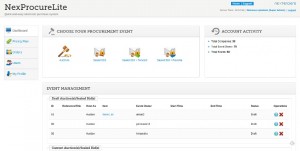
NexProcureLite-screengrabThe tender workflow can be set to any of the following; Standalone PQQ, Single stage (techno-commercial) and Two stage (Technical & Commercial) bidding, with integrated Forward and Reverse Auctions. This provides significant flexibility for buyers, allowing them to adhere to OJEU and UK procurement standards in all but the most demanding procurement scenarios – even for small lots! Building on our experience in delivering highly secure commercial software NexProcureLite uses server side data encryption to ensure that your data is protected, you can also choose client side encryption to guarantee complete traceability. The solution generates full audit trails and reports helping to promote accountability and auditability throughout the tender cycle.

While not exclusively targeting the construction sector, the company has been blogging about construction-related matters, including, for example, the UK government’s construction strategy, and continued low rates of e-Tendering and sub-tendering in the UK construction industry. It clearly sees the industry as a strong opportunity. However, I still believe the SaaS AEC collaboration vendors have strong positions as they can integrate e-tendering into their support for the whole project delivery process, and requirements for such ‘joined-up’ thinking will only grow as projects are encouraged to collaborate more through building information modelling-based approaches.

Permanent link to this article: https://extranetevolution.com/2014/04/nextenders-targeting-uk-construction/

M-Files – bridging the SaaS vs on-premise ECM divide

A generic ECM provider with AEC expertise, M-Files aims to help organisations wanting the best of both SaaS and on-premise hosting worlds.

Over the past few years I’ve seen various generic enterprise content management (ECM) systems target the architecture, engineering and construction (AEC) sector. When Software-as-a-Service (SaaS – though then known as ASP: application service provision) solutions (4Projects, Asite, Conject, Buzzsaw, e-Builder, etc) were first beginning to establish themselves in the US and UK markets around the start of the century, they were often competing against established electronic document management vendors (eg: Documentum). Solutions such as Open Text Livelink were resold in the UK AEC market by Causeway Technologies, while Microsoft’s SharePoint was sold as an on-premise AEC solution by firms such as Cadac (post).

And – over time – I encountered various purely cloud-based storage solutions which saw the AEC market as an opportunity (eg: Drop.io, Box.net, Vaultium), while employees in many organisations will often bypass corporate solutions and rely on generic cloud storage services such as DropBox, Google Drive or Microsoft’s OneDrive (formerly SkyDrive) – part of a widespread phenomenon sometimes called ‘Shadow IT’ or ‘Stealth IT’ (a December 2013 survey by cloud IT operations specialist 2nd Watch found that 61 percent of US business units bypassed the IT function completely, instead choosing, funding and managing their cloud services on their own – see CIO article; I also wrote about Shadow IT back in February 2008).

Appetite for cloud-based solutions in the AEC sector has clearly grown over this time, but many organisations still prefer to retain their own in-house IT provision. Some vendors have sought to cover both groups, providing ‘hybrid’ suites. The afore-mentioned Causeway, for example, could provide its OpenText-based ECM solution both on-premise or SaaS; Newforma (see recent post) started out as an on-premise server solution but now integrates with a Project Cloud SaaS option; and McLaren Software’s portfolio includes both ECM and SaaS offerings, allowing organisations to make a transition from, say, SaaS use during initial design and project delivery to on-premise applications for operation, maintenance, governance and compliance purposes during the remainder of the project’s life-cycle.

M-Files

M-Files logoGreg MillikenM-Files also seeks to cover both options – like OpenText –  by providing a hybrid application, but says it is much more flexible than other solutions. VP of marketing Greg Milliken, right, told me the company – founded in Finland, but now with a US head office in Dallas – has been growing at 50% per annum for seven years. Initially bootstrapped, it closed an investor round in April 2013, and has been looking to expand its presence in various markets including the AEC sector. The company claims it is quite familiar with the AEC market, having created a presentation plotting software solution for AutoCAD users called M-Color that was successfully sold to thousands of AEC customers. M-Files also has a solid base of customers in the AEC sector, including architect Aedas, healthcare architects BSA LifeStructures and Finland-based contractor Fira (see below). This experience gave it a good understanding of the specific ECM needs and requirements of AEC companies, Greg told me.

The company’s current core ECM solution combines document management, workflow/business process management, image capture and processing, permissions management, records management and collaboration capabilities. In addition, quality management and project management solutions can be built on the M-Files ECM platform to address specific industry and use case needs and requirements. As a result, the application has attracted considerable interest from highly regulated sectors, including life sciences and the oil and gas industry, which require rigorous control of documentation, versions, processes, etc.

M-Files screenshotThe core of the system is a relational database where all stored items or objects (documents, drawings, forms, invoices, proposals, etc) are managed using a configurable set of metadata fields and associated rules, not folders – so that users find items by searching intuitively for “what” rather than searching folders for “where”. The rules and metadata allow, for example, internally held documents to be shared with external collaborators, and for detailed audit trails of all objects to be maintained. In large projects where many changes are made to numerous documents,  high levels of file exchange often occurs between servers as documents are constantly updated.

However, the  M-Files approach reduces the traffic by using ‘differencing’ techniques and replication rules, which dictate that only files that meet specific criteria are exchanged between servers and vaults. In this approach, only a document that has been designated for replication is transferred to the server — and only the changes to the existing document are transmitted, with the new version being created by merging the original and the ‘Delta’ file (although M-Files maintains a complete version history of all documents). (This approach is something I’ve encountered a few times – Graphisoft incorporated it into ArchiCAD 13 in 2009, for example [post], and it remains a feature of Graphisoft’s BIM suite – see Lachmi Khemlani’s recent AECbytes review of BIMcloud).

M-Files at Fira Oy

Fira OyFinnish construction firm Fira Oy uses M-Files to ensure that development and preparation work advances quickly and that the data produced is documented in real time for use by all stakeholders involved in each project. Anything from 1,000 to 3,000 documents reside in the data bank associated with each project, and approximately 100 different document templates are used in project administration. Looking to replace email-based processes and having evaluated web portal-based systems, SharePoint and expanded use of network folders, it deployed M-Files ECM in 2007.

Fira architects, site managers, vendors and subcontractors all use the same project bank repository within M-Files ensuring that only the most current and up-to-date documentation is used. The firm pre-configured and automated the metadata entry process within M-Files to make it easier and more efficient for its site managers to administer the system while working remotely from construction sites. In 2010, Fira integrated M-Files into its process management software.

With M-Files, Fira architects dictate design changes and then select which other individuals need to review and sign off on the file via the permission management features of M-Files. Once approved, the final design files are merged with cost calculations enabling Fira to immediately provide customers the cost impact of design changes.

M-Files also helps Fira rapidly produce all information needed for compliance purposes (in Finland , auditors can visit worksites at any time to conduct quality assurance evaluations and verify if project documentation is in order), and is being deployed to support areas of HR and IT management, plus BIM (Building Information Modelling).

Hybrid ECM

M-Files can be provided as a 100% on-premise application or a 100% SaaS application “or anything in between”, said Greg. The SaaS component is delivered using Microsoft Azure, in both public and private cloud options – the virtues of cloud-storage include rapid disaster recovery, he continued. It can also be tightly integrated with back-office systems such as ERP and CRM.

Hybrid enterprise content management (ECM) platforms are increasingly popular, allowing organisations to store and access their content both in their networks and in the cloud. Analysts Gartner and Forrester have both predicted rapid growth in adoption of hybrid ECM in 2014; such flexible computing environments allow businesses to maintain their on-premise CRM, ERP and other business applications while integrating hosted solutions to improve and enhance the functionality of their legacy systems. I was told M-Files, according to Forrester, is one of the only providers of a true hybrid ECM application.

The application is complemented by a series of mobile apps (on Apple iOS, Android and Microsoft Windows Mobile), with strong “social” commenting  and sharing capabilities similar to those found in Yammer or Jive, Greg said. The cloud-based service starts at $39 per user per month, with the on-premise variant costing $495/seat for a paid-up term license.

Permanent link to this article: https://extranetevolution.com/2014/04/m-files-bridging-the-saas-vs-on-premise-ecm-divide/

GoReport latest to deliver RICS reports via iPad

RICS licenses another mobile technology provider, GoReport – this time to support Homebuyers Surveys.

GoReportSome 13 months ago (25 March 2013), I wrote about Belfast, Northern Ireland-based mobile technology provider GoReport, among others, and almost exactly a year ago (25 April 2013) I reported on North Shields, UK-based vendor Kykloud and its RICS-approved mobile survey templates – now widely used in the public and commercial property sectors. Roll forward a year, and GoReport has just announced that it will be delivering a suite of popular RICS survey reports via iPad devices, including the HomeBuyer Report, Building Survey and Condition Survey.

Traditional systems of surveying with notebooks, cameras, etc, are rapidly being replaced by mobile technologies that can capture on-site data, and then incorporate images, sketches and laser distance data into edited reports. GoReport enables these reports to be exported to replicate the RICS-branded format and sent directly to a client via email. Reports can therefore be produced more quickly, efficiently and cost-effectively.

GoReport CEO Conor Moran says:

“This important agreement with the RICS means that thousands of its members can access and fully utilise the benefits of this whole new way of working and be confident that the same reassuring quality standards and guidelines will continue to be met.

“In this highly-competitive industry where time is money and client demands and deadlines are increasingly challenging, recouping the valuable hours ‘lost’ by retyping written notes, finding photos and formatting final reports can give additional time for reflective thought, increased margins and business growth for many in the sector.

“This new software technology instantly transforms and improves the efficiency and profitability without ever compromising on quality and professionalism. Getting started is simple as no software installation is required and all the data is securely stored and backed up using secure and approved servers.”

RICS HomeBuyer Announcement from GoReport® on Vimeo.

Update (24 April 2014) – A quick note for clarification received from Kykloud‘s Ed Bartlett: “Our RICS agreement also covers residential HomeBuyers and has done for a year. GoReport doesn’t have the exclusive on this one….”

Permanent link to this article: https://extranetevolution.com/2014/04/goreport-latest-to-deliver-rics-reports-via-ipad/

Corecon signs up B4 Consulting as reseller

Corecon signs up B4 Consulting as reseller. Partnerships are key for SaaS vendors, but you need the right partner.

Corecon logoCalifornia, US-based SaaS project management software vendor Corecon has signed up B4 Consulting as a reseller. The application, primarily sold to US general contractors, subcontractors, developers, and engineering and professional services firms, will be bundled by B4 Consulting with its SAP Business One offering to “create a highly affordable web-based, end-to-end solution”. Klaus Schottenhamel, president and CEO of B4 Consulting, says:

“Our industry experience tells us that small and mid-sized construction companies desperately need affordable and innovative end-to-end project management solutions. Partnering with Corecon, we will address those needs by delivering the industry’s only cloud-based suite of construction software integrated with a comprehensive back office system. Our collaboration with Corecon is a real game-changer for the construction industry as we are addressing a pent-up demand for affordable innovation with a proven cloud-based solution.”

B4 Consulting will bundle Corecon capabilities with the finance and accounting functionality of SAP Business One. The SAP Business One solution powered by Corecon creates a single platform for all business operations, eliminating redundancies, streamlining operations, and providing instant and comprehensive real-time reporting.

My view

Having spent an afternoon in Newcastle yesterday with people from Viewpoint Construction Software, the Portland, Oregon-based provider of construction ERP solutions, and its UK-based subsidiary 4Projects, I think they would dispute Mr Schottenhamel’s assertion that they offer the only cloud-based construction software integrated with a back office system. Particularly following the acquisition earlier this year of Maxwell Systems, Viewpoint has a strong offering to small and mid-sized construction businesses, and with Andy Ward now applying his SaaS expertise across the Viewpoint group its cloud-based software services are certain to expand.

I have been watching several SaaS vendors’ partnering programmes, and identifying the right partner with complementary expertise but also an understanding of SaaS and of collaboration is clearly vital. Conject made little headway when it partnered with Sage in north America; Asite struggled to win work through its involvement with the ReproMAX network; and Aconex partnered in 2011 with Calgary-based Tidefall Software, which no longer seems to be operating. On the other hand, 4Projects raised its profile in Australasia through its partnership with Melbourne-based Project Collaboration (post), though this arrangement now seems to be “in transition” (see yesterday’s post); and Newforma established itself in Australia through its association with SmartSoftware.

I know some SaaS vendors are actively seeking new partners to expand their global reach. Surveying data capture and asset management vendor Kykloud, for example, recently began marketing in Australasia, and Ed Bartlett told me yesterday that they are eyeing opportunities in other regions. (I would be interested to hear from would-be resellers who think they have the right mix of complementary skills, services and market reach).

Permanent link to this article: https://extranetevolution.com/2014/04/corecon-signs-up-b4-consulting-as-reseller/

think project! achieves ISO27001 certification

Thinkproject-logoAs I have, over the years, noted ISO27001 certification achievements for Conject (February 2006), Cadweb (April 2007), Aconex (December 2011), and Kykloud (August 2013), among others, it seems only fair to mark a similar milestone for Munich, Germany-based SaaS construction collaboration technology provider think project!. It has just announced achievement of the information security certification, based on comprehensive, independent examination of all security-related aspects of its IT and business processes, as well as its technology infrastructure.

Permanent link to this article: https://extranetevolution.com/2014/04/think-project-achieves-iso27001-certification/

Bain Capital pays US$230M for stake in 4Projects parent Viewpoint

viewpointcs-logoHot news from Portland, Oregon is an announcement that US investment firm Bain Capital has made an investment of around US$230 million in Viewpoint Construction Software, the parent (since February 2013) of Newcastle, UK-based SaaS construction collaboration software vendor 4Projects.

The deal sees Bain buy out two previous institutional investors, Updata Partners and TA Associates, but apart from changes to the institutional investors on the board, there will be little management change. Jay Haladay, Viewpoint’s chairman and CEO, will continue in his current role as will all members of the company’s executive and management team.

Fuelled by previous investments and acquisitions, the company’s revenue has grown from around $19 million in 2009 to a forecast of $140 million this year. Coverage in the US press (see, for example, The Oregonian, New York Times, Portland Business Journal) suggests the investment  may postpone a potential initial public offering  (IPO) for a few years, and gives Viewpoint the resources to buy other businesses, hire more employees (4Projects Newcastle HQ has space on the current 4th floor, while the 3rd is currently vacant) and expand overseas (as well as 4Projects in the UK, it also has a mature construction ERP-focused business based in Melbourne Australia, but its relationship with Australian partner Project Collaboration – post – is, I was told, “in transition”; I understand that the 4Projects solution will be sold as Viewpoint for Collaboration in Australasia by a directly employed sales team instead).

The Bain announcement  coincided with a visit by me to 4Projects’ Newcastle head office (post) and I talked to Viewpoint VP of strategy and corporate development Matt Harris about the deal. He told me Bain had researched the Viewpoint capabilities in detail, identifying its collaboration and BIM capabilities as strong points and cross-checking these with key Viewpoint and 4Projects customers. Earlier this year, the company acquired US-based AEC SME estimating and ERP vendor Maxwell Systems (post).

Viewpoint currently has 700 employees developing and supporting financial compliance, project management, project collaboration, estimating, mobile, content management and Building Information Modelling (BIM) software for construction industry professionals.

[Disclosure: I have undertaken past consultancy projects for 4Projects. On this occasion, 4Projects purchased three pints of beer for me in a nice pub close to their Newcastle HQ.)

Permanent link to this article: https://extranetevolution.com/2014/04/bain-capital-pays-us230m-for-stake-in-4projects-parent-viewpoint/

Newforma extends mobile and cloud functionality

Newforma, once mainly known for its on-premise project information management, is extending its mobile and cloud construction collaboration offerings.

Newforma-logoNew Hampshire, US-based construction software vendor Newforma has today announced three new mobile apps, plus an update to an existing app, to improve on-site project information management for users of its on-premise Newforma Project Center (release 10.2) and its Newforma Project Cloud solution (as mentioned in my February 2014 update).
Newforma TasksNewforma Mobile apps

The new apps, which I previewed last week with director of product marketing Dave Wagner and Michael DeSouza, director of product design, reflect a shift from activity-centric tools to ones that span the process of data capture and review. They new tools are:

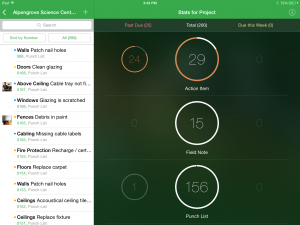
  • Newforma Tasks app (top right), which provides an interactive dashboard for assigning, reviewing, and updating project quality control tasks, such as work-to-complete and punch lists (aka defects management).
  • Newforma CaptureNewforma Capture app (right), which provides a single place for capturing project data, including text, photos (with markup) and metadata, as the user walks the site. By default, the app stores data locally until it is uploaded, enabling faster, more continuous data capture (more urgent items can also be uploaded immediately if required and if connectivity is available)
  • Newforma Project Email, which provides instant access – similar to the Newforma Windows client – to emails that team members have filed using Newforma Project Center.

Tasks and Capture are both available for iOS devices, with Android versions planned for later this year; Project Email is already available on both iOS and Android. Meanwhile, a new version of the (currently iPad-only) Newforma Plans app now allows users to create and locate field notes, punch list items, and action items on relevant drawings.

Create Link in Newforma PlansLast week’s preview let me see how quickly Plans could be rendered on an iPad, with a “treasure map” thumbnail giving context to any action items or markups that might have been created. Coloured pins help identify different items according to their status; a ‘Favorites’ feature allows users to create personalised lists of sheets that they use frequently, while – for cross-team use – a ‘hyperlink’ feature can be used to build relationships between different drawings for rapid access and cross-referencing (interestingly, adding hyperlinks is only available on the iPad, not on the desktop view).
New Project Cloud functionality

Since its acquisition of Attolist nearly two years ago, Newforma has been building more SaaS capability into its product suite, particularly to support users who may not be using the on-premise applications, and to support users of its field management mobile apps. In short, it is building a suite that provides a ‘single version of the truth’ for project users, helping eliminate duplication and data entry errors.

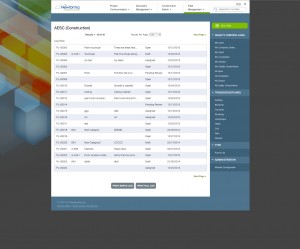
QCScreenShotAlongside Communications, Document Management and Construction Admin, a new tab has been added at the top of the browser-based tool to cover Quality Control processes (eg: punchlists, work-to-complete, non-compliance items, inspections) while the usability of the overall user interface has also been improved. Foremost among the improvements is a ‘spatial index’ activity centre which allows an administrator to define particular project spaces, making it easier for users to locate quality control tasks such as work-to-complete or non-compliance items.

Newforma Chief Executive Officer Ian Howell said the Newforma Project Cloud updates are just the latest in a roadmap of extended improvements to the overall Newforma PIM solution:

“Newforma Project Cloud provides project hosting in the cloud, where everyone on the project team can access RFIs, submittals, plans, and other key project information from a single source. Many customers have told us they’re slashing their submittals review cycles in half using Newforma Project Cloud. Now, with new capabilities for field management, the quality control aspects of the construction phase of project delivery can benefit from similar performance improvements.”

(If you are attending this year’s BIMShowLive in Manchester, UK, 23-24 April, Newforma is exhibiting on stand GS16.)

Update (19 May 2014) – For another review of these Newforma software updates, look at Lachmi Khemlani’s AECbytes article, Newforma’s Expanded Cloud and Mobile Offerings.

Permanent link to this article: https://extranetevolution.com/2014/04/newforma-extends-mobile-and-cloud-funtionality/

Conject Group revenues reach €20M

Germany’s ILM SaaS specialist Conject Group grows revenues 14% in 2013 to reach €20M (£16.6m) milestone.

ConjectMunich, Germany-based SaaS construction and real estate software vendor Conject has announced that it grew its revenues 14% to €20 million [£16.6m or $27.6m] in 2013. It also achieved some €25 million [£21m or $34m] in new orders. New customers included retailers Karstadt and ECE, manufacturer Caterpillar, and highways organisation E-Plus in Germany, Unicredit Bank, the ÖAMTC and the Post Office in Austria, the new FIFA 2018 stadiums in Russia, and – in the UK – London Heathrow Airport (Conject is being used by the team working on Terminal 2) and Birmingham City Council. I am told the group is profitable (“the focus is on increasing profitability”), but the group does not release specific profit numbers.

Ralf Haendl, group CEO, said:

Ralf Händl“The healthy growth of all regions in 2013 shows that the Architecture, Engineering and Construction (AEC) sector is recovering well worldwide, and that CONJECT strategy of growth through acquisition and internal investment is solving the collaboration needs of clients. In 2014 we will continue providing a comprehensive ILM offering especially the extension of our worldwide, location and time zone independent service as well as the extension of our portfolio through acquisition and partnership. We will focus on meeting industry needs including for mobile apps, SaaS and BIM solutions.”

The revenue growth keeps Conject comfortably ahead of its fellow Munich-based AEC SaaS technology vendor think project!, which grew its revenues 17% to €17.2m in the same period.

‘Hub’ growth strategy

Steve CooperI asked UK MD Steve Cooper about the results and he highlighted the expansion in infrastructure-related work: “In the late 2000s, I’d say 90% of our work related to buildings, but it’s now about 50%, with the other 50% associated with airports, highways, bridges and utilities,” he said. This expansion is not just in the UK, but in other regional markets; Steve highlighted orders in 2013 in New Zealand from energy and water clients (eg: Meridian and Watercare). He had also noticed a sharp upturn in the Middle East: “orders in Dubai were up 100% on the previous year” (Jumeirah Village was a recent project win there).
However, as a group, Australasia and the Middle East are not what Steve described as “hub markets”. Its key hubs are currently all in Europe: Germany, the UK and France, and from each of these hubs various satellite operations – Russia and Singapore, for example – are being developed with a view to them becoming hubs in due course. Conject has long experience of the Russian market through its work for clients Lendlease and Mace (it is working with the latter on a major urban development project in St Petersburg, for example), and while its southeast Asian operation is more recent, Steve said it is “growing rapidly”. The group will not be speculatively investing in new markets, he said.

BIM for ILM

Continuing to position itself as a provider of Infrastructure Lifecycle Management (ILM) services (it was using the term when I first interviewed company staff in 2009), Conject says it is expanding its portfolio of SaaS tools, mobile apps (it acquired French mobile business Wapp6 in late 2013 – post) and support for building information modelling (BIM).

It will also be starting a ‘soft launch’ in the UK of its SaaS FM application during Q2 of 2014 with a formal launch of the toolset in Q3.

A similar timescale is associated with the roll-out of its BIM capabilities, where the group is keen to differentiate itself by adopting an asset-focused perspective to BIM in line with its ILM ethos. Steve told me Conject has joined BuildingSMART and remains active on the BIM Technologies Alliance, and he attended a recent meeting hosted by BIM Task Group chairman Mark Bew where the UK’s journey beyond 2016 ‘Level 2’ towards ‘Level 3’ BIM was discussed. While many industry folk are focused mainly on BIM for design and construction (see his recent Conject blog post), Steve feels Conject’s ILM approach fits well with asset-centric approaches such as ‘Soft Landings’ and the long-term reuse of data throughout the operational life of a built asset.

Permanent link to this article: https://extranetevolution.com/2014/04/conject-group-revenues-reach-e20m/

McLaren releases FusionLive business intelligence portal

McLaren-logoMcLaren Software is building new BI and BIM capabilities into its FusionLive SaaS construction collaboration platform.

London-based SaaS construction collaboration and (since October 2012) CAFM technology vendor McLaren Software has released a new version of its FusionLive SaaS platform including a new business intelligence (BI) portal with some building information modelling (BIM) capabilities. According to the news release:

“The Business Intelligence (BI) portal will help deliver predictable, productive and profitable projects by providing quality data to support management decisionmaking and reduce process bottlenecks. In addition to a new BIM 3D viewing experience, the users will be able to merge two or more models as well as generate COBie compatible work sheets from models.”

McLaren Software has quietly seen a couple of management changes in recent months. Chief marketing officer Tim Taylor moved to Bentley Systems in late 2013, a new US-based marketing VP was appointed in October, and CEO Paul Muir now has a more strategic role in parent company Idox plc as chief strategy officer for the EIM (Engineering Information Management) division of the group. Former HP, Intergraph and – most recently – GL Noble Denton executive Peter Russell-Smith is the new CEO of McLaren Software and is quoted in the news release:

“Worldwide our SaaS customers build critical infrastructure and need real time meaningful information on their schedule.  The Business Intelligence Portal increases their visibility of real time project information enabling them to make informed decisions needed to stay on schedule.  We’re investing heavily in supporting management decision making, simplifying access to engineering documentation for the  mobile workforce, and building information modelling (BIM) capabilities integrated with McLaren’s computer aided facilities management (CAFM) solution.”

I’ve noted business intelligence becoming a recurring theme among the SaaS AEC collaboration vendors in recent years, as they’ve looked to move beyond their document collaboration roots. For example, capabilities were being developed in Conject’s UK division five years ago, and were eventually launched in January 2012 (post), Asite talked about business intelligence at its recent Adoddle 17 launch, it’s on the Viewpoint/4Projects roadmap too (post), and offered in the US by e-Builder too (post).

Permanent link to this article: https://extranetevolution.com/2014/04/mclaren-releases-fusionlive-business-intelligence-portal/

Load more