The UK Modern Built Environment Knowledge Transfer Network is seeking the opinions of members on design and decision tools for new buildings. Its questionnaire will help shape the Technology Strategy Board’s forthcoming call as part of its Low Impact Buildings Innovation Platform; information will be used to provide an insight into industry priorities in this area. Click here to take the survey.
Permanent link to this article: https://extranetevolution.com/2008/11/design-and-decision-tools/
Nov 21 2008
SaaS – software, service and trust
Courtesy of a news item on InternetNews.com, I learned that enterprises’ desire to offload costs associated with maintaining their own software or storage infrastructures doesn’t automatically mean a boom for Software-as-a-Service (SaaS) vendors. While the technology – the Software – is undoubtedly important, so is the Service. SaaS customers need to be able to trust their vendors.
The article talked about outages suffered by Amazon and how the problems these created for Amazon’s customers were exacerbated by the lack of Service Level Agreements (SLAs) and email support. I was surprised that such a well-known name as Amazon did not have SLAs in place. In the risk-averse industry in which I work – architecture, engineering, construction (AEC) and property – customers have, from the very earliest days, demanded written undertakings about their providers’ uptime, etc.
Selected quotes:
- “It’s important that companies try and exceed expectations and go the extra mile.”
- “It’s much easier to switch from a SaaS application than a normal application because you don’t have to pull out the application and replace it and test it and secure it.”
Permanent link to this article: https://extranetevolution.com/2008/11/saas-software-service-and-trust/
Nov 21 2008
BIM: What does it do for You?
Yesterday I attended a meeting in London of the Building & Estates Forum of Constructing Excellence. One of the topics discussed was the rise of the design manager and how building information modelling (BIM) could bring a dramatic change in this type of role.
I am sure some of these issues will also be explored at an event run by Salford University’s SCRI Forum next month. On 2 December, SCRI is holding a workshop entitled Building Information Modelling: What does it do for You? looking at the current state of BIM, how will it change over the next few years and what this could mean for industry practitioners. For further information, email Karen West.
Permanent link to this article: https://extranetevolution.com/2008/11/bim-what-does-it-do-for-you/
Nov 14 2008
EE in Dubai – yesterday
Some of my UK-based colleagues and friends have assumed that I must be on something of a Dubai ‘jolly’, but that’s a long way from the truth. Perhaps because I was on a short, intensive visit, I started Thursday with an early meeting then jumped into a taxi to get to the next meeting – a process I repeated twice more without stopping for lunch. So, by 3.30pm, I was starving hungry and ready for a restful evening. Except that I had the Gulf States Building Awards dinner to attend.
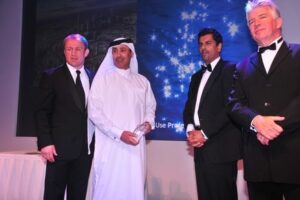 However, it was an excellent event. Translating an industry dinner from a UK context to Dubai meant a few changes, mainly regarding the serving of alcohol (those tables that wanted it could order wine once the event was under way) and the choice of comperes (Shiulie Ghosh and David Foster from TV network Al Jazeera – Shiulie is ex-BBC, of course). And while many in the audience were UK expatriates, the sporting celebrities (England rugby union internationals Will Greenwood, Neil Back and Jason Leonard) will probably have been completely unknown to some of the locals – judging from the local newspapers I’ve read during my stay perhaps cricket stars might have been better.
After the dinner, many of the guests quickly disappeared, which was a shame as Building had laid on some post-dinner entertainment (the wandering magician was fantastic!).
(I am writing this blog post using free wifi in the newly-opened Terminal 3 at Dubai International Airport.)
Update (17 November 2008): The Gulf States Building Awards are covered here, and you can read the shortlist and the citation for the Downtown Burj Dubai project that won the BIW-sponsored “Mixed use project of the year” category here.
Permanent link to this article: https://extranetevolution.com/2008/11/ee-in-dubai-yesterday/
Nov 11 2008
EE in Dubai – first reflections
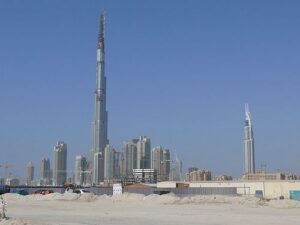 I have been in Dubai 48 hours now and have really enjoyed learning about working here. It’s a steep learning curve, though, as the sheer number and scale of the construction programmes currently under way is way beyond anything I’ve ever seen. Dubai has numerous developments that, on their own, are each already way bigger than London’s Canary Wharf and yet are being built in a fraction of the time. Some of the buildings themselves are simply breathtaking. The Burj Dubai tower, in particular, dominates the skyline and is one of the features I use to keep myself oriented as I travel around.
It’s not just buildings, of course. To meet the needs of the growing population that will live, work and shop in these new buildings, new infrastructure is also being constructed at a furious pace. Viaducts and stations for the new Dubai metro now stretch alongside the main thoroughfare, Sheikh Zayed Road, for example.
The intensity of some construction activity is also very different to most of UK experience. I am staying in a BIW apartment close to the existing Dubai World Trade Centre, and construction of an immense new Centre alongside is going on round-the-clock – I hear the clatter of drills as I go to sleep and wake to the gentle tweeting of moving heavy plant (no Considerate Contructors Scheme here)!
Speaking of tweets, I’ve been using Twitter to post occasional updates and to get news from my favourite Twitterati, including construction news from Contract Journal and the Building Twitter feed which I discovered just before I travelled to Dubai (but not NCEmagazine of course!). I’ve also used Twitpic to post a couple of photos (useful as in Dubai I can’t share them via Flickr), and then reused these in my first Dubai post. Given that I haven’t had time to read a newspaper or watch television, my RSS feeds have been great for keeping in touch with key developments back in the UK and more locally (eg: today’s FT story: Major Dubai developer cuts 200 jobs (also reported by Building here)- shows that even the UAE is not immune from the worsening global market). And there’s lots of free wifi access – I watched people in a shopping mall earlier this evening going online while munching their McDonald’s.
Update (18 November 2008): Just checked the NCEmagazine Twitter feed. It stopped updating on 20 October, three days after the last tweet from @CNPlus. Have Emap given up on Twitter?
Permanent link to this article: https://extranetevolution.com/2008/11/ee-in-dubai-first-reflections/
Nov 10 2008
EE is in Dubai

 I am in Dubai – a real hive of activity for construction – all this week, visiting various BIW projects and customers, and will be blogging about it all shortly.
Permanent link to this article: https://extranetevolution.com/2008/11/ee-is-in-dubai/
Permanent link to this article: https://extranetevolution.com/2008/11/beware-of-the-trolls-2/
Nov 07 2008
Show Us A Better Way – finalists
I have blogged before about the Power of Information Task Force (a UK Cabinet Office initiative) and its Show Us A Better Way competition, which attracted 100s of entries. Well, The winners shortlist has been announced in the Guardian (see also the Free Our Data blog), and the ultimate winner will be announced on BBC Radio 4’s iPM programme tomorrow (my personal favourite is UK Cycling, though I also like the Roadworks API idea).
(Update (11 November 2008): the winner was Can I recycle it?)
By the way, the Google Project 10 to the 100th competition apparently received over 100,000 ideas, with voting on a shortlist due to begin on 27 January 2009.
Permanent link to this article: https://extranetevolution.com/2008/11/show-us-a-better-way-finalists/
Nov 04 2008
Recession and the construction SaaS providers
The R-word has arrived. In his Brickonomics blog, my good friend Brian Green today talks, not for the first time, about “the recession in construction”, which he says “is looking increasingly desperate as the giant commercial sector appears to be heading for a nasty fall”.
Earlier this year, like many industry people, I was hopeful that the economic downturn would mainly affect the housing sector – I did, for example, point out the potential impact on businesses like Autodesk’s Buzzsaw considering a focus on the UK housing sector (see 4 June post Autodesk UK house-building research). However, as Brian suggests, the malaise seems much more wide-ranging, and I think it could well extend into the businesses providing IT services to the construction industry.
There are already signs this is happening. For instance, today (reports WorldCAD Access), Autodesk released preliminary Q3 figures with CFO Carl Bass saying: “The sharp downturn of the global economy is substantially impacting our business. Demand for our products fell dramatically in October in all geographies as the financial crisis worsened.” Customers are having difficulties in getting credit, projects are being delayed, and the strong US dollar isn’t helping. Q3 revenues are forecast to be down on the previous quarter, with “cost cutting to begin immediately” (see also news release).
Of course, Autodesk doesn’t only operate in the architecture, engineering and construction (AEC) sector, but a large proportion of its revenues come from that space. Also, the majority of its revenues are for conventionally-delivered software, often with significant upfront license fees, not Software-as-a-Service (SaaS) where costs can typically be spread over the period of software use (as well as Buzzsaw, Autodesk also owns SaaS construction player Constructware).
Nonetheless, if a global industry player is seeing signs of a recession impact, it is likely that others will do the same. The rosy forecasts for SaaS growth earlier this year (eg: SaaS market “to undergo very rapid revenue growth” (Ovum in May); McKinsey talks up SaaS again (April); SaaS on the rise in Europe (IDC in April)) were written before the recent global banking crisis, and while I believe that construction-oriented SaaS is likely to prove more resilient than conventional IT in a downturn (see Web-hosted software on the rise), vendors in this space will not be immune.
For a start, as Brian Green points out, it is no longer just the housebuilders that are feeling the pinch, UK commercial developers are also suffering, and a similar recession to that of the early 1990s could see £10 billion worth of work disappear, particularly in private offices and retail, and this could have a profound knock-on effect on contractors and project managers – all key markets for the leading UK collaboration vendors.
Enlightened organisations like Constructing Excellence have been warning against a knee-jerk return to lowest cost procurement. If adopted, such approaches will, I’m sure, also extend to the procurement of web-based collaboration tools. Customers will be even keener to get the time, cost and efficiency savings arising from using the tools but will not be prepared to pay the previous market rates, and may even skimp on vital consultancy or training support resulting in less effective (and ultimately more costly) deployments.
A word of warning, though, to those contractors looking to boost their low tender price by whacking in lots of sometimes spurious claims: the secure audit trails built into most of the leading solutions provide a detailed record of who did what and when, potentially heading off expensive (profitable) litigation.
Due diligence will also assume greater importance. Similar to the gloomy months after the dot.com bubble burst, potential customers will want to be sure that their chosen service provider is going to be around for the duration of their project(s) and will need to look much more closely at the financial resilience of the vendor. The leading UK vendors – eg: [my employer] BIW Technologies and 4Projects – are today profitable businesses, generating significant revenues from a broad range of customers (including non-UK clients), and have good forward order books; they also have solid managerial experience gained from weathering the 2000-2002 era of dot.com doubt. Some of the other vendors, though, may be reliant upon smaller, perhaps less internationally diverse portfolios, and could have less headroom in their accounts to withstand either a prolonged downturn or significant downward pressure on fees.
I expect the impressive growth rates (eg: Business Collaborator grows 20% in 2007; Asite finally returns to growth (26%); 4Projects turnover up a third; BIW grows 24% in 2007) achieved by some of the leading construction collaboration technology providers up to 2008 will slow significantly. If the broader industry projections about this possibly being a two-year UK dip are correct, then these vendors may have to extend their efforts to more buoyant overseas markets (BIW is winning work in Dubai; 4Projects is opening offices to serve the north American oil and gas market; Australian provider Aconex has a very widespread international network of offices) or on winning work in sectors of the UK construction economy – the London 2012 Olympics programme, CrossRail, public sector investment in schools, hospitals and social housing, etc – that are more immune from the recession.
Permanent link to this article: https://extranetevolution.com/2008/11/recession-and-the-construction-saas-providers/
Oct 29 2008
Building webinar experience
I sat through a webinar hosted by UK trade magazine, Building, earlier today. Entitled Improving Business Efficiency in a Tough Economic Environment, it featured a presentation by Steve Masters of BT, and was chaired by Ray Crotty of C3 Systems (formerly of Bovis). Reflecting Steve’s role at a telecoms giant, most of his talk was focused on ICT – lots of talk about service-oriented architecture, SaaS and the like – and wasn’t particularly specific to the needs of people working in the construction industry. However, that apart, I had some other minor niggles.
- Firstly (more of a micro-niggle really), in the run-up to the event, I received emails saying the event was due to start at 12.00 BST – in the end, it started at 12.00 GMT.
- The webinar interface (On24.com) was quite sparse in terms of the information it presented (basically, a Powerpoint screen, a small video screen, a field to ask questions or make comments, and a few buttons to view or download background information or slides. Some may like such simplicity, but I like to feel part of a group when I attend the event. There was no indication of how many people were watching, their backgrounds or interests, etc (OK, some may not have wanted to expose their details, but it would be good to ‘see’ those less reticent).
- Having run some BIW webinars earlier this year, I know that some web-conference tools (eg: WebEx) allow presenters to poll the audience and present the results in graphs; there was no two-way communication of this kind to help us feel we were engaged with or helping shape the event.
- I wasn’t particularly motivated to ask questions but I live-blogged via Twitter during the event – partly to see if anyone else I knew was also online (the only related Tweet I saw was from Building‘s web editor!). At Be2camp 2008 earlier this month having a live Twitterfeed allowed live and virtual attendees to share comments, notes and links and to ask questions.
- Finally, it wasn’t clear if a video of the event would be shared online (eg: via YouTube) where those unable to attend live could view it, comment on it and embed/link to it.
I believe Building is looking to do more online events in future and wants to develop a more Web 2.0 approach to them. GMT aside, I hope these suggestions may help.
Permanent link to this article: https://extranetevolution.com/2008/10/building-webinar-experience/

 nima’s That Information Management podcast
- That Information Management Podcast - talking about the circular economy with Paul Toyne
- That Information Management Podcast - on artificial intelligence and construction, with Rene Morkos
- That Information Management Podcast - nima virtual conference 2023
- That Information Management Podcast - on social housing and neurodiversity with Charlotte Bates
- That Information Management Podcast - talking diversity with Mark McBride-Wright
- That Information Management Podcast - building safety with Dame Judith Hackitt
- That Information Management Podcast - LIVE at DCW 2023
- That Information Management Podcast - We have a new member of the team!
- That Information Management Podcast - LIVE at UK Construction Week!
- That Information Management Podcast
AEC TECH TV