BIMStore revamps

bimstore2019 logoUK-based BIM object library bimstore launched its new version 4.0 at an event at the Rocketspace venue in Islington, London yesterday (17 January 2019 – news release).

Originally launched in 2011 by Newcastle-based architectural practice Space Group, bimstore claims to be the UK’s largest manufacturer-specific BIM library, and sits alongside the group’s consultancy business, BIM Technologies. The platform was rebuilt in 2013 when the platform was being used by 70 manufacturers to host over 2000 objects, and had some 10,000 registered specifiers using the site (access is free to specifiers), who had completed 400,000 downloads since launch. Like other providers in the product library field, Bimstore’s business model is based on manufacturers paying an annual hosting charge; manufacturers can also commission the business to create their BIM object content.

The product library landscape

This has become a competitive marketplace with Newcastle neighbours NBS’s National BIM Library and SpecifiedBy (posts) also up against Sweden’s BIMObject, Cobuilder’s GoBIM from Norway, the US’s SmartBIM, BIM&Co from France and MagiCAD Cloud from Finland, among others, as well as manufacturers’ own object-hosting websites. In October 2017, BRE announced its DataBook project, set to launch in 2018, linking BIM objects to fixed manufacturers’ data sources.

UK BIM Alliance product data reportIn October 2018, the UK BIM Alliance industry organisation published a State of the Nation report, A fresh way forward for product data (PDF). Written by a group chaired by Su Butcher, this highlighted issues including the lack of a commonly agreed standard for digital product data in the UK or in Europe, the need for ‘a golden thread’ to manage product data through the project lifecycle, and problems with how product data is currently hosted and managed. On this last point, it particularly noted how the different hosting companies each had slightly different ‘standards’ for object creation, which were not all aligned with each other. The report recommended that manufacturers’ product information management (PIM) databases should be linked (ie by API) to any company hosting their information, enabling manufacturers to manage one database with all other information automatically linked – ie a “single source of the truth”.

bimstore 4.0

Rob CharltonBimstore founders Rob Charlton, left, and Adam Ward presented the new version to invited guests at Rocketspace, noting the retirement of ‘Ermintrude’, the brand’s yellow cow mascot, and its replacement by a new dynamic logo (the one above is just one of over five million variants). Charlton said the new bimstore, developed over 14 months, aimed to break down silos between specifiers and manufacturers, encourage collaboration, and champion better ways of working. It also aimed to meet the recommendations of the post-Grenfell Hackitt Review for a more rigorous digital ‘golden thread of building information’.

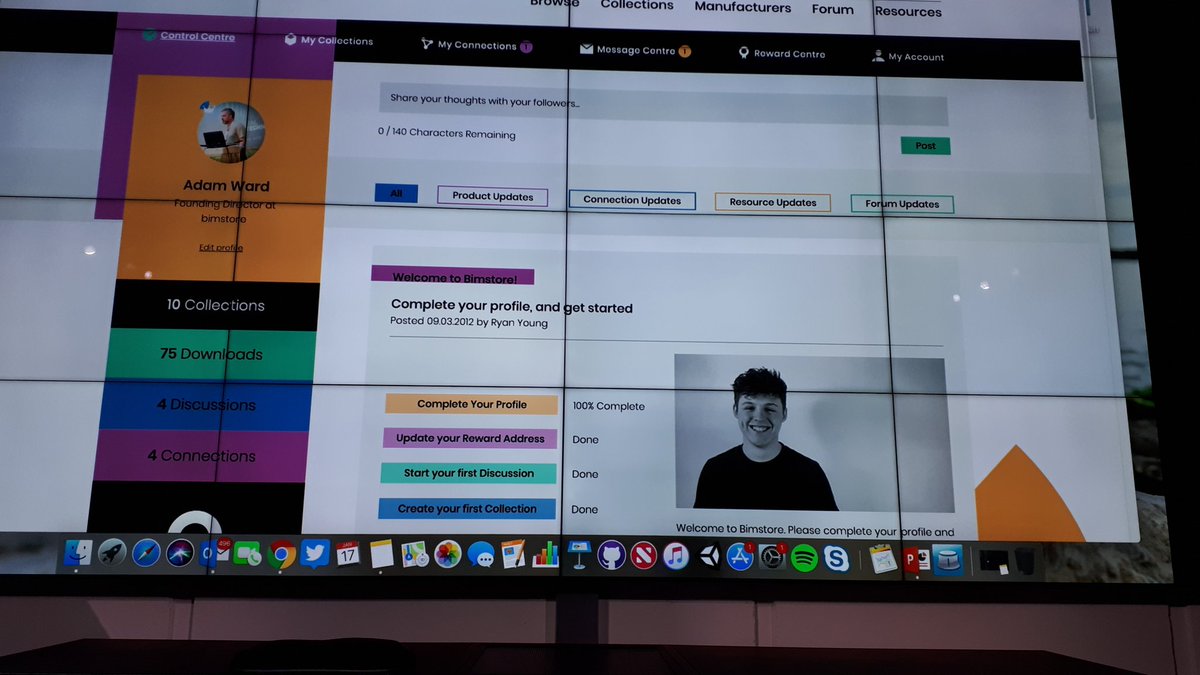
Aspects of the new site’s operation resemble familiar social media platforms such as LinkedIn, with abilities to create personal profiles and to connect to and message individual users, and so build communities, both generic and specialist. In a live demo, Ward showed “curated collections“: bundles of content (either private or public) created within bimstore to support particular communities or specialisms – temporary works, retro furniture, etc. The platform also offered a few gimmicks to encourage communication and engagement – t-shirts, special status (“pineapple”, “veteran”) for users of the site’s discussion forum, etc.

Adam WardManufacturers can log into the platform and view real-time activity feeds and metrics (the number of times their objects have been viewed or downloaded, their top products, top search terms, etc). Ward demonstrated the bimstore Data Manager showing how easy it was to edit metadata and to create new variants of objects in the system. Importantly, the platform can be connected via an API to a manufacturer’s own website, PIM application or platform – fulfilling that UKBIMA recommendation for a ‘single source of truth’. API interfaces also enable data downloads from bimstore into a manufacturer’s CRM system – potentially, a powerful aid to product sales and marketing teams. New-look bimstore also now has ‘apps’: modular 3rd party integrations with bimstore partner solutions.

Particularly interesting from a project collaboration and whole life value perspective, Ward said bimstore’s development roadmap includes integrations with project ‘endpoints’ so that manufacturers might connect in real-time to specific instances where their products have been installed and are now operated as part of built assets.

Permanent link to this article: https://extranetevolution.com/2019/01/bimstore-revamps/

BIMtech provider Opentree acquired by Graitec

UK-based document and BIM process management software developer Opentree has been acquired by Graitec.

Opentree logoTeesside, UK-based Opentree, a provider of enterprise document management solutions, has been acquired – for an undisclosed amount – by France-based Graitec, an Autodesk reseller and developer of BIM, fabrication and design software (it has a UK office in Southampton). Opentree’s software portfolio includes a PAS 1192-compliant BIM workflow solution, Cabinet (May 2017 post), widely integrated with several providers of common data environments (CDEs), including Oracle Aconex, Business Collaborator, Viewpoint (October 2017 post) and Autodesk’s BIM360 Docs.

Cabinet logoCabinet supports the in-house “work-in-progress” phase of BIM authoring, prior to designs being shared with the client’s wider project team. UK BIM expert Mervyn Richards worked with the firm to ensure it supports the BS1192:2007 processes required at Level 2, with Cabinet helping compliance through automated file naming and seamless upload to the client’s CDE.

Practices and businesses with a further requirement to publish project data externally to a hosted environment are then often faced with the challenge of interfacing with  multiple CDE vendors. Opentree’s Cabinet enables firms to manage internal documentation and model information locally throughout the project lifecycle and then publish to CDEs of their – or the principal contractors’ – choice, as and when a particular project dictates. A Software-as-a-Service version of Cabinet has been in development and this will continue.

Along with engineering client businesses such as Sellafield and TSP Engineering, UK AEC customers include UK contractor NM Group, offsite construction specialist Fusion Building Systems, and the Purcell design practice.

Graitec view

In the company’s announcement, Graitec president Francis Guillemard says:

Graitec logo“this acquisition will be pivotal in helping our customers with the day to day management of their project documentation from initial conception and tender, through to project delivery.”

Steve Houlder, Graitec COO says:

“The BIM market and the BIM for Manufacturing market is growing at a rapid rate in many countries. One of the major difficulties faced by our customers at all levels from housing development through to capital projects, is the management of data from project conception to the start of the collaboration phase, ensuring data consistency and adherence to standards being one of the most important topics. With Opentree we can address this growing issue for many of our customers, aligning Graitec and Autodesk technologies.”

 In September 2018, Graitec launched its BIMUP programme, offering customers tailored implementation and training support in deploying BIM. Opentree’s Cabinet would seem to be a strong addition to this offering.

Opentree view

Opentree MD Andrew Frank says:

Andrew Frank“By joining Opentree and Graitec, our customers will further benefit from being owned by a company with a long history in design and collaboration, who have the skills and expertise to push Opentree even further into the market of W.I.P. management, We see this a key strategy for all customers to manage this process better than they do today.”

Graitec says it will now offer data management and W.I.P. management to customers who have been trying to solve the problem. By helping them adhere to data standards, deliver consistency, conform to both BS1192 and the upcoming ISO19650 BIM standards, Graitec claims it will be at the forefront in helping customers manage their data and projects effectively enabling them to achieve  time and cost savings, as well as improving internal and external data quality processes.

[Disclosure: Opentree has been a client of pwcom.co.uk Limited since July 2017. This post is not part of its work for the company.]

Permanent link to this article: https://extranetevolution.com/2019/01/opentree-acquired-by-graitec/

Deltek acquires Avitru

Deltek has expanded its software offering to architectural and other design firms by acquiring US-based Avitru, a deal which brings with it an ongoing commercial partnership with the US architects body, the AIA.

Deltek logoIn yet another consolidation in the architecture, engineering and construction software space, Deltek, the ever-acquisitive Virginia, US-based ERP software vendor, has bought (for an undisclosed amount) another US-based business, Avitru (formerly also known as Arcom).

The deal complements Deltek’s acquisition of UK-based practice management software specialist Union Square in July 2016, which enhanced Deltek’s reach into professional design practices and small contracting firms, particularly in the UK and Australasia – a sector also targeted by firms such as the UK’s Cubic Interactive (with its Rapport3) and CMAP, plus Australia’s Total Synergy, who launched its latest Enterprise solution at Digital Construction Week in London in October 2018 (post).

Avitru

Avitru logoAvitru, based in Atlanta, Georgia, is a developer of building specification systems, including including MasterSpec (a product of The American Institute of Architects), SpecText, SpecBuilder Cloud and e-SPECS. Deltek’s announcement says the acquisition expands its offerings for the AECO industry by bringing in more resources, capabilities and expertise. Avitru CEO Jim Contardi says:

“Avitru’s mission has been to empower architects, engineers, contractors and owners to make better, faster decisions. Now, with Deltek, the incredibly powerful combination of our solutions will give architects even more tools to design, build and operate in a better built environment. Avitru couldn’t have found a better home!”

Interestingly, Avitru has a strategic partnership with the US professional membership association, the AIA – a 93,000-strong body representing architects. The AIA created MasterSpec some 50 years ago to support the development of accurate specification documents for construction projects. Deltek will continue Avitru’s partnership with AIA.

This relationship between a professional association and a technology provider echoes that of the UK’s RIBA and Newcastle-based NBS. The latter was the trading name of RIBA Enterprises, providing specification information resources, and a range of software tools including the National BIM Library, the NBS BIM Toolkit and the NBS Online Viewer. Its latest software development was a cloud-based platform incorporating specification and BIM standards: NBS Chorus, launched in August 2018.

Two months earlier, however, the RIBA announced it was selling a £31.8 million stake in RIBA Enterprises, to LDC, the private equity arm of Lloyds Bank (read Architects’ Journal report). LDC and RIBA both hold significant minority stakes, with NBS’s management holding the remainder of the business’s shares.

Permanent link to this article: https://extranetevolution.com/2019/01/deltek-acquires-avitru/

A first look at ACCA’s usBIM CDE

usBIM is a cloud-based BIM collaboration platform or common data environment (CDE) from Italian software developer ACCA, set to be launched in 2019.

ACCA

ACCA logoBased in Italy, about 40km east of Naples, ACCA is a software developer specialising in applications for the architectural, engineering and construction industries. Founded in 1989, it has been  developing solutions for wide range of construction industry needs, and now has over 90 solutions in its portfolio. These range from architectural design, bills of quantities, structural design and analysis, maintenance plans and facility management, to health and safety, energy efficiency, scaffolding, technical systems engineering, fire prevention, renewable energy and office management. A member of BuildingSMART International, ACCA claims to have the largest number of IFC-certified BIM software solutions in the world.

ACCA’s main architectural design authoring tool is a BIM application called Edificius. Unlike some well-known industry solutions, this is available on a convenient Pay-As-You-Go monthly plan for €59pcm, or on an annual license subscription plan for €599/year. There are also variants of Edificius for landscape and MEP design use. Like its fellow European design authoring software vendor and BuildingSMART member, Bricsys (posts), ACCA has also been developing a cloud-based collaboration solution.

usBIM

usBIM environmentComplementing Edificius and other locally installed products will be usBIM, a cloud-based BIM management platform. Currently undergoing final auditing and testing ahead of a 2019 launch, usBIM will provide a CDE (Common Data Environment) and enable direct online interaction with model-related objects, data and documents.

In keeping with ACCA’s open standards/BuildingSMART ethos, usBIM allows users to build and manage entire models using open formats (IFC, PDF, XML, etc) rather than proprietary ones. usBIM users can interact with the platform anywhere, anytime and from any device without having to use any proprietary software.

usBIM screenshotThe core platform functionality is supported by a browser tool (usBIM.browser) and by a project management application called PriMus (through which users can can “share and exchange documents in open formats such as XML, PDF, JPG, etc. and able to guarantee full authenticity, security and source of the data…”). The core cloud solution stack comprises:

  • usBIM.viewer+ – a plug-in that simplifies communication between the different collaborators on the platform, enabling them to view IFC files of 3D virtual models from BIM software such as Edificius®, Revit®, ArchiCAD®, Allplan®, Tekla®, VectorWorks® and others … without the need for the native BIM software. Multiple IFC files can be combined in a single view, to simultaneously view all the design aspects in an integrated way.
  • usBIM.gantt – a plug-in for project management, scheduling and 4D time simulation of the whole construction process. Project managers can assign a time-line related property to each component of the BIM model in IFC format to see the entire construction process.
  • usBIM.clash – a BIM clash detection plug-in that can be integrated with the usBIM.platform and with other ACCA software BIM authoring software and tools, and which allows users to check and manage conflicts between federated IFC BIM models.
  • usBIM.code – a BIM code checking plug-in that allows control and validation of the IFC model with regard to standards and procedures outlining the scope of the project requirements.

ACCA’s Tony de Palma says usBIM is hosted in Europe: “The service is hosted using two servers in the EU territory, with data storage and processing all undertaken exclusively within EU territories. The service infrastructure follows the CISPE (Cloud Infrastructure Services Providers in Europe) code of conduct, and incorporates data protection systems in line with the EU General Data Protection Regulation (GDPR).”

The usBIM.Platform CDE has been tested by various Italian local authorities including the Provveditorato ai Lavori Pubblici di Lombardia & Emilia Romagna. De Palma says subscription fees for the service have yet to be finalised but are, at least initially, likely to be based upon a single administration fee, with no limit on number of users or number of projects.

Permanent link to this article: https://extranetevolution.com/2018/12/a-first-look-at-accas-usbim-cde/

Procore closes US$75m funding round

Procore logoCarpinteria, California-based SaaS construction technology provider Procore has announced that it has closed a $75 million funding round led by Tiger Global Management (in October 2018, Tiger Global raised $3.75bn for its latest VC tech investment fund, surpassing its initial target of $3bn – FT).

This round, which values the company at $3 billion (up from $1bn in 2016 when it  could initially claim “Unicorn” status) will be leveraged to support product development, partner platform expansion, and continued investment in hiring and developing top talent. Tooey Courtemanche, Procore founder and CEO said:

Tooey Courtemanche“At Procore we’re committed to delivering products and solutions that improve the lives of everyone in the construction industry, so we will continue to invest in the core areas of our business that have direct positive impact for our users. We believe business drives culture, and culture drives business. This investment round will allow us to advance product innovation, expand on the largest partner and developer ecosystem in construction technology, and continue to hire and develop the best talent to support our mission and vision.”

The company says it currently has over 1,300 full-time employees working across 12 offices around the globe, and will exit the year with more than 5,000 customers on projects in over 100 countries.

This latest funding adds to a series of successful rounds totalling around US$180m (including four rounds in 2015 and 2016), that has enabled Procore to expand internationally, including into Australasia and more recently into the UK, and to fund acquisitions – in September 2018, Procore acquired another California-based firm BIMAnywhere, a visual BIM collaboration platform for construction and facilities management (news release).

[Disclosure: I have written occasional freelance pieces for Procore’s Jobsite.]

Permanent link to this article: https://extranetevolution.com/2018/12/procore-closes-us75m-funding-round/

Plangrid Connect launched

Plangrid logoSan-Francisco-based provider of SaaS construction productivity software Plangrid (set to become part of Autodesk) recently announced the launch of PlanGrid Connect: an out-of-box, no-code platform, which gives teams the flexibility to create custom integrations and enables real-time access to critical data with any application. In parallel, updates to the Plangrid API allow information entered in Field Reports and Tasks to be exchanged between apps, and new pre-built integrations enhance how safety records, RFIs and 3D files are shared to and from PlanGrid. The company is running webinars, in partnership with its integration services provider Azuqua, in January 2019 to talk further about the development.

Easily configurable integrations

Building on an existing set of direct integrations between PlanGrid and other popular solutions like Autodesk Revit, Kahua and EarthCam, PlanGrid Connect enables construction companies to easily integrate with more than 100 other applications. Powered by Azuqua, PlanGrid Connect gives customers out-of-the-box connections to systems such as Box, Egnyte, Smartsheet and DocuSign. With a simple drag-and-drop interface that eliminates the need for expensive custom software development, customers can build PlanGrid integrations tailored to fit the specific needs of their business in minutes.

For example, with PlanGrid Connect, a DocuSign integration allows signed documents to be saved and organized in PlanGrid so they can easily be found and referenced during inspection walk-throughs. An automatic sync between PlanGrid and a cloud storage platform can also be scheduled — plans and documents stored in Egnyte or Box can be automatically pushed to PlanGrid and project data can be archived back to the cloud storage platform.

PlanGrid expands APIs

New PlanGrid API endpoints allow information entered into Field Reports and Tasks to be exchanged between and viewed in other technology applications. The API endpoints enable customizable integrations with dashboards, trackers, project management tools, data analytics services, cloud storage platforms and more.

For example, an integration between PlanGrid and Smartsheet can map the project schedule directly to PlanGrid Tasks. When an office user such as a Project Engineer updates Smartsheet, the corresponding Task in PlanGrid will automatically sync and update, allowing a field team to know exactly what they need to do and when.

(The Plangrid Connect announcement (here), which was also briefly discussed by Plangrid’s Amit Puri at COMIT‘s community day in London on 6 December 2018, reminds me of a flurry of ‘Connect‘ announcements in 2014: Aconex launched its Connected BIM service in October 2014, the same month that Trimble Connect was launched, after which Bentley Connected with Trimble. Newforma launched its cloud services Connectors in September 2016 – including a connector to Plangrid, which is also integrated with HoloBuilder [see previous post].)

Permanent link to this article: https://extranetevolution.com/2018/12/plangrid-connect-launched/

360° developments from HoloBuilder and Panono

HoloBuilder launches SiteAI progress control

HoloBuilder LogoHoloBuilder, San Francisco-based provider of 360° reality capture for construction sites, is adding an Artificial Intelligence solution, “SiteAI”, to automate  progress control. The solution (released at Autodesk University 2018 in November) uses computer vision and deep learning to analyze materials, objects and structures captured in 360° imagery data on the HoloBuilder platform. SiteAI allows for automation of construction processes, especially focused on progress tracking.
 
HoloBuilder SiteAI ProcessAutomated progress control calculates progress reports without additional effort from capturing weekly 360° progress photos. The progress can be automatically tracked, analyzed and compared to the planned schedule to detect discrepancies as fast as possible. When SiteAI is implemented across projects, it allows processing progress payments faster, knowing the quantity for specific materials, comparing construction progress to schedules and much more.
 
SiteAI has been developed in collaboration with US Hensel Phelps – also a collaborator in developing HoloBuilder’s 360 Documentation solution (July 2017 post), available in Europe. With tens of thousands of 360° images captured, Hensel Phelps has been actively piloting HoloBuilder’s Computer Vision algorithm to automatically analyze the work put in place by location. Will Plato, VDC Manager of the Southwest District at Hensel Phelps said:
 
“The partnership that Hensel Phelps has created with Holobuilder is built around their understanding of our jobsite photo documentation process and how their solution brought immediate improvements and efficiencies to our people. Their capability to do more with data through the development of SiteAI brings additional value and analytics to our construction scheduling and execution. I am excited about the future as the possibility of bringing data silos to an end is truly going to be obtainable.  They are letting us document the landmarks of today so that we can construct the reality of tomorrow.”
 
SiteAI is in an early-access program stage for selected customers with the company asking more customers to join the waitlist. It will be accessible to HoloBuilder users in early 2019.

Panono

Panono 360 cameraI don’t know what devices are used to provide imagery to Holobuilder, but I recently saw a novel reality capture tool: a 360° camera from Germany-based Panono was demonstrated at the recent COMIT community day in London. The ball-shaped device has 36 cameras which trigger simultaneously to capture their environment in a spherical panoramic photo. With a total resolution of 108MP it is the highest resolution 360° camera on the market.

Panono provides a cloud-based, fully-automated hosting environment in which images (‘spheres’) can be stitched together in minutes, and viewed using Panono’s viewer software. Spheres can also be downloaded as high resolution JPG files (16k Equirectangular) for VR application or analog use. Panono logoThe camera costs €2141 (including VAT and shipping – c. £1931 or US$2441) but a November special offer dropped the price by 25% to €1545.

Permanent link to this article: https://extranetevolution.com/2018/12/360-developments-from-holobuilder-and-panono/

The future of project controls

Several innovative companies in the field of project controls have come together at an event (organised by Phil Shatz) at the Little Ships Club by the River Thames in London. Presentations are scheduled by InEight BASIS, ShapeDo, Aphex, Sablono, BuildSafe, Turbo Chart, Resolex, BuiltIntelligence, Chase, and Th3rdCurve. I will be live-blogging from the event this afternoon.

InEight BASIS

InEightBASIS logo(2.05pm GMT) – Dr Dan Patterson (InEight) has focused on project controls for past 20 years, and believes most projects fail due to poor planning, not poor execution. BASIS is a planning assistant, sitting alongside existing tools such as Primavera P6 or MS Project, complementing critical path management (CPM). It uses “augmented intelligence” – BASIS makes suggestions as users develop the planning process – and then “Human intelligence” – where team members apply their opinions as markups to the plan which are then subject to discussion and consensus development. Patterson talked about BASIS’s context-aware inference engine, plan templating, and normalising knowledge using tags, and machine learning. Collaboration with field experts is enabled via  a simple scorecard which registers whether individuals buy-in or push-back against the plan.

Resolex

Resolex logo(2.15pm GMT) – Tony Llewellyn of Resolex presented about optimising complex construction projects, focusing on behavioural theory as well as technology. Project Intelligence combines social, technical and commercial elements, he says – “it’s important not to forget about the people (who don’t always behave in a rational, sensible manner).” Llewellyn talked about the importance of early warning signals (EWSs) – signals or indicators of future developments – which organisations are often very poor at identifying, or optimistically believe will sort themselves out. There are few mechanisms to identify EWSs – so Resolex’s tool RADAR is used to help identify issues using a web-based questionnaire created specifically for each project, and which is usually deployed at monthly intervals. It creates a safe environment to provide feedback, and lets organisations take action before issues turn into crises.

Aphex

Aphex logo(2.30pm GMT) – Carlos Adams presented Aphex Planner (a platform I covered in May 2018), describing industry issues and the recommendations of the Farmer report Modernise or Die.  We have to innovate, Adams says, but do it within existing practices, encourage lean thinking, have tools that are simple to use and which provide actionable data, and which treat users as customers. Aphex Planner, based on Last Planner thinking, aims to help make users lives easier, to deliver project efficiencies, and to provide companies with insightful data. Aphex identified that most current short-term planning methods are inefficient, relying on tools that aren’t fit for purpose. Adams did a rapid presentation of the platform – the latest release, with new features, was pushed out today, he said – and includes tools to manage resources such as construction plant, and reporting dashboards. Positive testimonials from Network Rail, Hinkley Point and HS2 were shared.

Sablono

Sablono logo(3pm GMT) – Lukas Olbrich presented on behalf of the Berlin-based construction progress monitoring vendor Sablono (which I’ve seen exhibited at Digital Construction Week in recent years), founded in 2013. Like Aphex’s Adams, Sablono is born out of frustration that many construction folk still tend towards pen, paper and sticky notes rather than technology. Project management remains focused on time, quality and budget – mainly using spreadsheets and Gantt charts, but new technology can help us, Olbrich says. Sablono aims to help project supply chains know what they need to do next. The platform shows different levels of programmes, long and short range, and provides real-time reporting dashboards covering tens, even 100s, of thousands of activities (a Mace project in Greenwich, southeast London, had 150,000 interdependent and overlapping activities, for example). Project insights that used to take seven days could now be gained in a few hours; team meetings dropped from 40 minutes to 15 minutes (YouTube video – updated 6 June 2021).

BuildSafe

BuildSafe logo(3.15pm GMT)BuildSafe is a mobile tool for safe and efficient construction projects, said founder and COO Sam Jaeger (former Textura Europe executive Paul Bamforth is currently an advisor; post). It is a Swedish company established in 2015, and aims to involve all parts of the supply chain in gathering data to solve problems on site so they don’t affect productivity. Sweden’s high tax regime encourages businesses to become more efficient and improve their margins, Jaeger says, and BuildSafe focuses on field issues – the three Ps: people, process (“our processes are killing us whilst creating little or no value”) and purpose. The platform comprises a web platform and a user-friendly mobile app used to report observations, risks and accidents in the field. Ambitiously, it was first deployed on the £600m Urban Escape project in central Stockholm – it was used by 300 people; there were around 120 inspections every month, risks were reduced on average by 80%, and improved reporting to the whole supply chain – all achieved by creation of 250,000 data points.

Turbo-Chart

Turbo-Chart logo(3.30pm GMT) – Russell Johnson presented Turbo-Chart – pitched as the efficient solution for Time-Location charts (aka Time-Chainage charts) – and used an early example from the Empire State Building’s construction to explain the principles. Turbo-Chart connects an image/location of a linear project (a high-rise building, pipeline, metro tunnel, highway, railway, etc) and relates that to a schedule (imported, for example, from Primavera P6 or MS Project). Johnson did a very rapid live demonstration, importing a schedule from P6 with some custom code, and then showed one he’d started earlier. Changes in P6 are replicated into the Turbo-Chart; data can also be pasted in from Excel; different charts can also be compared.

Th3rdcurve

Th3rdcurve logo(3.50pm GMT)Th3rdCurve is a new company, founded in 2018, which is developing a project control simulation platform. It was presented by CEO and co-founder Niall Faris (who has background in finance software), who started the company alongside senior engineers with experience on major London tunnel projects including Crossrail, HS2, and, in particular, Thames Tideway. The company’s mission is to deliver “investment confidence by unlocking organisational capability.” The company’s services are: business transformation, project services, controls systems delivery and controls training. Partnering with Prendo, Th3rdCurve has developed SCHOLA – a simulation tool that helps anyone working in a project environment embed good management practice, Faris said.

FastDraft

FastDraft Built Intelligence(4.30pm GMT) –  NEC contract expert Glenn Hide and Nathan Lambert of OnDemand Software presented FastDraft / Built Intelligence, an administration tool for drafting and managing NEC contracts. The platform is used to administer contracts (not just NEC, but also FIDIC, JCT). The site offers a portal presenting a series of ‘register’ modules delivering elements of a contract, and is automatically updated as contract processes are instigated, progressed and completed. Like CEMAR (September 2017 post; since acquired by think project!), it adopts a look and feel resembling paper-based notifications. Status reports can be exported (eg as Excel spreadsheets). The platform is not just about contract compliance, Lambert says, it also prompts users to provide context for contract change notifications, while “contractor’s assumptions” regarding risks can also be captured. The platform, Hide said, deliberately excludes “general communications” to keep teams focused on contract processes, embraces the whole supply chain, and is priced competitively to encourage wide adoption.

P3M Ecosystems

(4.45pm GMT) – David Dunning of Chase Management Services didn’t have a polished product to promote but had a concept to share, focused on meetings management, on what he called “governance technologies” to avoid nasty surprises. He said these can be avoided by taking three steps: 1) listening with confidence (he cited a meeting feedback and monitoring tool, MeetingQuality, that might help with this); 2) sorting out the data (as this involves collating data from multiple future-facing systems, he has set up a group, the P3M Data Club to create an open reporting framework); and 3) “operationalising governance” (he likes Microsoft’s Teams product, and believes it can be applied to a project board’s governance). This prompted some discussion of virtual programme board meetings.

ShapeDo

ShapeDo control change(5.20pm GMT) – Ari Isaacs presented the ShapeDo proposition which I have seen evolve from change control (June 2017) to dispute resolution (April 2018). ShapeDo doesn’t sit comfortably in any conventional software category (eg document management), Isaacs said. Software can potentially undertake key human interactions as well as established processes, he says (thought it may be difficult to sell solutions that replace their users, he admits). Design information (40% of data exchanged) is often a reflection of much wider project understanding, but information exchange is often reliant on manual interpretation and action – ShapeDo helps automate change detection, reports on who has reviewed documentation and when, and efficiently identifies changes between versions of information. Such changes can then be used to generate notifications of new bills of quantities, for example. 20-40% improvements in design and QS efficiency can be achieved, Isaacs said – “we got through 3000 drawings in two days – it was phenomenal,” said a ShapeDo user in the room. The ShapeDo technology is capable of being applied to BIM, but Isaacs doesn’t think the industry is ready to use this yet – most design is in BIM, but a lot of construction is managed using smart 2D.

Update (16 January 2019) – Further details of future events are on the Glimpse of the Future website. Next project controls event is on 12 February, with a BIM event to follow on 5 March – both in London. Phil Shatz is also taking the event to other locations too.

Permanent link to this article: https://extranetevolution.com/2018/11/the-future-of-project-controls/

RIB plans further cloud expansion

Stuttgart, Germany’s RIB Software is expanding aggressively beyond its central European heartland, winning customers in Australia, the US, Asia and the UK, and plans growth in its cloud-delivered construction ecosystem developed in partnership with Microsoft.

RIB software logoEarlier this autumn, I talked to RIB’s COO and executive board member Mads Bording about the company, which he joined when the German software business acquired Copenhagen, Denmark-based SaaS construction collaboration technology vendor Docia in July 2014, having previously (October 2012) acquired Australia’s SaaS player ProjectCentre (since rebranded as iTWOcx and revamped in 2017). RIB has over 800 people and in 2017 achieved revenues of €108.3m (c £96.4m or US$123.8m).

Docia and iTWOcx still co-exist within the RIB portfolio as part of the “iTWO ecosystem”, Bording said, providing a strong basis for document management, and catering for the regional markets where they were developed. Docia usage continues to grow, he said, while iTWOcx’s more enterprise orientation continues to sustain a stable client base.

The RIB group’s core product is iTWO which Bording described as an “integrated 5D BIM solution.” Emphasising how construction has lagged other industry sectors, he said iTWO was inspired by SAP and digital transformation in the automotive industry during the late 1990s. SAP identified opportunities to rationalise and integrate the hundreds of software applications used to design and manufacture a motor vehicle, and to build it virtually, integrating internal stakeholders and external suppliers, and eliminating mistakes before even committing to an assembly line. “This enabled co-development, co-creation – they could reuse data from one platform, and reuse standard components from one BMW series to another, and they could do integrated concurrent engineering with suppliers like Bosch.”

Estimating foundation

RIB was founded in 1961. It started out as the internal estimating and IT  department of a German contracting group that was then spun out as a separate entity before being acquired. It then grew organically, Bording said, benefiting from Germany’s very detailed and cost-oriented culture. “It had a fantastic estimation kernel that had been created within the industry, and which became the de facto standard, and this eventually became the cost backbone of the RIB tool used today for 3D, 4D and 5D.

The first version of the iTWO technology was deployed as client-server technology in 2011, and the business initially targeted the top 1,000 contractors, providing a premium-priced enterprise solution in the ERP space. “It was also agnostic so far as design solutions were concerned, so we could connect to whatever formats contractors might be using and create a federated model that was clash-free and also buildable.” Bording explained how iTWO could, for example, take an architect’s design of a building’s floor plate and translate it into manageable processes for constructing that floor plate, detailing the quantities and the sequence of construction.

“At an inflection point”

However, iTWO is no longer aimed solely at contractors. RIB found asset-owners such as Deutsche Bahn, major municipalities and technology clients wanted a less wasteful process than that traditionally provided by contractors. “By building virtually, you can simulate different alternatives, and also plan for future building scenarios.” A technology business, for example, might need to anticipate future hardware, power and cooling requirements in its data centres and office buildings, and factor these costs into its cost model for the building. “For them, buildings are mission-critical, so we are now at an inflection point in the construction space.”

Mads BordingPreviously the core platform had been heavily dependent on Citrix technology, but Bording explained how the iTWO product has been recoded in the last four years, using HTML5 so that it can be fully cloud-enabled and deployed as an on-premise solution or as a private cloud or a multi-tenant architecture. Major industrial customers with substantial IT resources often want RIB software hosted internally and integrated with other tools inside their businesses, he said, but RIB also has a mass market with less sophisticated requirements. For these, RIB offer the product as a subscription-based cloud solution, and, in May 2018, the company engaged with Microsoft as a development partner to offer RIB via the Azure cloud, as MTWO (rather than iTWO), with hybrid on-premise hosting as an option where customers have stringent security requirements.

He sees the technology market shifting towards support of more collaborative and value-adding work which demands “a more democratised end-to-end process leveraging data in the model, helping companies make money from the data in BIM” (we touched briefly on the UK Construction Leadership Council’s report on best whole life value and on the Project 13 alliancing model). Asset lifecycle costs are also vitally important, Bording said, but current business models often don’t let information flow. “Virtual design and construction is still very new. It is easily understood by university students, but if I am talking to a 55-year-old cost estimator or engineer I get inertia or resistance.”

Marketing the iTWO ecosystem

RIB’s strongest markets are in central Europe (“around 90% of assets created in Germany use our technology”), while Bording says the Nordic region is also very mature in terms of its adoption of BIM and of collaboration tools. UK customers include LendLease; US customers include general contractors plus manufacturer clients such as Procter & Gamble (June 2017 news); Asia is also a key RIB target market – the company signed a deal with China’s MyHome group in June 2017 (news), and its 6th annual global community and partner event, the iTWO World Conference, was recently held in Guangzhou, China. Since August 2018, the company has announced major deals with Siemens Energy Management (September), German/Dutch power transmission business TenneT, and American Electric Power (November), plus three other enterprise deals with unnamed clients.

As well as acquiring SaaS technologies, the Docia and ProjectCentre acquisitions helped raise the regional profiles of the core RIB iTWO/MTWO ecosystem in Scandinavia and Australasia. The long-term vision is to consolidate everything into the core platform with over 600 software developers all focused on the same technologies and able to leverage still further the group’s 30% investment in R&D (a policy that was a factor in Bording’s decision to sell Docia to RIB, he said).

RIB aims to become a large European-based global player like SAP, Bording continued, and is planning a higher marketing profile in the coming months and years. “We have a great ecosystem – if you want a strong estimating tool, we have that; if you want scheduling, we have that, and if you want an enterprise system, we have that as well.” RIB offers Platform-as-a-Service capability, he explained, and has open APIs that will enable ‘open BIM’ or other technologies that complement RIB’s core solutions and can be sold as third party tools from RIB’s ecosystem (similar to Autodesk’s Forge platform – see post).

A fund-raising round in April 2018 raised €131m which is earmarked for further acquisitions (in January 2018 it completed the acquisition of Australian estimating vendor Exactal, and in August acquired an 80% stake in German CAFM vendor, IMS), and for building a partner and reseller channel network to help in distribution of the product portfolio. Also in August 2018, RIB announced its first MTWO MSP partnership and investment agreement with ICS, a Microsoft certified partner from Redmond, California, and it has since signed two further MSP deals – in Australasia and Holland. Update (7 December 2018) – RIB has agreed a three-year deal with California contractor Hathaway Dinwiddie to implement MTWO.

Seeking to target the maturing BIM market, RIB will be making a further push into the UK too (the company announced an April 2017 deal with UK contractor Carillion, nine months before the Wolverhampton-based group collapsed into liquidation) – it has established a London office and has a UK website.

Update (28 February 2019)

RIB has announced a contract with the joint venture between Eiffage and Kier for the UK’s High Speed Two (HS2), London-Birmingham rail project. Bording said:

“Once again RIB has succeeded in winning a significant customer from the railway and infrastructure sector and further advancing our position in the UK. The JV consisting of two highly professional and esteemed companies, have executed a very professional and robust evaluation process, and I am very proud of the selection of iTWO technology to support this mega-project. We are very excited to support the JV with the state of the art iTWO technology in the establishment of new standards in infrastructure delivery, resilient operations and passenger experience.”

Eiffage and Kier were JV partners with Carillion in the CEK consortium that in July 2017 secured two out of three construction contracts on the central third of the Phase One route (in total, seven contracts were awarded). When Carillion collapsed into liquidation in January 2018, its interests in the project were taken over by Eiffage and Kier. Lots C2 and C3 cover North Portal Chiltern Tunnels to Brackley (£724m) and Brackley to Long Itchington Wood Green Tunnel South Portal (£616m), respectively.

Update (30 June 2020) – The Exactal subsidiary and its two key products have been rebrandedCostX and CostX Benchmark have been renamed as iTWO costX and iTWO benchmark.

Permanent link to this article: https://extranetevolution.com/2018/11/rib-plans-further-cloud-expansion/

New African BIM portal: NavBIM

NAVBIMWhile discussion about building information modelling (BIM) in north America, Europe and the Asia Pacific region is well advanced, it has yet to reach the same levels across much of Africa. A recent initiative, NavBIM, from the BIM Academy Africa aims to help African organisations jump-start their BIM adoption journeys.

Vaughan Harris told Extranet Evolution about why he helped establish NavBIM

“This an exciting time for the African construction sector, as it moves into its own era of digital construction and unlocks the efficiencies of digital construction and information management not only during the design stages of projects, but throughout the construction and operational stages too. The key to unlocking this potential is BIM.

This navigation tool is a comprehensive step-by-step guide aligned with international BIM standards and best practice to help teams improve how they share and analyse data through the entire life of a building.

Countries such as the UK, Australia, Canada and Singapore have transformed their own construction sectors significantly and valuable lessons can be learnt from their combined journeys. It is however also important to factor in Africa’s unique strengths and weaknesses into the process.

BIM is a journey. We envisage that it will grow with time and will inspire more advanced and innovative use of BIM. I would like to encourage all BIM practitioners to join in this industry effort to grow this portal into a wealth of BIM knowledge for Africa.”

NavBIM

Much of the information on NavBIM is through the guidance development philosophy from Australian Natspec and the Singapore Building Construction Authority. The site also includes much of the associated British Standards and refers to parts of the BS 1192 / ISO 19650 standards. Launched in September 2018, the BIM portal has already achieved over 172,000 impressions on the African continent alone. Some basic guidance is provided free, but a subscription is required to view some of the detailed content, including information about common data environments (CDEs), etc.

Permanent link to this article: https://extranetevolution.com/2018/11/new-african-bim-portal-navbim/

Load more