Construction-savvy Plangrid adds to Autodesk toolset

Plangrid has been expanding into the UK since 2017 with internationalisation now largely complete, and the solution now more about workflows than ‘sheet’ management. Company executive Bill Smith also identified how Plangrid complemented Autodesk’s design strengths.

Plangrid logoOn 18 October 2018, around a month before Autodesk announced its US$875m acquisition of Plangrid, I talked to Bill Smith, Plangrid‘s president of global field operations, about the company’s growth.

Smith was in London to visit the Digital Construction Week trade show, and to work with Plangrid’s growing UK-based team, now 10-strong, as it expanded its sales and marketing efforts (having made its first concerted UK marketing efforts with a stand at DCW in 2017).

Internationalising Plangrid

The company has since recruited UK staff from other vendors, including three people from Viewpoint, he said. Viewpoint has apparently been shedding some UK staff following its April 2018 acquisition by Trimble, while Plangrid said it had also attracted interest from some Viewpoint customers when it exhibited recently at UK Construction Week in Birmingham.

As well as Viewpoint, Plangrid’s competitive landscape includes mature SaaS solutions such as Oracle Aconex, Asite, Procore, Autodesk and Bentley’s collaborative toolsets, plus more recently founded businesses such as US rival FieldLens and France-based Finalcad – which Smith said shared some investors with Plangrid, and was encountered as a rival for projects, particularly in Asia. Plangrid was also getting enquiries from potential customers in mainland Europe, he said – the UK was to be the hub of the company’s European operations.

Since 2017, Plangrid had spent time internationalising its solution so that it would appeal to non-US construction businesses, with the work likely to finish in early 2019, Smith said:

“While most of the functions are the same – they are just called different things, so we have either renamed processes or given them more generic titles. … Plangrid started out working on US hospital projects so we learned from how teams worked on those, but even in the US there are different terms for the same things. Most of the internationalisation, particularly in the back end, is now complete, so it’s now about rethinking US names such as punchlists to make them more generic – we are tending to talk more about ‘issues’ and ‘tasks’ now, for example.”

Plangrid Android drawing viewThe platform has expanded from its original focus on ‘Sheets’, and moving more towards of a classic SaaS workflow platform, he continued. “We are managing submittals, issues, tasks – we’ve just done a major release on this – and we are now more of a business application rather than managing paper.” Building information modelling (BIM) hasn’t had a major impact yet, but Plangrid was planning a new release incorporating a 3D viewer in early 2019.

The Plangrid platform is hosted by Amazon Web Services (AWS), with UK customers currently supported by an AWS facility hosted on the US east coast – though, as a mobile solution provider, Smith said customers should be less concerned about “data at rest” and focus on ensuring device and transmission security. “Construction is probably the least secure industry I’ve every seen in my life.”

Initially iOS-only, the Plangrid solution is now available on Android and as a Windows application, as well as offering a web browser-based environment, with major releases made about every 60 days. People in management tend to like iPad devices, but at site level smartphones are more widely deployed, Smith said. Originally developed in English and Spanish language versions, the solution is now supported in approaching 20 different languages.

Plangrid growth

By October 2018, Plangrid’s global headcount had grown to 380 staff, and the company was planning to reach 400 by the end of 2018. Most of these staff are based in the United States, with around a third in San Francisco. International sales and marketing offices in Canada, the UK, Australia, Hong Kong and India (and “soon to be in Singapore”) accounted for around 40 people, he said.

Bill Smith - Plangrid president, global opsGlobally Plangrid has around 10,000 paying customers (“we’ve moved from the original user model to a customer model”), predominantly in its US heartland, but including a growing number (“currently around 200 customers”) in each of EMEA and Asia Pacific. This translated into around 100,000 end users of the Plangrid platform, with user growth currently around 15-17% year on year, and the company is “acquiring about 10 customers every day”. Smith said Plangrid was seeing growing interest from owner-operators (he divided the company’s customer base into roughly 20% owners, 40% general contractors and 40% subcontractors) – with hospitals, retail, hotels, and corporate campus owners increasingly interested in the platform.

Smith joined Plangrid in October 2014, shortly before its US$19m Series A funding round, led by Sequoia Capital, in May 2015. The company then had about 45 employees, and Smith’s job was to grow the Software-as-a-Service business, drawing on over a decade’s experience of successfully growing SaaS operations at San Francisco-based Taleo, a HR solution acquired by Oracle in 2012.

A Series B Funding round in November 2015, led by Tenaya Capital, with additional fundings from Sequoia Capital, Founders Fund, Y Combinator, and Northgate Capital, raised a further US$40m (news) – a round that valued the company then at US$419 million, according to PitchBook. Ambitions were to grow the company in what was seen as a massive market that is just beginning to utilise technology in the field, with a view, Smith said, to future acquisition or a possible float – though he said compliance issues often deterred US businesses from going public. He had identified a lot of interest in construction from software majors including SAP and Microsoft, and mentioned that former Autodesk CEO Carol Bartz now sits on Plangrid’s board. Regarding Autodesk’s solutions he said, “We overlap a little bit on design, but mainly we pick up where they leave off as teams move into construction.”

Postscript

That final remark perhaps confirms some of the rationale for Autodesk’s acquisition. Its mobile solution is attractive to workers needing information out on site – not an area where Autodesk solutions have traditionally been strong (to be fair, this is also common to other software vendors strong on design – rival Bentley Systems, for example, has been growing out its construction management toolset too; post).

The business is also growing at a good rate, expanding into new markets, taking the collaboration battle to rival products such as Viewpoint and Aconex – both going through post-acquisition adjustments – and offers a strong mobile-first product to complement Autodesk solutions that were mainly designed for office-based deskop/laptop interaction.

Permanent link to this article: https://extranetevolution.com/2018/11/construction-savvy-plangrid-adds-to-autodesk-toolset/

Autodesk acquires Plangrid for $875m

Surprise consolidation in the construction cloud collaboration space as Autodesk acquires the rapidly expanding Plangrid.

Plangrid logoAutodesk has announced it is to acquire PlanGrid, the San-Francisco-based provider of construction productivity software, for US$875 million, saying it will “enable Autodesk to offer a more comprehensive, cloud-based construction platform.”

PlanGrid software lets general contractors, subcontractors and owners in commercial, heavy civil and other industries work together throughout the construction project lifecycle. PlanGrid software offers real-time collaboration, keeping the field and the office on the same page. It gives builders real-time access to project plans, punch lists, project tasks, progress photos, daily field reports, submittals and more.

“As designing and making converge, Autodesk is connecting project data from design through construction and putting predictive insights into the hands of contractors,” said Autodesk CEO Andrew Anagnost. “There is a huge opportunity to streamline all aspects of construction through digitization and automation. The acquisition of PlanGrid will accelerate our efforts to improve construction workflows for every stakeholder in the construction process.”

“At PlanGrid, we have a relentless focus on empowering construction workers to build as productively as possible,” said Tracy Young, PlanGrid CEO. “One of the first steps to improving construction productivity is the adoption of digital workflows with centralized data. PlanGrid has excelled at building beautiful, simple field collaboration software, while Autodesk has focused on connecting design to construction. Together, we can drive greater productivity and predictability on the jobsite.”

Proposed Integration

BIM360 logoJim Lynch, Construction General Manager at Autodesk, said, “This acquisition allows us to do more for general contractors, and we’ve got new growth opportunities with subcontractors and owners. We’ll integrate workflows between PlanGrid’s software and both Autodesk Revit software and the Autodesk BIM 360 construction management platform, for a seamless exchange of information between all project members.”

Autodesk and PlanGrid have developed complementary construction integration ecosystems to which customers can connect other software applications. The acquisition is expected to expand the integration partner ecosystem, giving customers a customisable platform to test and scale new ways of working.

Analysis

Update (10.30am, 21 November 2018) – On the face of it, Autodesk is taking out a fast-growing US-based competitor, and improving its offering in the construction phase of projects.

In June 2014 Plangrid saw itself as competing with Bluebeam, Autodesk’s BIM360 application, and FieldLens. It was one of several mobile-oriented construction cloud platforms that aimed to improve site worker access to documentation, drawings and workflows – taking information from the design process out into the field (GenieBelt, Basestone, FinalCAD, and AproPlan are other Europe-based examples).

Given that Autodesk has BIM 360 Docs as part of its BIM 360 suite of applications (see previous post), the Plangrid acquisition appears to be an admission that the Docs application doesn’t offer the streamlined experience demanded by users working on a project site. Autodesk has long supported design collaboration – its Buzzsaw solution was launched around 20 years ago – but such solutions didn’t always integrate well with non-Autodesk solutions used across a multi-disciplinary team. Moreover, the desktop or laptop browser experience of SaaS collaboration platforms is very different to that required by mobile workers who have, in the past 10 years, been increasingly using tablets and smartphones – small wonder that leading AEC SaaS collaboration vendors have invested in acquiring mobile expertise.

Permanent link to this article: https://extranetevolution.com/2018/11/autodesk-acquires-plangrid-for-875m/

Autodesk BIM360 embracing 5D

Cost management is being added to Autodesk’s BIM 360 platform, the company announced at AU2018 in Las Vegas last week. The 5D BIM addition will help it compete with the growing cost management capabilities of rival CDE products.

BIM360 logoAutodesk is adding cost management capability, sometimes called 5D BIM, to its BIM 360 software ecosystem, the company announced last week at Autodesk University in Las Vegas.

The BIM 360 platform was launched at AU2017 following a revamp intended to connect workflows across all its BIM 360 products (which include the BIM 360 Docs document, drawing and model management toolset). The ecosystem, based on Autodesk Forge, is also intended as an environment in which partner companies can create accessory software applications, and around 100 partners have now provided software integrations.

At the AU2018 Connect and Construct Keynote, Jim Lynch, vice-president and general manager of Autodesk’s Construction Business Unit, announced it had added cost management capabilities to its BIM 360 platform, providing real-time visibility of the financial health of a project, and reducing decision-making risk. Lynch said: “Together, we’re delivering technology that supports key construction workflows by centralizing project information for all stakeholders and opening the door for innovation through greater access and analysis of project data.”

Little is currently known about the new application (reports Engineering.com); Autodesk said it will be offered as a limited availability pre-release in December 2018.

5D competition hots up

However, the addition of cost management to the BIM 360 portfolio is surely intended to help it compete with the growing cost management capabilities of rival common data environment products.

Oracle Aconex logoOracle Aconex has a long history of incorporating cost control functionality into its platform. One of its acquisitions, Conject (previously BIW Technologies) developed a cost control module as part of its document management platform in the early 2000s, winning sales to major UK contractors who valued the immediacy of up-to-date reports of the financial consequences of project changes. More recently, Aconex’s July 2015 Worksite acquisition boosted the Australian collaboration vendor’s project cost functionality, expanded still further by the deal to acquire Anglo-German rival Conject in March 2016. Meanwhile, Oracle had acquired SaaS construction payment management platform Textura in April 2016, and, just seven months after Aconex had launched Connected Cost in April 2017, Oracle announced it was acquiring the Australian-based business for US$1.2bn.

Other businesses which will be watching Autodesk’s development with interest include:

  • Bentley logo 2017Bentley Systems – Bentley’s ProjectWise platform has been gradually extended to include more construction change management capabilities, following the 2015 acquisition of EADOC, ProcureWare in 2017, and Synchro in June 2018. At last month’s Year in Infrastructure conference, Bentley executive Steve Jolley told me the company aimed to expand its support for construction managers beyond BIM – “Their primary concerns are time, money, risk”.
  • Trimble logoTrimble  – As another US-based construction technology giant, Trimble has a long history of collaboration buys dating back to Meridian Systems in 2006, and since then including Sketchup in 2012, GTeam in 2014, and in 2018 the major buys of e-Builder and of Viewpoint. The latter deal, in particular, will focus Trimble on cost management; before it acquired the UK-based 4Projects SaaS collaboration business in 2013 and a mobile collaboration developer in December 2014, Viewpoint’s core US business related to ERP systems (and I have been hearing industry rumours that Viewpoint’s new masters want to build on this legacy rather than boosting SaaS collaboration functionality – which may explain some recent UK company staff departures).

  • RIB software logoRIB – Stuttgart, Germany-based RIB Software has described itself as “the world’s leading provider of 5D BIM Big Data technology for the construction industry” though its pure SaaS capability, iTWOcx, was mainly based on acquisitions.

Permanent link to this article: https://extranetevolution.com/2018/11/autodesk-bim360-embracing-5d/

PropTech leader is new GoReport CEO

Belfast, UK-based Software-as-a-Service developer GoReport has appointed RICS PropTech leader Anthony Walker as its new CEO.

GoReport logo 2018SaaS PropTech business GoReport* has appointed Anthony Walker as its new CEO. The Belfast, UK-based business says it is looking to expand its portfolio of digital surveying solutions for the commercial and residential property sectors.

PropTech passion

GoReport - Anthony Walker, CEO of GoReport (Nov 2018)Walker has more than 30 years’ industry experience as a surveyor and project manager. He chairs the RICS Building Surveying Professional Board Group on which he also leads on PropTech, and he developed and led the PropTech offer at Trident Building Consultancy for over four years.

He has also held a number of senior positions within the public and private sector including 10 years with the Department for Education where he led the Property Data Survey Programme, the largest single building surveying programme in Europe covering more than 52 million square metres of internal area. Walker said:

“PropTech is my passion and has been central in my professional life for over 20 years. Most recently I’ve witnessed first-hand how much simpler and effective GoReport makes intelligent data capturing for surveyors on site and the added value it brings for their clients. Their customer service is something that stands them out in this space. I’m really looking forward to being a part of the continued growth and development of this innovative company.”

GoReport is best known for its software for surveyors, project managers and estates managers, capturing site data electronically to convert into vital property management information, reports and data analytics. Founded by Conor Moran, the business launched its iPad-based application in November 2012 (post), enabling companies to create standard data capture and report templates for their surveys, so that surveyors can then efficiently capture information on-site. Early users reported time savings of up to 70% in compiling reports, and support for RICS standard reports followed in 2014. Moran left GoReport and joined Aveva in early 2017.

Competition

Competing PropTech solutions include Kykloud* (Moran claimed GoReport delivered a high quality report than what he saw as Kykloud’s more quantitative asset management-oriented approach). Launched in January 2012 (post), North Shields, UK-based Kykloud also said it improved surveyor productivity and in April 2013 was the first to provided RICS-approved reporting tools. It also looked to expand into overseas markets including Australasia and the US, while also winning major domestic projects, including, in 2016, a three-year condition survey of around 80,000 buildings in 22,000 state-funded schools across England for the Education Funding Agency (where Walker worked up to August 2014). More recently, in January 2018, Kykloud was acquired by Austin, Texas, US-based software business Accruent for an undisclosed sum.

[* Disclosure: GoReport and Kykloud are past clients of pwcom.co.uk.]

Permanent link to this article: https://extranetevolution.com/2018/11/proptech-leader-is-new-goreport-ceo/

Growth continues at Asite

SaaS construction collaboration technology provider Asite grew its revenues and profits in the year to 30 June 2018. With AEC acquisitions happening almost monthly, is the London-based vendor the next big target?

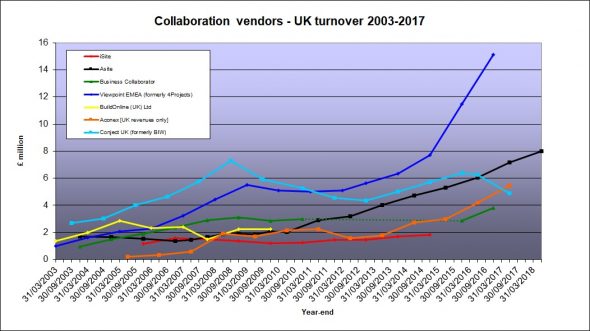
Asite logo 2012According to its just-published annual report (here), the London, UK-headquartered company saw revenues grow 12% from 2017 to £8,004,773 – around US$10.47m or €9.17m. During the same period, operating profit increased 85% to £1,357,702 – around US$1.78m or €1.56m – from 2017’s £733,370.

The revenue growth figure represents a slight slow-down on the 2016-17 year, which saw revenues climb 18%, while the operating profits showed a bounce-back after dipping in 2017 for the first time since the global financial crisis.

construction collaboration vendor revenues to June 2018

This latest report was published less than five months after Asite’s previous results announcement, when it highlighted its investment in new offices in Hong Kong and development of its New Dawn release of Adoddle, launched in March 2018. Tony Ryan (Asite CEO)CEO Tony Ryan’s messages still focus on its growing global footprint and new releases of its Adoodle platform (the latest wheeze has been an instant messaging tool, aMessage); he describes the company’s common data environment as providing “Common Data Everywhere” (another variant on CDE – Bentley Systems has, for example, been talking about its “Connected Data Environment” for some years; post).

Global footprint

Within its “global footprint”, the mature UK market still contributes the largest proportion of Asite’s revenues: 76.9% – up slightly on 2017’s figure; revenues grew by 12%. Revenues were up in every other region apart from the Middle East, for which no figure was supplied (any revenues from that region were presumably rolled into results elsewhere – perhaps with India, where revenues jumped 60%). Elsewhere, revenues were up nearly 31% in Australasia, and 11% in Europe, while revenues grew by a comparatively sluggish 6.5% in north America – dropping it to third place in revenue terms behind the UK and Australasia.

Headcount dropped over the 12 months to June 2018, from 242 to 213 – the bulk of the reductions being born by Asite’s largely India-based technical team which shrank from 205 to 183 people. Excluding directors’ remuneration (some £614,000), the total wages and salaries bill was around £2.6m, meaning the average pay for an Asite employee is just over £12,000 – underlining the low cost-base provided by Asite’s Indian operation.

The next big deal?

Asite is in an interesting position compared to its competitors, particularly those from the UK. Following the acquisitions of BIW by Conject (then Aconex, then Oracle; post), and of 4Projects by Viewpoint (then Trimble; post), Asite is now – in revenue terms – the largest UK-based independent construction collaboration vendor. It must surely be being courted by potential acquirers (perhaps the rapid publication of its latest results and the trumpeting of its 85% profit growth is partly a marketing ploy to would-be suitors? See: the next big AEC SaaS acquisition?)

The UK market is also targeted by other US-based vendors – not just old hands like Autodesk (first Buzzsaw, now BIM 360 Docs) and Bentley (ProjectWise), but more recent arrivals such as Plangrid and Procore. The leading German players RIB and think project! might yet also enter the UK collaboration market – the latter acquired the UK’s CEMAR in May 2018 – while Belgium’s Bricsys 24/7 could be boosted following its recent acquisition by Hexagon (post).

Permanent link to this article: https://extranetevolution.com/2018/11/growth-continues-at-asite/

Synchro buy a key step in building Bentley’s construction capabilities

Bentley’s courtship of Synchro started when the two firms collaborated during the Crossrail project in London, and the Synchro acquisition is a significant step forward in Bentley’s support for construction operations.

Bentley logo 2017This year’s Year in Infrastructure conference provided a platform for Bentley executives to talk about the June 2018 acquisition of Synchro Software, the 40-strong UK-based 4D BIM pioneer, and to explain how this broadens the Bentley ProjectWise construction offering.

Synchro logoTom Dengenis presented Synchro at the conference, highlighting how 4D construction modelling can make a critical difference to timely project delivery. In a product keynote, he showed how Synchro was used to help plan future construction work at Barcelona’s Camp Nou stadium, and contrasted the performance of the team delivering London’s Shard versus the team delivering another – ultimately discontinued – skyscraper in the City of London).

In a building and construction press briefing, Noah Eckhouse, Bentley’s SVP of Project Delivery, told a building and construction press briefing that Synchro provided greater “situational awareness” in projects and said “Synchro is being used by construction teams instead of post-it notes, Gantt charts and thick packs of plans.” And Steve Cockerell, Bentley industry marketing director for rail, thought Synchro was ideally suited to managing rail track possessions. Greg Demchak, now Bentley technical architect, joined Synchro in 2013, and hosted a conference session showing how Synchro helped a project team from PC3 rapidly review constructability options for the Echowater treatment plant in California.

Founded in 2007, Synchro applied learning from other industry sectors to combine scheduling tools with spatial data. The Synchro Pro platform can import project schedules from Primavera, MS Project, Excel and Asta PowerProject, and then synchronise these with building information models, so that project teams can better understand how a project might be delivered, and then – once a project is underway – to monitor progress against the programme and make adjustments as necessary.

The Synchro product portfolio includes: Synchro Site, which allows users to monitor progress on an iPad or on Microsoft HoloLens; Synchro Scheduler, free software which provides traditional 2D Gantt chart project planning and scheduling software with an advanced CPM engine; and Synchro’s free open 4D model viewer.

Expanding construction support

Bentley VP for construction, Steve Jolley said: “For infrastructure projects, integrating Synchro’s 4D construction modelling completes the reach of our ProjectWise CDE.” While Bentley had been investing heavily in BIM for years, he highlighted how the company had gradually been expanding its construction-oriented toolset, citing the 2015 acquisition of EADOC and ProcureWare in 2017, and looking to expand its support for construction managers beyond BIM – “Their primary concerns are time, money, risk”. He said Bentley has formed a construction group to try and take a larger slice of the construction space.

“If you imagine construction projects as pyramids, we have good relationships with the asset owners and operators, and we have good relationships with the Tier One contractors who are managing digital construction and design integration. As we have engaged more with them and with Tier Twos we now know what we need to do.”

This may involve further acquisitions, Jolley said.

Steve Jolley“Time – 4D – was the obvious first step after 3D, and while Bentley Navigator provided some 4D capability it was nowhere detailed enough for construction project management purposes – hence the Synchro deal. We have a very good foundation in Connect, in iModel.js, but there could well be some further acquisitions along the way.”

Jolley said Bentley had a long working relationship with Synchro dating back, in his case, to work with Crossrail, where Bechtel wanted greater certainty about the project’s planning, particularly when it came to complex structures like stations and to interfaces with operational underground lines and other infrastructure. Demchak recalled some complex workflows with data needing to flow from ProjectWise, through IFC, into an access server and back again.

“At that point we decided we needed an API. We couldn’t evolve with all this crazy data exchange, so we started building an API and a mobile app – Crossrail was one of the first users of that tech – in around 2015. … This was the point when Synchro became more than just an animation tool, more than a visualisation tool.”

The integration of Synchro into Bentley’s ProjectWise CDE offers a potentially powerful differentation from other project delivery platforms that are mainly focused on managing 2D and 3D information and workflows (though other vendor applications are also addressing the 4D aspect, particularly on detailed planning – Aphex and Visilean, for example).

Announcing its ProjectWise integration with Microsoft 365 (post), Bentley stressed the importance of workflows:

“With Synchro’s digital workflows, constructors don’t need to recreate 3D construction models from scratch, which would have orphaned the BIM models created during design. ProjectWise, with Teams and Flow, will automate digital workflows for construction planning to leverage the BIM intelligence. This immersive environment for visibility into the path and sequence of construction completes the reach for project delivery. Microsoft and Bentley are working together on further HoloLens applications for ProjectWise and Synchro to be introduced later in the year.”

The company’s iTwin Services will also integrate Synchro’s 4D construction modelling into its monitoring of project timeline states. Such detailed monitoring is vital for construction projects, said Jolley, mentioning the views of Hatch’s program manager Johan Palm who had collaborated with Bentley on its open source library iModel.js developments:

iModel.js gives Hatch the ability to implement a stakeholder engagement technology that extends the iModelHub visionary technology. We can expose complex project information to a level that is accessible, consumable, and extendable via the cloud and in context to the 3D model. Most importantly we can do so in a manner that embraces change as the project progresses.”

It will be interesting to see how Bentley’s construction offerings grow over the next year or so, but the early signs are that it is growing a strong suite of solutions that take the company well beyond its design roots and into the capital-intensive project delivery phase.

Permanent link to this article: https://extranetevolution.com/2018/10/synchro-buy-a-key-step-in-building-bentleys-construction-capabilities/

Hexagon on Bricsys 24/7: “Watch this space”

Now part of the HexagonPPM portfolio, Bricsys 24/7 has continued to extend its CDE capabilities, with an enhanced BIM viewer and support for IFC. Could it provide the basis for a revamped HxGN SMART Build offering? Announcements are planned for mid-2019.

Bricsys logoFollowing on from yesterday’s lunchtime news that Sweden’s Hexagon had acquired Belgium-based construction software developer Bricsys, the latter’s London user conference saw demonstrations of the the company’s BIM capabilities and then took a quick dive into “The Future of the CDE” [common data environment].

My BIM-embracing colleagues were impressed by Bricsys BIM, so the CDE demonstration was perhaps underwhelming by comparison. Bricsys 24/7 is “big in Benelux” (according to the company’s communications chief, Don Strimbu) and, after defining a CDE (useful for an audience with a large number of delegates from outside the UK), we learned about how the product was being deployed on a major project in Brussels: the Leopold II tunnel project.

Since October 2017, Bricsys 24/7’s viewer has been extended to incorporate full support for IFC (as 24/7 product manager Jurgen Schepers promised; Bricsys is a full member of BuildingSMART International). The viewing platform also uses 3D WebGL, and enables 3D annotations of the model.

Bricsys24/7 will be offered free to all BricsCAD v19 users next year (echoes of how Autodesk tried to expand adoption of Buzzsaw by offering it free to AutoCAD users nearly two decades ago). The roadmap now includes support for BIM Collaboration Format (BCF) and for virtual reality (VR).

CAD and BIM market

Hexagon logoAfter the main public sessions, we learned that the conversations between Hexagon and Bricsys had been going on for around 18 months. For Bricsys, which for a long time has focused most of its resources on software development and relied on resellers to undertake its marketing, CEO Erik De Keyser said a relationship with Hexagon would boost its sales and marketing activities; Hexagon’s Rick Allen said the parent company would also help boost Bricsys’s profile in north America, and Hexagon is clearly in the mood to take on Autodesk in the CAD/BIM market, criticising its aggressive pricing and subscription models, and looking to give its customers an option (“we will be leading horses to water, and a lot of them will drink”).
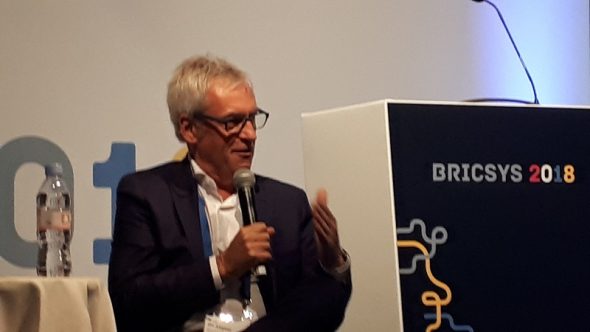

Eric De Keyser at Bricsys2018

De Keyser, above, also stressed that it’s not just about Autodesk. He identified that the potential global market for BIM is still under-penetrated, with – even on optimistic estimates – only around 16% of designers using BIM applications – “We are going for the 84% that don’t currently do BIM“.

Bricsys 24/7 and HxGN SMART Build

Asked about the potential ‘fit’ between Bricsys 24/7 and HxGN SMART Build, De Keyser said the Hexagon product extended across a much wider range of capabilities – estimating, planning and scheduling, for example – while 24/7 was specifically aimed at design collaboration activities, but it was recognised that the products complemented each other well. Some work is clearly already under way: “Watch this space in about nine months,” was the message.

HxGN SMART Build was launched at a time when Hexagon was looking to diversify away from its focus on oil and gas, and to use its expertise on detailed project planning and scheduling in other markets such as construction. It looked to integrate 4D and 5D project controls capabilities gained from the October 2015 acquisition of Ecosys, but making technologies designed for specialist engineering procurement construction businesses (EPCs) applicable to architecture, engineering and construction, I think, proved challenging. A collaboration with Skanska and a research project grant in Singapore are the only instances of industry engagement with HxGN SMART Build that I have been able to identify.

So perhaps Bricsys 24/7 will provide the new platform upon which Hexagon can relaunch its SMART Build ambitions?

Permanent link to this article: https://extranetevolution.com/2018/10/hexagon-on-bricsys-24-7-watch-this-space/

Hexagon acquires Bricsys

Swedish software giant Hexagon AB has acquired Belgium’s building design and collaboration software business Bricsys.

Bricsys logoErik De Keyser (Bricsys CEO)BREAKING (London – 1pm BMT) – In London today, opening the 2018 conference of Ghent, Belgium building design and collaboration software developer Bricsys, CEO Erik De Keyser announced a milestone: Bricsys has been acquired by Sweden’s Hexagon AB (read Hexagon announcement) for an undisclosed amount.*

Hexagon’s executive vice president Rick Allen said: “The acquisition will have a disruptive and lasting effect,” highlighting the company’s flexible approach to software licensing and stressing the versatility of the DWG file format. The deal adds building CAD and BIM software capabilities, plus collaboration via the SaaS product Bricsys 24/7 (rebranded from Chapoo a year ago), to the Hexagon PPM portfolio. In 2017, Bricsys’s turnover was approximately €13 million (c. £11.5 million or $14.9 million).

Bricsys’s CAD platform, BricsCAD, supports 2D/3D general, mechanical, and sheet metal design and building information modelling (BIM) in one system. It is 100% based on the DWG design format (described by Hexagon as the “de facto standard design format”), and gives designers, engineers and BIM professionals access to thousands of vertical CAD applications created by third-party developers. Bricsys also offers time-saving, artificial intelligence-driven add-ons – from conceptual modelling to seamless BIM workflows and cloud connectivity.

Hexagon President and CEO Ola Rollén says:

Hexagon logo“Hexagon has long been a leader in structural & process piping design. The Bricsys acquisition extends our domain expertise into building design, adding walls, floors, doors, and other construction related features. More importantly, we can now provide the AEC market with an end-to-end platform – with conceptual design, CAD design, BIM software and collaboration tools, project and cost controls, in-field construction execution tools (work packages), and progress documentation (reality capture) – to connect, automate, and ultimately ‘autonomise’ the entire building and construction ecosystem through our HxGN SMART Build solution.”

HXGN SMART Build and Bricsys 24/7 fit

Update (1.45 pm, 23 October 2018) – The mention of HxGN SMART Build is potentially significant for Bricsys 24/7.

Launched in June 2016 (news release), HxGN SMART Build intelligently links models, schedule, and cost in a cloud and mobile building construction management solution for construction planning and execution. It connects site-based field workers to the office, offering real-time, bi-directional communication to align planning and execution of construction. In June 2017, Hexagon announced it was partnering with Skanska – the construction business planned to use SMART Build to consolidate all elements of its estimation, design, planning, scheduling, pre-construction and construction processes into one cloud platform.

On the face of it, it sounds like SMART Build offers a lot of the functionality that one might expect in a common data environment like Bricsys 24/7 (since last year, Bricsys has started to use the CDE term – its session this afternoon is entitled “The Future of the CDE“).

* Update (14 November 2018) – Ralph Grabowski opines: “The purchase price was not announced, but given Bricsys revenues of 13 million Euros a year, we can assume a purchase price estimated roughly at US$45 million, given the typical 3x valuation metric.”

Permanent link to this article: https://extranetevolution.com/2018/10/hexagon-acquires-bricsys/

Script&Go plans Site Diary upgrades

Script&Go logo 2018Fulfilling a promise made in January 2018, Script&Go is now a UK registered business and – despite, or perhaps because of, Brexit – has opened offices in London and Birmingham. The Rennes, France-based mobile application developer says (see announcement) that it wants to move closer to its UK users and improve its products – a Site Diary app is its main UK product – to suit their needs.

Script&Go says the UK will see a wide range of changes in Site Diary from January 2019, including:

  • Improved product with new features such as Task Management, Timesheet, improve PDF Report, chat, etc. All features will be integrated and collaborate with each other.
  • New product design (colours and user interface)
  • New pricing in the British pound sterling currency
  • Product hosted on Microsoft Azure and connected to Azure active directory federated login.


Permanent link to this article: https://extranetevolution.com/2018/10/scriptgo-plans-site-diary-upgrades/

Basestone wins Best Application of Technology at DCW Awards

BasestoneLondon-based mobile construction technology developer BaseStone won the award for Best Application of Technology at the Digital Construction Awards 2018 – part of the Digital Construction Week event in London last week – for its work on the Bakerloo Line link at Paddington Station.

The “Best Application of Technology” category provides recognition for companies and projects that effectively utilise specific technology to improve processes and deliver measurable improvements. BaseStone’s nomination for this category cited a 60% productivity gain achieved by BaseStone and long-standing customer, the Costain Skanska Joint Venture (CSJV), for their work on the London Underground Bakerloo Line Link (BLL) project at Paddington Station.

Rivals in the category included a Kier project using Clearbox (post), and an entry by VolkerFitzpatrick and GenieBelt. Familiar technology names in other categories included 3DRepo (post) in the R&D category, and GroupBC for its Sainsbury’s Digital Estate project with retailer Sainsbury’s (discussed at GroupBC’s 2017 user conference), in the digital innovation category.

Permanent link to this article: https://extranetevolution.com/2018/10/basestone-wins-best-application-of-technology-at-dcw-awards/

Load more