Total Synergy’s latest SaaS product, Enterprise, features advanced forecasting and resource planning tools for architects, engineers and construction design firms.
 In time for last week’s Digital Construction Week show in London, North Sydney, Australia-based AEC project management software developer Total Synergy launched its new Synergy Enterprise platform, targeted at architects, engineers and construction design professionals.
This latest Software-as-a-Service product, which features advanced forecasting and resource planning, has been in development for some months, helped by recent product development recruit Paul Hemmings (formerly at RIB after it acquired ProjectCentre), and extends the core Synergy SaaS product launched in November 2017 (see Total Synergy targets AEC designers).
Core practice management platform
EMEA regional manager Damiaan van Zanen said Synergy is making waves as it grows to become a globally adopted product:
“Since launching the new cloud version of Synergy in November 2017, we’ve seen more than 130 AEC businesses, totaling over 1100 users, adopt it for their AEC project delivery management — from sole operators on our Professional and Business products to companies with over 150 staff.”
 Synergy supports built environment design businesses throughout the entire project delivery lifecycle — from opportunity to work breakdown, forecasting and resourcing, and document delivery. Its project delivery management functions are underpinned by a comprehensive project accounting capability to ensure visibility into project and practice profitability throughout the lifecycle.
Synergy Enterprise
The latest advanced forecasting and resourcing features released with Synergy Enterprise allow directors to look ahead in their business to see revenue forecast at phase and stage level, and individual staff capacity and utilisation in a simple, drag and drop Gantt chart.
While the Synergy Enterprise release brings new capabilities in practice and project management, further functional growth is planned. Hemmings says:
 “The release of Synergy Enterprise helps design practices answer two key questions: Do I have enough revenue in the pipeline to run my business, and do I have enough staff to deliver the projects? Synergy Enterprise is the third tier of our project and business management platform. From here we’re actively developing features that suit design businesses with diverse portfolios and reporting needs, multiple offices, foreign currency billing, and continued enhancements to online document management and delivery.”
 I also talked with Total Synergy CEO Scott Osborne this week and he invited firms to look closely at the platform’s drag-and-drop planning board. “Project accounting is not everybody’s favourite activity, but being able to quickly manage how and where project design work gets undertaken does get people excited,” he said.
He also mentioned the firm’s work with Microsoft to take advantage of Azure storage and build project portals for digital storage of information used by small- and medium-sized businesses (topical and interesting in light of Microsoft Azure’s continued expansion to power Bentley’s Connected Data Environment – see previous post).
 At its 2018 Year in Infrastructure event in London last week, Bentley Systems announced the general availability of integration between ProjectWise 365 Services and Microsoft 365.
 ProjectWise is Bentley’s ‘workhorse for work sharing’ used by 70% of Engineering News-Record’s Top 250 Design Firms in the design and engineering of all types of infrastructure assets. Now 20 years old (see this October 2018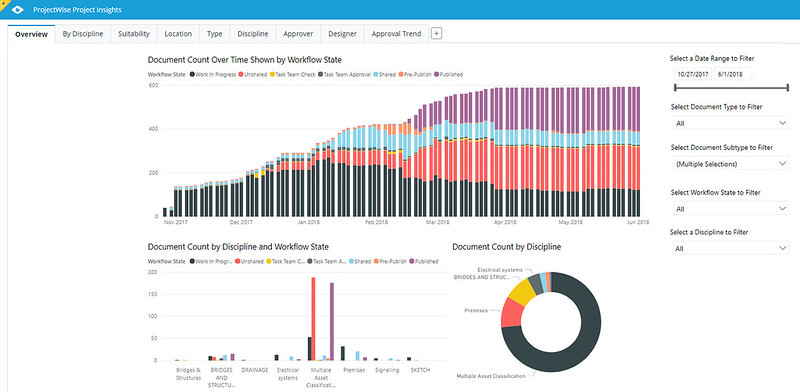
 The Microsoft 365 integration is clearly seen as extending the reach of information stored in ProjectWise. “There’s a lot of information locked up on ProjectWise – we need to unlock it and make it more widely available across teams,” Noah Eckhouse, Bentley’s senior vice president of Project Delivery, told a building and construction press briefing. By using Microsoft 365 tools such as Azure Search, Microsoft Flow and Microsoft Teams –
  Munich, Germany-based construction and engineering Software-as-a-Service provider
  “Further investing in the French-speaking markets is a major cornerstone in our international growth strategy. This move provides think project! with the opportunity to acquire new French and international customers, while adding a leading collaboration solution to the local product portfolio.”
 The software, accessed via a standard web browser, mimics the look and feel of a ring-binder using index tabs to denote different sections of information (each sub-section can then be further sub-divided as necessary). A user with several projects is presented with a view of a bookshelf containing a binder for each project. Other users can be invited to open and use project binders, while iBinder also allows certain tabs (for example, contracts or budgets) to be locked, making those sections and their contents inaccessible to unauthorised users. Multiple virtual ‘bookshelves’ can apparently also be created for different types of binders.
 In
In 

 “Sophisticated clients are increasingly thinking about the ‘whole life’ of their built assets. They are now starting to see them as investment ‘products’, and so need to regularly re-evaluate them, to have a clearer view of how those ‘products’ perform – particularly if they might need to update them, dispose of them, or acquire new, better ones – right down to the performance of individual systems.”
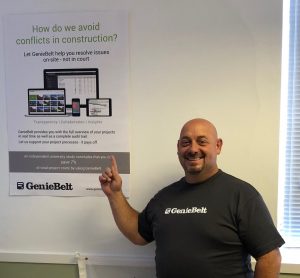 GenieBelt has appointed
 “GenieBelt’s mission is to significantly improve our customers’ earnings, by providing them with full data ownership, transparency and real-time communication. We have seen customers from all around the world welcome this approach, but to change a $10 trillion industry takes dedicated, skilled and experienced visionaries. Rusty Hamilton is such a person. So combining the right person with an increasing interest from USA is an opportunity to seize, and it allows us to serve and grow our US customer base even better”.
 Interoperability remains a major challenge for many construction IT users, with single vendor proprietary file and data formats vying with more open formats shared by multiple vendors. The Nemetschek group fits into the latter category and it has been a long-time proponent of ‘Open BIM’ since
  September 2018 has seen the launch of the 2019 editions of
  I got an update on how the suite manages collaborative workflows from Vectorworks Architect product specialist Luc Lefebvre. We talked about Vectorworks Webview tool – a slick way for designers to share models with clients via a browser-based session (
 The Cloud Services offerings include a desktop web portal accessed via a standard brower, a Vectorworks Nomad app that allows users to access, view, mark up, share, and sync Vectorworks files across iPhone, iPad, or Android devices, and the Vectorworks Remote App – which lets users connect their mobile devices to their Vectorworks desktop (they can use the app as a navigation palette, or as a remote control for presenting design options).
 In August 2018 I spoke to the founders of a relatively recent arrival in the AEC software market whose formative experiences were gained in the Middle East and CIS regions.
  Both men have solid construction experience from projects across different regions including the EU, Turkey, Middle East, CIS and the Balkans. During their construction careers, they have used software collaboration tools including those provided by the major players in the industry – but felt they were all missing something and that they could develop something better.