Bentley has acquired Synchro to add 4D BIM capabilties to its product portfolio, ‘broadening’ its ProjectWise offerings.
 The US’s Bentley Systems has today (20 June 2018) announced the acquisition of 40-strong UK-based 4D BIM pioneer Synchro Software (for an undisclosed amount). The deal, according to Bentley, “broadens Bentley’s ProjectWise construction offerings.”
 Bentley’s portfolio already included ConstructSim, a 4D construction modelling application used in project delivery of industrial plants. Synchro takes the 4D capability wider. Synchro has been deployed to support construction planning, scheduling, and project management strategies across a wider variety of projects, with clients including London’s Crossrail. According to Bentley, Synchro “incorporates other construction variables (human, materials, equipment, falseworks, and space) for safe, reliable, and predictable project delivery performance.” End users will be able to compare construction strategy alternatives—even in early stages of design and bid processes—and to evaluate the feasibility and efficiency of different scenarios.
Bentley says it will incorporate Synchro’s 4D construction modelling through the ProjectWise CDE (it refers to a ‘connected data environment’, rather than the more widely – at least in the UK – common data environment; in October 2017, ProjectWise appeared past the tipping point in its transition from on-premise to being the cloud-based centre of an ‘ecosystem’ of cloud services). As a result, it claims infrastructure project delivery will benefit from “unprecedented digital workflow advancements”. Steve Jolley, Bentley’s VP for construction, says: “for infrastructure projects, integrating Synchro’s 4D construction modelling completes the reach of our ProjectWise CDE.”
Crossrail’s Malcolm Taylor says:
“Using 4D models to plan helped speed up the project teams’ understanding of what we needed to do and when. They could also tease out conflicts that were not normally apparent from regular Gantt charts and drawings. Using the 4D model for construction progress also manages payment expectations as it allows teams to readily agree on what’s completed and accepted—as well as producing an excellent as-built record for the future maintainer.”
Bentley Systems’ CEO Greg Bentley describes Synchro as “leading the adoption of 4D construction modelling” for significant projects worldwide. He says extending digital workflows and superseding disconnected planning and scheduling will offer “enormous and immediate” benefits.
My reaction
 I have followed Synchro’s development from the mid 2000s, when CEO Tom Dengenis, right, left SaaS construction collaboration technology developer Asite to lead Synchro as it grew and raised funds in 2007. I met Dengenis at another software vendor’s event in 2017, and earlier this month I noted Synchro’s tie-up with Denmark’s GenieBelt (I am not sure how that will survive the Bentley deal).
The deal will immediately excite industry watchers who welcomed the acquisition (announced in December 2017, completed three months ago, in March 2018) of SaaS collaboration technology vendor Aconex by Oracle, provider of the Primavera scheduling toolset and Textura construction payment management platform. We now have at least two major AEC software vendors with strong 4D capabilities alongside design authoring, while Trimble (after its April 2018 deal to buy Viewpoint) and RIB also seek to play in the 5D cost control space.


 Now that the Australian-based but internationally operating construction collaboration SaaS vendor
 Bowles and his colleagues (including representatives from partner businesses) briefly explained these technologies to a construction industry audience including several existing customers of Salesforce. They highlighted the industry’s productivity challenges and its widespread continued reliance on creating and then sharing conventional documents, drawings and spreadsheets via email. As a company, Salesforce practices what it preaches when it comes to investing in its workforce – its own experiences show that businesses that invest in their employees outperform those that don’t, attracting better people, retaining them longer, and helping them be more productive.
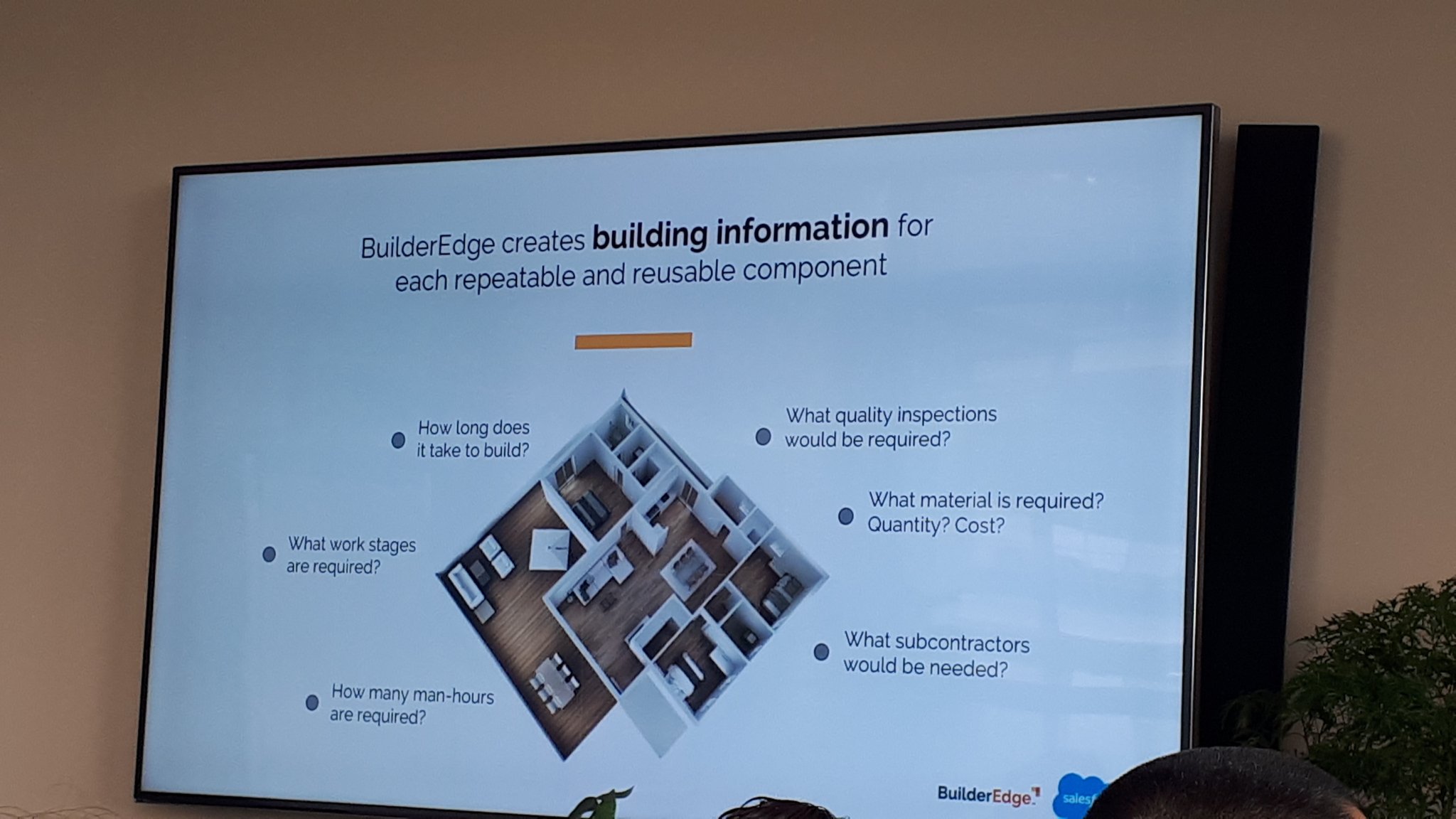 I talked to one of the presenters, Avi Kaye, afterwards, and we identified there is a strong need to educate traditional construction organisations to rethink their near-bespoke approaches to every project. Offsite and design for manufacture and assembly, DfMA, techniques are increasingly advocated as ‘disruptions’ that could capitalise upon BIM and so improve industry productivity, but many industry professionals tend to start projects almost from scratch.

 Kamha describes the Tenderfield platform as comprising four pillars: tendering and bid management (Bid.it), project document management (Plan.it), subcontractor collaboration (Sub.it), and project management (Build.it). One of the business’s strongpoints, he says, is its construction lead network. “Tenderfield is not just about project delivery, we create an ecosystem which connects businesses to new opportunities, with registered users able to receive notifications of tender opportunities for free.” Depending on the functionality required,
  The project management toolset now includes 14 tools (and growing) covering tasks including defects and non-conformance reporting, email tracking, meeting minutes, project instructions, purchase orders, requests for information, safety notices and site diary. Collaboration on designs is managed through a 2D PDF ‘planviewer’ tool (building information modelling, BIM, is not yet a customer need, Kamha said).
 Tenderfield’s user base has grown to over 10,000 users, with most of its customers comprising small businesses: “While competitors like Aconex target the top end of town, the bigger firms and projects, a typical Tenderfield customer will be a medium-size contractor with around 15-30 users and might be working on around ten projects at any one time,” Kamha, right, says. “Many work in the residential, commercial and retail new build and fit-out sectors, and we’ve managed about Au$2bn [c. £1.1bn] worth of work on the platform so far.” Registered users can invite new users to access project-related information and collaborate on the platform for free, and ‘smart’ emails can also be sent from the system to non-users inviting them to collaborate.
 The PoC aims to connect the 4D construction model in the Synchro platform and project plan data with GenieBelt – automatically via APIs – to allow instant onsite registration of progress, reporting, questions, marks, tagging and pictures to flow via GenieBelt back to the 4D platform.
 Tom Dengenis, CEO of Synchro, and Ulrik Branner, CEO of GenieBelt (right), both regard this PoC as the next trajectory in delivering transparency and accountability to the industry, paving the road for data continuity all the way from the design phase over construction to facility management and maintenance.
 “We are excited to be collaborating with GenieBelt, who are as passionate about driving change in the construction industry as we are. The combination of our 4D digital construction platform and the real-time updates provided by GenieBelt will enable significant process and business improvements,” says Tom Dengenis.
 Munich, Germany-based SaaS construction collaboration technology provider
 When I talked exclusively to think project! CEO Thomas Bachmaier (above left, with CEMAR CEO Ben Walker) about the deal earlier this week in London, he highlighted FIDIC as one of the contracts most widely used by its customers in continental Europe. While the think project! platform did support some contract processes, he said, it was not as sophisticated in its capabilities as CEMAR. Its capabilities complemented Think Project! and this is what attracted them to the deal.
 “Entering the UK market with CEMAR is a major cornerstone in our international growth strategy. This acquisition provides think project! with the opportunity to acquire major UK and international customers, while adding a leading contract management solution to our product portfolio. We are very pleased to welcome CEMAR to think project! and are confident they will contribute significantly to the Group’s continued growth.”
 “We are delighted to become part of the think project! Group. CEMAR will benefit from the experience and structures of think project’s international project business, as well as from synergies in our complementary technologies. Our joining forces has created a strong partnership for digital transformation that will further support our customers in the UK and internationally.”
 “Total Synergy has been a leader in the practice management and project accounting space since 1999. The new cloud product — Synergy — launched last year to the global market, has the best potential I’ve seen for SME built environment design businesses to collaborate securely on projects with shared, multi-party access.