London-based startup Aphex has launched a cloud-based production planning application that will appeal to anyone frustrated by continued reliance on paper, sticky notes and spreadsheets for detailed weekly planning.
 Some two years in development, newly launched (see news release)* Aphex Planner aims to help the often multi-disciplinary, multi-company groupings involved in trying to expedite detailed on-site construction activities.
Production planning
In an industry notorious for its low productivity and high levels of waste, it is no surprise that ‘lean’ approaches to construction have been repeatedly advocated. And to support lean construction approaches, various decision-making processes and supporting technologies have been devised – notably the Last Planner System (LPS) developed by the founders of the Lean Construction Institute, Glenn Ballard and Greg Howell in the 1990s.
While project management scheduling tools like Primavera P6 and MS Project are widely used for creating overall master programmes and showing the different phases of activities, the LPS focuses within those phases. Rather than being done by planners, such detailed production planning is therefore undertaken by the construction professionals who will directly manage work execution; these ‘last planners’ are the frontline supervisors who are dependent on one another for release of work. LPS-style working involves them working collaboratively to develop weekly schedules of tasks required to hit milestones, while identifying dependencies and constraints that might affect those schedules. And any breakdowns in the process are used as opportunities to learn and to prevent reoccurrence.
US-based Strategic Project Solutions (SPS), DPR Construction and Ghafari were among the first firms to develop software to support LPS (ProjectFlow, OurPlan and vPlanner, respectively), but most production planning still tends to be undertaken using paper-based processes and Microsoft Excel. In a related field, in the early 2000s, researchers at Loughborough University developed the Analytical Design Planning Technique (ADePT; read November 2009 post) which BIW Technologies [my then employer] attempted to turn into a web-based software product (PlanWeaver) before eventually shelving development. I recently wrote about another LPS-inspired product, Visilean (March 2018 post: Visualising lean BIM: VisiLean), and almost simultaneously was contacted by the London-based developer of a new cloud-based planner product, Aphex Planner.
Aphex founders
 Aphex was established in 2015 by a pair of recent graduates, Carlos Adams (right) and Carlos Carvalho. Adams told me the two had first met at college in Farnborough aged 16, and both went on to study in the built environment faculty at the University of the West of England, whilst also nursing entrepreneurial ambitions. Upon leaving UWE in 2013 both joined the graduate schemes of large companies (UK Power Networks and Costain, respectively), but were disappointed at the lack of sophistication in the software tools deployed in delivering major projects – particularly when they compared technologies with friends working in other industry sectors (“our tools could have come from anytime in the last 40 years – whereas they had the latest tools, intuitive to use, more engaging, with great user interfaces”).
The duo looked at their spreadsheet tools and the industry’s preoccupation with cost and time, and then teamed up in late 2016 with civil engineer Damian Bucke who wanted to develop a better short-term planning tool. They formed Aphex, recruited an ex-Goldman Sachs VP and developer, Elliott Williams, in early 2017, raised some initial seed funding and, with a prototype of the Aphex Planner product to demonstrate, found some further investors in Australia. They also found a consultant who shared their love of well-designed software – Adams said:
“we wanted to develop a B2B product that users would find slicker than they were used to – to be really user-centric, not just for efficiency, but to make users feel empowered by the tool. Being empowered by good design is one of the core principles of Aphex.”
Along the way, the Aphex team has also established some potentially powerful technology partnerships, with IBM (for weather data, now integrated into Aphex Planner) and with Oracle (clarifying that Aphex Planner is a different proposition to the US giant’s Primavera toolset).
Aphex Planner
Bucke demonstrated Aphex Planner to me at Aphex’s Shoreditch base. After logging in to the browser-based software, the user is presented with a dashboard view. “Anyone regularly involved with short-term planning, will be used to looking one week back, one week forward, and then to weeks beyond that.” The application can provide different timespan views, and, by colour-coding activities for different users, allows users to quickly identify their responsibilities. For managers responsible for multiple sites, aggregated dashboards are offered from which the user can drill down to specific projects.
 “Aphex Planner has been designed to be as collaborative, open and transparent as possible,” explained Bucke. The site level dashboard provides data on activities, their start and finish dates, and their locations, and then, if any other activities are scheduled in the same date ranges and in the same locations (the same buildings, zones, floors, etc – displayed in PDFs of drawings), these are identified as clashes.
Like the shared wallchart and stickynotes in a traditional LPS process, Aphex Planner can then be used to agree sequences of work to resolve the clashes, and these sequences can be printed out to guide daily tasks. Inbuilt notifications help keep users abreast of any changes relating to their company’s activities; users can also annotate activities with photographs and comments.
As tasks are recorded as complete, the dashboard provides graphs showing activity and project progress; where tasks are delayed, the reasons behind the delays can also be recorded, helping teams identify common root causes and trends. Bucke said the incorporation of weather data would allow for automatic warnings relating to activities that might be compromised by adverse weather.
Bucke has been working on detailed planning within the Crossrail Project in London. He described how teams had been sharing plans each separately logging in to a single installation of the standard Microsoft Project platform. Plans were time-consuming to produce, with some issues only shared once a plan has been saved. “With Aphex Planner, multiple users can log-in simultaneously and identify issues as they are flagged almost in real time.”
Aphex Planner has just been soft-launched and is being trialled on Crossrail and on a High Speed 2 project. The company offers free month-long trials, after which users can switch to paid plans starting from £35 per user per month.
[* Disclosure: pwcom.co.uk Ltd has provided PR consultancy services to Aphex.]

 In one part of the report (p.19), NBS usefully shows how awareness and adoption of BIM has changed since 2011. This is valuable trend data as NBS has largely deployed the same methodology to collect its data each year, so the composition of its (self-selecting) sample will be broadly the same each time. BIM advocates will be encouraged that adoption apparently continues to increase.
 What will be the impact of the acquisition on Viewpoint? – “The deal has still to be completed, of course, but in general, when Trimble acquire a business, they usually let them run very autonomously. That said, they have some solutions that are highly complementary to Viewpoint.
  “But this doesn’t mean we are isolated from other major software vendors. Trimble has been a strong supporter of Open BIM, and, as the industry digitises still further, it will be important that we address interoperability with the products of some of the other major providers.”
 In a corporate update call with journalists, Bentley Systems CEO Greg Bentley gave an overview of the company’s recent performance, supported by CFO David Hollister and chief product officer Bhupinder Singh. Such calls have been reinstituted following a hiatus after the company announced in July 2015 that it was considering an IPO. For the avoidance of doubt, Greg Bentley said the company was “not currently working on or waiting for an IPO”. In the meantime, around a third of the company staff had the option of dealing in the company’s shares on NASDAQ’s Private Market, and, partly as a result of such dealings, ‘co-venture’ partner Siemens has accumulated a 9% share in the company’s voting stock, Bentley said.
 The US-based but increasingly international provider of software for infrastructure project delivery and operation said it was on track to surpass an annual revenue runrate of US$700 million during 2018. A growing proportion of its revenues continues to derive from subscription income, and the company successfully limits ‘churn’, retaining around 98% of its subscribers, Greg Bentley said.
 Product performance highlights included annual revenue runrate growth of approximately 20% or more for brands including ProjectWise. As
  On Wednesday 23 May, at Siemens’ Crystal Building in London’s Docklands area, the software development startup
 In June 2017, I wrote about Israeli-based startup ShapeDo and its software that helps identify and manage design changes. ShapeDo’s software detects differences between drawings. It can be used constructively to help manage associated workflows (change orders, etc) and track the cost implications of changes in contracts and budgets (ShapeDo is now positioning itself as a project controls tool – it exhibited at the November 2017
 “Typically, a dispute comes down to the question: what went wrong with the project? Resolving this question often involves expert witnesses reviewing all the drawing changes, which is incredibly manual, labour intensive and expensive. ShapeDo’s ‘track changes’capability can reduce the time spent on each drawing up to tenfold, enabling far faster and better analysis. In addition, Shapedo helps index and schedule drawings to eliminate duplicates (which immediately saves a lot of time and associated costs) and provides a speedier alternative to the manual review of 1000’s of paper drawings.
 Two days after
  For example, after Germany’s Conject brought UK-based BIW Technologies in
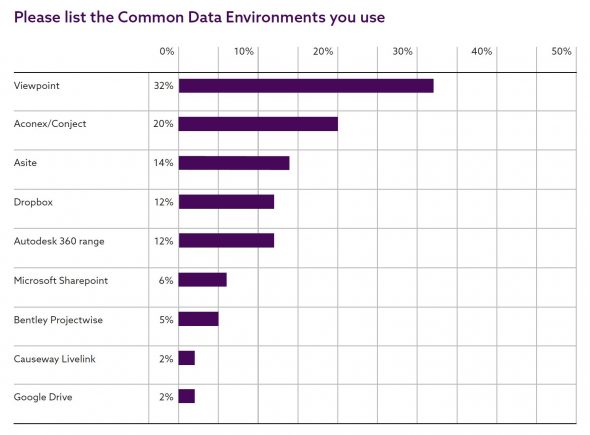
  And while we might expect there to be some rationalisation of overheads, the bigger challenge will be assimilating the two recent acquisitions, which both bring substantial customer and user bases (at yesterday’s London event, Viewpoint said it now had over 315,000 current active users of Viewpoint for Projects on almost 160,000 projects; e-Builder has supported over 200,000 projects), with the Trimble Connect applications. There will be scope for economies of scale in rationalising hosting and other infrastructure provision, and also – as Aconex did following its Conject acquisition – to identify and invest further in the highly valued functionalities of the different SaaS and mobile systems. By developing the ‘best of breed’ capabilities that will retain customer and end-user loyalty, Trimble might encourage them to migrate to enhanced new solutions.
 Of the currently independent vendors, Munich, Germany-based
  The afore-mentioned
  If Viewpoint’s combination of ERP and collaboration proved an attractive proposition to Trimble, Germany’s
  UK-based
  Another UK-based vendor,
  A sister company of Belgium-based
  US-based
  Manolis Kotzabasakis, CEO of Viewpoint, says: