Demand Logic: collaborative BMS data

‘Internet of Things’? BMSs have been streaming data for years. Data for post-occupancy evaluation? Ditto. London-based Demand Logic builds collaboration around energy data.

Demand Logic logoWhen I first heard of Demand Logic, my initial thought was that it might be a startup business riding the crest of the current new-build BIM boom in the UK, but the more I learned about it from chairman Sonny Masero and CEO Joe Short the more I realised this is a company whose application and services are just as relevant to many existing buildings, regardless of whether they have been designed using BIM or not. It also features strong collaboration and data analytics capabilties attractive to organisations involved in Smart Cities initiatives (Demand Logic is also a successful graduate of the Cognicity Challenge – see previous post).

SaaS-based data analytics and visualisation

Over a coffee near their Islington, north London office, Joe said the idea of Demand Logic first emerged in the late 2000s, but it took a few years to turn this into a functioning product. One of the first customers was London’s King’s College University who started testing a “minimum viable product’ in January 2013, retrofitting it in a mix of buildings of different sizes and ages across three London campuses. In the first nine months, the University identified £390,000 in energy savings alone, plus other benefits, including recommendations on energy management, maintenance and occupant comfort (see case study). Other customers gradually followed suit, and the last 6-8 months have been “ballistic,” Joe said.

Demand Logic summary diagramDemand Logic involves the installation of a small piece of hardware (a DAD – data acquisition device – roughly the size of a small book, with installation taking less than half a day, sometimes less than 25 minutes) that plugs into a building’s existing building management system, BMS. But the company is not a hardware provider – the DAD is merely a ‘gateway’, a data collector for Demand Logic’s core Software-as-a-Service application. The DAD helps the software gather data about all the BMS assets, starting first with a “major plant review” capturing the major heating, ventilation and air conditioning (HVAC) items – eg: boilers, chillers, pumps – but, after a few days, gradually extending to a complete map or record of the entire system down to terminal units – eg: thermostats and similar controllers. (We talked briefly about Asset Mapping, another London-based startup which I saw present at a London data event in January and which has been collaborating with Demand Logic.)

Joe Short (Demand Logic CEO)Data can be collected from most BMSs almost regardless of their manufacturer or vintage. “We are a neutral data partner, able to collate lots of very granular data from all types of BMSs including many originally installed in buildings in the 1980s,” said Joe. “And we have found that, despite this data being available, many organisations have never capitalised upon it.” Was this due to apathy or ignorance, I asked.

“Not really. The main issue has been that building controls guys or facilities managers have been under-resourced – many organisations don’t appreciate their HVAC systems are the equivalent of small factories; a chiller can use as much energy in half an hour as might be saved by a year of user behaviour changes.”

Demand Logic is now capturing over 20 million data points a day from a range of buildings. As well as educational institutions, its systems are now monitoring clients‘ office buildings, a data centre, banks, a national newspaper, and several blue-chip corporate HQs.

Data-based collaboration

Customer staff and authorised supply chain partners can login to the Demand Logic HTML5 web interface (so accessible across multiple mobile devices) and start to review and analyse data, stored in a secure cloud environment, about their buildings’ systems. The interface offers a range of data presentation tools from timelines to scatter diagrams to help summarise trends and to identify anomalies. Users can also use the platform’s social collaboration features – which has an interface clearly influenced by social media – to discuss issues, agree actions and test out hunches based on both current or historic data. Maintenance, repair or upgrade tasks can also be managed from suggestion stage right through to completion.

Inevitably, perhaps, we did talk about BIM, and it seems growing awareness of the power of data and of ‘Government Soft Landings’ has seen an increase in the number of enquiries from businesses involved in new-build projects and looking at whole-life costs and post-occupancy evaluation. “We find organisations wanting large glass buildings increasingly need an agent-based Big Data ‘lens’ to provide real-time insights into their energy use,” said Joe. Demand Logic is therefore being used on more commissioning projects, helping designers and occupants understand the inter-relationship between building fabric, systems, people and their behaviours.

Demand Logic charge a fixed fee for hosting and providing its service. Equipment is free. The business is confident the energy and maintenance savings will pay back within a few months.

Permanent link to this article: https://extranetevolution.com/2015/07/demand-logic-collaborative-bms-data/

M-Files opens UK office

M-Files logoPreviously based mainly in Finland before opening a US office in Dallas, Texas, hybrid on-premise/cloud-hosted enterprise content management software vendor M-Files is now expanding its operation in the UK, opening an office in Reading, Berkshire.

I talked to the company in April 2014 when it outlined its experience in delivering solutions to customers in the architecture, engineering and construction markets, pointing out that many organisations still want to retain information within their fire-wall.

According to the company, the new office, plus investment in personnel and marketing, is part of the company’s commitment to increasing its presence in the UK. It says:

… an increasing number of UK businesses are realizing that information management is a strategic priority …. Common requirements include the need to transition away from the use of unmanaged network file folders, and getting control of personal and less secure file sync and sharing apps for managing business content. Companies are turning to enterprise information management solutions such as M-Files to eliminate content chaos and information silos while enabling fast and easy access to the right documents and other information from any core business system and device.

The tone of the news release doesn’t suggest it is targeting businesses with extensive collaboration needs beyond the firewall and outside the organisation, yet the AEC sector (where these needs are widespread) remains one of 12 industry sectors listed on the M-Files website (its AEC case study – registration required – concerns a US-based electrical engineer Booth & Associates).

Permanent link to this article: https://extranetevolution.com/2015/07/m-files-opens-uk-office/

Kahua: pushing PaaS in construction

Platform-as-a-Service allows developers to create apps that can be employed on a core system. In construction, Asite’s doing it in the UK; Kahua is attracting investors in the US.

The global construction market is huge, sprawling and, in many countries, immensely fragmented. Thousands of businesses start up and die every month, and even in a relatively narrow niche such as the construction technology sector it can be difficult to keep up to date about every venture. However, sometimes I recognise a name associated with a company and give it a little more attention – for example, Kahua.

Kahua logoNo, I haven’t mentioned this Alpharetta, Georgia, US-based business by this name before, but I have previously written about its CEO and co-founder, serial entrepreneur Scott Unger, and his previous businesses including Constructware (acquired by Autodesk in 2006), founded with Brian Moore. The duo also developed and eventually sold, in 2012, a business called Compliance 360. Kahua was launched in 2009 as Integrated Lifecycle Solutions (see my 2010 post), focusing, again, on B2B collaboration in construction. However, it aimed to introduce a new paradigm:

Among other things, its game-changing technology will enable independent stakeholders in a project to own, control and seamlessly share their independent project data and business processes. … Our platform will easily adapt to individual stakeholders’ business processes and user needs, solve the data ownership issue, and enable organizations to extend critical functionality to the field easily and cost-effectively.

Platform-as-a-Service

Integrated Lifecycle Solutions closed two funding rounds totalling US$3.5m in 2010, and set about building a community of users of its Platform-as-a-Service. Core components of this platform include reporting, workflow, search, collaboration and mobility. Customers can build industry applications that are customized to their specific business processes. Kahua says this solves the “data ownership challenge”:

“By providing a single cloud platform where each company owns and controls their database, project stakeholders can finally collaborate efficiently and without having to adopt multiple systems or getting into costly data integration projects.”

Kahua also argues that this helps teams work how they want to work:

By maintaining all customer databases in a single cloud platform, data can easily flow from one company, or phase of the project to the next, without disruption. The data also remains in a format that’s completely “consumable” by each stakeholder’s specific applications, regardless of how these applications are configured or their level of complexity.

Development and consolidation

kStore from KahuaThe platform was launched in 2012 (during which year the company also raised a further US$2m), and by the end of 2013, 48 third-party applications had been developed on the platform, now rebranded Kahua. In 2014, Kahua announced the release of integrated mobile document management apps allowing customers to access functionality on iOS and Android tablets and phones (the technology allows for any application designed on the Kahua Platform to run on any combination of PC, tablet or smart phone – so, a single application can be rapidly created and utilised immediately across many devices). Recent announcements and additions to the Kahua online store, kStore, include Lean Pull Planning, Design Review, and Safety and Inspections Checklist applications.

Kahua’s latest news (see Atlanta Business Chronicle) is that it has raised US$7m in a Series A round from several angel investors encouraged by the firm’s progress. In six years, the business had gained over 500 customers including construction firms, general contractors, hospital institutions and transportation authorities, and expects 2015 revenues to reach US$1m. The $7m will be invested in product development and sales and marketing, Unger said. One of the investors highlighted Kahua’s sales strategy: Kahua clients such as building owners and large construction companies mandate their sub-contractors, and vendors also use Kahua’s software: “That revenue model provides exponential growth without having to have a huge sales force.”

Other PaaS offerings

Asite logo 2012Mention of Platform-as-a-Service reminds me strongly of London, UK SaaS construction collaboration vendor Asite which set out to create its own PaaS offering following the launch of its AppBuilder platform in 2009 (I got a detailed briefing in August 2010; coincidentally, the Kahua partner-developed solution for rapid app creation is also called App Builder). Apps offered through the Asite platform include tools for contract management, time and expenses, BIM execution protocols, defects, etc.

(Another related, but more open, development I’ve seen – through COMIT – is the EU-funded MobiCloud project, which aims to create a European Corporate Appstore and the technology to develop the applications that it hosts in a cost-effective manner.)

Permanent link to this article: https://extranetevolution.com/2015/07/kahua-pushing-paas-in-construction/

‘Hammers’ nominations open

Hammers 2015Nominations have opened for the 10th running of the Construction Computing Awards, also known as the ‘Hammers’. You have until 4 September to make your online nominations.

Nine of the 24 award categories require submission of a written entry that will be judged; 14 categories will continue to involve online voting; and a final category is the Construction Computing magazine editor’s choice.

Shortlists will be announced on 10 September with online voting opening for eight weeks up to 6 November. The awards event will be held at the Hotel Russell in London on 19 November.

My view

I been a somewhat sceptical observer of this event since its inception (in 2007 I had a particularly acrimonious exchange with one of the former event organisers), criticising, among other things, its lack of transparency (the figures from the online voting have never been shared, something I again urged in 2009). In common with many industry awards events, participants can therefore sometimes suspect that sponsoring the awards and/or taking a table at the event increases a business’s chances of winning an award.

Such suspicions can be allayed by greater clarity on the criteria for inclusion and shortlisting in a category, and by making the judging process as transparent and objective as possible. In the past year, for example, I have participated in panels judging the Bentley Year in Infrastructure Awards, the CIPR Excellence Awards, and the IBP Communication and PR awards – my involvement is public knowledge, and the provision of detailed guidance to entrants and to the judges reviewing their entries and interviewing shortlisted teams helps ensure clarity, rigour and independence.*

I mentioned ‘clarity’. Both judging awards and online voting is also easier if you are clear about the category and have some knowledge of the candidates’ strengths in that field. Since their inception in 2006, the vagueness of some of the Hammers categories has allowed some software products to be nominated in multiple categories (in 2012, Asite was shortlisted for 10 awards) – and sometimes to win seemingly inappropriate categories (also in 2012, the contract administration application Sypro was, I think, a somewhat bemused winner in the project planning category – see comments on this post).

(* I understand judges for this year’s Hammers include “Construction Computing” magazine editor David Chadwick and industry consultant Mervyn Richards – if you are interested in judging the 2015 awards, email event director Josh Boulton).

Permanent link to this article: https://extranetevolution.com/2015/07/hammers-nominations-open/

Fostering innovation: Cognicity and hackathons

A collaborative, open source BIM application, 3D Repo, won the Cognicity Challenge, underlining London’s leading role in developing new AEC technologies.

Canary Wharf and clockThe Cognicity Challenge is an initiative of London’s Canary Wharf Group, set up to identify and accelerate the development of interoperable smart city technologies, and encouraging participants to develop smart city solutions that can be retrofitted to existing buildings, as well as anticipating future construction and adaptation needs. The resulting technologies should help improve efficiency and reduce costs for people living and working in the city, while also personalising and improving the quality of their experience. Last night I attended the showcase event for its third cohort at Canary Wharf’s Level39.

The event also attracted a handful of other #UKBIMcrew regulars, including Aecom’s David Philp (also UK BIM Task Group leader, recruited to participate in the event’s “Fireside chat: The ABCDs of Smart Cities – Adapt, Build, Connect and Design”), Arup’s Casey Rutland and Rob Klaschka. We then had short innovator presentations from two six-strong groups of businesses, the first addressing the “Connected Home” (lots of “Internet of Things” talk), the second “Virtual Design and Construction”. Nearly all of the latter were addressing BIM-related issues:

  • BasestoneBasestone – familiar to me since January 2014, I have kept in regular contact with founder and CEO Alex Siljanovski and his team, writing about their v2.0 release last October and a startup funding win in November, and it was good to see them announce use of their system by Canary Wharf Contractors. Update (12 July 2015) – just seen a recent Basestone blog announcement regarding integration with Dropbox.
  • 3D Repo – developing an open-source BIM platform to enable better collaboration on construction projects, and announced as winner of the Cognicity Challenge VDC category. I talked briefly to some of the team and hope to get a fuller briefing on the platform soon.
  • Simudyne – provide a simulation platform supporting data assimilation, model integration and customizable configuration and visualization of simulations.
  • Tridify – imports Open BIM IFC files and transforms them into visualisations accessible on mobile devices, reality headsets and 3D ‘caves’.
  • iBISM – an abbreviation of intelligent building information system modelling, the iBISM application is particularly focused on mapping mechanical and electrical assets in existing building management systems, and outputting unique internal floor layouts mapping data.
  • CyberCity 3D Inc – delivers 3D geographical information system (GIS) models with detailed surface, roof, and façade attributes.

Initiatives such as Cognicity and Wayra (which incubated Basestone’s initial development) have helped propel London to become the second most important technology hub after California’s Silicon Valley (according to Eric van der Kleij, an ENTIQ speaker at last week’s Base London conference; ENTIQ managed the Cognicity project), and there is also a growing hackathon community. For those unfamiliar with the term, Wikipedia says:

a hackathon (also known as a hack day, hackfest or codefest) is an event in which computer programmers and others involved in software development and hardware development, including graphic designers, interface designers and project managers, collaborate intensively on software projects.

AEC Hackathon, London, July 2015

London AEC HackathonA hackathon focused on the architecture, engineering and construction sector, is less than two weeks away. Running from Friday 17 July to Sunday 19 July, the first London AEC Hackathon is a meeting place for innovators and technologists on the one hand, and construction businesses willing to provide hack team challenges on the other:

Our industry faces fresh new problems that urgently need brilliant minds to solve them. Smart Cities, BIM, IoT, Energy and Urban Living will collide in an intense weekend event bringing innovators ideas, data sets, challenges and prototypes in front of new faces who can expand, bend and manipulate the ideas.

The event is supported by the KTN, Innovate UK and the Future Cities Catapult who will be offering unique data from recent Building Performance competition case studies. It will take place at the Catapult’s Urban Innovation Centre in Clerkenwell. I will be talking at the event on the Saturday morning, along with Su Butcher, ActivePlan’s George Stevenson and a host of other techie speakers, at the invitation of Paul Doherty of The Digit Group, who has helped with several AEC Hackathons in the US (and I understand there will be a further AEC Hackathon in Europe, in Eindhoven, Holland, at the end of October 2015).

Wikipedia science conference

Wikimedia UKHackathons also feature as part of the ‘fringe’ to the Wikipedia Science Conference, taking place in London on Wednesday and Thursday 2-3 September 2015 at the Wellcome Trust in London. Two hackathons follow – in Cambridge on the Friday (4 September) and in London on the Saturday (5 September).

There is a full two-day conference programme with 18 plenary speakers, plus a large ‘unconference’ session, and a Royal Society of Chemistry-sponsored wine reception on the Wednesday evening. And the princely sum for this feast of Wikipedia and STEM know-how is just £29 (register via Eventbrite here). I’m hoping that the event might attract some science, engineering and technology communicators too – the CIPR has had a working group focused on this area.

Permanent link to this article: https://extranetevolution.com/2015/07/fostering-innovation-cognicity-and-hackathons/

Towards Level 2: new 4Projects release

4Projects by Viewpoint - blueAs we draw ever closer to 2016, SaaS construction collaboration application vendors are becoming increasingly focused on compliance with ‘BIM Level 2’, the UK government’s target for delivery of all centrally procured public projects (and also a target for some private sector clients). Last week, I noted Conject talking about how it was helping its customers on their Level 2 journey,* and today Viewpoint has announced (see news release) its latest 4Projects release “providing critical features to meet BIM Level 2 compliance”:

4Projects includes document control, project communications, BIM viewing and management, and mobile capabilities to help ensure the right information reaches the right people at the right time.

4Projects BIM Information Planner brings the management of the model information into a truly collaborative environment. It allows project managers to assign roles as well as establish and track which deliverables are required at different stages of the project and to what level of detail.

According to Rob Humphreys, Viewpoint’s VP of global product management:

Rob Humphreys“We realize that all levels in the construction supply chain will need to demonstrate BIM Level 2 compliance in the next year and we are focused on helping contractors on government projects, as well as private sector contractors, meet these requirement. By allowing entire project teams to walk through models and quickly coordinate and update information, identify risks, and quickly assign, track, and manage tasks to resolution, we help customers meet this compliance. The 4Projects BIM solution also helps project managers save time by identifying and validating whether the information they are receiving is what was requested, avoiding errors and interruptions later on. …”

Additional BIM viewing and management updates in 4Projects include:

  • Model Differencing – helps users quickly identify changes between 3D model revisions with colour-coded tracking.
  • Model Measurement Tool – team members can easily gather dimensions when in the field, taking point-to-point measurements from models using snap points.
  • File Name Checking Tool – administrators can set file name requirements to help guarantee all models in the BIM container follow naming conventions, and help users easily find files they need.

* Update (8 July 2015) – Asite is another SaaS vendor talking up its Level 2 BIM credentials.

Field View at Costain

In another recent (18 June) 4Projects-related development, UK contractor Costain has announced that it is adopting the 4Projects Field View application (formerly Priority1) and starting to roll out the technology across at least 10 projects from July 2016.

Permanent link to this article: https://extranetevolution.com/2015/07/towards-level-2-new-4projects-release/

BIM: bigger infrastructure muscle

Conject the ILM groupI wrote recently about SaaS construction collaboration technology vendors upgrading their hosting infrastructure, noting how 4Projects, Asite, Aconex and Conject had either already upgraded, or were in the process of upgrading their hosting facilities to keep ahead of the increased usage of their platforms. Implicit in many of the upgrades is an assumption that building information modelling (BIM) is placing increasing burdens on storage and data transfer bandwidth, and Conject‘s latest news release concerning an upgrade to its UK hosting makes this abundantly clear:

The pre-existing Conject infrastructure was robust, but the advent of BIM and the associated digitisation of information associated with the design, build and operation of a built asset means customers’ need for data storage is growing exponentially.  In the last 12 months, three times more data has been uploaded to the Conject platform than in the corresponding period in 2011/2012, with BIM model files comprising 90% of this growth.  The upgrade incorporates future-proofing of storage capacity.

Conject regional director Steve Cooper emphasises: “This upgrade means we will continue to provide very high levels of data security and maximise data availability well into the future,” while long-time client Mace Group’s Crawford Patterson says:

mace logo-new.gifConject’s investment in infrastructure means I can rely on the enhanced security and know we can access our information irrespective of the volume of data in our projects. My team also noticed an immediate improvement in overall system performance, particularly when running project queries and generating enterprise and programme level reports.

conjectCDE logoConject UK’s latest blog post also provides an update on its progress regarding its BIM Common Data Environment (see my March 2015 post: Conject finally enters the BIM race), with senior product consultant Richard Moyle again stressing the key importance in BIM of “collaboration with control”. He adds: “More than 100 BIM projects are being supported by the Conject CDE, with varying levels of complexity”.

Permanent link to this article: https://extranetevolution.com/2015/07/bim-bigger-infrastructure-muscle/

Three enterprise deals boost Aconex

Aconex logo 2014Aconex‘s bullish trading update last month has been followed by three major deal announcements from the Melbourne, Australia-based SaaS construction collaboration technology vendor, including

Shares in the company have continued to do well on the Australian Stock Exchange market (as The Australian reports), today (2 July) trading at over Au$3.40. Update (8 July 2015)The AFR reports billionaire John Gandel doubling his money following his investment in Aconex.

The competition

The Lendlease deal may ring alarm bells at European-based rival Conject which has long retained a close working relationship with Lendlease in the UK and Europe dating back to its Bovis days. Of course, the Aconex deal is mainly focused on its stronghold in the Australian market and in southeast Asia but that hint about “making the platform available to other business units globally” sounds a little ominous.

QA Teambinder logoOf course, simply signing an enterprise deal does not mean other vendors are locked out (often different parts of the same group can choose other solutions). The John Holland group, for example, has also signed a similar three-year enterprise subscription agreement to make QA Software‘s TeamBinder available for all construction and engineering projects. QA’s GM sales and marketing, Rob Bryant, says the deals are non-exclusive, maintaining the right of teams to select their system of choice. TeamBinder is already used by John Holland, says Rob:

“Using TeamBinder’s master project approach, our teams will be developing project templates that follow the JHG project workflows enabling rapid deployment of TeamBinder for all new projects. TeamBinder’s proven expertise in delivering project document control for infrastructure has been a key consideration for JHG as it targets major projects in NSW and throughout the region.”

Aconex UK – an update (3 July 2015)

Just double-checking my records, and I note I didn’t cover Aconex (UK) Ltd’s results for the year to 30 June 2014 (the UK-based operation’s accounts were available from Companies House on 19 April 2015).

In line with the healthy double-digit up-tick enjoyed by the parent group, the UK office reported turnover up a hefty 55% from £1.766m to £2.74m, with a pre-tax profit of £0.357m (up from a marginal loss in 2013). Notes to the accounts suggest 72% of sales were from non-UK projects.

Permanent link to this article: https://extranetevolution.com/2015/07/three-enterprise-deals-boost-aconex/

Finalcad expands beyond France

Finalcad is a mobile-first construction application primarily focused on managing quality – but also with eyes on the BIM opportunity.

Finalcad logoBased near Paris and first launched in 2011, Finalcad is a mobile-first construction application primarily focused on managing quality. The company claims to be the only vendor in the mobile construction apps space covering all major mobile platforms with native apps – available for iPad and iPhone, Windows 8 and Android.

International expansion

Previously little known outside of France, it has expanded on the back of relationships with international clients including Vinci and Bouygues, and has been deployed by such firms on a number of major sports stadia – 11 of them in France, including the Nice Allianz Riviera Stadium, the Stade des Lumières in Lyon and the new Bourdeaux stadium (case study). Initially self-funded by the firm’s founders, Finalcad received a €2.1m (c. £1.5m) investment from Serena Capital in June 2014. This has helped the firm strengthen both its development team and its international marketing (the company currently has 50 people and offices in Singapore and London), and the application has been deployed on major projects in south-east Asia and on some UK projects. Since 2011, Finalcad claims it has been used on some 5000 projects in 25 countries.

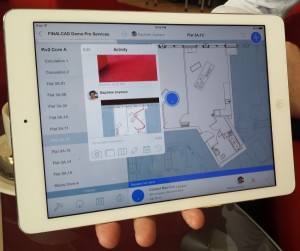
Finalcad on iPadI met Baptiste Joyeaux, head of international development in London last week and he demonstrated the application to me. Its interface is similar to other tools such as 4Projects’ Field View (formerly Priority1) and Snagr (who I talked to at LondonBuild recently; 2011 post) insofar as it adopts a plan view of built assets with issues at different locations indicated by coloured blobs.

Mobile-first interface

The mobile tool is straightforward to use. When an issue is identified, it is automatically assigned a unique ID and the user can immediately assign it to a contractor for resolution, recording details, adding a photo (annotating it if necessary) and maybe attaching any relevant documentation, and fixing a deadline for response. As Finalcad is a native app, connectivity isn’t required, but as soon as the user has an internet connection, they can choose to synch their device and the issue is uploaded to the cloud-hosted system (deployed via Amazon Web Services – also being used by Snagr).

Finalcad on iPhone and iPadA simple colour coding system then helps the user keep track of the issue’s status. An un-synched issue is blue; once synched it turns green; when the recipient of the notification starts to work on the issue it turns yellow; the issuer then might receive a notification that the issue has been fixed and if they then confirm it has been resolved, they can close it out, and the blob turns to grey. Baptiste demonstrated the rapid relay of notifications from issuer to contractor and back again, showing me the report outputs summarising the status of issues by project zone, by contractor, etc. All interactions are captured in a secure audit trail.

Baptiste also showed me how Finalcad had been customised to offer more granular levels of navigation to meet the needs of different stages of projects. For example, even before rooms are created, Finalcad can be used to capture and share information on individual structural elements: pile caps, beams, etc.

The application also has QR (quick response) code capabilities (article). On major projects with thousands of rooms or zones, QR codes are created to label individual locations. When the Finalcad user scans the QR code with their device, the application automatically takes them to the relevant information. This opens up opportunities for Finalcad also to be used beyond commissioning and handover for repair and maintenance purposes.

Open BIM

Finalcad also sees opportunities in becoming a field tool for BIM, with the 2016 UK government mandate in mind. By retrofitting information captured on the field back to the digital mock-up, Finalcad believes it can bridge the gap between ‘as-planned’ and ‘as-built’ models. Finalcad is also working towards compliance with Open BIM standards (it joined BuildingSMART earlier this year).

Finalcad is available free for trial use by a single user, while the professional package is normally on a per-project basis, allowing use by an unlimited number of users and with no cap on storage.

Update (2 July 2015) – I learned yesterday that Finalcad’s marketing director Aurélien Blaha was formerly at Dassault Systèmes. (Tenuous link time….) According to an Engineering.com post by Bruce Jenkins of Ora Research, Dassault is [again] hoping its manufacturing industry experience will help realise ‘the industrialization of construction’.

The company, of course, has some AEC background – having provided the underlying CATIA technology used by Frank Gehry’s practice (as distinct from Gehry Technologies, now part of Trimble; post) – but, looking back a few years, I recall Dassault reported as “gunning for Autodesk” in 2010. Plus ça change …

Permanent link to this article: https://extranetevolution.com/2015/07/finalcad-expands-beyond-france/

Surveying Project Information Management

At AECbytesAECbytes, Lachmi Khemlani is working on a research project studying the implementation of project information management (PIM) software in AEC firms, as part of which it is conducting a brief survey to better understand how users are using PIM in their firms. Your response to it would be invaluable in guiding the development of PIM software to better serve your needs. Please click on this link to launch the survey.

Often mentioned in Extranet Evolution, Lachmi is a US-based fellow writer and researcher in the architecture, engineering and construction technology sector, editing AECbytes, and contributing to various books and other publications (she wrote the foreword to the second edition of Chuck Eastman et al‘s BIM Handbook, for example). She also travels widely to observe industry events (we first met at a Harvard conference on construction collaboration in March 2006, and, for the third year running, both of us plan to be at Bentley’s 2015 Year in Infrastructure conference in London in November).

She recently attended and wrote about Autodesk’s AEC Summit, for instance, where she noted the continued development of the Autodesk 360 cloud suite – “according to Autodesk, BIM 360 is the faster growing product in its history” – with, among other developments, BIM 360 Scheduling, BIM 360 Docs (perhaps, finally, superseding the venerable Buzzsaw?), and BIM 360 Enterprise Insight, scheduled for release this year.

Permanent link to this article: https://extranetevolution.com/2015/06/surveying-project-information-management/

Load more