Despite adoption of online collaboration platforms, continued parallel use of email can cause problems for projects if a dispute arises, says Mail Manager
Over two decades ago, the first Software-as-a-Service construction collaboration platforms were launched, holding out the promises of a “paperless office”, “access anywhere anytime and on any device”, and “a single source of the truth”. In 2020, none of these have been completely delivered. For now, we often simply have less paper, access so long as the telecomms hold up and information is in the right format, and an ecosystem of multiple potential sources of truth.
In 2000, when I started working for BIW Technologies (later Conject, now subsumed into Oracle following completion of its acquisition of Aconex in 2018), the transition from traditional paper-based correspondence to email was well under way. Many architecture, engineering and construction (AEC) users were increasingly comfortable using electronic communication systems – particularly when these systems were largely dependent on hardware that was physically hosted in their offices or in a corporate data centre.
Entrusting communications to “the cloud” was another matter, however. As a result, even where centralised web-based systems are established to host construction documents, drawings, photographs and forms, many users will circumvent the systems and communicate via email. In February 2006, I wrote my first “email argument” post (followed by others in 2007 and in 2009). By this time, AEC SaaS vendors were building strong integrations between their collaboration platforms and email tools such as Microsoft Outlook. But, even today, over 20 years after the first extranet adoptions, the first instinct of many construction professionals is to use email as their communication platform for project-related correspondence. And many mobile solutions also push email notifications by default.

Mail Manager
 It is hardly surprising, therefore, that applications have been created to manage project-related emails. The appeal, for example, of Newforma to many AEC businesses was that it sat inside their firewall and had a plug-in to Microsoft Outlook that allowed emails to be quickly saved with their respective projects (July 2007 post). The same could be said for intranets and for other tools that were tightly integrated with Microsoft Office and/or its Sharepoint solution (for instance, Cadac Organice – October 2011 post). International construction consultancy Arup has also worked in this field, developing a tool called Mail Manager. Today around 70,000 people across some 2,000 companies deploy the UK-based solution.
Earlier this year (April 2020), Mail Manager published a report (news) highlighting the construction sector’s continued reliance on email (based on a survey of 450 users in AEC firms across the US [33%], UK [47%], APAC and South Africa). It also looked at what happens when a project goes wrong and firms need to retrieve information relating to their projects.

It is sobering reading for those thinking that most interactions might be in their collaboration platform aka extranet or in a common data environment (CDE) system. However, Mail Manager might well form part of a CDE: the latest UK guidance on the ISO 19650-2 BIM process says: “the CDE is a combination of technical solutions and process workflows” (p.28). It continues:
“… many solutions exist to deal with different types of project information. There may, for example, be document management tools for design files, contract management tools that manage commercial information, email management tools for correspondences and mobile based tools for site quality data. Each solution may have multiple and different workflows ensuring that information is carefully planned, shared, stored, managed and retrieved and that it is timely, correct, complete, and consistent.” (emphasis added)
According to Mail Manager’s survey, email is still, despite the predictions of its downfall, the letter of today when it comes to projects. Indeed, 55% of respondents reveal over 80% of their project correspondence is via email, while a further 24% answered 71-80% of their project correspondence is via email. Additionally, 88% of respondents are concerned about project information not being readily available, and not being visible. That’s particularly worrying given 99% have had to retrieve emails from a past project.
Survey findings
- The ability to retrieve information
- 1 in 5 (18%) respondents ‘need to reproduce information’ when chasing payments
- 1 in 5 respondents say scope disagreements are the biggest problem they face
- Where is your evidence of the things that you’ve agreed to on a project?
- In a legal dispute, half of the respondents (48%) need to retrieve correspondence relating to scope/agreements on the project, and a further 23% need to retrieve contracts
- The AEC industries are good at documenting information, but not retrieving it. 0% say their information is not documented
- The day file of years gone by is not anymore. It all lies in email
- Email is king. 50% of respondents say the majority of information relating to scope changes reside in email
- Businesses are concerned about their ability to find project information
- Only 1 in 10 respondents are confident and comfortable with finding project information
- Retrieval of project information key
- 99% of respondents have had to retrieve emails from a past project
- 60% of respondents have had to retrieve emails regularly from a past project
- Businesses are looking more at how to make them more efficient and productive
- Despite the buzz around Digital Twins, BIM and cybersecurity, 1 in 5 respondents (19%) list streamlining processes as their key initiative, while 14% are focusing on cloud adoption
Online data capture
Issues about accessing the audit trail of a project in the event of a dispute were recently highlighted by claims consultant HKA (read 2 June 2020 Construction Enquirer article “Contractors face data danger fighting covid contract disputes“). With construction businesses starting to make staff redundant due to uncertainty during the COVID-19 pandemic, the consultant warned contractors to protect project data or risk vital information walking out the door with redundant staff. HKA director Lori Noeth said:
“Dealing with claims is a lot more difficult where project staff are no longer available, and their collective knowledge is lost. Information needs to be carefully collated now prior to the departure of key staff so their project knowledge is captured in records rather than just committed to memory.”
Loeth recommends documenting everything electronically and using indexing software to make searches easier. She said: “Contractors need to keep a tight hold on their project data to give themselves the best chance of success with future claims.”
Finalcad: “digitalisation has been patchy to date”
 Update (26 June 2020) – French SaaS technology firm FinalCAD undertook similar, but more international, research looking at construction work practices in France, Spain, Singapore and Japan. Its survey (report here) found email was the most common tool used for assigning work, for documenting safety issues or incidents, and for sharing information about those issues with colleagues. Purpose-developed software tools tended to be used less often by the survey’s 400 respondents. According to FinalCAD, this lack of digitalisation “means that essential tasks … are inefficient and inaccurate [and] is compounding the problem of low margins in the industry.”

 NoteVault was profiled in Extranet Evolution in
  “Digital twins continue to transform the way projects are delivered and operated. Inherent in every digital twin is a stream of continuously updated data, and for construction, automating the semantic interpretation of field reports can now be one of the richest sources of live project information. With the addition of NoteVault’s market-leading resource tracking capabilities, the SYNCHRO 4D construction environment delivers the most comprehensive construction digital twin solution available. We are excited to continue advancing the scope of construction digital twins.”


 “E7 is distilled from Envision (E and the seven letters that follow), in a deliberate design cue reflecting our decade-long tradition of supporting major resource, energy, and infrastructure projects. This change will apply to our organisation, Ennova Consulting Pty Ltd, and our software application, Envision. Our new company name in Australia is E7 Pty Ltd. … Our new logo is inspired by our focus on the capture and analysis of data from projects.”
 GoReport CEO since 2018 (
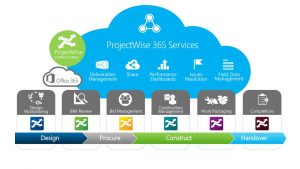 This pre-configured “instant-on, web-based” ProjectWise 365 solution has now been made generally available. It complements the enterprise-level ProjectWise Design Integration (DI) platform used — often on-premise — for work sharing by 74 of the ENR Top 100 Design Firms, said Dustin Parkman, Bentley’s VP, project delivery. With remote project working now widely enforced around the world due to the COVID-19 pandemic, such ProjectWise DI users said the platform helped “sustain their project productivity over the forced transition to work from home,” Parkman continued.
 Parkman told me ProjectWise 365, as a purely cloud-based solution hosted by Microsoft Azure, is good for small work groups, with none of the barriers that hamper enterprise IT deployments:
 “Foth’s infrastructure team for the most part hasn’t skipped a beat during the pandemic. We are fortunate that infrastructure and IT leadership teams have designed and implemented a versatile and robust technology solution to support our geographically diverse workforce. Mobile CAD workstations, cloud technology, VPN and RDP solutions, mobile Riverbed WAN optimization, Microsoft Teams and Skype collaboration solutions, and various document management solutions all play key roles in keeping everyone securely connected to each other and to their work, all while staying efficient and productive.
 Finally, following Bentley’s acquisition of SYNCHRO (
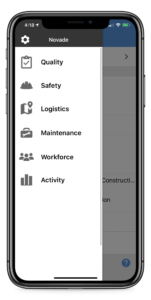
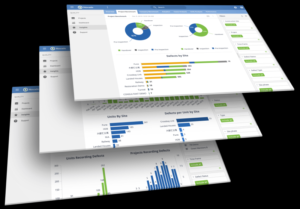 Depending on the tasks and on the mobile device (Novade apps are available for Apple iOS and Google Android; data is hosted in Microsoft Azure facilities), the toolset includes QR code recognition, near-field communication (NFC), image annotation, forms, digital markup (Novade is not a drawing revision management tool, Zasadzki stressed) and digital signatures. The core field modules — Quality, Safety, Logistics, Maintenance, Workforce, Activity — are also supported by strong geo-location services. Depending on the type of project, locations can be tracked in hierarchies (suburb, block, street, number, level, unit) or by chainage for linear civil engineering projects. Data was also being captured for use by project teams using 4D building information modelling (BIM) to support progress reporting, augmenting the data captured in project management tools and so-called common data environment (CDE) platforms. Field-captured data can also be summarised and reported upon via the Novade Insights business intelligence module.
 Founded in 1991 and based in Auckland, New Zealand with an additional office in Sydney, Australia, RAMM Software is a leader in asset, work, and field management cloud software to local governments, national authorities, consultants, and contractors throughout Australia, New Zealand, and Fiji. A 40-strong business, RAMM says its open and flexible architecture allows the expansion from the road maintenance and operations industries into other asset types in the near future. RAMM serves aroster of APAC clients, including New Zealand’s state-owned highway owner, the NZ Transport Agency, every local government council in New Zealand and all of their road maintenance suppliers, over 120 local governments in Australia, and the Fiji Roads Authority.
 thinkproject CEO Gareth Burton says:
 RAMM Software’s general manager, Graeme Norman, will continue with the company in the role of thinkproject regional manager for Australia and New Zealand. He says:
 Customers pay a fixed monthly fee per camera per calendar month (currently
  Since I first wrote about the impacts of the coronavirus shutdown on construction (
 Some new services are also being developed to support projects working through the pandemic. A
 The latest annual report and accounts from Stuttgart, Germany-based software provider
 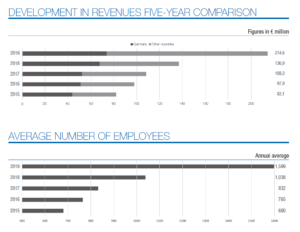 Until 2019, RIB derived most of its revenues from Germany. Now it’s much less: