‘Buzzword bingo’ may occasionally include ‘Big Data’ – alongside terms such as BIM, business intelligence, artificial intelligence, machine learning and digital twins. Growing use of such terms in the built environment suggests we are beginning to appreciate the value of data – or how data demonstrates value.
Common definitions of Big Data (such as the one in the English edition of Wikipedia, for example) make it clear that we are talking about enormous volumes of data – “data sets with sizes beyond the ability of commonly used software tools to capture, curate, manage and process data within a tolerable elapsed time”. On 25 September 2019, at Bentley Systems’ digital academy in London, Constructing Excellence held a small conference on big data, and I helped to set the scene.
The ‘big picture
Humanity’s ability to create data is growing almost exponentially. Activities in meteorology, genomics, complex physics, biological and environmental research, internet search, and finance and business informatics (to name just a few) are all spewing out huge volumes of data. In our daily personal and business lives, we are increasingly surrounded by devices that contribute to these volumes (mobile devices, software logs, digital cameras, microphones, RFID readers, wireless sensor networks and streaming instrumentation, among others). Population growth, wider literacy, associated use of mobile devices, and adoption of social media and the ‘Internet of things’ are accelerating the trend.
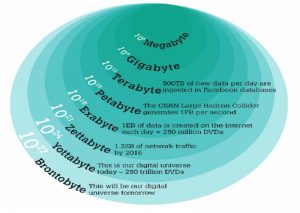 Ten years ago (2009), we and our hardware and software created just under one zettabyte (that’s a billion billion megabytes) of data – by 2016, this figure had grown to 16.3ZB, and by 2025 it will be ten times as much: 163ZB. And a growing proportion of this data (around 80%) is also unstructured data – data that cannot be neatly defined in rows and columns or in databases – captured in images, video, audio, PDFs, point-clouds, emails, word-processed documents and the like. Such semi-structured and unstructured data requires more storage, is more difficult to manage and protect using legacy solutions, and is more complex to analyse.
BIM, the built environment, BI and Big Data
Core BIM processes, by contrast, tend to involve the creation and sharing of highly structured model data held in interrogable databases – and, at a project level, the data sets are usually well within the capabilities of commonly used tools. Yes, common data environments, CDEs, may also hold a wealth of associated unstructured data, but model authoring applications and the numerous workflows related to creating new built assets (or refurbishing existing ones) tend to be founded on structured data. As a result, we can generate a lot of business intelligence, BI, from all this information, holding it in data warehouses, and presenting it in reports and dashboards, but BI presents a tiny proportion of what might be contained in ‘Big Data‘.
Some AEC technology vendors might like you to think that their platforms will deliver ‘big data’ insights, but usually they are just crunching what is in their databases (a 2018 ‘construction dive’ from Oracle Aconex, for example, talks about Big Data, but the project insights come from BI tools within the Aconex construction management software).
- BI uses descriptive statistics with data with high information density to measure things, detect trends etc.
- By contrast, Big Data analytics uses inductive statistics to infer laws (regressions, nonlinear relationships, and causal effects) from large data sets to reveal relationships or dependencies and to perform predictions. Crucially, Big Data analytics is primarily (often c.90%) focused on un- and semi-structured data.
I used a water analogy to explain the difference. A data warehouse is like a store of bottled water. This water (data) has been filtered, disinfected, divided into neat portions and packaged for easy consumption – it is clean, refined and structured, and we have confidence in its quality. By contrast, a data lake is like a large body of water in a more natural state: water constantly streams in from different sources to fill the lake, and people can look at the surface, dip a toe in, dive in, or take samples. That data lake holds a vast amount of water (and other things – from microscopic pollutants to plants, animals and inanimate objects); its water is not clean, refined or structured, and large volumes of it may need significant processing. Understanding the health and value of the data lake may also involve looking at its situation, and at its interdependencies with other systems, and re-appraising it periodically as it will be constantly changing.
Big Data analytics
Analysing big data is typically a multi-step process involving data- and text mining, data optimisation, natural language processing, searching, path/pattern analysis and statistical analysis. Often millions, even billions, of data points need to be processed, so analytics is often conducted on massively parallel software running across multiple servers (technologies include MapReduce, Hadoop and Apache Spark).
Human subject matter experts help identify what data might need to be ingested, how that data might need to be linked, and whether additional processing or data might also be needed. Artificial intelligence and machine learning (post) are also exploited, as algorithms engage in anomaly detection, association rule learning, clustering, classification, regression and summarisation. The outcomes from typical big data analytics can be visualised through various dashboard ‘lenses’: groups / fractal maps, links and networks, geographical maps, and lists.
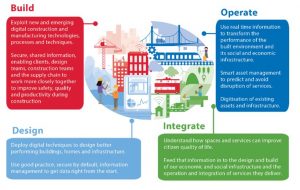 The information-intensive built environment industry has huge opportunities to exploit the data it collects, and recent UK industry debate about ‘digital twins’ and ‘national digital twins’ hints at what the future might hold. Owner-operators and their project teams often accumulate vast swathes of information, much of it in documents, and sometimes not always well-connected – disciplinary, organisational, contractual, and digital silos often need to be broken down to get the ‘big picture’ about how built projects are planned, designed, constructed and then operated and maintained.
Analysing such records across entire portfolios, and even establishing data connections to other portfolios, may yield further insights. Such insights might be even more valuable when decision-makers can also draw on data showing the social, economic and environmental impacts of interactions with the wider built environment, and then start making informed predictions about what new investments might deliver (this is the interconnected vision of the ‘national digital twin’ put forward by the Mark Enzer-led digital framework task group of the Centre for Digital Built Britain – post). In many instances, the analysis falls short of definitions of Big Data analytics; nonetheless, deploying BI can deliver powerful insights.
A case study: BAM Ireland and Autodesk Construct IQ
At the Constructing Excellence mini-conference, Michael Murphy of BAM Ireland illustrated how contractors might exploit the hitherto under-utilised data they collect while delivering their projects. He highlighted how silo mentalities hinder this process, and mentioned a research finding suggesting “95% of all data captured goes unused in the engineering and construction industries.” In its use of data, he said construction needs to shift from being:
- reactive (responding to events that have already happened) …
- … to become proactive (actively identifying risks by analysing an organisation’s processes), and …
- … then predictive (analysing processes and the environment to identify potential future problems).
Murphy also cited a 2019 KPMG survey of 223 business leaders which forecast that data analytics and predictive capability would be the number one priority for tomorrow’s construction businesses (and he used the same ‘Digitise, integrate, predict‘ mantra promoted at Autodesk University London in June 2019 – post).
“What if every team member, across every discipline, could predict and act to prevent risk, every day?” Murphy asked. BAM worked with Autodesk to develop and apply its Construction IQ technology, which analysed data collected by its BIM 360 suite during delivery of projects. Like many other construction organisations, BAM was often engaged on multiple projects simultaneously, and was keen to digitise its information capture processes rather than rely on traditional paper-based data management methods (time-consuming to compile, with data rarely used to its full potential).
 While using the BIM 360 suite on a seven-project BIM to FM programme to deliver court buildings for Ireland’s Ministry of Justice, BAM began to exploit the thousands of pieces of data its teams were collecting. The initial project and programme dashboards were alarming, though: Murphy said 100s of high risk issues appeared to be outstanding on each project, suggesting BAM Ireland was a high risk contractor. However, further investigation revealed that many issues had been dealt with, but – and highlighting a training issue – the BIM 360 users involved had not closed these issues in the platform.
Once both BAM and subcontractor users got used to reporting and tracking issues through to closure, they were able to provide a more accurate view of their ongoing project risks. The analysis and reporting tools then became more useful in answering questions such as: What safety risks are trending on my project? Which projects are carrying more risk? What disciplines drive RFIs in my project? What are the root causes of RFIs in my projects?
Murphy said BAM Ireland achieved a 20% improvement in quality and safety on site with the added capacity to make better decisions supported by the solutions. Managers now have an easily accessible, cross-project dashboard that improves oversight across multiple complex projects. Data capture techniques improved – workflows were 95% digital – reducing paper usage to only mandatory, legal documents. And project staff now spends 25% more time focusing on tasks and risk items through the use of Construction IQ. Murphy finished his presentation with a quote from BAM Ireland’s head of digital construction, Paul Brennan:
“While other construction software solutions are simply focused on digitizing paper based workflows, BIM 360 is taking it a step further to truly harness the power of data. This is where our team sees the most value and where we can really start to have a positive impact on improving the challenges our industry is faced with.”
Murphy and BAM Ireland colleagues did a similar presentation at Autodesk University London in June 2019, talking about their focus on using data to promote pan-project change and look at the root causes of industry safety and quality issues (it also reminded me of an October 2018 AECOM presentation on Bentley ProjectWise and its Microsoft integration). Digitised workflows combined with powerful data analytics can help firms gain insights into how their projects (and their project participants) can be made more efficient and predictable, and it seems we are now beginning to see the evidence. With UK industry also being urged to adopt whole-life value approaches, and for service providers to be assessed on their ability to add value, such data may also be a powerful factor in helping them prove their value.
[I am a long-time supporter of Constructing Excellence, and am a member of its Digital group. This post is a slightly edited version of a post written for the CE blog.]

 Trimble SiteVision enables users to visualise digital models from a wide range of data collection, design and constructible modelling tools in open industry-standard formats including IFC and LandXML. For civil projects, SiteVision accurately visualises data from Trimble’s Quantm, Business Center and Novapoint; design data from Civil 3D and Bentley OpenRoads; and GIS data from Esri ArcGIS software. SiteVision powers building information modelling (BIM) projects with open data from Trimble’s Constructible BIM solutions including SketchUp and Tekla, and BIM data from Autodesk Revit and AutoCAD software. For utility companies, PLS-CADD power line design, Distribution Design Studio (DDS) and other industry-specific design data is also supported.
 The proposition remains broadly the same. Buildiro is described as “the world’s first mobile app for materials procurement which solves the key challenge of knowing stock availability thereby eliminating wasted time spent driving to merchants to source items.” By resolving inventory issues, tradespeople become more productive and merchants build better customer relationships with live online stock availability. Buildiro says thousands of customers have been able to source materials up to 30% faster following the first trial earlier this year. Founder Lukas Polach, right, says: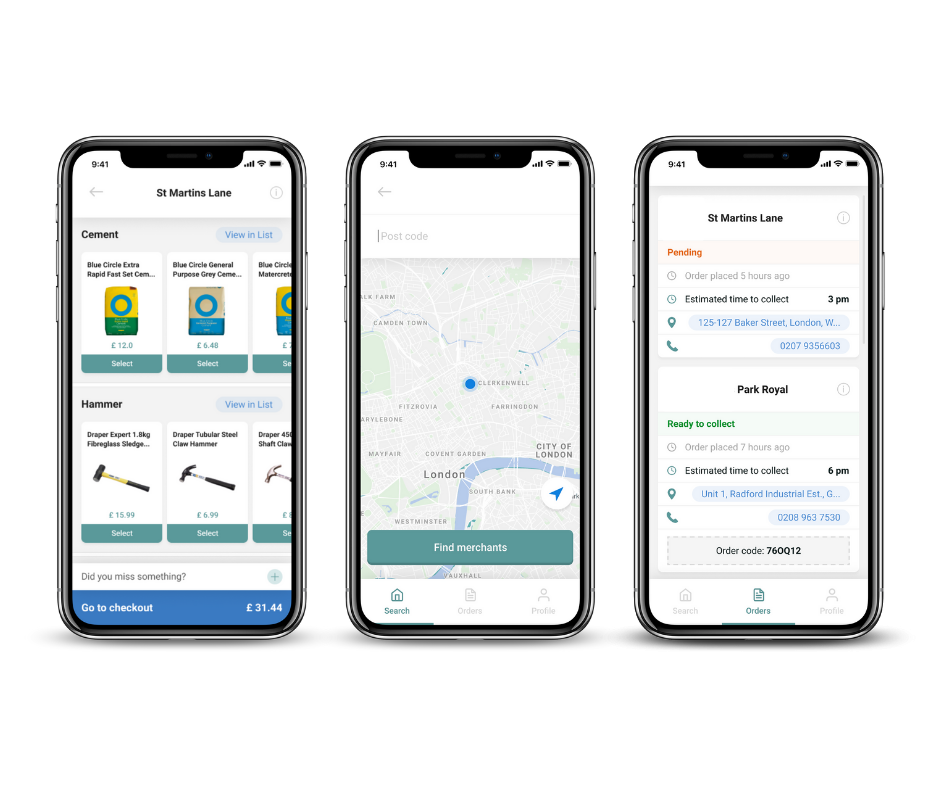
 A new Microsoft SharePoint-based project information management (PIM) solution,
  The launch event was fronted by Paul Daynes, right, formerly at Newforma UK (
 Nittygritty’s operations director Liam Southwood was somewhat less positive about SharePoint (“… in terms of it’s document management capabilities, it doesn’t really offer much more than Dropbox”), underlining that Atvero was developed to add new areas of AEC-focused capability (right). He described how it integrated with Autodesk products such as Revit and AutoCAD, plus graphics tools from Adobe. It also has the potential to share information with other collaboration products (his slide showed links to AEC platforms including Autodesk’s BIM 360, Oracle Aconex, Trimble’s Viewpoint For Projects and GroupBC). Southwood said the platform could manage file naming (a la BS 1192:2007), and had powerful versioning and revision control. A project portal can also be created to share information with external partners, creating issue sheets and the like. An Outlook plugin in Atvero also allows tight email integration “to lighten that pain”. In a live demonstration, he showed how a Revit plugin for Atvero can “reconcile Revit revisions in compliance with BS 1192/ISO 19650”, support approval processes, create standard issue sheets, and issue model files in DWG, DWF and PDF formats.
 Daynes said Atvero enabled firms to move from existing on-premise solutions – including 28Hands’ Mail Manager, Deltek PIM and Newforma – to a cloud-based Sharepoint platform. This can be hosted by Microsoft in region-specific locations, helping firms meet clients’ data sovereignty requirements.
 Productivity and profitability among many professional architecture and engineering services businesses remains a challenge, according to a July 2019 Service Performance Insight white paper produced for construction technology provider
  Digital Built Britain was produced to map the next steps in the digital journey beyond the April 2016 target of “BIM Level 2” (see March 2015 post:

 When new starters begin working for a new company, they normally have to submit training records or other documents, be registered, and then initiated on their employer’s HR, safety and corporate policies. A ‘white label’ solution, GoContractor enables employers to create online forms, share documents, and build custom training, testing and interactive material. The new-starter works through the process in their own time using any web-connected device and arrives for work with sufficient knowledge to make an immediate start.
 In March 2019, GoContractor appointed a new CEO, John Naughton, based in the company’s New York office. Naughton has more than 15 years of experience in technology transformation in construction, agriculture, marine, mining, and manufacturing, joining GoContractor from Trimble where he was a business area director focused on civil engineering and construction technologies.
 In November 2018,
 Integrating BuildingConnected with PlanGrid solves a major problem for project managers, who typically use the same designs, plans, estimates and other documentation during pre-construction as in the construction phase. Historically, managers needed to manually transfer these files and documents into field collaboration software, a time-consuming and repetitive process that can result in missing files or data errors – and ultimately, miscommunications and project delays.
 “By connecting our portfolio of construction solutions, we’re empowering customers to realize meaningful workflows across the entire project lifecycle, whether it’s delivering design files from the office to the field or referencing an accurate as-built during building operations. Autodesk is reimagining the construction business for the digital age, and we look forward to the positive impact this integration will have for our customers.”
 Having established an EU hosting base, the US’s
 (Incidentally, while watching the above YouTube video, I noticed its claim that it could “Create a Digital Twin of your entire project with ease.” This clearly depends on what definition of digital twin is used, and whether the reality captured data is connected to other data. It would not – on its own – deliver a digital twin in the way that it is being defined in the
  Finland’s
 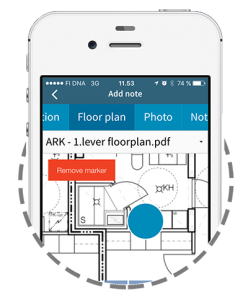 Based in Helsinki, Finland, Congrid was founded in 2013 by a team of construction site managers who had become frustrated with the use of pen, paper and Excel spreadsheets to control quality and safety on construction sites. Congrid’s cloud-based software offers users one platform to handle quality and safety management on any construction project, reducing quality costs, improving safety and maximising site productivity. Over 100 customers include major developers, construction firms, contractors and subcontractors in the Nordic region.
 Formerly (until June 2019) known as TaloInfo, HomeRun was founded in 2012 in Helsinki, and – as its new name suggests – has developed a solution more targeted at the house-building and renovation and maintenance sectors. It is a digital tool for resident communication, document management, project management and management of materials selection. By 2017, it had grown to a 10-strong business generating sales of €730,000. It shares some customers with Congrid.
 Congrid CEO Timo Makkonen, right, says: “Both companies are aiming to increase their business in the Nordic countries. This partnership will also benefit our existing customers in Finland. We want to help them succeed even better. Our applications complement each other. By combining data, our customers will have access to the best software easily, and they can enter their data into a single system.”
 HomeRun CEO Otto Laurila, left, says that both companies already share some common customers. “Our products complement each other well, and both can focus more on their own core business. The partnership makes business sense both in Finland and internationally.”


 “We are excited at Winjit to be a part of the RIB family. Our strategy and focus on IoT, Artificial Intelligence and Machine Learning software applications aligns with RIB’s MTWO platform. We are looking forward to work closely with RIB teams worldwide in the AEC industry. RIB’s commitment to Winjit proves the scalability of its business model. This partnership further strengthens Winjit to serve its customers and employees much better worldwide.”