Discussion about ‘Digital Twins’ and national digital twins has grown rapidly since 2017, with Bentley Systems leading conversations and supporting UK research.
The notion of creating a ‘Digital Twin’ of a built asset – a digital representation of the physical asset that is also connected to the physical asset to exchange real-time data – has been increasingly widely discussed in the past couple of years in the AEC sector.
Bentley champions ‘digital twin’ thinking
 It is something that I particularly associate with Bentley Systems, as the concept has been widely discussed by the company over the past three years. It was highlighted at the company’s Year In Infrastructure conference in October 2017, but was trailed almost a year earlier in a joint news announcement in November 2016 about the company’s alliance with Siemens. Technology consultancy Gartner included ‘digital twins’ in its Top 10 Strategic Technology Trends in 2017, and added impetus was created by the publication by the UK’s National Infrastructure Commission of its Data for the Public Good report in December 2017, which recommended a national national twin, an information management framework, and a digital framework task group. In October 2018, the NIC’s Sir John Armitt talked about the report, and there were several ‘digital twin’ announcements at Bentley’s YII event in London (read: Bentley ProjectWise365 extends Microsoft integration), including add Bentley’s Azure-based iTwin™ Services. Soon after, in November 2018, the Centre for Digital Built Britain‘s digital framework task group published a set of guiding principles – the Gemini Principles – laying out the foundations for national digital twin thinking (followed by a roadmap in April 2019).
 In 2019, Bentley’s digital twin momentum appears to be growing. There was more talk of digital twins at the InfraHack event in London in May 2019 (read: Hacking the Bentley iModel platform). The company has also been running some invitation-only TwinTalk breakfast discussion meetings in London (organised by Mark Coates – see previous post – and compered by journalist and YII regular Antony Oliver, the events have focused on digital twin thinking – on 6 June, attendees heard speakers from Ordnance Survey and Google [article by Oliver; some #BentleyTwinTalks tweets here]; on 25 July Sam Chorlton from Data & Analytics Facility for National Infrastructure, DAFNI, talked about the Digital Twin Hub [more tweets here]). Another TwinTalk is scheduled for London next month and a follow-up will take place at the October 2019 YII event in Singapore – at the 25 July TwinTalk, CEO Greg Bentley (right) also highlighted the high number of award entries featuring digital twin thinking submitted for this year’s event (the finalists were announced this week). And before that, on 9 September 2019, Bentley is also sponsoring a ‘Digital Twin Day’ at the Institution of Civil Engineers in London (more details here) – part of CDBB Week.
What is a ‘Digital Twin’?
The term ‘digital twin’ was coined by Michael Grieves at the University of Michigan in 2002 and related to the then emerging concept of product lifecycle management. Grieves proposed that a digital model of a physical system (a car, for example) could be created as a virtual entity on its own, containing information about the physical system, and be linked with the physical system through its entire lifecycle. Data then flows between the real and virtual space to keep the twins synchronised.
As mentioned above, the concept is now being championed in the built environment. Responding to the NIC’s recommendations, Cambridge’s Centre for Digital Built Britain (established as a successor of the UK BIM Task Force to lead the next stage in the UK construction industry’s digital evolution) is working with the Alan Turing Institute and other partners to develop the UK’s digital twin capabilities. It describes digital twins as:
“realistic digital representations of assets, processes or systems in the built or natural environment. Essentially, they enable better decision-making throughout the whole-life of assets and systems – their delivery, operation, maintenance and use.”
‘Digital twins’ and the industry currently known as construction
While individual digital twins are powerful aids to efficient asset development, they will have even greater potential if connected with other systems. Thus the aspiration is to develop a ‘national digital twin’ – an ecosystem of digital twins connected via securely shared data. In parallel, this aspiration also requires a transformation in how the architectural, engineering and construction sectors think and work digitally.
 Digital twin approaches are a key development beyond BIM, which has dominated UK construction industry technology discussion since 2009. And the terminology is starting to change. Clients and project teams were once exhorted to achieve ‘BIM Level 2’, with projects being delivered in compliance with various processes, protocols and standards. Today, the CDBB, the UK BIM Alliance* and BSI are discontinuing the idea of BIM levels and seeking to make information management business as usual, in line with the emerging international standard ISO 19650.
 With growing client focus on whole life value (look at the 2017 Industrial Strategy and the July 2018 Construction Sector Deal; also the Construction Leadership Council’s 2018 report, Procuring for Value), industry professionals are being encouraged to look beyond the ‘design’ and ‘build’ stages, and to apply processes and technologies that also support ‘operate’ and ‘integrate’ – with digital twin and systems thinking to the fore. So, while BIM may provide the foundation of the digital twins of new buildings or infrastructure assets, their value and utility will depend upon both the physical and digital assets being efficiently maintained and updated as necessary throughout their operating lives, and upon their performance and social and economic impacts being efficiently evaluated.
Bentley/CDBB digital twin research
With Bentley Systems, the CDBB has been working with Cambridge University Institute for Manufacturing (IfM) researchers plus partners from Redbite, Topcon and Geoslam on a pilot project to develop a dynamic digital twin of buildings and systems on the university’s West Cambridge campus (background here). Bentley’s Bruce Hutchinson told me the overall goals of this activity are to:
- Demonstrate the impact of digital modelling and analysis of infrastructure performance and use on organisational productivity.
- Provide the foundation for integrating city-scale data to optimise city services such as power, waste, transport and understand the impact on wider social and economic outcomes.
- Establish a ‘research capability platform’ for researchers to understand and address the major challenges in implementing digital technologies at scale.
- Foster a research community interested in developing novel applications to improve the management and use of infrastructure systems.
Work has progressed in three packages. The first saw creation of a building information model of the IfM, drawing on a 3D model of the building created using Bentley technologies, plus a detailed context capture scan undertaken by Geoslam, and 3D geometry and photogrammetry based on drone and vehicle-based scanning and camera devices by Topcon. In parallel, Redbite’s asset management solution, ‘itemit’, was used to develop an asset register, along with asset identification tags, for critical equipment across the IfM. And the team has deployed and tested additional ‘Internet of Things’ (IoT) sensors and devices that will help monitor and control the condition and operation of critical assets and the environment in the IfM. Hutchinson said 50 environmental sensors (including temperature, humidity, light), each taking readings once a minute, push data into the Bentley AssetWise solution used on this project.
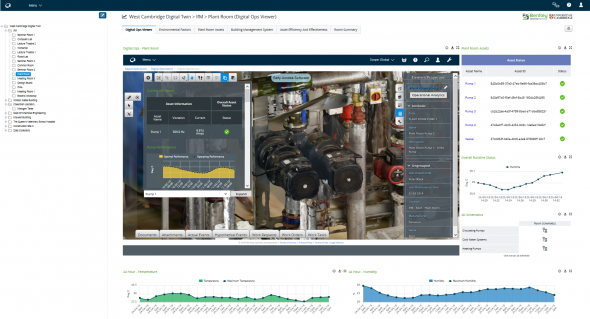
Example of model and operational data viewed using Bentley’s AssetWise platform. The dashboard first view gives a user more comprehensive access to all the available data. Users can create custom KPIs and dashboards to give maximum value, assist with decision support and navigate assets via a vertical hierarchical structure.
The second work package has focused on integrating data from various sources to enable effective data analytics and to drive better decisions. APIs with Bentley’s AssetWise platform form part of the solution, helping integrate data collected through the campus’s building management system – creating a digital operations platform. In keeping with the Gemini Principles, the digital twin uses common data standards such as IFC and is interoperable. This ensures digital twin development is vendor-agnostic and will help identify any gaps and weaknesses in the current IFC schema.
The third work package is focused on developing applications to exploit the captured data in the digital twin. Potential applications include predictive analytics to improve asset maintenance, better asset tracking, tools to improve equipment utilisation and management, analysis to help reduce energy consumption, and augmented reality support for maintenance and inspection.
Practical examples from research such as this, plus insights and lessons learned being collated by the early owner-operator members of the Digital Twin Hub community (who include the Sellafield nuclear plant), will be invaluable as the Gemini Principles are progressively fleshed out, the national digital twin starts to connect assets and inform decision-making, and the industry currently known as construction embraces whole life thinking.
* In June 2019, I was invited to be a UK BIM Alliance ambassador, and in July to be an executive director and chair of the Alliance’s Technology Group (Mott MacDonald CTO Mark Enzer, chair of the CDBB’s digital framework task group, spoke at the group’s July meeting). With Alliance chair Anne Kemp, I will be representing the Alliance and the ICE’s digital transformation community of practice at the ICE ‘Digital Twin Day’ event on 9 September.
{Disclosure: I have been an invitee to Bentley Systems’ TwinTalks events in June and July 2019, and will again be attending Bentley’s Year in Infrastructure event in Singapore in October at Bentley’s invitation.]
 The latest report to show under-digitisation of construction comes from a Bentley Systems survey of more than 720 business professionals across Europe, North America, Latin America, the Middle East, Africa, Australasia, India, China, and South East Asia. It found that almost half of business (44.3%) had limited or no insight into company or project performance. Professionals were either not collecting data or were collecting it manually instead of digitally. Even though half understood the importance of collecting project data, they failed to make the most of it by not digitising it.
 California, US-based construction management software provider
  Based in New York, NY, Honest Buildings was founded in 2012 by CEO and co-founder Riggs Kubiak. It began marketing in the UK in late 2012 and officially launched in the UK in February 2013 (
 “Procore and Honest Buildings share a vision that centers around transforming the construction industry, and we have an opportunity to realize this vision through the development of a global platform that connects everyone in construction. Honest Buildings has been solely focused on providing value to owners, and when fully integrated on the Procore platform we will create even greater value by delivering a powerful solution that provides transparency and accessibility of information to general contractors, specialty contractors, and owners on a single system of record.
 “Honest Buildings has facilitated over $20 billion of projects for the world’s largest owners and fast growing companies. Joining Procore will accelerate our growth globally in building technology that empowers owners and their teams to manage projects and the capital that funds them. Our companies’ missions and cultures align so well that from our first meetings together the energy was palpable. We at Honest Buildings are excited about the speed and impact we can have on the built world by joining the Procore team.”
 The business was established by one-time workplace accident investigator and current CEO Luke Anear in 2004 in his garage in Townsville, Queensland, and initially focused on provision of safety documents. The smartphone revolution four years later spawned the idea of digitising the documents into a mobile app, and the iAuditor safety inspection app was launched in 2012. The business was backed in a Au$6.1m (US$4.7m) Series A funding round in 2014 by Atlassian co-founder, Scott Farquhar and Blackbird Ventures, and in 2015 opened another Australian office, in Sydney, followed by US offices in San Francisco and Kansas City and a UK office in Manchester in 2016. That year also saw a Au$30m (US$23m) Series B funding round led by Index Ventures (with participation from Farquhar and Blackbird; read
 The international expansion of Stuttgart, Germany-based

 This has led some players, notably Autodesk and Bentley Systems, to invest in technologies that extend their portfolio capabilities to support BIM onsite. Bentley took a major step forward with its
  LetsBuild aims to make BIM easy to use on site and across multiple projects while providing comprehensive data to enhance as-built documentation and learning. Thomas Goubau (right), CRO of LetsBuild, says:


 As a ‘Wikipedia purist’, I am, of course, biased, and we should acknowledge the two ventures are very different.
 Harvie started by clarifying that Designing Buildings Wiki is to some extent a knowledge management project: “The industry is not particularly good at sharing knowledge, or even understanding what ‘knowledge’ is. Its knowledge is fragmented and siloed and much of it is behind firewalls or sign-up barriers. Our objective is to make industry knowledge fully integrated and freely available. A wiki seemed to be the most collaborative way of doing this.”
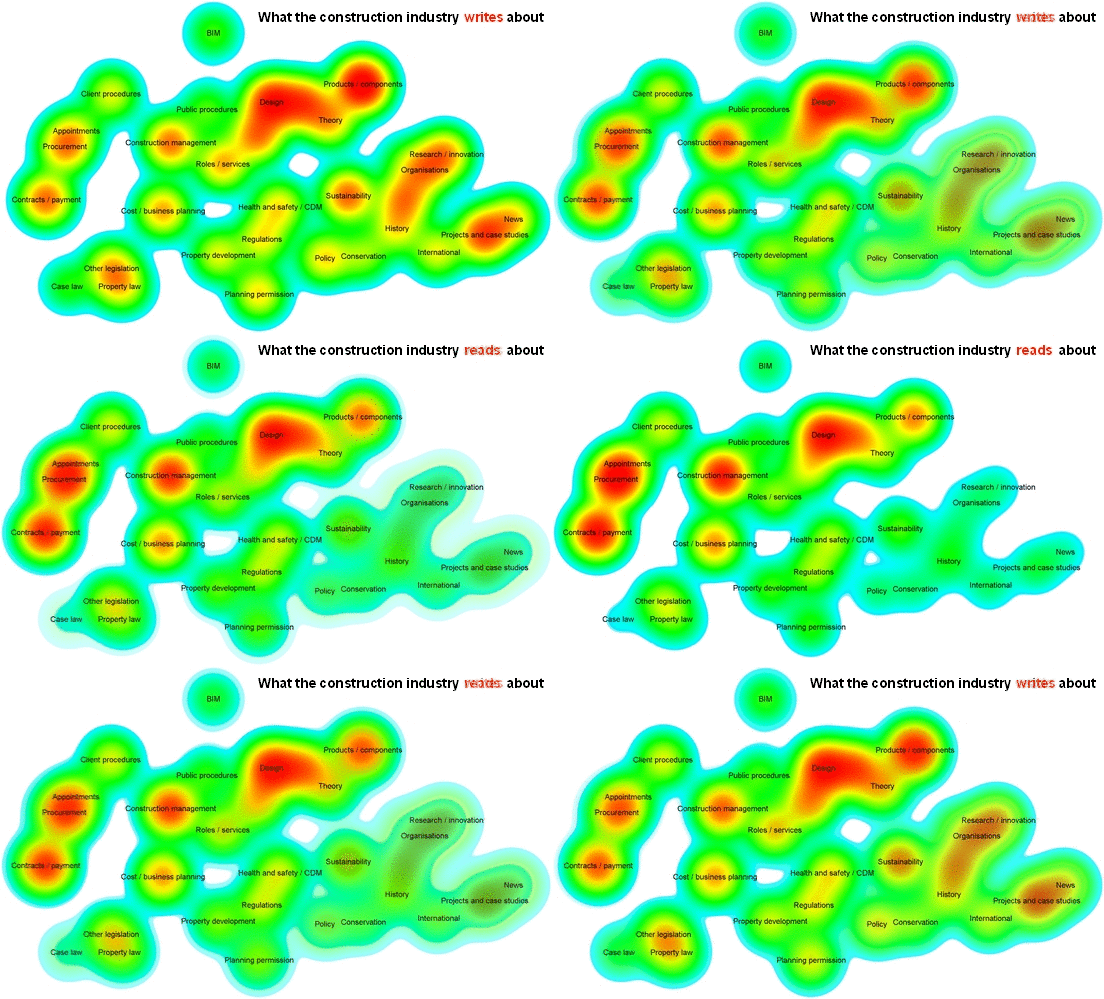 The BIM Wiki project grew out of
  Belfast, Northern Ireland-based mobile surveying application developer

 Verifi3D’s rule editor allows design checks to be defined and customized by the user to align the model with local regulations and client requirements. Schuyer’s initial focus was on showing if, and how, buildings met regulatory and project-specific requirements regarding accessibility and life safety compliance. The latter is particularly topical in the UK following the Grenfell Tower fire disaster, the ensuing Hackitt report, and ongoing discussions about mandating the “golden thread of information” into future building regulations.