Tel Aviv-based Buildots uses 360-degree wearable cameras and AI for “automated detection of schedule and design discrepancies.”
At October’s Digital Construction Week 2019 trade show in London, I spotted Israeli startup Buildots among the exhibitors. I didn’t have chance to learn more then, but the company presented at December’s COMIT community day (held in IFS‘s impressive new offices by the River Thames in Staines, west of London).
 Founded in Tel Aviv and now with an office in London, Buildots was founded in early 2018 by Roy Danon (CEO), Yakir Sudry (CTO) and Aviv Leibovici (CPO) – who presented at the COMIT ‘wearables’ event. The three have backgrounds in computer science and electrical engineering, and all have worked for the Israeli government or its defence force. Buildots investors include Innogy and TLV Partners.
Automated detection of schedule and design discrepancies
 Leibovici (right) described Buildots’ solution as “automated detection of schedule and design discrepancies.” It aims to help contractors more effectively manage the plan, execute, measure and optimise cycle – especially the measure and optimise steps. The toolset combines data collected by 360-degree cameras worn by employees with data from project schedules and uses artificial intelligence, AI, to compare captured visual data with what is scheduled in the project programme and what has been designed. It gives “precise control of the last 5%”, Leibovici said, and enables “continuous flow assurance” – which is vital in the high density residential projects where Buildots has hitherto been focused.
Buildots data and analysis from projects undertaken in Israel was shared (I understand the firm is also working with UK contractor Balfour Beatty in London). Leibovici said wearable devices enable seamless collection of highly detailed information (visual evidence). In one walk around a single floor of a residential development, data on 2500 elements was captured. Moreover, once the data had been collected, uploaded, processed and analysed, Buildots could also help to identify missing elements (missing power sockets, for example) or errors (eg: wall apertures that had been closed – on one project, 812 walls and 515 door openings were being created, and the toolset identified two doors had been omitted).
 Snapshots from the visual evidence could then be used to notify contractors about defects or omissions, while also providing a visual as-built record of how and where services had been installed prior to floor, wall or ceiling finishes being applied. The Buildots Software-as-a-Service solution also provides dashboards showing percentage completion of work packages, work logs, and can be used to help schedule payments.
The quality of visual data is, of course dependent upon the quality of the 360-degree camera used. At the COMIT event, Liebovici responded to questions about the weight of the devices and battery packs, the frequency of surveys, and lighting levels. Accurate image capture is apparently easier in sunny Tel Aviv than cloudy London!
The Extranet Evolution view
 Using wearable or mobile devices to capture visual site data is being trialled by several contractors, alongside more conventional capture using static laser-scanning and photogrammetry equipment and techniques. Perhaps the most notable competitors to Buildots in this space are the US-based OpenSpace and Holobuilder solutions.
OpenSpace hit the headlines in August 2019 after raising US$14m in Series A funding (read Forbes article), and has integrations with Procore (OpenSpace news) and Autodesk’s BIM 360 (ditto). The technology has also been deployed in the UK: St Albans-based Lindford Consulting offers OpenSpace project recording as one of its services, for example (Update [22 January 2020] – read this BIM+ interview with Lindford’s Edward Carolan).
 Holobuilder launched its 360 Construction Documentation Solution in July 2017, for example, and has expanded in Europe and progressively extended the platform’s functionality, adding SiteAI (December 2018), a JobWalk Planner (April 2019), and – launched at Autodesk University in November 2019 – SpotWalk, the first robotic construction 360° capture solution. SpotWalk equips Boston Dynamic’s Spot robot with autonomous 360° image capturing technology, allowing customers to let Spot remotely walk around a project site and create a 360° digital record of their construction projects. US Holobuilder customer Hensel Phelps is already testing SpotWalk on its $1.2 Billion San Francisco Harvey Milk Terminal 1 Airport project.
 In December 2018, COMIT also hosted a demonstration of a German-built Panono 360-degree camera (post), and 3D photography and scanning by firms such as Matterport have also featured. Away from 360-degree photography, smartphone or tablet apps for progress documentation – geo-located progressive assurance – are provided by Leeds, UK-based eviFile* (May 2017 post), which has been successfully winning work on civil engineering infrastructure and utilities projects. In July 2019, eviFile announced a project with Yorkshire’s Drax power station where its technology could potentially save the generator £1m a year (read Yorkshire Post report).
Update (10 September 2020) – Another player in this market is Oculo (read BIM+ article Hard hat cameras ensure Claridge’s project runs smoothly).
[* Disclosure: I am a non-executive advisor to eviFile.]
 Newforma, the US-based provider of hybrid (on-premise and cloud) project information management technology backed since mid 2017 by Battery Ventures, has
 Brock Philp, CEO of Newforma, says:
 “Leadoo brings website content alive! Our chatbots activate passive website visitors, who represent over 90% of all traffic, by providing a two-way conversation between the visitor and the site which converts them into leads. In our experience in other markets in Europe, we find that all aspects of the building trade – including tradespeople, suppliers and merchants – can benefit from our bots.”
 Depending on a company’s requirements, Leadoo can implement different bots including ModalBots, VideoBots and InpageBots, the latter being hugely successful. Leadoo says InpageBots sit as a natural part of website content, do not distract or interrupt the visitor, and have a 6x higher engagement rate than traditional chatbots as they ask just the right questions at the right place and time.
 In addition to immersive learning and ‘



 Hivemap is targeting medium-sized projects in the £5m to £50m bracket – schemes, Hobby (left) said, often undertaken by SME main contractors run by ambitious 30-something construction professionals. These are often frustrated by the sheer volume of reports, spreadsheets, emails and other communications – Wolter (right) says “Hivemap helps project leaders focus on the crunch points. No need to read lengthy reports and emails. This means better and faster actions“.
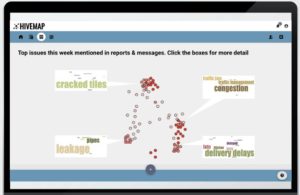 The basic project management features of Hivemap are provided free of charge. Documents, drawings and forms can be uploaded to the system and accessed by authorised team members via a standard web browser (native mobile applications are in development, applying a WhatsApp style interface to encourage near real-time conversations, while retaining records of who did – and said – what and when). A mindmap-style interface is easy to navigate; users can define shared team and private spaces, populate these spaces with project-related content, manage a range of common industry workflows (including progress on ordering and taking delivery of materials, etc), and rapidly create reports via a drag-and-drop report builder.
 Conducted in partnership with Construction Manager magazine, the Autodesk report is based on an August 2019 online survey of 251 UK construction professionals, and follows a similar survey undertaken by
  According to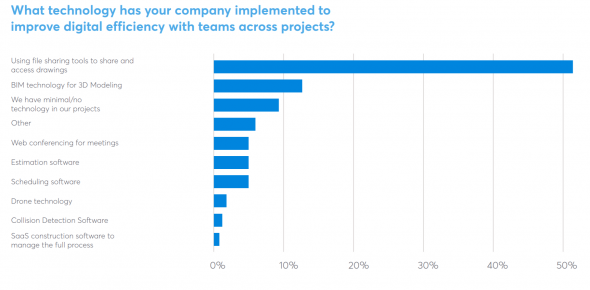
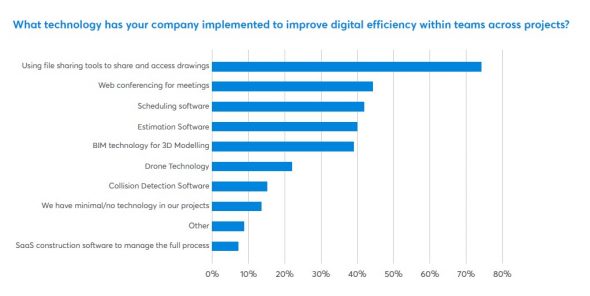
 Not all surveys do this though. In August 2019, for example, I received a copy of Rochdale, UK-based IT services provider
 Stuttgart, Germany-based


 Headquartered in Adelaide, South Australia with another office in Melbourne, Redstack is a well-established reseller of Autodesk and other software to building, construction and manufacturing markets in Australia with over 21 years’ experience. MD Michael Lachs says: “There is a great many synergies between the two businesses, and it made a lot of sense to bring the two together.” The business will roll into RIB’s majority-owned A2K brand.
 Just over a year since launching (
 Kreo has decided that ‘freemium’ is the way forward: making the Kreo platforms completely free for a limited number of projects. This allows professionals to test the technology without having to commit to any payment. Within a month it says it signed up over 100 new active users across Kreo Plan, Takeoff and Design. Kreo Design is attracting particular interest, with users drawn by its cost estimation, integration with Autodesk’s Revit, and architectural reporting features, the company says

 “We continue to execute our strategic plan to become the leading Construction Intelligence platform for asset owners and general contractors. thinkproject has leading BIM capabilities for both design (3D) and project schedules and sequencing (4D). By acquiring Conclude, we enhance our cost management with a leading cost management solution, offering further 5D capability to the group product set, while deepening our relationships with major international asset owner-operators delivering some of the world’s most demanding engineering and construction projects.”
 Conclude was founded by Drees & Sommer, Marco Lehmbach and Peter Kaul to offer innovative and practical software tools for demanding construction projects. Conclude founder and managing director Lehmbach says:
 According to an August 2019 report from ARC Advisory Group (
 At Bentley’s Year in Infrastructure conference 2019 in Singapore, the company’s Noah Eckhouse, senior vice president, project delivery, said: “users of ProjectWise … have made Bentley one of the largest ISV users of Azure“. He also announced Bentley’s intention to spread the net still further by targeting potential ProjectWise users in small and mid-sized companies. Building on
  Purpose-built for design teams, Bentley describes ProjectWise 365 is an innovative, 100% SaaS-based offering enabling teams involved in design and engineering, from practitioner and design leads to stakeholders, to readily store and find designs, accelerate content sharing and collaborative workflows, and manage feedback, for maximum team productivity. The new ProjectWise 365 cloud services will be generally available by the end of 2019.