M-Six VEO launched

Offered as both a Software-as-a-Service and on-premise solution, M-Six’s VEO BIM application doesn’t yet compete with document and project management platforms, but it may do one day….

M-Six logoAt last October’s Newforma user conference in London (post), I first heard about Oregon, US-based M-Six‘s VEO platform (with Newforma Project Center, this enabled a building information model to be viewed, and to roll-back through process data such as RFIs and see relevant BIM views – efficiently delivered using delta “diff” files). Newforma was one of the first to integrate this technology, but it is now available separately from M-Six, who officially released VEO on 6 February 2013.

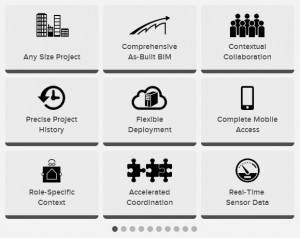
The cloud-based VEO platform (it can be deployed from VEO’s cloud servers, from ‘private clouds’, or as an on-premise toolset) supports several visualisation and collaboration applications that can be used in the design, construction, and operation of buildings and other assets. At one time, each tool had its own name (though these no longer appear to be used), but they neatly summarised the envisaged functionality (with strong caveats that some functionality isn’t yet fully formed):

    • VEO Lux for navigation and visualisation – VEO currently supports Autodesk Revit and AutoCAD, with Graphisoft and other formats to be supported “in the near future”, and can deliver photo-realistic images but not animations.
    • VEO Logic for coordination and validation – though its clash detection “functionality may not match that of your existing coordination application”
    • VEO Time for scheduling and sequencing – again, its functionality “is not yet capable of supporting all the needs of construction project management scheduling”
    • VEO Archive – a model-linked document library – “VEO won’t replace a document management solution that provides document release management with configurable workflow tools” (so early partner Newforma retains value, as could other document collaboration solutions – though much will depend on the integrations achieved between them and VEO; a thought: could SaaS firms license VEO and offer it as part of their hosted solution?)
    • VEO Track for asset tracking
    • VEO Pulse, providing real-time sensor data

In the two latter respects, and bearing in mind that VEO will be available as an Apple iPad app (“coming soon”), I was reminded of Kykloud (post), while the asset tracking will also interest facilities managers and others involved with operation and maintenance processes (see recent posts on Aconex, McLaren, for example).
M-Six VEO-overview

VEO is available on a free trial basis (currently Windows only; a Mac versions is “planned”), supported by an installer, tutorials, training materials and videos. Product pricing starts from $250/month per single concurrent user (hosted by VEO, with 25GB storage and 10 hours computing time). A project license would allow unlimited users access to a single project, with 500GB storage and 100 hours cloud compute time (and flexible hosting options), and would cost $2500 per calendar month.

Permanent link to this article: https://extranetevolution.com/2013/02/m-six-veo-launched/

Aconex launches Smart Manuals

Aconex Smart ManualsMelbourne-based Software-as-a-Service construction collaboration provider Aconex has today launched Aconex Smart Manuals, effectively a relaunch of an updated suite of products acquired when Aconex bought Grazer in June 2012 (post). The module allows contractors to efficiently capture, review and deliver the documentation required for operation and maintenance of a built asset, and owners can easily maintain that documentation over the operating life of the asset.
Kerri Lee Sinclair, Aconex vice president of operations and maintenance solutions says:

“Aconex Smart Manuals extends the business benefits of the Aconex online collaboration platform to the transition from construction to operation and asset information management. When all project team members collaborate in real time to compile digital documentation – with a complete audit trail – contractors are assured of meeting their obligations, closing the account and moving on to the next project. At the same time, owners can proceed with confidence to realize the full value of their asset through efficient operation and maintenance.”

I had a demonstration of Aconex Smart Manuals last week and talked at length with Kerri about the functionality – a conversation much informed by my experience in launching similar functionality at rival BIW, now Conject, in the early 2000s (see my first Grazer post). Then BIW was facilitating the progressive compilation of the Health & Safety File – a key but hitherto laborious and time-consuming requirement of the UK Construction Design and Management, CDM, Regulations that used to result in numerous ring-binders full of printed information. By enabling its electronic compilation, operation and maintenance information did not have to be retrospectively compiled at the end of a project, and was in a more durable format. Kerri recognised the similarities with Australian experiences, describing the process of manual compilation as “grunt work” often delegated to junior employees, and highlighting the dangers of reliance on paperwork that could be destroyed in a flood or other catastrophe.

Some ten years later, Aconex Smart Manuals offers much the same capability, but with added workflow support, progress visibility and status reporting, and is delivered in three ‘flavours’ to meet different needs and budgets:

AconexSmartManualsMontage

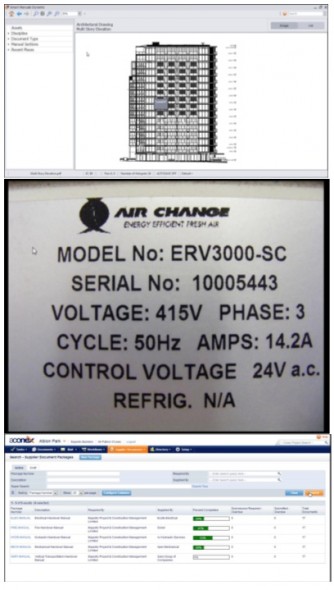
  • Aconex Smart Manuals enables contractors to define and assign subcontractor tasks and deliverables, automate review and approval processes, monitor all subcontractor actions and performance, maintain a complete and searchable audit trail, and deliver comprehensive, accurate digital manuals to owners. ‘Smart’ differentiators include the ability to navigate graphically to physical assets and access their associated information. Kerri demonstrated to me the use of photographs to select buildings on a hospital campus, then used a simple building elevation (right top) to select the appropriate floor before navigating to a particular electricity supply board, and showing information held about that asset; file searches could highlight relevant drawings, documents, photos (centre), scanned images with stamps, etc.
  • Aconex Smart Manuals Dynamic extends the capabilities of Aconex Smart Manuals to owners for the update and control of operation and maintenance manuals throughout the lifecycle of the asset. This product is integrated with the Aconex online collaboration platform, enabling users to access and manage asset information in a secure, cloud-based environment. Kerri likened this to enabling an electronic ‘full service history’ for a car, creating a resource that could be used beyond the defects and liabilities period and throughout the life of a building, with perhaps sub-manuals for discreet areas or individual tenants in a building.
  • Aconex Digital Manuals is a streamlined version of Aconex Smart Manuals which provides centralized communications and information management, as well as status monitoring for all subcontractor tasks and actions (right, bottom), enabling contractors to deliver professional digital manuals compiled progressively during the project.

Aconex Smart Manuals and Aconex Digital Manuals can be used as stand-alone solutions for projects already in progress or integrated with the Aconex platform from project inception. At a project’s conclusion, assuming owners did not want to maintain the manuals, information could be provided on DVD or USB devices.

Not totally new, but challenging

When Aconex first partnered with Grazer, in 2011 (prior to the latter’s acquisition), I wrote about my sense of deja vu insofar as the tie-up helped Aconex deliver something that has long been available from a competitor. Much of what I saw last week from Aconex was immediately familiar, and while the workflow, progress monitoring and status updating for compliance are useful additions, they are not unique. Conject capabilities have moved forward, for example, with Conject PM PropertyFile running status reports on information stored in that system, and Conject’s Business Intelligence module delivering graphical progress reports on O&M update workflows.

Today’s launch also clearly extends the capability beyond Aconex O&M Manuals’ initial limited availability in Australasia, and will be monitored with interest by rival AEC collaboration vendors who already have O&M or facilities management capabilities as part of the product portfolio. In addition to Conject (launching a SaaS-based FM module this year; post), McLaren Software (who acquired FMx in late 2012; post) will be watching closely. It also poses a conundrum to Aconex. Smart Manuals is a product set that extends client engagement beyond project completion and handover, and – as Kerri admitted – it raises a question of “how deep into FM do we go”.

Permanent link to this article: https://extranetevolution.com/2013/02/aconex-launches-smart-manuals/

Unit4 growing its SaaS revenues, as BC6.1 approaches launch

Unit4BussoftToday saw the Netherlands-based Unit4 business software group publish its financial results for the year ended 31 December 2012. Its core business is focused on ERP and related financial tools, but its software portfolio also includes the UK-based Business Collaborator SaaS construction document collaboration and workflow business which ceased to exist as a separate unit just over a year ago (post; BC is now a toolset offered through Unit4collaboration).

In challenging European market conditions, Unit4 grew revenues 5.4% with profits up 3%, while the earnings from SaaS and subscription models are becoming an increasingly important contributor to group revenues, growing 31% during 2012; its SaaS and subscriptions generated €57.0m, or about 12% of total group revenues (€469.8m). It says a trend towards SaaS is now “clearly evident” and “increasing numbers of potential customers are considering moving to the cloud, including for full ERP suites.” And industry watchers suggest “Unit4 is becoming a persistent irritant to the likes of SAP and Oracle in the UK public sector.”

This will make interesting reading to executives at Viewpoint, a US construction ERP vendor, which recently made its first European acquisition, buying SaaS construction collaboration business 4Projects earlier this month (post), and talking about eventually offering integration between the two products, which would make its AEC-specific ERP platform available to 4Projects customers and others in Europe.

Given that it was a relatively small operation alongside the big Unit4 corporate offerings, there was no overt reference to the collaboration business in the results announcement nor in the segment of the analysts briefing that I listened to online (I noticed that in the Netherlands ‘big four’ accountancy firm PWC signed an additional contract for UNIT4 DocumentManager in 2012 – but I am not sure if this is the same technology).

buscoll-makingchangehappenconf13I am hoping to get an update on the BC business’s progress when I attend the Unit4 user conference in Birmingham next month. According to the website, this event will also feature an exclusive preview of the latest edition (v6.1) of Business Collaborator with key features including a public API, QR code integration, enhanced usability, richer desktop integration, and a streamlined global dashboard.

Permanent link to this article: https://extranetevolution.com/2013/02/unit4-growing-its-saas-revenues-as-bc6-1-approaches-launch/

DesigningBuildings: a wiki in progress

WikipediaI have been interested in the potential use of wikis in the construction industry since the early 2000s, and have long regarded them as collaborative tools, with people collectively creating and improving content. Wikipedia is, of course, the most well-known wiki project (one of several from the Wikimedia Foundation).

I am a long-time Wikipedian, and as a construction PR professional and occasional public speaker on use of social media in the architecture, engineering and construction (AEC) sector, I will talk about appropriate use of Wikipedia to share information about notable subjects. However, I am often confronted by individuals’ and companies’ frustration that they haven’t been able to get their content accepted by other Wikipedia editors (this is a complex issue much discussed in posts in my PR blog, covering notability, conflicts of interest, neutral point of view, independent references, etc, etc). However, particularly for subjects which may be too industry-specific or UK-centric for Wikipedia, there is an alternative.

DesigningBuildingsLast November, I discovered DesigningBuildings (post), a UK-based open wiki established purely for the AEC and property sectors – and covering  more than just the design process implied by the name: its backers hope it will detail all aspects of planning, design, construction and management of built assets. Launched in July 2012 and backed by the Chartered Institute of Building, property developer Development Securities, engineer Buro Happold, architect Rogers Stirk Harbour + Partners, and the College of Estate Management, it aspires to be an “expert wiki”. It is encouraging UK industry practitioners to create articles, perhaps reusing information produced for other purposes, so that they and their companies are promoted as authoritative sources of knowledge and expertise.

To date, the site has accumulated over 600 articles, with some achieving exceptionally high Google search engine results. Today, for example, I did some Google searches for various keywords:

  • “management contractor” – first result
  • “room data sheet” – first result
  • “preliminaries” – second result
  • “interim certificate” – first result

From a PR and marketing perspective, such search engine results are spectacular, particularly if I was, say, a management contractor or a quantity surveying practice looking to be be associated with a prominent article. DesigningBuildings is not a business directory, but articles can also be sponsored so that a company’s name and hyperlink appears – in a similar way to Google Adwords – alongside the article. Moreover, authors of articles can append a signature to the page (eg: here’s an article I started on the Chief Construction Adviser – currently 9th in Google search engine results) with a link to a user page (here’s mine) with further links back to their website and showing other contact details.

DesigningBuildings article on architectural ironmongeryWith construction marketeers becoming increasingly keen on content marketing, DesigningBuildings could become a powerful platform for agencies and in-house teams to promote businesses (and the individuals in them) as experts or opinion leaders on key areas of the site’s content, which they create. Moreover, the content might also be shared via other social networks – since I first discovered the site, it has added ‘Share’ buttons at the bottom of articles.

The site uses the same Wikimedia content management system as Wikipedia, but DesigningBuildings has been developing a more user-friendly editing interface. However, from talking to the team,* I know it adheres to some of the same principles as Wikipedia. Articles must not be promotional in tone or about companies, their products, services or projects. However, there remains considerable scope to write with authority and insight about generic subjects – architectural ironmongery, for example (I have spoken to two recent meetings of architectural ironmongers, and reckon GAI members could quickly create factual articles about door handles, locks, hinges, door-closers, fire-doors, electronic access systems and the like).

* Disclosure: I am undertaking some paid consultancy work for DesigningBuildings.

Permanent link to this article: https://extranetevolution.com/2013/02/designingbuildings-a-wiki-in-progress/

16 reasons why nobody yet dominates the construction SaaS collaboration sector

Despite widespread adoption of SaaS-based construction collaboration platforms and wider acceptance of SaaS, no company has achieved real dominance across any major regional, national or vertical AEC market. Why? [Warning: this is a longer-than-usual post!]

By revenues and (notwithstanding recent restructuring) by manpower, Aconex is the biggest player in the Software-as-a-Service (SaaS) based construction collaboration market, but its prominence has been achieved on relatively modest revenues and, in recent, years, continued losses. The Melbourne, Australia-based company was one of several that launched during the dot.com boom of the late 1990s and early 2000s, all hoping to ride an architecture, engineering and construction (AEC) e-business wave generated by faster internet speeds, increased use of IT, and growing enthusiasm for collaborative working. Of course, the dot.com bubble soon burst, puncturing plans for rapid growth and stock market flotations; vendors instead had to settle into longer campaigns to achieve market dominance (which, in my view, is different to ‘leadership’ which is prone to all sorts of definitions depending upon how a vendor justifies its leadership claims – see September 201o post: Does “industry leadership” matter?).

Yet, despite apparent consensus on the value of SaaS-based construction collaboration platforms and wider acceptance of SaaS, no company has achieved real dominance across any major regional, national or vertical AEC market. Why?

I have been asked this several times, and there is no quick or simple answer. There are numerous often inter-related or overlapping factors that are beyond the control of individual vendors (a complex market structure, global recession, etc) and then vendors may mistime or miscalculate their strategies.

  1. Fragmented customer base – Choices about collaboration systems are made at both project and enterprise levels, by consultants, by main/general contractors, and by the ultimate owners of assets (or sometimes by multi-company groups comprising two or more of these). Few of these firms dominate their markets, so there is fierce competition at every level in the supply chain; it is therefore difficult (impossible?) for a vendor to agree strategic deals with most of the leading companies that will give it, in turn, a dominant market position in one country or region. Equally, many consultants, contractors and clients/owner-operators are in competition with similar firms, and may consciously select a rival platform to maintain a perceived differentiation.
  2. Continuous ‘pilot projects’ – Particularly in the early days of collaboration, systems were often selected on a trial or pilot basis, with no guarantee that a system would be deployed on subsequent projects. Indeed, often rival systems would then be tested for comparison purposes (notwithstanding the difficulties of comparing performance across even apparently similar projects), drawing out the final selection of a preferred system still further.
  3. ‘Project churn’ – As AEC supply chains are reconstituted for subsequent projects, competitive marketing and sales processes – already often protracted and time-consuming – often had to be repeated. This limits the vendor’s ability to market the system to new customers and their supply chains.
  4. ‘People churn’ – Similarly, with many construction people employed only for the duration of a project, personal preferences count for nothing if they are no longer in post when it comes to their employer company selecting a system for its next project.
  5. Product sale complexity – Simple self-service approaches to buying online collaboration have not worked (at least not yet – Woobius and some other low-cost platforms have tried; post). Particularly at the higher-end, collaboration platforms are still sold like consultancy services, with their precise configuration and delivery capable of almost infinite variation, and with considerable scope for negotiation over what is provided and at what price. Without more “commoditisation”, buyers find it difficult to make consistent comparisons between the different offerings.
  6. ‘Low hanging fruit’ – Vendors’ sales people will often chase one-off project opportunities (I recall colleagues sifting through published contract leads to identify potential customers) where the cost of a collaboration system will be regarded by the customer/team as an overhead of project delivery. This reactive, project-centric approach to sales is different to the more strategic approach needed to secure corporate deals, which will also be more complex and time-consuming to negotiate. For example, I understand Aconex secured some major project deals in Australia with global mining firms like Rio Tinto, but did not then convert these into longer-term enterprise deals.
  7. ‘Lock-in’ – If and when a vendor does successfully negotiate a longer-term relationship with a customer so that its system is used on multiple projects, the customer may, when the deal comes up for renewal, be reluctant to move to a rival platform. In-house users and supply chain partners would need to be retrained; data might need to be exported from the previous system and imported into the new platform. As a result, the potential risks of switching supplier may outweigh the benefits, creating a technology ‘lock-in’ that looks like customer loyalty, but isn’t.
  8. Strong service relationships – Of course, vendors can also build a strong bond with a customer by being responsive to their technology needs, ensuring high levels of customer service, and offering financially attractive long-term commercial deals. This can mean a steady and predictable revenue stream for the vendor as they nurture their loyal “cash cows” while consistently replace ‘churned’ projects; here, genuine customer loyalty may mean experienced collaboration users do not switch to any emerging market leaders.
  9. Low SaaS commitment – It is easy to forget that provision of SaaS collaboration to the architecture, engineering and construction industry was not solely the preserve of new start-ups; firms such as design software giants Autodesk and Bentley also created online collaboration products, while Microsoft’s SharePoint has also been deployed as a collaboration solution. Historically, these firms already enjoyed significant penetration into the AEC sector, but they lacked expertise in and commitment to SaaS approaches to software sales, licensing, hosting and support. As a result, their solutions (eg: Buzzsaw, Projectwise), while initially popular among design users, failed to achieve the same degree of dominance as their on-premise CAD products.
  10. Fear of the M&A ‘downside’ – In other markets, leaders can emerge as they buy up competitors and take over their loyal customers. This has not happened in the AEC collaboration market. For a start, if a vendor bought a direct competitor, it would need to support two applications and two hosting infrastructures and then progressively move customers to a single solution. This runs the risk of antagonising users of the discontinued solution(s), while slowing development of its incumbent solution(s). And, for some of the reasons above, there is often little solution loyalty to limit ‘churn’ and make such M&A activity viable.
  11. Limited M&A appetite – Even if these issues could be satisfactorily addressed, there has been little appetite for merger and acquisition activity among the leading players (ignoring the mergers of then financially distressed businesses such as BuildOnline and Citadon). Most acquisitions have been by suppliers of other types of software (eg: ERP in the recent case of 4Projects) looking to grow some SaaS capability, with the exception of Conject’s acquisition of BIW in December 2010 (where there was at least a good regional ‘fit’). Given the substantial war-chest of up to Au$50m created by Francisco Partners’ investment in Aconex in September 2008 (post), it is perhaps surprising that the company has only made one small acquisition (of Grazer last year; post) and not looked to consolidate the market by acquiring a competitor or two.
  12. Global financial crisis – The past five years or so saw many AEC projects discontinued or delayed, consultants, contractors and clients going bust, with some regions or countries particularly badly hit. This had a knock-on impact on all project-based businesses, including collaboration vendors who, in some extreme cases, found loyal enterprise customers going into liquidation (eg: BIW suffered from the effective withdrawal of Nakheel from the Dubai market, and the demise of two long-term deals with major UK banks; Aconex was also hit by the Dubai downturn). The credit crunch has also increased competition on price, cutting margins and so limiting the ability of vendors to invest in marketing and sales.
  13. International structural differences – While many of the collaboration platforms offer generic functionality, there can be significant differences between industry structures, processes and terminologies. As a result, for example, US-developed systems were rarely effectively deployed in markets adopting more complex, UK-style approaches to construction project planning, design and delivery. UK-developed systems could be successfully deployed in the US, but buyers can be sceptical of non-US platforms – and the location of hosting facilities can be critical (EU businesses can be wary, for example of hosting their data in the US).
  14. Transient marketing – Provision of local sales and support can help but it is expensive and time-consuming to create a self-sustaining operation in a new country; and partner networks have, so far, had limited success (Aconex, Asite and 4Projects all have active partnership programmes – post). Aconex grew its global footprint very rapidly during the 2000s, but rarely deployed more than a handful of people in each country. Arguably, it could have achieved deeper market penetration by focusing on some key growth markets (China, Japan, India, etc), establishing local hosting and indigenous employees, rather than chasing distributed opportunities. It has invested heavily in recruiting US personnel to grow its north American business but the benefits have been slow to appear.
  15. Micro-management – Growing a SaaS business to become a major player in a country market is an achievement, of course, but then taking that business the next step so that it dominates a region or global market is a very different challenge, and one which company founders, used to hands-on micro-management, may find a step too far. It is also easy for small issues to distract such leaders (could the Hitler t-shirt debacle have been nipped in the bud by the Aconex chairman’s early resignation, for example?), though Aconex has been appointing some experienced US executives, so this may yet change.
  16. No ‘killer’ functionality – Across the main vendor platforms, fundamental file-sharing capabilities have become increasingly similar and there is often little difference between the user interface/experience. Vendors have therefore been trying to anticipate what other functionality or services will be valued by their customers and/or end-users. For example, BIW invested in developing its project cost control functionality, while R&D at 4Projects and Asite has been focused on building information modelling (BIM) capabilities, and, if/when data begins to flow more seamlessly between project participants, we could yet see demand for greater integration between collaboration and other systems such as ERP and HR, with facilities management also a potential growth market. Contract change control (eg: NEC3 management) has been a keen UK battleground, and mobile tools are also increasingly important. However, the ‘Killer app’ has yet to emerge that will encourage migration to the relevant market leader.

Have I missed any key factors out? What else has slowed this market and the emergence of a genuinely dominant market leader?

Permanent link to this article: https://extranetevolution.com/2013/02/16-reasons-why-nobody-yet-dominates-the-construction-saas-collaboration-sector/

Construction project management survey

Derek Singleton of Texas-based Software Advice has been in contact regarding a construction project management survey he is hosting (sponsored by Viewpoint, Procore, Prolog and PASKR), with the objective of developing a benchmark report next month (March). All industry professionals who participate will be entered into a raffle to win an iPad mini. The survey is here.

Permanent link to this article: https://extranetevolution.com/2013/02/construction-project-management-survey/

Aconex restructuring

aconexAustralian SaaS construction collaboration vendor Aconex is restructuring to reduce overheads at its Melbourne head office.

Readers’ comments on previous blog posts, including one about Australian SaaS collaboration vendor Aconex and its 2012 annual results (Aconex growing revenues again), and – more recently – my reflections on the 4Projects acquisition got me looking at recent Aconex activities.* Meanwhile, on Friday, I received text messages and direct messages via Twitter about redundancies at Aconex’s Melbourne office; one of the rumours talked about “40 heads” rolling – but I couldn’t corroborate this.

Downsizing

Certainly, some Aconex employees’ posts are to be discontinued. An Aconex spokesman confirmed the company was restructuring parts of the business “to better align the organization with market trends and growth opportunities”. He continued:

“… the business is healthy. With a robust backlog of orders and a strong pipeline of new sales opportunities across all geographic regions, we are seeing continued solid revenue growth. The restructuring will strengthen our ability to support this growth while managing our levels of investment in different parts of the organization.”

I was told the number suggested for Melbourne was “off by a very wide margin”, but that posts were lost in other locations; “following the action, our current total headcount is around 350” (this does not preclude the total number lost across the company being around 40, of course – three months ago, in November 2012, CEO Leigh Jasper was claiming “35 offices globally with 400 people“). The rationale for the downsizing is economic:

“… the Australian economy has recently come under pressure. Being prudent, we anticipate a softening in the regional market, particularly in the mining segment. The action that we took adjusted our organization accordingly. … The positions represented a number of organizational functions and levels of responsibility.”

So, it’s the economy, stupid

The Australasian market has been strong for some years and the Australian dollar has strengthened accordingly, but this has made Melbourne (and other Australian cities) an expensive place to host a head office. Moreover, Aconex is also under pressure in its domestic market from rival vendors, including the indigenous QA’s Teambinder, plus ProjectCentre (recently acquired by RIB – post), as well as local partners of international competitors – such as ProjectCollaboration (post) who are reselling the 4Projects platform.

There was some investor criticism in 2011 of the board’s strategy of focusing heavily on the north American market at the expense of other markets and/or global customers where Aconex had potentially dominant positions. Up to June 2012, Australasia contributed 50% of all Aconex revenues.

This might not have mattered so much if the global business had returned to the growth levels it achieved before the global financial crisis. However, what one blog comment described as “an aggressive ‘go global anywhere’ sales strategy” appears to have generated lots of quick project wins but relatively few that were converted into long-term enterprise deals. Partly as a result, Aconex has not really kicked on from the Au$40m revenue level (restated) that it reached in 2009, while profits have been non-existent since 2007.

Aconex, 2005-2012

* Why has no vendor yet emerged as the dominant global player? Watch out for a future post on this topic.

Permanent link to this article: https://extranetevolution.com/2013/02/aconex-restructuring/

Kykloud improving surveyor productivity

kykloud-logo-whiteKykloud is making inroads to the mobile surveying market thanks to its scalable enterprise-strength cloud-based software architecture and a highly useable mobile interface.

I met up with Ed Bartlett, co-founder of integrated surveying and asset management software vendor Kykloud, in London earlier this week, just over a year after he and Nick Graham first demonstrated the Kykloud system to me (post) and we talked about its applicability to facilities managers and others involved with asset operation and maintenance.

Since then, the application and the business have clearly moved forward. The tablet application now features one major new button – “Surveys” – and this signifies where a growing volume of interest in Kykloud is coming from. In addition to its suitability for FM (it won an award recently), Kykloud is attractive to asset owner-operator organisations, and/or their consultants, who need to undertake a large number of surveys – for example, condition surveys of schools, hospitals or offices.

Ed BartlettEd (right) told me the company had found considerable interest in its tools from a range of consultants and contractors, including Sir Robert McAlpine, Willmott Dixon, White Young Green, Drivers Jonas Deloitte, Sweett Group, Summers Inman, Space Group, Faithful & Gould (see below), and Davis Langdon. He discussed examples of the types of projects that are being undertaken:

  • collating surveys of 8,000 schools for the Education Funding Agency (AECOM’s Davis Langdon is undertaking this work across northwest England and the east and west Midlands as part of the EFA’s Property Data Survey Programme)
  • assessing 300 HMRC buildings
  • undertaking a project for an international client with 88 sites in ten countries.

Kykloud-ipadviewWith its iPad-based mobile application (v2.3 now available in the Apple iStore), surveyors were finding that Kykloud dramatically improved productivity over conventional survey methods. Professionals no longer had to separately undertake a survey, compile a report and then email it to their colleagues or the client; instead, using pre-prepared templates (fully configurable to suit each organisation, client, asset and type of survey), all the required data could be systematically captured via the iPad app and then uploaded to Kykloud’s securely hosted data repository and reporting system, where it can be checked for consistency and quality assurance purposes, and then used to generate reports.

kykloud process

Photographs taken with an iPad could also be tagged and associated with each project, saving a laborious separate process of uploading images from a digital camera. “Time savings in data collection are quickly being turned into financial savings, with Kykloud delivering a payback within just days in many cases,” said Ed.

Once captured in the Kykloud system, data can, of course, be collated so that organisations can make informed decisions about, for example, roof works that might need to be undertaken on buildings within a region – helping create packages of work that can be let to contractors. Ed talked about survey data being collated and used to plan procurement processes, and even becoming the ‘first data drop’ for reuse by designers and other team members using building information modelling (BIM).

Captured data can also be re-used for comparison purposes; an initial survey from a year ago might be downloaded to a surveyor’s iPad so that he can assess what has changed in the intervening period, explained Ed, or it might be used to assess the quality of workmanship and maintenance applied since the previous survey.

Faithful & Gould

Atkins Group subsidiary, Faithful & Gould has been using Kykloud on several building surveying commissions, including the condition survey of more than 200 sites for the Scottish Agricultural College Estate (SRUC). It reports that the application has reduced the time surveyors spend on site by 50%, allowing them to double their output – savings that benefit their client.

Kykloud-reportviewFaithful & Gould associate director Andrew Tipper says:

“The time and cost savings are significant, literally reducing the time on site by half and eliminating the need for the lengthy ‘back office’ administration that typically follows a survey.

“But the really clever piece of the jigsaw is the software’s ability to manage portfolio-wide data and then generate added value in the production of whole life-cycle cost plans across whole portfolios, which provides invaluable data to our clients. This functionality means that the Kykloud is so much more that an “app” – it’s an enterprise class asset management tool.”

Permanent link to this article: https://extranetevolution.com/2013/02/kykloud-improving-surveyor-productivity/

Kahootz – targeting generic collaboration in public sector

kahootz logoA Google Alerts pointed me to a recently posted SlideShare presentation about project extranets from Berkshire, UK-based Kahootz. The business highlights how the architecture, engineering and construction industry has been using online collaboration for a decade or more, and urges more organisations to follow suit. However, Kahootz is not aimed expressly at the AEC sector (which, of course, has several very well established UK providers) – it is more of a generic collaboration product and, in particular, is targeting the public sector (its web-based platform has been approved by the UK government and is available via the UK Government CloudStore).

Launched in April 2012, Kahootz is a trading name/product from Inovem Ltd, whose Inclusionware product provides consultation and collaboration capabilities to central and local government, health trusts, consulting firms, corporates and representative organisations. In this sector, it appears to be competing with some of the services provided by McLaren Software’s parent Idox plc

Permanent link to this article: https://extranetevolution.com/2013/02/kahootz-targeting-generic-collaboration-in-public-sector/

Reflections on the 4Projects acquisition

4projects logoHaving had a couple of days to research and reflect on yesterdays’s announcement of Viewpoint’s acquisition of 4Projects (post) and to discuss it with industry friends, I thought I’d try to sum up a few strands.

Deal background

viewpointcs-logoWhile Viewpoint CEO Jay Haladay was somewhat coy about the the funding and terms of the deal it seems from the business and private equity press that it was backed by a Boston-based private equity firm TA Associates which invested $76 million for a minority stake in Coaxis Inc (which does business as Viewpoint Construction Software) in July 2012 (Portland Business Journal article). The investment was expected to help Viewpoint expand its product range through both internal development and acquisition; the two deals since then have added mobile and SaaS capabilities to the group, along with 11 and 61 employees respectively, making it around 390-strong.

Price-wise, most parties remain tight-lipped, though one of the UK private equity sites, Unquote.com, gave a ball-park figure of £25m-£50m (a range which neatly bookends my guess-timates). Taking the lowest of these figures, of that $76m cash pile (which was probably augmented by other reserves), Viewpoint will have spent over half, $39m, to acquire 4Projects from August Equity and its other shareholders.

Of course, the board of 4Projects Ltd has changed as a result of the deal. In addition to Steve Nelson, Jason Warde – now firmly based in the US – has stepped down as a director of the UK company; four new board members have been appointed, representing the new owners: Jay Haladay, Matt Harris, Jim Paulson and Benjamin Ertischek (respectively, CEO, SVP strategy and corporate development, COO and CFO at Viewpoint). All four are also on the 4Projects Holdings Ltd and 4Projects Management Ltd boards.

Branding and marketing

Initial reaction to the deal from UK-based competitors was muted. Asite CEO Tony Ryan did take to Twitter to say:

Shame to see another UK name eventually disappear

… to which 4Projects CTO Andy Ward quickly responded:

Wishful thinking I’m afraid Tony. 4Projects name is going nowhere. Expect to see it everywhere 🙂“.

Certainly, there are no immediate plans to rename the business. When I talked to the Viewpoint team, they said they were taking a group-wide look at their product portfolio, but they recognised the 4Projects name has over a decade’s history behind it and is a familiar brand in several key markets (it also has a certain “does what it says on the tin” about it, being ‘for projects’).

While the immediate message was one of “business as usual,” I understand the intention is also to invest more heavily in 4Projects’ marketing than in recent years (the company disbanded its marketing team under Clare Watson in March 2011).

Tony Ryan’s suggestion that the 4Projects name would disappear is perhaps based on earlier examples of merger and acquisition activity in the UK SaaS collaboration field:

  • The bullishly-marketed, but almost continuously troubled, BuildOnline initially survived several mergers but was eventually rebranded as CTSpace when it merged with Citadon in December 2006, though the product and company names survived a while longer
  • CTSpace was subsequently bought by Sword in December 2007, who then sold it to Idox in November 2011, after which the CTSpace name disappeared in March 2012; the SaaS product is now part of Idox’s McLaren Software portfolio
  • Also in March 2012, the BIW name was discontinued in favour of the German parent company’s Conject brand, following its acquisition 15 months earlier
  • The company called Business Collaborator no longer exists, but its AEC SaaS collaboration product retains its name and is the mainstay of Unit4 Collaboration, an offering of the Holland-based Unit4 Business Software group (post).

UK collaboration: a success story?

Looking back at recent history of SaaS-based construction collaboration, it is clear that the UK market has spawned several successful businesses which ultimately proved attractive to overseas buyers (US, Germany, France, Holland). The somewhat fragmented and complex nature of British project delivery forced vendors to develop greater sophistication and configurability in their applications, and I think these characteristics have (a) helped adoption in non-UK markets and (b) proved attractive to would-be buyers looking to deploy the technologies in other regions and verticals.

Who’s left? Well, Asite, of course, and firms like Cadweb and Sarcophagus, though  – with lower traction – they will clearly not be as attractive as 4Projects.

Social media

Social media helped spread word of the acquisition. Of course, I blogged (the site recorded over 700 page views yesterday) and tweeted about it – and I saw over 70 other tweets and re-tweets about the deal in the 30 hours after it was announced. And it was good to see Jay Haladay (Update, 15 February 2013 – named Technology Executive of the Year by the Technology Association of Oregon) take to YouTube to give the CEO’s personal view:

Permanent link to this article: https://extranetevolution.com/2013/02/reflections-on-the-4projects-acquisition/

Load more