UK exclusive: 4Projects acquired by US ERP vendor ViewPoint

4projects logoSunderland, UK-based Software-as-a-Service construction collaboration technology vendor  4Projects has been acquired (for an undisclosed amount) by Portland, Oregon-based financial systems vendor Viewpoint Construction Software.

viewpointcs-logoAlmost exactly a year after I talked to Viewpoint executives about their aspirations for the US enterprise resource planning software company (see ERP vendor Viewpoint viewing collaboration space), the 4Projects acquisition was announced to its UK staff this morning (Update, 11.55am: see also Viewpoint news release). The UK business, which turned over just under £5.1m in the year to March 2012 and has been consistently profitable since 2003 (post), will continue to trade under its own name. No redundancies will result from the move; indeed, Viewpoint is planning to “invest in the team,” funding further 4Projects marketing and product development so that it ultimately offer an integrated suite of on-premise and SaaS solutions to its customers.

Viewpoint’s third acquisition in a year

When I talked with Viewpoint’s CEO Jay Haladay and VP  Strategy & Corporate Development Matt Harris in February 2012, Jay hinted about moving into the SaaS collaboration space, which they saw as a complement to its existing on-premise AEC business solutions, and talked about mobile technologies and building information modelling (BIM).

In the past 12 months, Viewpoint has acquired an AEC content management solutions vendor, Construction Imaging (last May; post), and a mobile solutions provider, ACS Connect (last month; news release). In parallel, they also began to research key players in the collaboration market, and by last summer had identified 4Projects as their preferred target for a third acquisition.

A presence in the US market was not a factor in the decision, I learned from a pre-announcement conference call yesterday. 4Projects’ partnering strategy (see 27 August 2012 post) has seen the company widen its network to reach Australasia, Hong Kong, South Africa and various countries in central Europe, and the business had also been selling in the US since 2008 (post). Its expansion – like others (Aconex, Asite and Conject included) – was hampered due to the global financial crisis, but it had begun to see north America revenues grow substantially (50+%), albeit from a low starting point, during the past two years (see 14 January post: 4Projects growing again…); similarly, Aconex’s Americas revenues grew 70% in the year to June 2012 (post).

Strategic fit

Jay HaladayMore important in Viewpoint’s decision was the strategic fit. For some customer needs, it could develop its own applications; for others, it could work with partners; but some requirements could only efficiently be satisfied by acquisition. Matt said the 4Projects collaboration solution was well-known, highly scaleable and had adoption by industry clients, and its company team ethos meant the two businesses were “culturally well aligned”. Jay (right) stressed the ‘family’ element (his two sons both work in the company), underlining that staff morale was every bit as important as customer satisfaction and a strong product road-map.

The 4Projects acquisition also gives Viewpoint an opportunity to learn from the UK business’s R&D investments to expand its BIM and mobile capabilities (post). The US AEC industry was once regarded as ahead of the UK on BIM, but the British government’s 2016 mandate regarding BIM for public sector projects has done a lot to galvanise innovation in technologies and in the necessary people, process and structural changes. As a result, the UK is now second only to Finland, according to some. 4Projects has been investing in BIM and related cloud-based developments that its directors believed would help sustain the business as its industry customers moved from 2D CAD to nD. Now, such expertise could also prove invaluable to Viewpoint customers on the other side of the Atlantic (and in other regions).

ERP plus AEC SaaS?

A tie-up between a US-based ERP vendor and a UK-based SaaS collaboration specialist is not unprecedented: Conject (then BIW) announced a tie-up with Sage Construction and Real Estate (Sage CRE) in December 2009. At the time, I felt this was a potentially a powerful move by BIW, giving it access to a network of Sage business partners focused on construction-oriented customers. But I believe progress was hampered by the US recession, the ability and/or willingness of on-premise accounting software resellers to sell SaaS-based document collaboration from a relatively unfamiliar, non-US vendor, and loss of concentration following BIW’s December 2010 acquisition by Conject.

Through Viewpoint, 4Projects can be offered to an expanding north American (and, more recently, Australian) customer base; Jay said its construction-specific v6 ERP product was proving very successful, with 191 new customers secured in the past year (almost half of them former Sage customers), helping the business grow around 50% since 2011. The 4Projects product will not be ‘bundled’ with Viewpoint ERP (or vice versa), but over time the company will respond to AEC customers wanting to connect the two offerings.

Potential integration of an AEC-focused SaaS collaboration platform and an ERP solution was something I heard discussed by Unit4 last February (I attended the company’s UK user conference and heard of the group’s plans to extend the reach of its former Business Collaborator platform across its customer base; post). However, the Viewpoint team maintain that construction customers’ needs are too exacting for “horizontal ERP systems” to be adapted for use in the AEC sector. “The construction industry is a big vertical, and contractors have very specific requirements that are best met by tools like Viewpoint,” Jay said.

The numbers

A year ago, Viewpoint was a 250-strong business turning over about $40m. The three acquisitions since then take the workforce to between 350 and 400, and, allowing for growth during 2012, the combined group probably turns over somewhere over $70m. There is relatively little overlap in the operations of Viewpoint and 4Projects, with the latter potentially giving the US business an ERP foothold in the UK, mainland Europe and the Middle East (where it has no presence) as well as supporting its efforts to expand in Australasia.

Richard VertiganI understand the deal was timed so that private equity firm August Equity and some other shareholders could dispose of their stakes in the business without having to go through a further financing round. They had funded a £21 million July 2007 management buy-out which saw £9.6m of debt funded by bank loans, a further £10.7m of debt covered by loan notes, of which £7.9m was held by August Equity; while 4Projects directors, including CEO Richard Vertigan (above) and the then CFO Steve Nelson, collectively held around £3.4m of the remaining loan notes. The Viewpoint acquisition eliminates these debts from the company’s balance sheet, clarifies the company’s ownership (it’s now a 100% owned subsidiary of Viewpoint Construction Solutions), and has tied key executive directors, including Richard, sales director Steve Spark, SVP Jason Warde, CFO Chris Baty, CTO Andy Ward and client development director Duncan Mactear, to the company for the immediate forseeable future (while Steve Nelson has resigned from his non-executive role).

Deal value? – let’s take a guess

The Viewpoint team and 4Projects people I spoke to refused to discuss the value of the deal or how it was funded, so I can only speculate about how much it was worth….

At the time of the MBO, 4Projects was valued at around 6.7 times its 2007 revenues. Factors in that valuation will have included historic revenue growth figures and positive sentiment for SaaS businesses, but the global financial crisis saw 4Projects’ growth falter for two successive years after peaking at £5.5m in 2009, the construction industry’s recovery has been patchy and pre-recession SaaS enthusiasm may well have dissipated a bit. However, 4Projects’ CFO Chris Baty recently told me about the the company’s accelerating double-digit growth and prospects of a record-breaking year to March 2013, which could put the revenues at, say, £6m. Being optimistic, in the (unlikely) event a similar multiple was applied to this deal, we could therefore be talking of a transaction worth some £40m; being realistic, I suspect the valuation to be somewhat lower, perhaps around £30-£33m.

Permanent link to this article: https://extranetevolution.com/2013/02/uk-exclusive-4projects-acquired-by-us-erp-vendor-viewpoint/

MOBILT- SaaS targeting US home improvement market

Mobilt-websiteEarlier this week, I spent some time talking to Gerry Gerber, CEO of Dallas, Texas-based GerberSoftwareProducts LLC, about his Software-as-a-Service MOBILT application. Gerry spent almost 40 years in the home improvement market (or as my US friends say: “remodeling”), and has applied that experience in recent years to creating a low-cost, simple-to-use, web-based service to support procurement and delivery of residential refurbishment and extension projects.

As the name implies, the MOBILT is accessible from laptops, tablets and smartphones, and is intended to help small-medium sized businesses (SMBs) various clients, projects and – most importantly – the subcontractors they invite to bid and, if successful, to work on their projects (similar to the e-tendering systems deployed by larger firms on bigger schemes).

Mobilt-screengrabThe project leader can create a project, upload initial drawings, photographs, specifications and other information, then invite selected trade subcontractors to express interest in bidding, and then to submit prices for their nominated work packages, allowing the project leader to quickly build up a fully-costed proposal for the client. The platform includes simple audit trail features that indicate when bidders have viewed their messages, opened files, etc. Once the client had given the project a go-ahead, the project leader can then notify all the selected participants about the schedule, etc. For those not accessing the website, email notifications and texts are also used to help keep tradespeople updated about issues needing their attention.

Clients can also access the system (but cannot access the supply chain pricing information), as can supply chain members – both to manage their bids, but also, once a project commences on-site, to communicate progress, changes, etc to the lead contractor, fellow trade contractors, etc. The system includes some simple role-based privileges (eg: coordinator, supervisor) that help determine who sees what information.

Gerry believes there is a substantial market for such an application; he believes there arever 600,000 registered US-based businesses (and probably another 150,000 unregistered ones) engaged in the remodeling [sic: US spelling] market. Even modest remodeling projects can involve management of bids from dozens of trade subcontractors, so anything that centralises and improves process control is likely to be attractive to a busy contractor engaged in multiple concurrent projects.

The system is currently priced at a competitive $99 per calendar month with no limit on the number of projects or users or the volume of information stored on the platform. Gerry is currently planning a limited Beta roll-out of MOBILT in February; various improvements to the user interface will be developed during this initial launch, and in the longer term Gerry is also looking at the potential to create MOBILT apps.

My view

This is still a product at a relatively early stage of development, US focused, and would benefit from user interface design improvements to make it more polished and professional while retaining the ease of use vital to busy SMBs with limited time to learn new software applications. White-labelling (enabling users to apply their own company branding) would be attractive to many firms, I think, as would easy step-by-step configuration tools so users can selectively tailor the display of information to their needs.

MOBILT differs from most other SMB-oriented platforms I have looked at insofar as its main focus is on enabling and controlling online bid management not on file-sharing. I have looked at several simple stand-alone file-sharing platforms, but far fewer that focus on bid management, particularly at the SMB level. In the UK, for example, I have written about two: Darley eTender (November 2011 post) and AskTobi (January 2011 post) – the Darley system is an example of a well-designed user interface that might help guide Gerry’s development of MOBILT.

Update (20 February 2013) – Gerry has just added a new whiteboard-style video animation to the MOBILT website.

Permanent link to this article: https://extranetevolution.com/2013/01/mobilt-saas-targeting-us-home-improvement-market/

SpecifiedBy planning Q1 UK launch

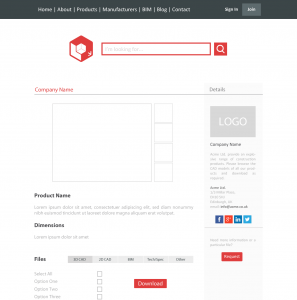
specifiedby.com-logo.jpgOn my PR and marketing blog in November, I wrote about Specified.by, a forthcoming web-based service for individuals and companies involved in the specification of materials and products used in the construction of buildings. SpecifiedBy is a venture by Edinburgh-based theCADcube and I asked director and founder Darren Lester (below right) about the service ahead of its UK launch, expected in March 2013.

For those unfamiliar with SpecifiedBy, can you briefly describe what the service offers, both now in the Beta phase, and longer-term plans?

Darren LesterSpecifiedBy connects specifiers with building product manufacturers, providing quick, painless access to detailed product information.

With an emphasis on organisation and collaboration, we provide specifiers with tools to search, share and download a variety of product information, including BIM and CAD models, technical drawings, tech/spec sheets and case studies.

We also aim to address file sharing among specifiers, real-time support from manufacturers and impartial product ratings and reviews.

For building product manufacturers, we provide a simple, effective and most importantly, measurable platform on which to promote their products directly to an influential audience. One which can directly generate online sales leads, starting the conversations that lead to strong working relationships with specifiers.

We will launch with a restricted number of manufacturers and specifiers in February to allow us to test everything before opening up publicly. Anyone who would like to be part of the private launch can sign up for an invite on our website.

What is the background to the business?

SpecifiedBy has developed naturally from our work on theCADcube, a website that provides architects and designers with a central library of 3D CAD models from leading product manufacturers.

Speaking with our users and from our experiences with product manufacturers, it soon became clear that there was a need for a ‘bigger picture’ product which addressed the building product sourcing and specification process.

Has growing UK interest in building information modelling (BIM) been a help or a hindrance, and, if so, how?

It has been a help, even though it initially caused some stress and a few late nights. I believe providing product information in a wide range of formats, including BIM, is key to helping both specifiers and manufacturers.

When we started work on theCADcube, BIM was just starting to become a mainstream topic, but I don’t think anyone predicted how much it would snowball over the last 12 months or so. So we were left with the question of how do we deal with BIM? theCADcube would have to make provisions for BIM components, but there is already BIMStore, the National BIM library and a few others. And none of them are exactly bursting at the seams with content.

As the demand for BIM grows, so does the need for secure hosting and promotional structures. So we thought about the challenges that BIM would provide to manufacturers in terms of actually delivering the content to specifiers, both through their own websites and third party websites, and we’ve incorporated that into what we are doing with SpecifiedBy.

How has SpecifiedBy been marketed, and what has been the interest/level of take-up to date?

All marketing so far has been pretty low key really. A few blog posts here and there and some promotion through social media is about the height of it. Obviously we intend to ramp this up a bit over the next few months. We will be at EcoBuild in March, at which we hope to be announcing our public launch, and we will attend a few other trade shows throughout the year.

The level of interest has been growing steadily, we have had lots of signups through our launch page and have almost filled our quota of 100 manufacturers (“the Beta100”) to run the private Beta.

We are toying with the idea of keeping the platform invite-only for a while and growing organically, with specifiers able to invite colleagues, but this and a few other decisions will be made based on feedback from the private testing.

We have also been really encouraged by the amount of positive feedback we have received from both specifiers and manufacturers. There seems to be a bit of excitement in the hope that we can really offer something different to online product directories.

You were scathing in your criticism of existing construction product specification sites. How will SpecifiedBy be different?

ScreenShot2I probably wouldn’t go as far to say my criticism was scathing, but I did point out that they don’t do enough for either specifiers or manufacturers, and perhaps that they are crap! From the feedback and interest we have seen for SpecifiedBy, it’s clear that we are not the only ones who feel like that.


For a long time they have got away with being ‘adequate’, and within an industry that is so innovative in many other ways, we really should be able to do better.

We are dedicated to developing tools for three main areas that will set us apart from online product directories: Organisation, Collaboration and Analytics.

We don’t want to another online product directory. If I thought for a second that that was all we would achieve with SpecifiedBy, I would pack it in now! A product directory drives traffic to manufacturers’ websites. We want to drive interaction and conversations between specifiers and manufacturers.

Will SpecifiedBy allow customer and/or end-user feedback on products used on-site? If so, how will these be shared online, and how will you guard against positive reviews written by the supplier/manufacturer?

Yes. We will have a simple product rating and comments system to begin with in order to see how people use it (if they use it at all!). Feedback we have gathered so far would suggest that specifiers would really like to get impartial feedback from other professionals who have actually worked with a particular product.

In terms of guarding against ‘fake’ reviews, an invitation-only platform would prevent against that, but if we don’t go down that route we will put some method in place for monitoring them.

What type(s) of collaboration will be supported on the platform?

Collaboration will initially will come in the form of shared project folders, where multiple users can add, remove, view and download product information within the same folder. It’s very simple, but very effective.

We are also working on some more formal ‘team’ functionality features and ways to improve interaction between specifiers and manufacturers, although these will not be ready for the initial launch so we can’t say too much more just now.

Permanent link to this article: https://extranetevolution.com/2013/01/specifiedby-planning-q1-uk-launch/

Dome Connect and iSnag

London-based project commissioning management consultancy Dome Consulting offers two related software products. It says its Dome Connect software is used for project collaboration, BIM management, snagging and defect management, commissioning management, and operation and management (O&M) manuals. It also offers a mobile snagging and defect management tool, iSnag, which “leverages the powerful functionality of Dome Connect,” and is used from Apple iOS devices. Both products were up for awards in the 2012 Construction Computing Awards (post).

Dome Connect

Dome Connect is a web-based project collaboration tool targeted at users within the construction and property portfolio industries. It appears to be an extension of Dome Consulting’s expertise in certification and commissioning management; the company offers support for documentation and technical authoring, including management, collation, writing and delivery of electronic template O&M manuals, health and safety files and energy log books, project completion files, BREEAM and LEED certification, tenant handbooks, etc.

In these respects, it is competing with the documentation modules offered by SaaS construction collaboration platforms such as Conject, or Aconex – which last year acquired Grazer, whose technology offers similar capabilities to Dome Connect. The latter’s strengths would, however, appear to be more focused on in-house estate management and facilities management, rather than on multi-company, geographically distributed collaboration throughout project delivery. Browsing the Dome Connect web pages, I noticed talk of an automated indexing engine – immediately reminding me of Newforma’s Indexing Server which can be used to sort, search and manage large volumes of unstructured information (post).

iSnag

In November 2012, Construction Enquirer reported various contractors had signed up to use Dome’s iSnag tool (which was released in February 2012 and formally launched in July), mentioning Lend Lease, Mace, Sir Robert McAlpine, Canary Wharf Contractors, ISG and Overbury. It says:

“Main contractors licence the use of Dome Connect across a project then the App is free for subcontractors, consultants and any other authorised members of the project team to download and use.”

There is certainly a lot of interest in mobile tools and Dome’s iSnag is one of several I’ve written about over the past few years, and while smartphones and iPads are a currently hot topic, mobile snagging functionality has been around a long time:

  • Back when it was known as BIW Technologies, Conject launched its own mobile defects management in 2006
  • rival BuildOnline (later CTSpace, and now owned by McLaren Software) had its own mobile offering around the same time
  • launched three years ago, Asite‘s AppBuilder platform enabled firms to create various tools including snagging systems (post)
  • almost two years ago, I wrote about SnagR
  • three months later, SmartBuilder1 was launched (post)
  • in January 2012, I wrote about Docia Deficiency List on Droid
  • in May, it was SnagList‘s turn (post)
  • late last year, I talked about Aconex’s latest iPad offerings (post), which included an inspection and snagging application, Aconex Field
  • and the afore-mentioned Newforma also has its own snagging app, launched in 2011.

Some are clearly integrated with Software-as-a-Service platforms, others synchronise with in-house systems, while others are mainly cloud-based solutions – it’s something of a confusing and noisy market at the moment.

iSnag won the judges’ award ‘One To Watch Product Of The Year’ at the 2012 Construction Computing Awards. Over the past two months, I have tried several times to contact Dome to talk about the products but the relevant director has so far not returned any of my calls. If he does, I hope to add some background information including hosting, licensing and pricing details.

Permanent link to this article: https://extranetevolution.com/2013/01/dome-connect-and-isnag/

Conject “to grow 15-20 per cent” claims CEO

conject-logoConject did lose ground to 4Projects in the UK in a “flat” 2011, Conject group CEO Colin Smith admitted to me on Friday, but the firm is now more competitive, he said, having just enjoyed a “monster December” to round off 2012. This admission followed my blog posts about its UK performance and that of its Sunderland-based UK rival (4Projects growing again).

Merging the UK-based business with its Germany-based sister operations took longer than expected to complete, Colin said, before continuing:

“… 2012 was a very different story. New UK orders alone amounted to £8.21m (a massive increase over the prior year) and Conject UK won the majority of competitive bids against 4Projects – so we are the ‘movers’ in the market today.”

Looking at order intake over recent months (SaaS businesses, of course, don’t normally report the impact of new orders immediately, but their impact on future revenues is very predictable), he was optimistic about the future performance of its SaaS operations across Europe, predicting robust growth of 15-20% for 2013.

ILM strategy

In particular, he was excited about Conject’s new SaaS-based facilities management application.

“The ‘flatness’ in Group revenue was largely caused by poor sales in the German FM business (€1.5m lower than last year) due to lack of competitiveness of the old on-premise FM product – an issue comprehensively addressed by the launch of our new SaaS FM product this quarter.”

Intended to replace an on-premise solution, this is currently being beta-tested by customers in Germany. The online FM toolset will be launched initially in Germany in March 2012, with wider market availability towards the end of the year.

To support its growth, Conject was investing in product development and marketing across its operations (product development is centred in Munich and Duisburg in Germany, and Nottingham in the UK), with staff numbers set to grow from 143 to 160 by the end of 2012. CTO Andrew Wainwright had delivered a consolidated group product strategy that was now being implemented, and the delivery of the FM application was the first tangible sign of the group’s renewed commitment to providing ‘infrastructure lifecycle management’ (ILM) solutions through the cloud.

Colin SmithThe group was also growing its international sales team, Colin said, with new appointments in New Zealand and Singapore as well as mainland Europe (Russia and Austria were strong markets for Conject, he claimed). In the UK, the company would be exhibiting at EcoBuild in London, 5-7 March, highlighting its building information modelling (BIM) plans. Looking at the group’s overall BIM strategy, he was very bullish:

“BIM is not (currently) a hot topic in Germany, but our commitment to BIM is both immediate and very significant. Given our relative resources, I am confident that Conject will out-perform all others in this space.”

Permanent link to this article: https://extranetevolution.com/2013/01/conject-to-grow-15-20-per-cent-claims-ceo/

Asite grows revenues 10 per cent

The latest annual report from the London-based SaaS construction collaboration vendor Asite shows revenues grew almost 10% in the year to 30 June 2012, while the company remained profitable for a third consecutive year. Its latest report and accounts (PDF), plus a blog post from CEO Tony Ryan, say revenue increased by 9.6% to £3.193m (2011: £2.914m).

UK vendor revenues Jan13-22nd

Operating profit for the period fell marginally (0.5%) to £0.420m (2011: £0.422m).

UK vendors profits/losses

In March 2012, I reported Asite’s 44% increase in revenues in the year to 30 June 2011 and its second year of profits, so the latest results show growth faltering slightly, though Ryan partly attributes this to investment in the platform, expansion into new markets and a move into “shiny new and much larger offices in Ahmedabad” (“Whilst this put a dent in the coffers, it is an investment well spent for future revenue expansion,” he said). The majority of Asite’s total of 90 staff (up from 71 in 2011) are based in India.

While the company is best known for its collaboration platform (renamed after the year-end; post), it also provides some e-procurement solutions (which in 2011 were apparently accounting for about a fifth of revenues), but the report doesn’t expand on the proportions attributed to its different products, apart from saying:

“We are now working in areas such as multi-media distribution and financial services, proving that our platform is now truly ready to grow within all sectors/markets on a global basis.”

Revenues from these global markets are still dominated by income from the UK, which accounted for 88% of revenue. From a low base in each case, Asite also saw growth in north America (Asite opens US office) and the Middle East, while its largest non-UK market was Australasia, accounting for £168k of revenues, and which has also been attracting growing interest from other UK-based vendors such as 4Projects (post).

Permanent link to this article: https://extranetevolution.com/2013/01/asite-grows-revenues-10-per-cent/

2012 on ExtranetEvolution: stats

2012 was the first full calendar year for ExtranetEvolution on WordPress, and I have just been looking at my annual statistics from Google Analytics, and comparing the year’s traffic with that of 2011 (post). During the year, the blog delivered 82,936 page impressions (up over a third on the near-60k recorded in 2011), generated from 25,608 unique visitors (up from 23,746).

Peak day was 16 October, when I wrote about Aconex appointing a new US general manager and BuildQatarLive, though it is likely the spike was also partly stimulated by attention to 15 October posts on Newforma and Nexadyne.

As a blogger on narrow range of niche topics (SaaS collaboration, BIM, etc), this blog will never become a high-traffic site, but it has many hundreds of loyal readers (a third of traffic is from returning visitors) around the world. The top six countries were UK, US and Australia, India, Canada and Germany, and the top cities London, Melbourne and Sydney.

Permanent link to this article: https://extranetevolution.com/2013/01/2012-on-extranetevolution-stats/

iExtranet from Paris-based oodrive

oodrive-logoI had a demonstration of iExtranet, a competitively-priced SaaS building and construction solution from Paris-based cloud storage company oodrive.com, this morning. The company mainly provides back-up services and online file-sharing solutions, and the iExtranet platform, which also has a variant for use by businesses in the advertising market, is used by some well-known international contracting organisations including Bouygues, Vinci and Bechtel, as well as numerous domestic customers (listing here).

iExtranet-toolbarEssentially, it acts as an online document library to share and collaborate upon drawings, images or documents, whatever their size or format. The interface (available in 11 languages) is elegant and straightforward, and the folders-based system is intuitive to use – within 20 minutes I was creating user accounts, granting user access and notification rights, sharing documents with other users, and viewing on-screen action-tracking reports.

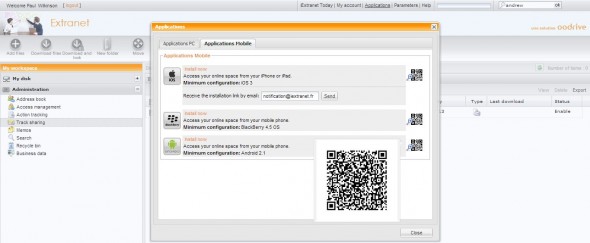
The browser-based system is also accessible via Apple, Blackberry and Android mobile devices, with efficient downloads of the relevant apps supported by on-screen QR (quick response) codes (below). A WebSynchro application allows users to ensure their locally stored folders can be synchronised with the online versions, and PDFs can be protected, even remotely, using iPDF functionality (useful where, for example, confidential financial information might be exchanged).

iExtranet mobile apps download

The platform has a CAD drawing viewer and audio and video streaming built into the platform too, and is competitively priced at £190 (€240) per calendar month per platform. Each platform administrator can add an unlimited number of users (an Excel import process is available to speed up this process). My demonstration host, Sophie Hosteing, told me that most construction customers set up iExtranet to manage all users across a single project, but that it could also be used to manage multiple projects within a single environment if required.

As well as its Paris office, oodrive has offices in Spain, Germany, Belgium, Switzerland and Singapore. The company also has a London office, and was considering marketing iExtranet  more aggressively in the UK architecture, engineering and construction market.

It is a competitively priced product which may be attractive to organisations which want the benefits of a simple, folder-based solution with little training requirement, without all the “bells and whistles” of more complex construction collaboration platforms such as 4Projects, Conject, Autodesk Buzzsaw, Asite, Woobius or ProjectCenter (all mentioned as potential competitors by Sophie). Indeed, I was told one French contractor had opted for iExtranet ahead of 4Projects to manage a scheme in Singapore as it did all the things they wanted without having to pay for functionality that wouldn’t be used.

Permanent link to this article: https://extranetevolution.com/2013/01/iextranet-from-paris-based-oodrive/

4Projects growing again…

4projects logoThe latest SaaS collaboration vendor to report on its financial performance is Sunderland, UK-based provider 4Projects, whose latest (abbreviated) annual return to Companies House covers the year to 31 March 2012. CFO Chris Baty was happy to provide me with some more detailed background to the business’s 2012 performance.

“Double digit growth”

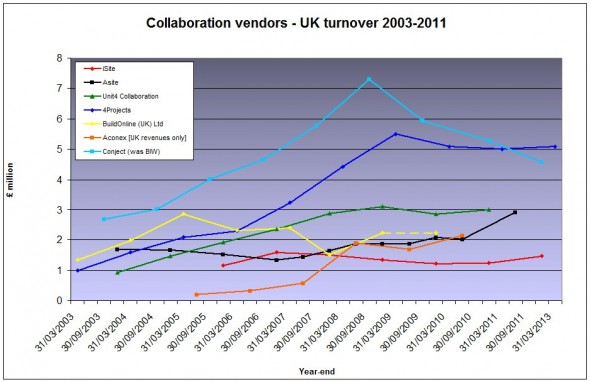
Revenues were up slightly (1.4%) at £5,075,250 (2011: £5,007,253), starting to reverse the two year dip in turnover since 4Projects’ £5.5m peak of 2009 (post). Chris told me that the company was beginning to benefit from the foundations laid in previous years, with more stable enterprise revenues now beginning to flow, “accelerating double-digit growth” in the current financial year (2012-13), and a predicted record year to report next time (“things are really buzzing at the moment”). As mentioned in a previous post, this performance means that 4Projects now has a higher turnover than the UK business of its rival Conject.

UK vendor revenues Jan13

4Projects’ growth was shared across every region, Chris said, including the UK. As previously discussed, the company had taken a cautious approach to the Middle East, but this was now its highest growth area, followed by the north America market. In both regions, 4Projects was seeing growth in excess of 50% (admittedly from a low base), while the benefits of its partner programme in other markets were also beginning to trickle in – we talked about its Australian partner, Project Collaboration (post), already a significant player in the ANZ region, which Chris said had secured some recent energy sector wins and would be contributing significant revenues to the 4Projects group in 2014.

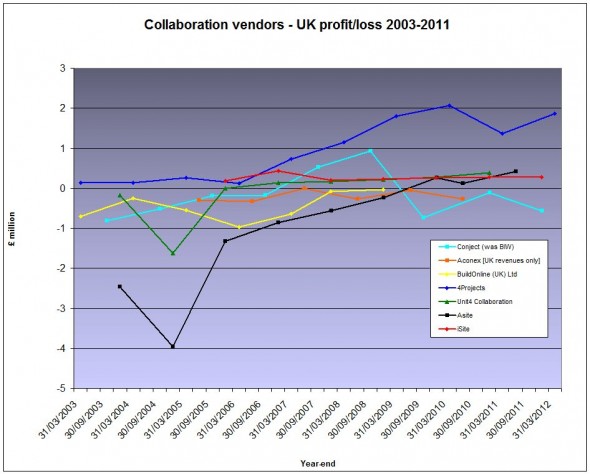
Pre-tax profits were also increasing at 4Projects. In the year to 31 March 2012, it achieved a profit of £1,862,700 (2011: £1,358,508), again heading back to the pre-recession levels of 2009. The company has continued to manage its customer portfolio to reduce its reliance on contractors and build up a core of construction industry client organisations.

UK vendors profit/loss

The company’s retail focused business 4Retail was “just ticking along,” Chris said (perhaps reflecting the uncertain performance of the UK retail sector). Overall, 4Projects staff numbers are up to 62 (57 in March 2012), with the company “recruiting on a wave of revenue growth” buoyed by interest in its BIM platform (“BIM in the browser”) and its 4BIM project (post) and related research initiatives which are a key element of 4Projects’ continued product investment.

Abbreviated accounts

When looking at Aconex’s financial performance recently (post), I commented about the now almost annual Aconex accounting adjustment. 4Projects inadvertently (I think) made an adjustment – if only to the amount of detail given. For most of the last decade it has published a full set of accounts, but the firm’s latest annual return to Companies House provides abbreviated accounts “prepared in accordance with the special provisions for small companies under Part 15 of the Companies Act 2006”.

Abbreviated accounts contain no details of turnover or profitability, so there is little transparency of the company’s detailed financial performance. Of course, 4Projects is not alone in the publishing abbreviated accounts; some other vendors I monitor have never published full accounts (Cadweb, Sarcophagus and Union Square, for example, spring to mind). But Chris explained the switch was little more than a new audit manager’s suggestion (“she just assumed that we would want to file the minimum requirements – as most businesses do”).

Permanent link to this article: https://extranetevolution.com/2013/01/4projects-growing-again/

Conject “challenged”

conject-logoAccording to its 2011 annual report and accounts, Conject Ltd (the UK-based SaaS collaboration and project control vendor formerly known as BIW Technologies) found 2011 “challenging.” Its report, filed at Companies House in October 2012, echoes almost word for word what it said in 2010, saying:

“The continuing global economic malaise severely impacted funding for private sector developments and the withdrawal of funding for public works projects (as part of the UK government’s debt-reduction measures) resulted in challenging trading conditions. Despite this, the company’s revenues amounted to £4.57m for the period, clearly demonstrating the strength of the SaaS business model.”

UKvendorturnoverDec2012 To put this into context, in 2010 (see post) Conject reported revenues of c £5.27m (after adjustment to account for 15-month reporting period), so turnover was down around 13%. This marks a turning point in the fortunes of the UK-based AEC collaboration vendors as it would appear that Conject has fallen behind rival 4Projects in terms of turnover (blog post to follow on that company’s results for the year to March 2012). Unlike 4Projects, the Conject UK operation has not been consistently profitable and in 2011 it reported an increased operating loss (pre-tax) of £563k, up from c £112k (adjusted) in 2010. UKvendor_profit-Dec2012 The order book at the year end remained pretty stable at £8.12m, down slightly from the £8.3m Conject reported a year earlier. According to a trading update in September (post), the Munich, Germany-based Conject group was finding 2012 a better year, talking of “a 50% increase in new contract awards in the first 8 months of the year, compared to 2011,” though it is unclear if this boost also included the performance of the UK-based business.

[Note: This blog post has been somewhat delayed; I tried to get some comment from Conject CEO Colin Smith on these figures (and on the performance of the Conject group as a whole), but Christmas and travelling meant we kept missing each other. With luck, we will get to talk very shortly.]

Conject looking for new CTO?

I understand that Andrew Wainwright, appointed Conject’s chief technology officer in June 2012 (post), has left the company after five months due to personal matters outside of work. I met Andrew briefly again at the recent COMIT “Building Information Mobility” conference (post), and he was talking enthusiastically about Conject’s BIM plans and I was looking forward to announcements in this respect (particularly as the company has been lagging behind vendors such as Asite and 4Projects in delivering BIM-related functionality – see recent post on 4Projects BIM research).

Permanent link to this article: https://extranetevolution.com/2013/01/conject-challenged/

Load more