BIM, SaaS and mobile driving Newforma developments

Once scathing of the attractions of Software-as-a-Service, Newforma is now actively embracing the cloud, SaaS, BIM and mobile, and eyeing potential social media ideas for future product development.

Last week I learned more about Newforma, developer of the enterprise-based Newforma Project Center application and now a recent entrant to the Software-as-a-Service collaboration space with its August acquisition of US-based Attolist, formerly provider of the AEC-Sync platform (post) – now re-branded Newforma Project Cloud. Having met Tim Bates, EMEA director, in late August, I was invited to a Newforma briefing at London’s Building Centre on Wednesday, and then got chance for a one-to-one chat with Newforma CEO Ian Howell the following day.

“Google for projects”

The core enterprise product Newforma Project Center is targeted primarily towards architectural and engineering firms, and its UK adopters include some well-known companies, including HOK, BDP (once a user of QA’s Teambinder, I recall), Aedas, Fosters, Scott Brownrigg, Steffian Bradley, Make and PRP. Outside design consultancies, adoption has been more limited, with about 50 construction firms using the on-premise solution. However, Ian explained that some US-based contractors such as Turner Construction preferred to use the system on some individual projects but not universally, “partly because many contractors prefer to adopt a project cost centre approach to data management.”

Newforma Today (image courtesy of Tuomas Holma, Cadfaster)

Tim Bates describes the on-premise system as a solution to “messy desk syndrome”, helping medium-to-large sized firms to index and manage the thousands of project-related communications they handle internally every day (note: ‘projects’ here usually include many non-construction projects – many internal exchanges can concern a wide variety of internal subjects). The company LAN-based Newforma Indexing Server can manage large volumes of unstructured information, including emails and PDFs, and provides powerful search tools to help people look across numerous folders and find, view and make use of documents, drawings, and associated email  correspondence and process forms (“Google for projects,” he called it). It also helps create the all-important audit trails that can be useful in avoiding or at least mitigating litigation. Both Tim and Ian quote the tweet from a user (Carl Davis, President and CEO of Array Healthcare Facilities Solutions) who saved $150,000 from finding one key email, among 36,000 others on a project.

(Newforma Project Center’s focus on design firms and on managing in-house projects and management of email and other documentation reminds me of Nottingham, UK-based Union Square’s Workspace which has a similar approach.)

Embracing cloud and mobile

With its Newforma-to-Newforma technology, shared folders can be securely synchronised with collaborators in other firms who are also using Newforma on a common project.
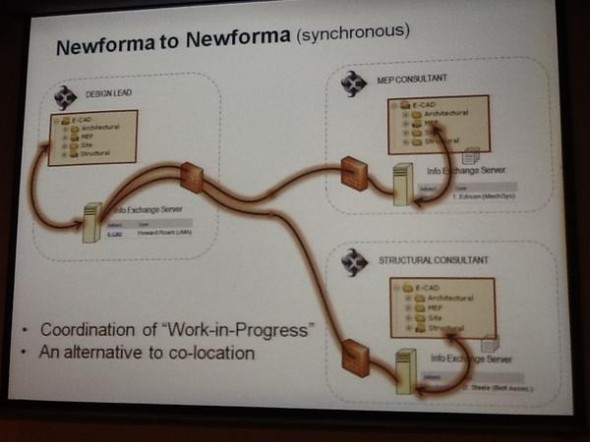
Newforma-to-Newforma (photo courtesy of Tuomas Holma at Cadfaster)

The Attolist acquisition has given the company the option to offer a complementary cloud-based sharing capability. A hosted project can also leverage Newforma-to-Newforma, thus avoiding the overhead of exchanging files by others who are also using Newforma Project Center. Another August 2012 addition – of the Maine-based mobile application developer TapTapas – has resulted in the launch of the first of a series of mobile apps to support Newforma out in the field. Snagging app Newforma Punch List came out last October, for example, and will be followed soon by a Field Notes app (again, I see trends: global SaaS vendor Aconex has recently launched apps in both these areas too – post); further Newforma apps – Plans (mobile mark-up), RFIs, Submittals, Action items – are in the pipeline, and Ian stressed these will be integrated with each other.

Another key development for Newforma has been its announcement that it has licensed M-SIX’s VEO platform, which enables either an Autodesk 3D or Autodesk Revit model to be viewed within Newforma Project Center. This was showcased at last week’s Building Centre event, with much attention focused on the ability to roll-back through process data such as RFIs and, for each RFI, to see the relevant views of the associated building information model (with file differences managed using delta “diff” files). In their announcement, Newforma highlighted:

“VEO’s use of cloud technology provides the scalable processing power and accessible-from-anywhere availability to stream the model views necessary for successful PIM-BIM integration and model coordination across dispersed project teams.”

(The VEO functionality isn’t yet supported via Newforma Project Cloud, but it is part of the road map going forward, Ian told me, and cloud-based BIM viewing was flagged as “coming soon” in his event presentation.)

Ian HowellAs is probably clear already, integration of project information management (PIM) with BIM, mobile apps and cloud hosting are all seen as key trends by Newforma in the development of the AEC industry’s software needs, but Ian (right) also asked the event audience about social computing: “What are your offices doing about enterprise social networks, rather than email?” He didn’t offer any answers himself and when we spoke about this the next day, he said they’d floated the idea to customers of Facebook-style ‘wall’ type discussions, but most were resistant, preferring the “analogue and asychronous” nature of email-type exchanges coupled with centralised file storage. But he was open to suggestions of areas where social collaboration might be implemented to support what he described as “software design for disconnected data-sets”.

Document control

We talked briefly about international differences in software adoption for construction document management, and both Tim and Ian highlighted how the UK differed from the US in its approach to document control. UK document control puts a document register at the heart, and the spreadsheet-type view of the process wasn’t initially easily replicated in Newforma, but the company quickly established that it already had about 80% of the information requirements available via configuration (rather than software customisation). To support its UK-based customers, it filled the remaining gaps, which also had the eventual benefit of making the more exacting and innovative functionality available to other international users.

Subscription-based approach

Newforma differs from many conventional vendors of on-premise software in that it licenses its product on an annual subscription basis, allowing firms to buy only as many seats as they need. During the worst of the recession, for instance, AEC firms which had had to reduce their workforce could easily adjust their subscription renewals to match current employee levels (external users are not charged for their access to customers’ hosted systems). However, Newforma also entertains other subscription-based licensing models within its portfolio: the SaaS-based Newforma Project Cloud is licensed on a per-project basis (similar to the approach of most UK vendors), helping encourage wider adoption – and therefore collaboration – among supply chain users within a project.

Permanent link to this article: https://extranetevolution.com/2012/10/bim-saas-and-mobile-driving-newforma-developments/

McLaren announces latest FusionLive Release

McLaren Software’s recent announcement of its private cloud offering for enterprise-class engineering document management (see previous post) has been quickly followed by the launch of the latest release of its Software-as-a-Service FusionLive collaboration offering.

The release is the first major update since McLaren absorbed the former AEC-focused CTSpace business in late 2011, and includes over 40 enhancements and new modules “including business intelligence reporting, automatic rule-based rendering of documents and bulk processing”.

Paul Muir, McLaren CEO, is stressing the dual offering, and says:

“We have seen a rise in adoption of McLaren FusionLive not only from AECO customers but also from major oil and gas owner operators in the Middle East and Australia to support major oil and gas capital projects”.

Permanent link to this article: https://extranetevolution.com/2012/10/mclaren-announces-latest-fusionlive-release/

McLaren launches Enterprise OnAir

Some six months after I talked to McLaren Software about its dual offering of SaaS and on-premise engineering document management platforms (post), the London-based vendor has announced a third option: McLaren Enterprise OnAir, a private cloud-hosted solution.

Complementing the company’s existing SaaS offering, FusionLive, this development means its McLaren Enterprise engineering document control suite (aimed at capital-intensive asset owner operators and EPC contractors) is no longer solely delivered as an on-premise platform (or as a certified solution for EMC-Documentum or IBM FileNet P8 ECM platforms). It can now be delivered as a cloud computing application, drawing on the company’s experience of providing its Software-as-a-Service FusionLive and CW products.

The McLaren OnAir cloud infrastructure consists of three secure data centres in the USA, UAE and UK and an associated communications network. Addressing potential concerns about hosting multiple customers on a single infrastructure, McLaren enterprise customers are each provided with dedicated servers, storage, backup hardware and communications for a monthly fee. And McLaren OnAir system, application administration and support services are available to further reduce the amount of in-house IT support required.

Paul MuirMcLaren Software CEO Paul Muir says:

“The availability of McLaren Enterprise – OnAir as a privately hosted option is a breakthrough in the enterprise engineering document control market. Customers can now take advantage of the depth of functionality and scalability of an enterprise scale solution without the need to provision or maintain a supporting IT infrastructure.”

My take

The stress on “enterprise engineering” helps distinguish between the multi-tenancy approaches commonly adopted by many SaaS collaboration vendors, particularly in the architecture, engineering and construction sectors, and the requirements of owner-operators and EPC contractors who often want a single secure installation solely for their major capital project. McLaren people will have years of experience in managing hardware, software and associated data and enabling web-based access, and so can quickly specify, commission and, when necessary, scale-up the infrastructure required to support document control on a major project (and will, no doubt, be subject to strict service level agreements, SLAs). In the cost-conscious AEC market, dedicated hosting facilities for a single project may often be prohibitively expensive, and – for such customers – McLaren has its FusionLive platform available.

The launch of OnAir might also placate customers of its SaaS-based products who might have been worried that the November 2011 acquisition of the former CTSpace business and its merger into a company better known for its on-premise platforms would mean a growing focus on in-house provision. Instead, it appears McLaren is looking to widen the potential uptake of its cloud-based solutions by allowing some customers who might have opted for the familiar locally-hosted option to rely upon McLaren to take on the hosting risks and responsibilities for them. I don’t anticipate a sudden stampede from on-premise hosting, but as SaaS and cloud computing continue to expand into mainstream IT, then McLaren is well placed to help owner-operators and EPCs support new capital projects’ document control requirements in their own private clouds.

Permanent link to this article: https://extranetevolution.com/2012/10/mclaren-launches-enterprise-onair/

iSite develop “Assetology” and launch ‘The Hub’

In 1987, actress Maureen Lipman famously said: “You get an ology, you’re a scientist,” in a TV advertisement for British Telecom, and I was reminded of this last week. I had been invited to the London launch, by Styles & Wood’s UK-based IT subsidiary, iSite, of ‘The Hub,’ an application of its web-based property information platform to support “assetology” – a ‘science’ perhaps otherwise better known as facilities management.

Styles & Wood CEO Tony Lenehan welcomed delegates to the company’s Smithfield offices, after which iSite director Martin Ward introduced the concept, before a customer representative, Steve Head of Nationwide Building Society, talked about the platform’s use in the organisation’s property services division.

iSite PortaliSite Portal  is positioned as a “building intelligence” system, which, through a suite of integrated modules (Portfolio, Planit, Projects, Caretaker, AssetManager), enables an organisation to manage its property operations more effectively. It powers Tesco’s MyProperty and Nationwide’s systems, and Lenehan talked about its growing importance to the group’s relationships with the Co-op and Morrison’s retail groups, among others.

‘The Hub’

I first noted ‘The Hub’ concept in April 2012, when Styles & Wood announced that iSite and Nationwide intended to jointly promote this suite of management systems, which are aimed at enterprises with an outsource services strategy.

iSite HubThe Hub takes the iSite Portal concept a stage further, providing a single consolidated view of all property and facilities information by connecting directly with outsourced partners and key internal systems to create a single version of the truth. With the aid of some excellent graphics and a video, Martin Ward explained: “the Hub does not impose systems on suppliers, it integrates and aggregates property and asset information, blending it with internal systems into one source of intelligence.”

He continued:

“In effect what we are introducing to the market is a new strategic asset management process that puts transparency and control back into the hands of the client – minimising risk, maximising control and proven to reduce costs by up to 15%. The approach is something we are calling ‘Assetology’; the solution is The Hub.

“The results with Nationwide have been excellent and there is now positive interest from some of the major retail outlets as well as other financial services providers. The Hub is going to gain real momentum and we think it will change current thinking around property and asset management as the FM and property market accepts the concept of Assetology. It is a new process; a new way of doing things. It is all about turning data into real time valuable knowledge that property teams can use and that gives them control.”

This notion of connecting multiple external systems for asset management is familiar. It is, for example, something that start-up KyKloud showed to me in prototype form in January this year, and long-standing construction collaboration vendor conject has been talking since March about launching its own SaaS-based FM solution before the end of the year.

OK, these competitors probably won’t be talking about “assetology”, and FM may be more of an art than a science, but, with some creative marketing, iSite managed to make an otherwise dry and quite complicated issue more memorable to its audience last Thursday.


Permanent link to this article: https://extranetevolution.com/2012/10/isite-develop-assetology-and-launch-the-hub/

ProjectCentre acquired by RIB Software

Sydney, Australia-based SaaS construction software developer ProjectCentre has been acquired for an undisclosed sum by the German technical ERP and BIM software business RIB Software AG. The announcement was made on Sunday 30 September, and is RIB’s second acquisition in under a month.

RIB expanding through M&A

On 11 September RIB announced the purchase (also for an undisclosed sum) of Memphis, Tennessee, USA-based estimating software business, MC². The MC² acquisition was seen by RIB CEO Thomas Wolf as a step towards successfully positioning RIB’s iTWO BIM 5D technology in the US market; MC² customers included some key US industry names, and RIB aims to migrate these top construction firms to its platform.

Similarly, the ProjectCentre deal gives RIB its first presence in the Australian construction market. ProjectCentre founders Paul Hemmings and Tim Clare have retained a 25% minority equity stake in the company, and will continue to head its R&D/Technology and client-facing teams.

I first wrote about ProjectCentre in May 2008, and I talked to Paul and Tim almost exactly a year ago, when we discussed its ‘anti-email’, forum-based approach and other ways in which it differed from competitors such as Melbourne-based Aconex. For example, ProjectCentre isn’t just about project management and document collaboration, it can also be used to track financial changes on construction projects (similarly, RIB  iTWO also manages both financial and design data, and US vendors such as Viewpoint [post], EADOC [post] and Corecon [post] also offer close integration between cost and design information). At the time, I said document collaboration had become an easily replicated, commoditised product, and I applauded ProjectCentre for focusing on delivering detailed business-critical ERP-type functionality to its customers.

SaaS plus BIM

Despite competition from Aconex and other local providers including QA’s Teambinder and the Leighton Holdings’ ailing Incite business (post),* ProjectCentre has apparently grown its revenues from $1.4m to $5m over the past four years, and the company anticipates tripling in size from its current 39 staff to over 100 in three years (reports The Australian). The RIB deal will also enable it to begin to combine its project collaboration platform with the building information modelling capabilities of its German majority stakeholder, and ProjectCentre CEO Kevin Davis talks about being at “at the forefront of an Integrated Project Delivery (IPD) movement that is vital to the future of the global construction industry.”

The architectural, engineering and construction market in Australasia is beginning to explore building information modelling approaches to project delivery, although the pace of change is apparently lagging behind that in the UK – when I spoke to Josh King of 4Projects’ new Australian partner, Project Collaboration, recently (post), he said “BIM is not a big deal yet in Australia, [but] it’s just a matter of when, not if.”

* Leighton was recently reported (by The Australian, for example) to be selling off some of its non-core IT businesses, including the Metronode and Infoplex operations which support Incite (see Incite Imploding?). Industry sources tell me Incite hosting may be switched away from Infoplex to HP.

Permanent link to this article: https://extranetevolution.com/2012/10/projectcentre-acquired-by-rib-software/

Corecon expands V7 mobile access

Corecon logoCalifornia-based construction estimating, collaboration and project management software vendor Corecon Technologies has unveiled updates to its web-based Corecon V7 platform (launched in May 2010). The enhancements provide further mobile access options and integration with other popular tools including QuickBooks, Microsoft Office, Sage Simply Accounting and SAP Business One.

Corecon Mobile Apple iPad FinancialDashboardCorecon V7 is now compatible with Google Chrome and Apple Safari browsers enabling its use on the Apple iPad. It incorporates new dashboards for its Contract Administration, Procurement, Correspondence and Documentation modules plus over 50 drag-and-drop widgets illustrating crucial data and alerts. Corecon president Norman Wendl says:

“… subscribers can already access and capture critical project information when using an Apple, Blackberry, Google Android, Palm or Windows 7 device. In our latest upgrade, Apple iPad users now have complete access to all of the functions, features and information in Corecon V7 when using their Apple device in the field or office.”

Permanent link to this article: https://extranetevolution.com/2012/10/corecon-v7-expands-mobile-access/

HP SaaS drawing storage set to expand (and integrate?)

Reprographic hardware corporation HP launched its SaaS-based cloud storage service, ePrint & Share nearly two years ago (post), and has continued to market itself to UK users ever since (I wrote about its Android app launch in May 2012). I was invited to a launch event at the RIBA in London today (24 September), where it announced:

“the second generation of its free web service for AEC professionals, HP Designjet ePrint & Share, which makes it easy to access and print large-format documents using an iOS or Android tablet or smartphone, a laptop or ePrinter touch screen.”

However, this wasn’t the headline – the company was more focused on promoting some new hardware, launching entry-level, web-connected solutions for large-format printing from virtually anywhere – new offerings targeted at AEC students, professionals and small studios. (SME level pricing starting from £745 for the 24-inch T120 printer; a 36-inch T520 costs £1825). These come with wifi access as standard, as well as LAN access, and are web-connected, enabling printing and file access from virtually anywhere, with copies of files automatically saved to the cloud, and the ability to attach a file to an email and print.

A voxpop video of beta users of the HP service showed someone accessing HP’s cloud service via AutoCAD WS on an iPad (post), and when I asked about wider access via third-party applications, HP DesignJet manager Phil Oakley also talked about accessing content stored in DropBox, and then mentioned PlanWell – a file-sharing service developed by US-based reprographic provider ARC which is also accessible via HP printers. But wider integration between HP ePrint & Share and third party platforms sounds to be on the way – I was told to “watch this space,” and look for an announcement in early 2013.

Permanent link to this article: https://extranetevolution.com/2012/09/hp-saas-drawing-storage-set-to-expand-and-integrate/

Aconex extends mobile offering to iPad

I’ve mentioned its imminent launch a couple of times recently but now it’s official: Aconox Mobile for iPad. The Melbourne, Australia-based SaaS collaboration vendor Aconex launched an iPhone app in May last year (post), and has now expanded its portfolio to include an iPad app (already winner of the 2012 Australian Mobile Award for Project Management), and an inspection and snagging application, Aconex Field (also a winner in the same awards)

I had a sneak preview of the iPad app earlier this summer from Aconex co-founder and general manager, product Rob Phillpot, and, over lunch in London recently, his colleague and fellow co-founder CEO Leigh Jasper, told me their apps were a response to growing demand for mobile access to Aconex across multiple devices. Aconex users can now log-in via their iPads to:

  • capture photos, video and audio on site for communication and onward distribution
  • access and manage latest project documents and communications anywhere any time
  • review images and drawings, and add comments and updates to colleagues
  • manage tasks and issues, and communicate associated action items
  • view and edit project information offline (ie: when a mobile connection is unavailable), and then synchronise files with the Aconex platform when connectivity is restored

According to Aconex’s news release, the iPad app offers all of the same benefits as the iPhone app, plus the ability to review and update documents and drawings on a larger display and keypad.

Permanent link to this article: https://extranetevolution.com/2012/09/aconex-extends-mobile-offering-to-ipad/

Conject trading update, and a new blog

The latest conject e-newsletter hit my in-box yesterday, including news of the final post-acquisition transition of the SaaS collaboration vendor from BIW Technologies to conject branding (mentioned yesterday), its nominations in the Be2Awards (post) and Construction Computing Awards (post), and its sponsorship of Constructing Excellence‘s Awards.

Trading update

The e-newsletter also talks about recent trading, reporting “a 50% increase in new contract awards in the first 8 months of the year, compared to 2011”. Internationally, it says “markets in Germany, Austria and Eastern Europe and Russia are proving very resilient”, and the company has “been busy developing many of our newer geographic markets” – mentioning Singapore, Poland and New Zealand, while the “Middle Eastern market has bounced back after a very quiet few years.”

As a social media fan, I think I should also applaud Conject for resuming blogging, with its new CONJECT Talk blog (Extranet Evolution started when I worked at BIW). By the way, if you think my blog-roll has missed a relevant blog, please let me know.

Permanent link to this article: https://extranetevolution.com/2012/09/conject-trading-update-and-a-new-blog/

Come to a COMIT event!

In addition to its Building Information Mobility (#MobiBIM) event in London on 15 November (post), COMIT (Construction Opportunities for Mobile IT) has two other UK events in the near future. Both are invitation-only, but the nice people at COMIT may have a few spare places:

  • Thursday 27 SeptemberThe Emperor’’s New Clouds – an invitation-only afternoon event organised by Timico at its premises in Newark, Nottinghamshire
  • Thursday 11 OctoberAn Evening with MobiBiz – an evening drinks reception in London where MobiBiz launches its cloud-based “Spend Intelligence & Spend Management” solution

And don’t forget: there is a mobile category in the Be2Awards 2012, being presented next week. Online voting is currently under way and, briefly, the contenders are:

Permanent link to this article: https://extranetevolution.com/2012/09/come-to-comit/

Load more