Profiling think project!

Relatively unknown in the UK, Think Project! is one of mainland Europe’s leading SaaS construction collaboration vendors with an impressive client list.

In London last Friday Thomas Bachmaier, CEO of Munich, Germany-based think project!, told me about the company, its architecture, engineering and construction collaboration platform and take-up of its Software-as-a-Service.

This was long overdue, particularly as I blogged about think project! back in 2008, when the company’s solution first featured in my coverage of the changing technologies at Australia-based Leighton Holdings subsidiary Incite, aka Nexus Point Solutions. In 2009, Incite launched its own Keystone platform with the intention of gradually replacing think project! and was set to grow a market outside of Leighton’s projects – until the “St Valentine’s Day Massacre of 2011.”

Thomas and I did talk about these events briefly, and he told me that the transition from think project! to Incite Keystone was still ongoing. think project! Solutions (the company’s Australian distributor) still has many active users in Australia and some projects managed by Incite are still on the think project! platform.

European base

I was more interested, however, in think project!’s operations across other markets. Like several other players in the sector, the company was founded (formerly Baulogis GmbH and AEC/communications GmbH) at the turn of the century as interest in providing construction-related services online blossomed during the dot.com boom. And similarly, the business was ambitious about creating an e-marketplace to serve the European construction industry, but soon discovered there was little appetite for such a venture so focused initially on document collaboration (gradually augmented by other, more complex management workflows).

While rival German vendor conject (post) successfully targeted building owners, think project! found it achieved more take-up among contractors (mentions of Hochtief, Strabag and Vinci, among others), and then among major infrastructure operators (including energy businesses RWE and E-on, and Germany’s national rail operator Deutsche Bahn and its Austrian equivalent, OBB). The platform is also the corporate standard for building projects undertaken by several major manufacturers including BMW, Audi, Volkwagen, Toyota, Bosch, Bayer and Roche.

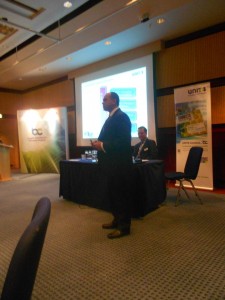
Thomas BackmaierThomas (right) said the company currently has around 90,000 active users on projects in some 40 countries, generating a turnover of around €15m (£12.6m). Most of the company’s projects are across mainland central Europe; the company has offices in Munich, Berlin, Utrecht, Warsaw, Moscow and Madrid, plus a Middle East office in Dubai. But its clients have implemented think project! on schemes in China, Brazil, Russia, USA and the UK, among other locations, as well as Australia. The platform had recently also been translated into Chinese so that it could be used to support customer projects in that region, such as BMW’s new Shenyang plant.

The majority of revenues (95%) are derived from providing think project! on a SaaS basis, but the company has occasionally provided an ‘enterprise solution’ for internal hosting where there are security concerns – Thomas highlighted the system’s deployment to support design and construction of a German government office and the new NATO headquarters in Brussels, for example. Like most of the UK vendors in this sector, it also tends to license its software on a per-project subscription basis, which Thomas feels is more likely to promote supply chain take-up of the system than if it was sold per-seat.

The core SaaS platform modules can be augmented by a variety of ‘plug-in’ services that allow users to interface with other software tools, from individuals’ Outlook email accounts or CAD tools through corporate intranets or document management systems to back-office ERP systems. Thomas described how Audi has used the think project! public API to integrate the collaboration system with its SAP platform (echoes of last week’s UNIT4 conference). We also, of course, talked about how building information modelling (BIM) was likely to add new customer and supply chain requirements to the platform.

The meeting gave me a useful insight into the scale and scope of think project! operations (and helped me position the company in relation to conject); I will be looking at the collaboration platform in more detail in a future post.

Permanent link to this article: https://extranetevolution.com/2012/02/profiling-think-project/

Unit4 combining collaboration, ERP and BIM in the cloud

The 2012 Unit4 customer conference this week at Birmingham’s International Convention Centre incorporated the annual user event for users of Unit4 Collaboration (formerly Business Collaborator), and there were some significant announcements both about the structure of that business and about the future roadmap for its collaboration platform.

I attended the event wondering how relevant the plenary sessions would be. After all, the majority of attendees were financial and HR people there to discuss Unit4’s ERP and financial management solutions. However, in the opening session – an interview with Unit4 UK MD Anwen Robinson and Group COO Ab van Marion, I got a couple of early surprises.

Anwen announced that Unit4 Collaboration MD Sanjeev Shah had joined Unit4’s UK board as business innovation and technology director, and that the collaboration division is no longer a stand-alone business, with effect from 1 January 2012. Its software functionality is now part of the Unit4 product portfolio, which is increasingly embracing cloud-based options, so BC can deliver Software-as-a-Service document management and online collaboration to more of Unit4’s customers.

Talking about future technology trends. Ab picked out the growing importance of mobile technologies and data (apps to be launched in July), the emergence of social media, and business analytics as three key areas for Unit4. Anwen then highlighted BIM(M) – building information modelling (management) – as another key development, particularly for the many Unit4 customers who build and manage buildings. Again, this was linked to BC’s experience in delivering software to support construction and management of built assets; Anwen said Unit4 had identified an opportunity to integrate the ERP-based processes involved in procuring those assets with project team’s BIM-based collaboration through BC. So the big picture for Unit4 is (eventual) integration of ERP and BIM.

BIM-as-a-Service (again)

After the plenary sessions, the conference broke into smaller sessions, and Sanjeev got chance to explain more about how the technical strengths of the former Business Collaborator business both complemented those of other parts of Unit4 and would be developed further. Essentially, BC – building on its experience in cloud computing and data as a service – will be the document management layer within Unit4, he said, and integration with ERP is essential if the industry is to meet the government’s aspirations and achieve BIM level 3.

Steve Crompton (formerly BC’s technical director, now head of product innovation) then fleshed out some of the detail. He highlighted recent developments such as last year’s launch of BC Six with an improved user interface, support for Microsoft Office, email integration, and developing support QR codes and RFID. Steve then gave an overview of BIM and of BC’s strengths in managing information – the ‘i’ in BIM – was key: “Without information, BIM is just BM: Basically Meaningless,” was one of several good sound-bites, followed by “BIM has to be in the cloud.

The key message was that Unit4 aims to help teams manage a “full, multi-discipline, information-rich model in the cloud,” enabling access via standard web browsers and via mobile devices, with users downloading as much as they need to work with immediately, not necessarily complete models that contain every detail even if irrelevant to a user’s immediate needs. This prompted some reminiscences between Steve, myself and Mott MacDonald’s Dave Glennon about ‘BIMaaS‘ (2008 post), and ‘atomic BIM’ (2009 post).

Chairman of the BC user group, Mark Bew later gave a useful overview of where the BIM Industry Working Group had got to in developing a coherent industry approach (his presentation included one of the clearest and most succinct explanations of COBie I’ve heard). He, too, mentioned the potential to link ERP to BIM-based collaboration processes as the UK AEC industry applied itself beyond the 2016 Level 2 target.

BC important to Unit4’s future strategy

Between Steve Crompton and Mark Bew, I missed a presentation about BC’s public (REST) Web Services API linking collaboration to Unit4 platforms (Agresso Business World, in particular). Instead, I had a briefing with Anwen Robinson, Sanjeev, VP Product Marketing Ton Dobbe and CTO Peter Brown.

Anwen believes Unit4 is uniquely placed in being able to offer both ERP and document collaboration capability, and both are certainly mature offerings, but I wondered about Unit4’s foothold – BC apart – in the architecture, engineering and construction sector.

She insisted the group had a strong exposure beyond the collaboration solution. She cited use of other Unit4 solutions within Halcrow, EC Harris, MVA and WSP. “Engineering has been an absolute sweetspot,” she said, as Agresso had been developed for people-based organisations (Anwen trained as an engineer). She then listed several industry clients such as Wessex Water, local authorities, retailers Debenhams, IKEA, Greggs, Monsoon and Selfridges, and developer Crest Nicholson. However, Unit4 hadn’t yet really targeted or penetrated the contractor market to as great an extent as consultancies, though it had financial management solutions for subcontractors, for example.

Anwen also said she had been keen to put BIM on the radar of the wider Unit4 user community, as something that could have a future financial impact on their activities -when property investment or procurement decisions had to be made, for example. And Unit4 is committed to incorporating BC functionality into its services to other customers and for Unit4’s internal use – the group is already using BC Assure (post) to support IT project management, for example, and she has demonstrated it herself to customers.

My view

For me, this is both the end of an era and a new beginning. A construction collaboration-focused company I have known for a decade no longer exists as a separate entity, and I won’t be able to track its success and compare its financial performance alongside its peers as I used to. Instead (and as anticipated two years ago), we have the former BC solution – a mature SaaS document collaboration offering – being marketed as part of a wider portfolio to existing Unit4 customers who may be attracted to document collaboration that is integrated with the ERP and/or financial management tools they know and trust, some of which are also being delivered as hosted services. Similarly, existing collaboration users may be attracted by new apps and integration opportunities to invest in other Unit4 business solutions.

Moreover, we are also shifting towards more data-intensive processes – including BIM – and growing customer demands to be able to rapidly and securely access relevant data on any device anywhere is likely to encourage more adoption of cloud-based services. And Unit4’s substantial public sector presence also means it is well-known in the very sector being targeted by Paul Morrell’s BIM mandate.

Unit4’s collaboration business is therefore likely to see increased take-up and it will also be less dependent upon the volatile, low-margin and price-sensitive AEC market. This marriage of business software with construction software may also hasten innovation (Sanjeev’s new responsibility, of course) with development of new tools offering rich levels of data capture, sharing, analysis and reporting to support business decision-making throughout the life-cycle of built assets, and relating the cost and performance of these assets to other business-critical operations.

(Disclosure: my expenses to attend the Unit4 conference were paid by the organisers.)

Permanent link to this article: https://extranetevolution.com/2012/02/unit4-combining-collaboration-erp-and-bim-in-the-cloud/

BIW launches pre-construction enquiry service

As the former PR person for Woking, UK-based SaaS construction collaboration technology vendor BIW Technologies, I had a strong sense of deja vu when I read its latest news release regarding a new enquiry management module. Managing processes relating to an Invitation To Tender (ITT) or a Request for Proposal (RFP) sounded very similar to how BIW Tender Manager – now Tender Control – was described back in 2003. Indeed, I had to call BIW sales director Steve Cooper for clarification that this wasn’t just BIW e-tendering rebadged for a new purpose.


No, it’s a totally new product, he told me. While Tender Control is used in a very formal way to issue drawings and documents to potential bidders, who must login to access and respond, the new application has a much lighter touch for end-users.

For a start, it is very email-focused. Any issued document associated with the ITT or RFP that is under 5MB is automatically attached to the email, while larger documents are accessed via links contained in the email. The ensuing process also uses functionality similar to that used in email marketing; for example, when a recipient opens the email, this action is recorded, as are actions such as opening attachments or clicking through to view links (no login is needed for email recipients to view the target files). The email also includes simple reply links that allow the recipient to say whether or not the company intends to submit a response, giving the issuing manager a quick view of who is likely to bid.

This process also contrasts with ITT/RFP processes that rely on use of printed documents or copying documents to CDs and posting them – which, in BIW’s view, can confuse suppliers, reduce response rates and result in sub-optimal quotes. Using suppliers’ existing email applications also means they don’t have to learn how to use any part of BIW in order to price the job.

As suppliers send queries, responses and related attachments back to the issuer (typically a main contractor), their communications are automatically tracked, sorted and collated in the BIW system, providing an audit trail of what was issued to whom, when they read it and what they are pricing against. Correspondence can also be shared quickly with design or construction teams and quotes compared on a ‘like for like’ basis.

Permanent link to this article: https://extranetevolution.com/2012/02/biw-launches-pre-construction-enquiry-service/

ERP vendor Viewpoint viewing collaboration space

While not a household name in the European construction ERP market, Viewpoint is eyeing opportunities across the Atlantic and knows a thing or two about the collaboration space.

“How come you dominate your marketplace and yet I’ve never heard of you?” – This was just one of the questions I asked Viewpoint Construction Software CEO Jay Haladay and VP  Strategy & Corporate Development Matt Harris during a WebEx session earlier this week.

While the 250-strong Portland, Oregon, US-based vendor is best known for its ERP software, it also supplies a document management module, and I was keen to learn more about its view of the architecture, engineering and construction market. As a UK-based observer, though, I was surprised to hear that Viewpoint leads the US ERP market, being used by 94 of the ENR Top 400 contractors, and yet it is almost unknown in UK construction accounting circles (which tend to look at RedSkyIT, COINSAccess, Sage, Causeway and IFS, among others). However, even if I hadn’t heard of Viewpoint, its CEO was certainly familiar with several of the SaaS construction collaboration technology vendors and their operations in the US and elsewhere.

Jay described Viewpoint’s recent history and its recent sustained organic growth – revenues up 46% in 2011 (on top of 40%+ growth in 2009 and 2010). Its solutions are heavily used by infrastructure owners and by contractors – with three-out-of-four of its 850 customers turning over in excess of $25m per annum. This has seen it make big US gains at the expense of rival solutions such as Sage, Intuit, CMiC, Maxwell, Oracle and others – and, according to Jay, 94% of its customers also use Viewpoint’s document management and project management modules included in most deployments.

Watching the collaborators

This has led to Jay and his senior team to keep a close eye on businesses offering similar functionality. For example, Viewpoint’s recent expansion into Australia (it set up a Melbourne office in 2008) exposed it to locally-based SaaS vendor Aconex, and while applauding its success in dominating the Australasian market, Matt says he is not surprised Aconex has found the US market tougher to crack. “Here, the market is more dominated by contractors than owners,” he said, “and contractors often regard ERP as the transaction ‘backbone’ of their business and want solutions that incorporate that.” He also talked about BIW’s and others’ “good-looking solutions” for project management.

So is Viewpoint going to move into the SaaS collaboration space? Perhaps in the long-term. For a start, its focus is solidly on the ERP market, most of its loyal core contractor customers prefer in-house hosted solutions on enterprise licenses, and Viewpoint takes great pains to deliver what its customers want and ensure high satisfaction rates. It also sees SaaS collaboration as a complementary solution that could be dovetailed with its offerings where appropriate. However, it is also investing in extending its product portfolio to include functionality that will increasingly overlap with that of some collaboration vendors. For example, with various software partners, it is developing solutions for mobile devices, particularly tablets, to enable reporting (we talked briefly about business intelligence – topical, following last week’s blogs about BIW’s BI module and kykloud), document management, and remote service management for geographically dispersed workers in large companies.

Permanent link to this article: https://extranetevolution.com/2012/02/erp-vendor-viewpoint-viewing-collaboration-space/

4Projects recruiting for growth

In December, I talked about the recent financial performance of Sunderland, UK-based construction collaboration technology provider 4Projects. I quoted CFO Chris Baty who said prospects for the current financial year were already brighter, and stressed 4Projects was investing to keep itself at the forefront of SaaS collaboration. A quick look at the company’s website gives some evidence of this investment, with no fewer than six current vacancies listed, for:

  • a support analyst
  • lead developer (.NET)
  • .NET developers
  • test analyst
  • international partnership manager
  • business development manager

If you are interested in any of these positions, please mention ExtranetEvolution when you apply. It probably won’t make any difference, but it will at least show you read a relevant blog 🙂

Permanent link to this article: https://extranetevolution.com/2012/02/4projects-recruiting-for-growth/

Darley highlights high cost of traditional tendering

Darley eTenderA quick update. In November 2011, I wrote about UK-based Darley PCM and its SaaS online eTender application – mainly aimed at SME-level clients, construction businesses and their supply chains. CEO Emma Jeffery has been in touch to:

These arguments are, of course, not new – other vendors have sought to streamline the process and drive out costs using similar tactics – but with the UK architecture, engineering and construction industry once again talking about a recession, it may be time for some SMEs to swallow their online uncertainty and make the switch to SaaS.

Permanent link to this article: https://extranetevolution.com/2012/01/darley-highlights-high-cost-of-traditional-tendering/

kykloud targets asset management with SaaS and apps

kykloud is a very polished new SaaS platform with mobile apps, targetted at asset owners and managers

I first heard of North Shields, UK-based kykloud via Twitter last year and had been waiting for it to launch for some months, intrigued by its mention of Software-as-a-Service based life-cycle cost management and by the combination of its co-founders. I finally got to meet CEO Ed Bartlett and CTO Nick Graham earlier this week and they told me more about the business, and showed me the applications they are developing.

kykloud formation

Ed was previously whole life cost director at Balfour Beatty Capital (other experience includes time at Cyril Sweett and Atkins subsidiary Faithful & Gould), managing an investment portfolio worth nearly £700m, and was frustrated by having to rely on spreadsheets or expensive bespoke systems to get an accurate view of the PFI/PPP assets for which he was responsible. He met Nick – formerly CTO at Sunderland-based construction collaboration technology vendor 4Projects – and they began to explore how SaaS-based database tools could enable web-based collection management, exchange and updating of asset data.

Together, they established kykloud (pronounced “k-eye-kloud” apparently) in early 2011 and – with venture capital funding from Northstar Ventures – set about designing a secure cloud-based platform and toolset for anyone managing the life time costs of major infrastructure programmes or large property portfolios. Its intended users will extend from the boardroom level where directors may monitor the performance of 100s of sites, down to the operational teams responsible for managing individual facilities, and the first customers (including asset-owning enterprise users, project managers and contractors) began using the system in late 2011 – just as kycloud finally unveiled its website and started recruiting a sales team.

The product

The kykloud platform is beautifully designed and delivers a rich level of functionality in both its browser-based and (forthcoming) iPad and iPhone versions (I was shown Beta versions of the latter; and, yes, Android versions will follow). Upon logging-in to the service, users are presented with a workspace that includes a map of assets and an overview of the properties and sites for which the user is responsible.

Either interface allows the end-user to start interrogating the system for information, and there is also a simple page-top menu (portfolios, sites, plans, reports, directory) to open up different areas of functionality. Within seconds, Ed was showing me how an asset manager could start using the system to review different time-spans and get at-a-glance views of actual, budget and forecast life-cycle performance data quickly – across entire portfolios, across sub-portfolios (regions, sectors) or for individual sites. Bespoke reports could be created quickly, based on various criteria and assumptions, and Ed demonstrated how new reports could be created to deal with different “what if” scenarios, drilling-down into site-specific details to show how information about fixtures, furnishings and equipment, their costs, replacement intervals and other data could be manipulated.

Ed then switched to the iPad to show how the system could be used as a mobile platform to both provide data ‘in the field’ or to capture data entered by the user for later re-use, reporting, etc. Constant connectivity is not vital – the iOS applications will still capture data (including photos), which can be synchronised later, as necessary.

Integration

Nick talked about the potential for kykloud to import data from a wide range of existing asset management systems; inevitably, we also discussed the ability to import as-built data from construction collaboration systems for re-use in operation and maintenance, and Nick was relaxed about that opportunity. kykloud is purely focused on the asset life-cycle management market, he said, and he hoped that kykloud would be integrated with any of the existing project delivery or computer-aided FM platforms where owners wanted to import relevant data as a starting point for life-cycle-based work; at the same time, the platform could also be used to import a wide range of data such as building energy use and other environmental metrics (kykloud has worked with Sustain on a whole-life carbon project looking at the payback from a change of light fittings for a retail client).

Here we also discussed building information modelling (BIM) and data standards; kykloud is being developed with industry foundation classes (IFCs) in mind, but it will – in Nick’s view – be some years before we see routine export/import from BIM into asset management toolsets, particularly as most of the ‘geometry’-related data will be largely superfluous as far as asset managers are concerned. Nonetheless, kykloud’s north-east location has also enabled some useful discussions with academics and practitioners involved with Northumbria University’s BIM Academy.

Marketing

kykloud is initially targetting three markets: housing management, PFI/PPP and retail – the latter a market where BIW has already provided some asset management capability to retailers such as Sainsbury’s. We briefly discussed BIW’s latest business intelligence module – post – and the capabilities of BIW’s German sister company conject, whose offering is focused on infrastructure life-cycle management, ILM, a similar-sounding sphere to that of kykloud.

Ed and Nick are SaaS fans who genuinely believe in the power of cloud-based solutions to collate and deliver rich information to business decision-makers and their operational colleagues. Like several of the construction collaboration systems, the platform is not licensed per-seat (the guys were coy about the exact pricing – free trials available too), so helping encourage access, sharing and collaboration.

kykloud is already a polished product offering a lot of functionality, and its initial users are apparently already feeding back ideas about how it could be developed and improved still further. It targets a potential clientele not currently well-served by SaaS solutions, and by being developed from the outset as a web-native platform can be quickly deployed and made accessible to authorised staff across a geographically-dispersed portfolio using a range of common devices, from standard web browsers to smartphones and tablet devices. In theory, it also suggests how business owners can really exploit the power of the data captured during design, delivery – including use of BIM – and operation of their assets, and reuse that data to manage both costs of their portfolio and – as will become increasingly important – its carbon performance.

Permanent link to this article: https://extranetevolution.com/2012/01/kykloud-targets-asset-management-with-saas-and-apps/

Cadac Organice sounding bullish

Preliminary results released by Cadac Organice suggest the Netherlands-based vendor of Microsoft SharePoint-based solutions for engineering document management had a successful 2011.

It highlights its introduction of a cloud-based solution – discussed in October 2011 with Gert-Jan de Kieviet, right, following his recruitment from Sword-CTSpace – and also mentions that David Parry, former CTO and co-founder of McLaren Software, has joined Cadac’s US organisation (McLaren and CTSpace are, of course, set to merge following the latter’s November 2011 acquisition by IDOX; post).

Jan Baggen, CEO Cadac Group Holding BV says:

“We are proud that 2011 has become our best year ever in our 25-year anniversary, despite a turbulent year in global terms. With revenue of 29M Euros (5% growth) and net profit of 3M Euros (25% growth), Cadac Group is one of the best performing companies in the industry.”

Final 2011 results will be released in the second quarter of 2012, after the company’s annual meeting.

Permanent link to this article: https://extranetevolution.com/2012/01/cadac-organice-sounding-bullish/

BIW launch business intelligence module

According to its latest news release, Woking, Surrey, UK-based SaaS construction collaboration technology vendor, BIW Technologies has launched a new business intelligence (BI) module that it says provides advanced business analysis and reporting capabilities from data across processes, documents, cost and budgets and compliance data/transactions. A second module provides quality, health and safety and environmental (QHSE) compliance data.

The BI module enables the design and delivery of bespoke project and programme dashboards, transaction reports and performance summaries. These can be produced in text or graphical form, and can be emailed to recipients. According to director Steve Cooper, monthly reports need no longer rely on data exported to expensive third party reporting systems, but can be completed within BIW’s online project control applications. Moreover, these reports can be viewed on all mobile devices, meaning the latest information is always available and never ‘out-of-date’.

BIW’s QSHE Compliance helps organisations roll out their QSHE plans, and then monitor and manage performance to ensure contracts remain compliant, through sets of questionnaire and survey functions, augmented by real-time performance management reports. The module has apparently been developed in conjunction with one of the UK’s leading supermarket retailers and a leading construction contractor, and collates all incident, accident, trend, inspection and scorecard data.

Permanent link to this article: https://extranetevolution.com/2012/01/biw-launch-business-intelligence-module/

TrackerPlus – managing BREEAM online

Thanks to Building4Change and the BRE Group e-newsletter, I see that TrackerPlus, “a fully integrated online BREEAM project management system,” has been recognised by BRE Global for its ability to streamline the BREEAM assessment process for members of the design team and allowing assessors to submit their assessments directly from the system to BREEAM for quality assurance (QA) and certification. As a result BRE Global has awarded London-based environmental consultancy Southfacing, the creator of TrackerPlus, the first BREEAM badge of recognition for software.

The BREEAM assessment process has two formal key stages: during the design stage, where assessment is based on design and procurement information such as drawings, calculations and specifications; and a post-construction assessment, based on ‘as built’ information such as record drawings, delivery notes, site photos, etc, that results in the final certificate. (An informal pre-assessment may often be undertaken at the project outset to demonstrate the building’s potential to achieve BREEAM ratings required by the local planning authority, funding body or client.)

Given that a lot of the information used in assessments on many projects is already routinely collected through a SaaS-based construction collaboration technology platform, I wonder if Southfacing has considered offering TrackerPlus as a solution that could be licensed and integrated into systems such as 4Projects, Asite or BIW (to name a few – and mention of QA also reminds me of Unit4 Collaboration‘s compliance system BC Assurepost), for use by qualified BREEAM/CSH assessors on those projects? As with other types of project workflow (eg: compilation of health and safety files, defects resolution), environmental assessment data could be collated in one place, reducing the amount of importing and exporting between parallel systems, and adding the most up-to-date reports and information to the dashboard views generated for authorised users by these platforms (I have contacted Southfacing about this idea).

Permanent link to this article: https://extranetevolution.com/2012/01/trackerplus-managing-breeam-online/

Load more