Construct.pm delivers mobile project management

Construct.pm logoLondon-based Construct.pm provides some real-time messaging alongside its core mobile construction project management workflow tools, and offers far more than the usual snagging tools.

With only a short time to spare to walk round the exhibitors at the Digital Construction Week show (post) in October, it made sense to arrange follow-up calls with some of those businesses whose products and services interested me. One was Construct.pm.
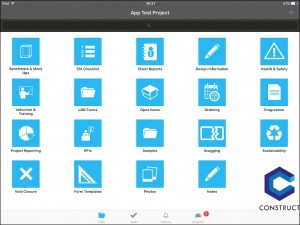
Construct homescreenThe core Construct product is a mobile App that uses real-time cloud technology to let construction managers and consultants manage their whole project on site without needing to go back to the office to handle admin and paperwork. It has been deployed on City of London office projects and on Crossrail, and while some rival applications are point solutions aimed at relatively discrete areas of work (defects, for example), Construct.pm – like ViewPoint for Projects Field View (post) – provides its customers with a growing range of tools tailored to their users’ needs. But it additionally provides Critical Path programme milestone management, digital forms and automated process workflows on top of drawing management, snagging and other workflow support.

Construct.pm, 10-strong and based in London, grew out of INTRO Labs, a mobile applications developer focused on making professionals “hyper-connected”, after founder Ant Erwin identified that enterprise use of cloud technologies and location-based services for project management was being repeatedly requested by corporate customers. Initial development of Construct.pm started in 2013, providing iPad users of with bespoke apps providing various site-based functions including daily checklists and site diaries. By putting these processes at users’ fingertips, Ant says Construct.pm was saving up to two hours a day per user.
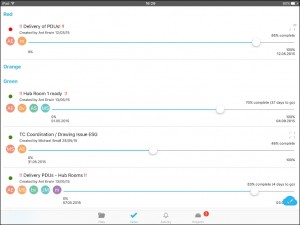
Construct task progressCreating bespoke forms was inefficient, so Construct.pm developed a form-builder and workflow platform to expedite the creation of processes, so that client businesses could customise the application to their specific needs; the platform can also be ‘white-labelled’ to provide corporate branding. Reflecting the company’s legacy focus on hyper-connectivity, the forms allow users to ‘follow’ particular processes and track progress, and there is a real-time bulletin board tool that provides instant commenting or messaging (assuming users have connectivity, of course; this is not unique: among others, GenieBelt’s “Beats” offers something similar, post).

The application was piloted with a small number of customers in late 2014. One of these was ISG, which was also using the Conject SaaS construction collaboration platform to manage documents and drawings (Conject announced it had acquired a mobile business, Wapp6, in January 2014 and launched its ConjectMI mobile inspection application in May 2014).

Conject integration
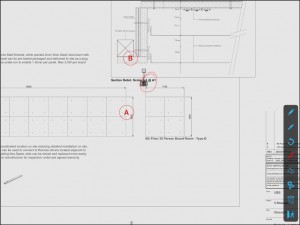
Construct redliningConstruct.pm is not seeking to compete with SaaS providers – Ant sees Construct.pm as complementary – and the business worked with Conject to integrate simple sharing of drawings from Conject to ISG users of the Construct.pm platform. Before going out on site, users autosync their iPads, and can then, if necessary, work offline with the latest versions of information up to that point, then resync once they regain connectivity. Construct.pm also developed some pre-rendering technology that speeds up the loading of drawings on the iPad. The application offers redlining tools and the ability to associate drawings to tasks and forms.

As a project management platform it also allows to import and export schedules and milestones from MS Project. And Construct.pm is also now looking to include building maintenance into the app so it can be used by owner/operators and their FM providers throughout the life-span of a building.

Having quietly launched the iOS application in April 2015, Construct.pm plans versions for Android and for Windows, reflecting what Ant sees as growing popularity of the Windows Surface tablets among some of its corporate customers. The angel-invested business is currently focused on the UK market, but its work with international customers has inevitably attracted some enquiries from overseas.

Permanent link to this article: https://extranetevolution.com/2015/12/construct-pm-delivers-mobile-project-management/

Zutec: desktop, mobile and even the “internet of things”

Ireland’s Zutec, through its focus on commissioning and handover has built a strong position in the megaprojects market, and is looking to expand further.

Zutec logoDublin, Ireland-based mobile construction technology provider Zutec exhibited at two London events I recently attended: the Digital Construction Week show in October (post) and Construct IT for Business’s “Future of BIM” conference (post). I arranged a post-DCW conference call with Zutec to learn more about the company and its products.

Zutec have been in my peripheral vision for some years. I first discovered them when looking at software solutions supporting operation and maintenance manual production in the mid 2000s; I mentioned them in Extranet Evolution almost exactly two years ago, and subsequently met the company’s founder Brian Maguire briefly at a COMIT drinks reception in London.

From CDs to COBie data

Chief operating officer Brendan O’Riordan told me the company had been founded by Maguire (now chairman) in 1999 and initially specialised in compiling O&M manuals on disk. It then switched to software development to enable its customers (often with Zutec consultancy support) to undertake the same task. It grew steadily, driven by organic growth and not reliant on VC investment, during the early 2000s, providing its services to major, complex projects such as Wembley Stadium and the Westfield Shopping Centre in London.

However, the flow of such mega-projects in the UK and Ireland dwindled as a result of the global financial crisis in the late 2000s, and so Zutec switched its focus to more buoyant markets in the Middle East (Abu Dhabi’s Cleveland Clinic and Doha Airport feature in the company’s track record) and the Asia Pacific regions (winning projects in Australia and the Philippines, among other countries, and opening an office in Mumbai).

As the UK construction market emerged from the recession, Zutec has successfully grown its UK presence, building on its relationship with the Wembley developer Multiplex, who, now Brookfield Multiplex, remains one of the company’s biggest customers, with Zutec used as its O&M tool, and for quality assurance and control (QA/QC) and ‘BIM to FM’ purposes.

The company is today around 40-strong, and, excluding the head office administration and sales operations, is still roughly equally divided between software development and provision of information management consultancy (some of its consultants are located full-time on site, others may manage multiple projects, providing initial set-up and training, Brendan told me).

Mobile tools

Zutec’s original focus on collation of post-project operation and maintenance information has naturally morphed into development of mobile applications to support site-based commissioning and handover processes, and planned maintenance (a field that puts them in direct competition with Dome Group and its iSnag tool – February 2014 post); Brendan said they rarely competed against SaaS collaboration vendors such as Aconex, 4Projects [now Viewpoint], or Conject – “often we are deployed alongside,” he said, citing a project where they imported floor plans from Aconex’s platform to use in QA/QC data capture).

COBie data view in ZutecDeveloped for Android and iOS devices, Zutec’s on-site data capture tools support defects management (AKA punchlists, snagging), quality inspections, safety hazards and test and commissioning data. The user interface creates pins that can be located on floor plans and used to help track progress (I was shown a room completion tracker, for example, and another tracking glazing installation) and record defects (at Doha Airport, the application helped contractors resolve around half a million issues). The tool is also able to handle IFC models and COBie data – useful for the developing market demanding BIM capabilities.
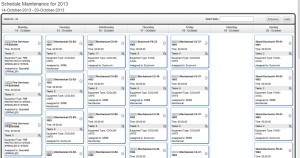
Planned Preventative MaintenanceBrendan also showed me a maintenance scheduling app, that will help technical staff identify and complete scheduled tasks, and also help them undertake these in sequence logical to the layout of a building. In a large building, around 2,700 systems needed to be managed, involving around 65,000 tasks per annum, he said; electronic management, supported by barcode readers and other mobile capabilities, helped ensure better planning, progress monitoring and faster resolution of any issues.

Remote sensing

Remote sensing - Live DataThe business has also started to look at remote sensing tools. Using standard Arduino micro-electronic components, Zutec has been creating multi-function ‘Internet of things’ devices that can be used to provide almost real-time monitoring of temperature, humidity, light intensity, CO2, etc, via wifi. These can be used, for example, during commissioning processes to monitor room conditions, with data accessible via both desktop and mobile devices, and updated at 30-second intervals. I was shown a model view of an as-built room overlaid with a box giving the room’s temperature alongside other, more process-related data.


Permanent link to this article: https://extranetevolution.com/2015/12/zutec-desktop-mobile-and-even-the-internet-of-things/

Augment – use AR to present your buildings

Augment logoAccording to Augment, augmented reality (AR) on a tablet device is the ideal tool for architects to present their building ideas and collaborate with clients and other team members, and for property developers to let or sell the finished buildings to tenants or buyers (architecture and construction is just one market the company is targeting). The VC-backed company, with offices in Paris and in the US, exhibited at the Digital Construction Week show in October, and I got a demonstration of the platform.

Using an Augment app on an iOS or Android device, and then using the tablet camera to view an image, users can view 3D models of both building exteriors and interiors. I was given some sample images in an Augment brochure and I’ve downloaded the Augment app to my Android tablet and been able to view detailed 3D models, doing walk-throughs and spinning round buildings from every angle. Using a tablet allowed me to show the images to other people, something less easy with Google Glass-type AR tools (eg: Visual-Wise, May 2015 post), and it was relatively intuitive to use – within minutes I was zooming in and out of apartments, and showing others points of interest.

Augment is offering a 30-day free trial. Whether in sales meetings, design reviews or just using it internally, business users can upload models to Augment’s servers and then invite other users to view the models on their own devices. If you then want to continue to use the service, then prices start from $300 per device per year (with a minimum of 10 devices – though I wonder if this rules it out as a tool for small design practices?), which allows users to upload unlimited 3D models.

Update (4 March 2016) – Augment has announced a Series A Funding Round bringing the total invested in developing its solution to $US4.7m.

Permanent link to this article: https://extranetevolution.com/2015/12/augment-use-ar-to-present-your-buildings/

Joined-up data needs joined-up CDEs?

Mature BIM use in future will increasingly require owners and their supply chains to share both legacy and real-time data about multiple assets. Being able to extract data held across multiple CDEs will be increasingly important. 

thinkBIMYesterday, I attended the final ThinkBIM conference of 2015 (“BIM outside the Building”, organised by Leeds Beckett University’s CKE); today, I’ve attended a Construct IT for Business conference in London on the “Future of BIM”. Before, during and after these events, I’ve also been talking to attendees (and tweeting to one or two others) about how the industry’s adoption of cloud-based common data environments (CDEs, a fundamental of BIM Level 2) will change as organisations look to share data drawn from multiple assets held on multiple CDEs.

BIM London Environment Agency slideThe Environment Agency’s Karen Alford spoke at both conferences, highlighting their use of Asite‘s platform as a CDE for their projects; Rob Jackson of architect Bond Bryan showed how his company has used the 4Projects platform (being rebranded ViewPoint for Projects) as their CDE; and in one of the ThinkBIM workshop sessions I heard Highways England’s David Owens talked about his frustrating experience trying to use multiple CDEs (this was developed further in a Twitter conversation this morning also including Shaun Farrell of Turner & Townsend).

A suggested basic requirement was the ability “to pass information from one system to another without needing to re-upload multiple times”. With clients sometimes specifying alternative CDEs, users can end up using multiple CDEs, none of which they can be expert in (“multiple systems equals lots of training every time and little opportunity to improve processes.”). Wouldn’t it be better, we discussed, if we could simply use our chosen system, and then (accepting relevant security provisions – the developing PAS1192-5 security standard was mentioned) be able to use its interface and tools to navigate to information held on other platforms?

From extranet integration to CDE connection

NCCTP new logoThis is a familiar suggestion. The concept of integrating different ‘extranets’ was something discussed at least 10 years ago when the Network of Construction Collaboration Technology Providers (now long-defunct) talked about having some common approaches, not just to construction information naming and numbering conventions (building on the Avanti principles that underpin BS1192:2007), but also extending to metadata describing workflows, reports, etc. The NCCTP objective then was to develop a common foundation to vendor platforms so that, if a vendor went bust, past and current projects held on that system could be easily recovered and set up with minimal fuss and business interruption on another vendor’s system.
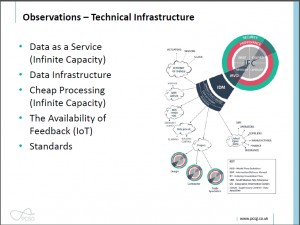
BIM Level 3 Technical infrastructure - Mark BewViewpoint’s Ben Wallbank spoke at today’s London event, and included a brief mention of his company’s involvement in an Innovate UK-funded project to help project teams share information “tier2tier” (see 4Projects to develop ‘satellite’ CDEs). I understand this project still has another year to run, being mainly focused on small constellations of CDEs. I asked Ben about when we might, for example, be able to use our favoured CDE (hosted by Conject, say) to connect to and access legacy or real-time data held on, say, a Viewpoint-hosted CDE. He felt it might be 10 years before this became possible.

Part of his justification was an explanation of the importance of PAS1192-5 given earlier by UK BIM Task Force chair Mark Bew. Talking about Level 3 BIM, Mark had highlighted the importance of protecting the security and provenance of data, so that only authorised users could access relevant information. However, such an apparently simple idea would, he said, require significant changes to construction contracts, to intellectual property arrangements, and even banking processes (providing ways for the IP owners to micro-charge for reuse of their data by other users, if required). And all this in addition to the software development challenges…..

Permanent link to this article: https://extranetevolution.com/2015/12/joined-up-data-needs-joined-up-cdes/

Geospatial expertise vital in managing BIM and Big Data

“Integration of BIM and GIS is a good place to start connecting BIM and Smart Cities

Yesterdays CIOB International Inspiring Construction conference (hashtag: #CIOBInspire) in London heard a series of great presentations on a “Smart future”, from Arto Kiviniemi of Liverpool University, BAM Design MD Andrew Pryke, Sellafield’s John Robison and AECOM’s David Philp. Data – some of it open, some of it Big, some in BIM, some of it in need of security – was at the core of all four presentations, but it was also also clear from all four speakers that we still have a lot of work to do to get our data more joined-up and all-embracing.

Foresight report 2020

This point is also a theme in a new report (available here) published by the Association for Geographic Information (AGI) on Monday. With more and more data becoming available to the human race (according to IBM, each day the human race creates 2.5 quintillion bytes of new data – about the same as downloading half a billion new HD movies every day), the AGI says it is critical that we are prepared to understand it and to use it effectively to manage our societies, economies and the environment. Chief editor of the report Anne Kemp says:

Forbes predicts that over the next five years the number of handheld devices in the world will increase from 10.3 billion to 29.5 billion. This will mean a huge increase in data, and a phenomenal surge in the amount of noise we will need to sift through to find the information we need to make good decisions.

The role of the geospatial community in managing this data is vital. The management of big data through geospatial analysis helps us to visualise patterns of information, create better understanding and dialogue, and make more informed decisions.

AGI Foresight 2020 image(The geospatial community refers to specialists who gather, display and manipulate information that has a location attached to it, from an address or coordinates from a GPS. Geospatial specialists display this information in maps that help people analyse large amounts of information – from the damage done by a tornado to the total number of home foreclosures in a specific area.)

The report says a truly connected ‘Digital Earth’ can only be achieved through location intelligence. A common thread through the report is the need for the GI community, and location intelligence, to tackle issues of data quality and data management to enable enhanced decision making in today’s ‘Digital Earth’. The report highlights that to do this the industry requires a fundamental and deep understanding of its relationship with digital data.

Echoing a point made first by Arto Kiviniemi and underlined by David Philp yesterday – “integration of BIM and GIS is a good place to start connecting BIM and Smart Cities” – the report stresses BIM, Smart Cities and the Internet of Things are key areas where location intelligence is being used to underpin decisions and address key social, environmental and economic challenges. Anne Kemp says

There is far more to location intelligence than maps. It’s all about data, what you do with it and what outcomes you can provide that counts. We are seeing an explosion in the volume of sensors and mobile devices in cities, homes and workplaces which are producing torrents of data. The role of location intelligence in the management of these datasets is vital, with it becoming the glue to connect them.

The management of big data through location intelligence enables people, and technologies, to visualise information and draw out insights to inform better dialogue and make informed decisions.

The 2020 report consistently highlights the important role in which location intelligence is playing across a diverse range of markets. I am confident that the geospatial industry has the skills to shape the way in which information is managed in the future. To do this we need to ensure that the technologies, homes and cities of tomorrow are developed with location data at their core.

[Disclosure: I attended yesterday’s CIOB conference at the invitation of the CIOB. Anne Kemp is a fellow member of the ICE’s information systems panel.]

Permanent link to this article: https://extranetevolution.com/2015/11/geospatial-expertise-vital-in-managing-bim-and-big-data/

An SME AEC SaaS catch-up

I have a backlog of industry posts that I will be posting over the next week or so, but I’ve also been sent a couple of other news snippets….

1: Corecon updates

Corecon logoPitched at the small to medium-sized end of the north American market (“Run your entire operation for about $1 a day!”), Corecon Technologies recently updated its CoreconLink for QuickBooks Desktop and Sage 50 Canada accounting software, providing users of Corecon V7 construction estimating, project management and job cost software with increased efficiency between Corecon V7 and some popular accounting systems.  This streamlined functionality was already available in CoreconLink for QuickBooks Online, SAP Business One and Xero accounting software, but there are some updates of CoreconLink accounting utilities for the online software applications as well. Read Corecon’s news release.

Meanwhile, if you work in the southern hemisphere….

2: SmallBuilders.com.au

SmallBuilders.com.auAnother cloud-based construction software business, Small Builders was launched by a Sydney, Australia-based  building and construction lawyer and a member of the Master Builders Association, with the objective of helping its users run sustainable businesses (“Small Builders gets you paid, gets you compliant, and gets you organised” – all for Au$990 a year – the starter rate).

At first glance, the solution seems to be strong on contract management (so perhaps similar to the UK’s Sypro, only aimed at Australian SMEs) John Dela Cruz says he aims to help SMEs avoid poor business practices:

“The Small Builders building software has been built for the needs of home builders and commercial contractors. If you are good on the tools and managing relationships then Small Builders gives you the essentials you need to run a successful business. You don’t need to be good with computers, Small Builders has been built for you – the small business that needs a practical solution – it’s quick and simple to use.”

Permanent link to this article: https://extranetevolution.com/2015/11/an-sme-aec-saas-catch-up/

Notes from Viewpoint’s Field View user day

The Field View user conference in London has provided some useful updates on Viewpoint’s mobile development plans.

13:00 GMTViewpoint For ProjectsViewpoint For Projects (formerly 4Projects) has been growing strongly in terms of users during 2015, adding 5,900 users/month, EMEA managing director Alun Baker told the last* user conference for Field View (formerly Priority1, acquired by 4Projects in December 2014).

Back in its MCS/Priority1 days, Field View started out as a ruggedised PDA application, but it made the transition to Android devices a few years ago. Today, Gareth Cottrell, Field View’s mobile development manager, showed early designs of the first Windows and iPad versions of the Field View mobile application (the developers are using Xamarin to write native Android, Windows and iOS apps) and talked about the new web edition of Field View (a Beta version – “better, snappier, more adaptive across devices” – will be available to some test users shortly). The new web interface features a left-hand side menu (the current edition’s menu is across the top), fast search tools and filters to help users locate their key projects and tasks, multi-task status change and reporting tools, among other improvements.

A customer story

fieldviewCustomer Gareth Burton, CIO – Europe at Laing O’Rourke, gave an overview of the company’s adoption of Field View, which started back in the pre-Viewpoint MCS days. The company’s philosophy is focused on assurance, ensuring certainty in processes that are less construction, more advanced manufacture and logistics, he said, and they are using FieldView to get real-time assurance they are working on the right information in the right place at the right time. Example Field View projects included the Francis Crick Institute, Crossrail and the Leadenhall Building (all in London), and he echoed MCS founder Richard Scott’s view that mobile value was delivered because the application did far more than snagging (Burton highlighted health and safety, quality, and process automation – asset management trials are under way).
Steve Spark (Viewpoint commercial director, EMEA) talked about building information modelling, and other driving forces: demand for better project delivery, more integration, and technology (data, mobile, business intelligence) as an enabler. He highlighted UK industry KPIs showing the need for change, and noted how other countries are watching the UK’s BIM drive (complete with detailed policies, mandates and timetables), and its focus on whole-life costs. Visibility  and control of processes are key, he said, but we need to overcome the poor interoperability of point solutions and silo mentalities of conventional AEC working approaches – and integration of supply chains and technology is fundamental.

API

14:15 GMT – Another customer, Gary Doel, head of business solutions at UK housebuilder Crest Nicholson, has been working with Field View on an application programming interface, API, seeking to work with its predominantly outsourced supply chains and replace (or at least better support) largely paper-based processes onsite. Snagging was the starting point, but other processes were also mobilised, so that Crest could centralise information to produce summary reports for management at all levels (integrating with data from COINS and other Crest internal business systems). Doel said some subcontractors didn’t even use email, so Field View was used to provide paper-based handouts regarding snags, etc.

BIM

14:45 GMT – Ben Wallbank (Viewpoint BIM strategy manager) aimed to help raise the understanding of the Field View user audience of the UK BIM journey, where BIM deliverables are already required by £11bn-worth of UK projects (excluding HS2). He outlined the Level 2 BIM deliverables and the precedence of the model, talked about COBie (“our aim is for Field View users to do COBie with even knowing they’re doing COBie”) and the Common Data Environment (CDE), and the emergence of ‘Big Data’. This increasingly means that a company like Viewpoint is now working to support data needs throughout the asset lifecycle beyond design and construction.

Viewpoint for Projects now incorporates an EIR Writer and a BEP Writer in its project communication toolset, helping set up team responsibilities and workflows. The company has migrated to a non-SQL database to enable better searches in its BIM management tools, and these include COBie validation and reporting, and integration between the CDE and Field View.

The ‘Big Data‘ challenge comes when clients (plus contractors) need to look at structured data across multiple built assets, and Ben started to raise subjects such as the ‘Internet of Things’ and Smart Cities.

Immersive technologies

15:15 GMT – Dave Elliott of Lutterworth, Leicestershire, UK-based Holivis was a guest speaker at the Field View conference, talking about immersive technologies in construction (businesses such as Soluispost – are also active in this field; I also see and hear a lot about VR, AR and tools like Hololens and Visual-Wise via COMIT). Predictably, Elliott mentioned Oculus Rift, Samsung Gear and ‘caves’, and showed how AR and VR can be used to help train people and to visualise built environments – though he initially used aerospace and automotive examples. However, he also showed examples of VR use in civil engineering projects, and in visualising and sequencing construction processes such as concrete pours.

Field View and ViewPoint for Projects integration

16:30 GMT – With the only occasional mention of “4Projects”, Richard Scott demonstrated BIM integration between the mobile application and the web-based collaboration platform, using a COBie export to populate a model held in Field View. He also demonstrated how Field View forms can be used to capture and add handover information (eg: product serial numbers, installation dates, warranty dates and related files such as photographs) about model objects and then synchronised with the Common Data Environment.

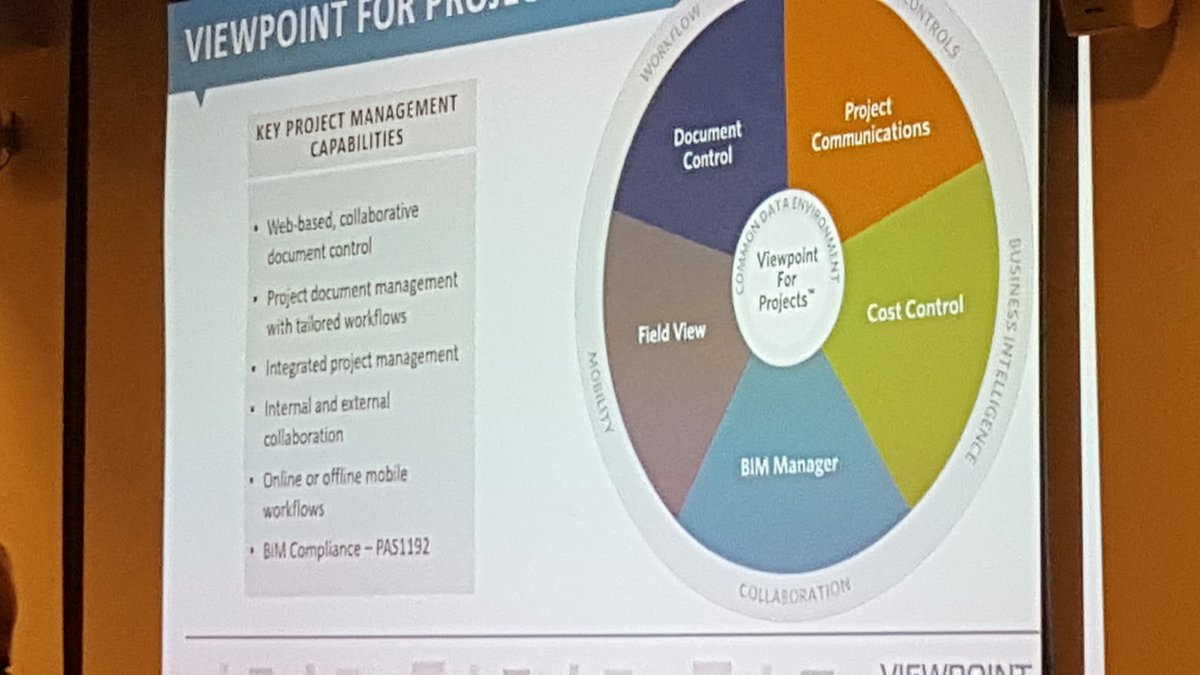
Key project management capabilities17:10 GMT – Viewpoint product manager Jeremy Larsen talked about the company’s product roadmap, strategy and direction, building on Gareth Cottrill’s earlier presentation and stressing usability, mobility, flexibility and integration in the context of Field View (like some AEC SaaS competitors – eg: Aconex [post] – I noticed Viewpoint has cost control as a key project management capability). In the past year, Field View (as a business) has been rebranded and integrated into the Viewpoint company; Field View (as a product) has been integrated with Viewpoint for Projects, though it remains a stand-alone product; a fully-documented API has been created; and customer feature requests have been prioritised and incorporated. Hosting facilities in Australia (AWS in Sydney) and the US (AWS in Virginia) will come online in December 2015 and March 2015 respectively.

[* From 2016, the Field View user conference will be merged with the Viewpoint for Projects user conference – with the next one set to be held on 25-26 May 2016 in London.]

Permanent link to this article: https://extranetevolution.com/2015/11/notes-from-the-viewpoint-fieldview-user-day/

Is BIM the answer?

As a collaboration commentator and occasional BIM speaker, I was one of several bloggers recently asked to comment on the UK’s BIM push for a Microsoft technology blog. As often happens, 90% of what I wrote ended up ‘on the cutting room floor’ (read the full post – including other people’s contributions – here). Just in case anyone’s interested, here’s the rest of what I wrote ….

Is BIM the answer to stabilising the industry?

Construction is an information-intensive industry and has historically been reliant upon exchanging lots of paper. Word-processing, email and computer-aided design (CAD) have accelerated much of the production and exchange of information, but the sector hasn’t really started to work with data. BIM provides an opportunity to digitise many of our processes, reduce our reliance on exchange of paper (or electronic paper) and support more collaborative ways of working. The BIM push since 2011 has already involved much detailed work on industry information standards, workflows and supply chain relationships, and if we can maintain a three-pronged push on people, process and technology we may slowly start to see the industry transformed. I say ‘start’ as there are still large parts of the industry who are either oblivious to BIM or regard it as irrelevant.

Do you think BIM and ERP integration is the future?

Too many people regard BIM as just 3D design, but BIM adds time (so-called 4D) and cost information (5D) to the equation. By incorporating cost information into information models, we start to improve visibility of out-turn costs, and streamline the flows of cost-related information up and down the supply chain. For larger organisations which deploy ERP there will clearly be benefits. However, construction is very fragmented, with lots of small and medium-sized businesses (SMEs) which use more traditional financial management tools, and these also need to be tuned to the project-based nature of much construction work. BIM is helping digitise construction, but digitising construction payment and financial management will take longer, and many SMEs, particularly in the domestic repair and maintenance fields, will be relatively untouched by the BIM revolution.

What do you think will encourage the adoption of BIM?

One reason we have seen extensive interest in, and take-up of, BIM has been the push from the UK government. With public sector client bodies responsible for around 40% of the industry’s turnover, the BIM mandate cannot be ignored, and it has accelerated the pace of adoption. Several private sector client bodies have also jumped on the BIM bandwagon, increasing the momentum. Another factor in adoption will be the sharing of case studies; we have growing evidence that BIM can help deliver projects faster, at lower cost, and exceeding clients’ initial expectations because it helps teams collaborate and innovate. And the development of industry-standard approaches to information creation and data-sharing also reduces a major headache – we are becoming less concerned about the applications and file or data formats we have to use to share asset information.


Permanent link to this article: https://extranetevolution.com/2015/11/is-bim-the-answer/

Site-based AR – connectivity still a challenge

Soluis logoSoluis was the official technology partner at the recent Digital Construction Week in London, and has been pioneering approaches to virtual and augmented reality. I asked Martin McDonnell, Soluis’ chairman about how these technologies could enhance collaboration, particularly on-site.

“Immersive ways of conveying information”

Martin McDonnellInnovation within the construction industry is creating a broad range of opportunities to plan, execute and record projects more accurately, efficiently and cost effectively.

Some of these innovations in visualisation which include virtual and augmented reality are benefiting from an increased willingness by those within the industry to embrace and apply them and this is presenting new immersive ways of conveying information to both internal and external stakeholders.

The direct commercial benefits are relatively obvious. Projects managers now have access to tools that allow them to walk clients through unbuilt environments virtually heightening levels of collaboration and understanding and mitigating a large part of the financial risk attached to changes and alterations once a project is built. Companies themselves can also use these new technologies to elevate their sales and marketing activities to clearly articulate yet-to-be-built environments to sell/lease floor space.

The benefits internally are slightly less obvious, but present huge opportunities which have the potential to transform the way a construction site looks and works.

With a shift towards data-driven construction now already very much under way, there is an opportunity for mass adoption of innovative visualisation technologies throughout the workforce to make the workplace safer, easier to navigate, more connected and more efficient.

A world where experts can clearly and effectively communicate with colleagues on a construction site instantly and virtually is now quickly becoming the reality. A world where the vast majority of training can be provided off site, avoiding the risk and cost attached to operating in volatile environments is becoming possible with a shift towards a digitally-enabled construction industry.

My view: “Need for connectivity …”

Immersive VR environments – whether in ‘caves’ or ‘domes’, by use of high-tech headsets such as Oculus Rift or combinations of smartphones and Google Cardboard (Visual-Wise, for example) – into which a client or project worker can step and visualise his or her project surroundings virtually can certainly be powerful when it comes to planning design, construction and future operation and maintenance activities. But when it comes to work on the actual project site itself, mobile augmented reality, AR, perhaps offers the most potential.

Workers cannot risk being distracted or disconnected from their surroundings, but if their view (and perhaps other sensory perceptions – sound, touch) can be enhanced by additional information, completion of routine tasks might be accelerated and completed more seamlessly with fewer steps. At present, this tends to involve conventional tablets or smartphones, which can use the device’s camera and then superimpose additional information over the camera image (contractor Costain used this in planning its upgrade of London Bridge station more than two years ago, and looking even further back, Woobius Eye was a potentially ground-breaking collaborative tool).

Yet wearable technologies eliminate the need even to hold a device, and might be incorporated into existing site-wear – for example, safety spectacles might incorporate smartglass technology that can be gesture controlled (like Bridgit’s Close-out).

However, the opportunity for site-based personnel to access and even update information in real-time remains constrained by one critical factor: connectivity. Current 2G/3G/4G and wifi communications technologies are rarely 100% reliable on a live construction site, and 5G remains something that may be rolled out sometime in the 2020s, helping to deliver the potential of the ‘Internet of Things’ or even the ‘Internet of Everything’ if we are lucky. In the meantime, we may perhaps have to continue relying on mobile tools that capture interractions with our surroundings and then synchronise these once a reliable data connection is established.

(Such challenges will no doubt be discussed at the forthcoming COMIT/Fiatech conference in London on 10-11 November 2015.)

Permanent link to this article: https://extranetevolution.com/2015/11/site-based-ar-connectivity-still-a-challenge/

SpecifiedBy raises further funding

UK construction product data start-up SpecifiedBy has closed a second seed round of investment of £350,000.

specifiedby.comSome 18 months after securing an initial round of seed funding (post), Edinburgh & Newcastle based startup, SpecifiedBy, has closed a second seed round of investment of £350,000, led by existing investors IP Group Plc and Northstar Ventures, with plans to transform how building products are researched and selected for building projects.

The company, founded by architectural technologist Darren Lester in 2013 and which has now raised over £500,000, will use the money to add to the current team and develop new solutions aimed at simplifying the research process carried out by architects and designers in order to make informed decisions about the building products and materials used in a particular project. It now provides information for over 15,000 building products and materials available in the UK and Ireland.

By structuring otherwise unstructured data about products and materials, SpecifiedBy says it provides the only advanced search and comparison engine for this market. Lester explained

Darren Lester

“There’s this huge problem in the construction industry where the majority of our information is still analogue. So in the example of building products, all of this data about technical performance, dimensions, sustainability criteria and standards, is locked up in PDFs and Word documents, making it very time-consuming to extract and make use of this information.

We’ve taken on the significant task of structuring all information about all building products and materials into a standardised, queryable database. By doing this, and by making this data open and accessible for everyone, we’re not only able to provide advanced search and comparison filters, but we can improve decision making and stimulate more frequent use of sustainably responsible products and materials.”

SpecifiedBy is working with industry organisations including the Chartered Institute for Architectural Technologists (CIAT) and the Alliance for Sustainable Building Products (ASBP) to ensure its platform has the desired impact on the industry. The company is a product of the Ignite startup accelerator programme, based in Newcastle.

Permanent link to this article: https://extranetevolution.com/2015/11/specifiedby-raises-further-funding/

Load more