France-based Finalcad is helping French construction benchmark its quality performance, and building its BIM capabilities.
 Last week’s Ecobuild exhibition in London gave me chance to catch up with Paris-based Finalcad, developer of a mobile-first construction quality management application. Readers may recall that I talked to the business’s Baptiste Joyeaux in the summer of 2015 (see Finalcad expands beyond France), and that its product – widely used in France and in Singapore – had also been deployed by property developer Mount Anvil on a multi-storey residential project in London (post). At Ecobuild, marketing director Aurelien Blaha updated me on two areas of Finalcad data exploitation.
Business intelligence
Finalcad had entered the market primarily as a snagging (aka punchlisting, defects management, quality reporting) platform, and – like some similar tools – it had also expanded to cover other common site-based processes. Most vendors in this space have focused on summarising this information to managers of individual projects; some have expanded this to enable customers to see reports across multiple projects; Finalcad has taken an additional step to publicly benchmark the performance of hundreds of workers across thousands of projects.
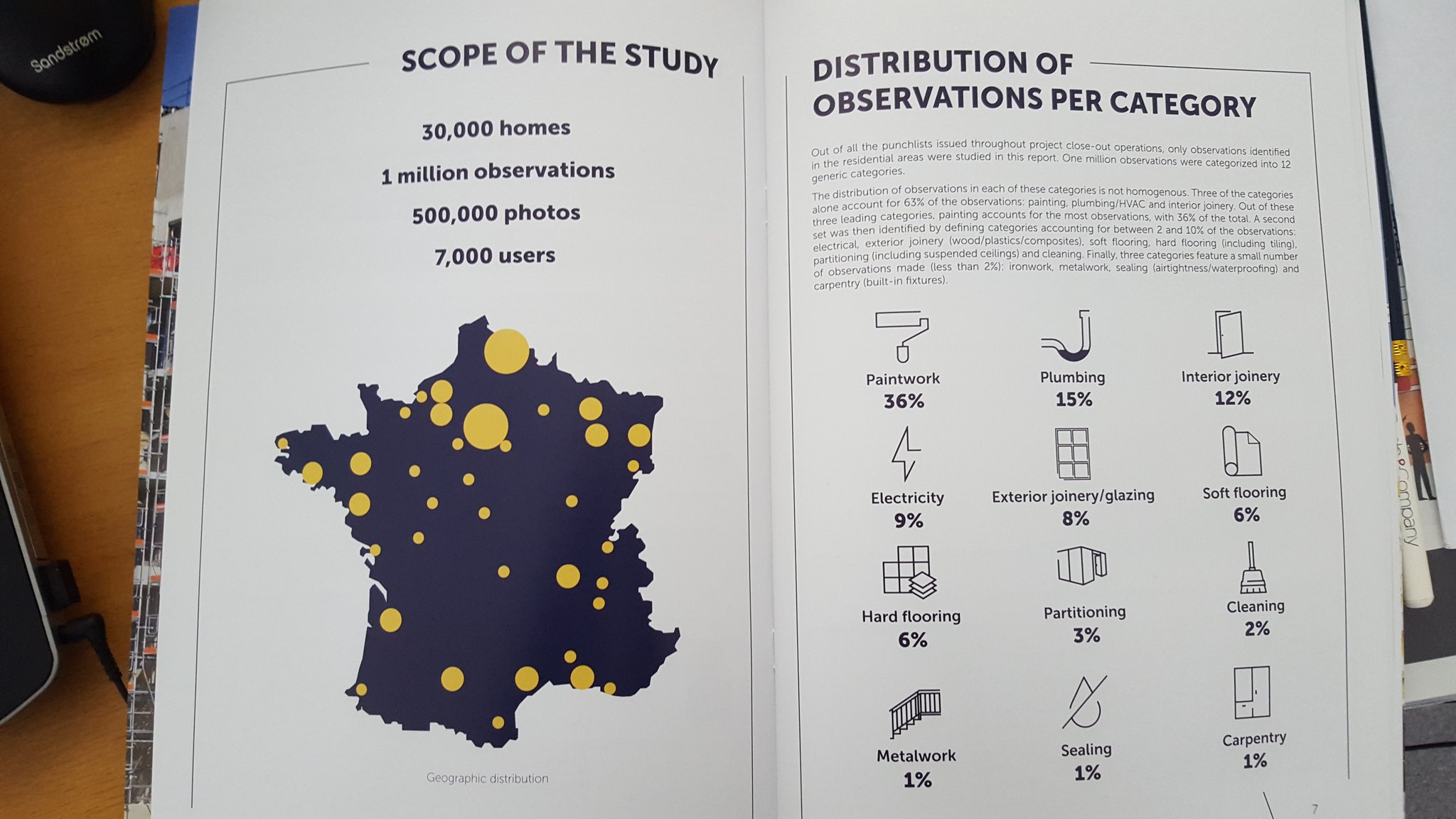 In September 2015, it publilshed its first ‘Construction Observatory’ report (download here, email registration required), looking at public housing construction across France. The study was compiled from a million defects reports, including 500,000 photographs, captured by 7000 users in around 30,000 homes. Among other findings, the study identified that painting, plumbing and carpentry accounted for 63% of all observations gathered in homes.
By aggregating the information, the sources and locations are anonymised, and the data becomes a neutral benchmark of industry practices – valuable to:
- Construction firms, designers, project managers and clients, who can compare their performance (who produces most defective work, who is most proactive in resolving it, etc?) against the national average
- Insurers interested in quality issues and their impact on completion warranties
- Public stakeholders keen to ensure value for money and operational expertise
Highlighting such information will also, Finalcad believes, contribute to pan-industry exchanges leading to action plans to improve quality levels. The company intends to produce further Observatory studies, developing new business insights and predictive analytics.
In the meantime, of course, Finalcad is also providing customers with data reporting services (1 March 2016 news release):
- A new GetMyData service enables information systems managers to retrieve data collected via Finalcad. With one click, a user with credentials can access notes, snags, quality controls and an image database through a secured web interface. This data can be downloaded directly in CSV format and integrated into the company’s existing big data systems.
- With FinalBIM, managers can now monitor project progress with compiled statistics in real time from a web platform. This platform provides an overview of how observations are distributed by trade, a ranking of the most recurring observations (by trade), project process in the form of an interactive site map, and a photo gallery featuring observations collected by Finalcad users in real time. FINALCAD algorithms harmonise this data in order to generate instant analyses.
“BIM with Boots On”
FinalBIM indicates the direction of travel at Finalcad. It is looking towards a future where BIM-originated design information can not only be interrogated from the field and used for reporting, but also for live updating of as-built information. At BIM World in Paris next month (6-7 April 2016), Finalcad will be launching a BIM with Boots On white paper, outlining closer integration of office-based design work and on-site activities.
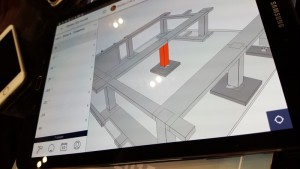 Finalcad has developed BIM solutions for structures and for finishes. Aurelien demonstrated how BIM data about individuals objects or elements (individual pile caps, or doors, for example) could be accessed in the field. As-built variations against the design can be reported back from the field and reported directly to the model authoring application – “challenge the ‘as-planned’ model with the ‘as-built’ model.”
The company’s heavy use of photographic evidence has also helped it to develop “image recognition” tools that can automate steps in site reporting. Finalcad is experimenting with deep learning and neural network approaches that enable its software to recognise objects on site and to automatically apply relevant metadata to them, so that the user has fewer fields to manually complete, Aurelien said, explaining their “three tap” user interface philosophy. The image recognition also extends to optical character recognition so that written data (equipment model and serial numbers, for example) can be captured and reported back to the model.
 London, UK-based SaaS construction collaboration technology vendor
 An email from an Asite shareholder reminds me that two years ago, Asite CEO Tony Ryan talked very bullishly about future revenues. He told journalists and bloggers attending the Asite user conference in
  Melbourne, Australia-based SaaS construction collaboration technology provider
  Aconex says it is developing its connected cost management solution from its
  The November 2015
  EADOC founder Eric Law is now a senior director of product management at Bentley, applying his project management software experience to a Bentley Project Delivery solutions portfolio which includes EADOC, ProjectWise and Navigator. The EADOC capital project management cloud-based solution helps construction managers and infrastructure owners gain real-time visibility into risks and costs.
 Following a moratorium in place since 1988, the County of San Luis Obispo, California, undertook construction of a US$180m wastewater treatment system consisting of 49 miles of pipelines, 580 manholes, 4,700 laterals, 21 pump stations, a 1.2 million-gallon-per-day tertiary treatment plant with 34 storage ponds, and 100 percent recycling through irrigation and groundwater percolation.
 The EADOC toolset helped reduce costs associated with building the project and managing public relations, and is expected to help reduce future costs for operations and maintenance. Eric told me EADOC Archives can be output for the client as parsable XML data – not just in static PDFs – capable of being shared with other applications.
 Last month (20 January) I did a short presentation about common data environments (CDEs) and the current state of the cloud-based construction collaboration market to an audience at the University of Westminster in London (where I am a visiting lecturer). My overview of the market included the usual SaaS players, and vendors better known as design authoring software providers (Autodesk, Bentley, Nemetschek), plus Trimble – who I described as “acquisitive” and “a growing force”.

 “Within our core segment we see project collaboration as a key technology for the construction industry, above all due to the close integration of BIM. Therefore, we are continuing to place strong emphasis on further expanding digitalisation and networking. With the acquisition of Lascom AEC, we entered the French market for CEC in the construction sector, which also enabled us to further develop our international business and gain PLM expertise within the Group.”
 QCLNG mega-project
 Fast-tracking the improvement cycle by an estimated one to two months
 “Envision today is a collaborative project delivery platform for design and construction projects that enables near real-time, site-based capture of project data and the continuous integration of that data into the decision-making process. It gives optimal visibility of a project’s schedule, progress, change and costs – drawing on the latest field information and collaboration among project participants, from field teams to design and construction offices and more – driving faster and more informed decision-making.”
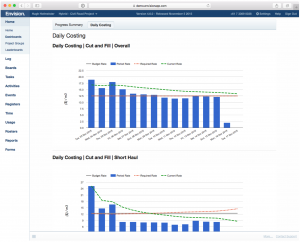 Indeed, Envision can effectively function as the data and reporting hub of a constellation of applications and web services, from Autodesk and Bentley BIM authoring tools, SaaS document management (Aconex, the former INCITE Keystone, and QA Teambinder), scheduling (Primavera, MS Project), estimating (Exactal), financial reporting (SAP, Oracle) and payroll and timesheeting applications. Hugh showed me project dashboards incorporating earned value management (EVM) curves as well as conventional bar charts and spreadsheets (Conject
  One of the Be Inspired Awards finalists at the 2015 Bentley Systems Year in Infrastructure conference was the international multidisciplinary consultancy AECOM. As
 He said ProjectWise was “the obvious choice”, “the most mature tool”, scaleable, and almost infinitely flexible (over one million configuration options) but wasn’t dependent upon everyone using other Bentley products (“ProjectWise is application-agnostic – we have lots of Revit users too”). It was also simple to start using; Albright showed the simple system icons and ‘software wizards’ used to help set up projects consistently on the system, and described his team’s philosophy of “Just in Time learning – what you need when you need it”, incorporating written help, graphics and video guides that anticipate commonly asked questions. The system’s support site is hosted by Bentley but populated by AECOM materials crowdsourced from its users.
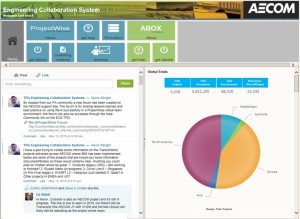 Benefits already identified include reductions in lost information, less rework from working on the wrong information, and the creation of a history and knowledge base for each asset. Automating, simplifying and reducing project administration tasks has cut the time associated with project start-up. And the use of local hard-drives has been replaced by the ProjectWise cloud, helping also to centralise system administration to a handful of individuals worldwide. Albright said “If the system increases resource utilization by just 2 percent, AECOM will save hundreds of millions of dollars on an annual basis.”
 Humberside, UK-based
  CAM has been developed with a modern, graphical approach, ensuring information and data is simple to understand.
 One of the most interesting north American businesses is Canada’s
  Presenting at and winning Google Demo day was yet another great opportunity to showcase just how much construction technology is changing, and how quickly that change is happening. 2016 is going to be a huge year for software adoption across the entire construction industry. On-site and in-office construction teams now have the appropriate tools (iPads, smartphones, larger data plans, etc.) to use software in their day to day.