Bentley extends ProjectWise adoption

Bentley Systems’ Year in Infrastructure conference (#YII2015) has seen a host of product and corporate announcements, with an enterprise deal with AECOM involving ProjectWise a headline item.

Bentley-advancing infrastructureLondon: 3pm GMT – CEO Greg Bentley opened today’s press conference with a brief mention of the US company’s declared intention (July 2015) to float on the stock exchange, but quickly dampened speculation by saying that Wall Street sentiment towards IPOs had chilled in recent months. Instead, therefore, he focused on the company’s acquisitions over the past year – including that of EADOC in March 2015 (see also April 2015 post: Law expands on Bentley’s EADOC deal) – and then a series of recent announcements.

ProjectWise CONNECT Edition now generally available

Bentley highlights ProjectWise’s extensive adoption in the infrastructure sector – its 2014 Annual Report (tabled at the conference) shows 45 of Engineering News Record‘s top 50 design firms are ProjectWise subscribers (and 283 out of the top 641 design firms). Historically, this has been mainly delivered as an in-house, on-premise hosted service, though ProjectWise Essentials, a SaaS option for smaller businesses with insufficient in-house IT resources, was launched a year ago (post).

Bhupinder Singh presenting at YII2015Now, with ProjectWise CONNECT Edition, this “workhorse for work sharing”, “the ‘gold standard’ for AECO collaboration worldwide” (Bentley’s words) is now available to the entire supply chain, taking advantage of Bentley’s Microsoft partnership using the Azure cloud-computing platform. Senior Vice President Bhupinder Singh highlighted the company’s cloud services as core to the triple challenges of increasing complexity of devices, software and data.

The YII2015 conference also has an awards programme, and two finalists presenting tomorrow are international companies seeking to deploy ProjectWise to, respectively, enable collaboration across their enterprise (AECOM) and develop consistent approaches to building information modelling (Arup).

AECOM enterprise deal

The conference has also coincided with an announcement that AECOM, which has named Bentley as a strategic partner for project delivery technologies, has extended its ProjectWise corporate commitment to fully include the new Bentley Cloud Services Subscription Program.

AECOM is a longstanding user of ProjectWise. As a finalist in the “Innovation in Project Delivery” category it has documented 80 percent savings in project startup from the capabilities offered by Bentley’s Cloud Services Subscription Program. Some 20,000 AECOM employees already use ProjectHub, a hybrid ProjectWise system developed in-house at AECOM, which uses seven identical “hubs” placed globally, allowing users to access the system from anywhere in the world and have a consistent experience across projects and geographies.

I will be learning more about both AECOM ProjectWise programme and Arup’s ProjectWise BIM project template in their finalist presentations tomorrow (Tuesday). EADOC is also featured in a finalist presentation relating to HDR’s Los Osos wastewater project in California.

[Disclosure: I am attending the Bentley Year in Infrastructure conference as a guest of Bentley Systems, who have paid my hotel expenses. I am also a juror in the BE Inspired Awards.]

Permanent link to this article: https://extranetevolution.com/2015/11/bentley-extends-projectwise-adoption/

Progressclaim targets Aussie CPM market

A Google alert brought me news (reported in BRW, and Dynamic Business) of an Australian construction technology start-up, founded in 2011, that is competing in the same kind of market as Textura.

Progressclaim.com logoLincoln Easton, CFO of a Melbourne, Australia-based contractor, was apparently only too familiar with the poor book-keeping, arguments, paperwork and threats that resulted from slow payment due to poor progress claim documentation – often based on manual processes. A 2009 industry report suggested contract disputes added an average 6 per cent to the cost of each project. So, in 2011, Easton established Progressclaim.com, a software provider whose product connects the systems of contractors and subcontractors – replacing spreadsheets and email – so that they can generate, process and track cost claims arising during projects, and ensure they are are correctly formatted and compliant with the relevant legislation.

The first prototype software was tested on commercial projects in 2012-13; customers have included Built, Decmil and Victorian builders Buildcorp Commercial and Winslow Group; and the now 11-strong business claims annual revenues of about Au$1m (“Easton says it could potentially reach $30 million in four years’ time”). The BRW article also positions Progressclaim as potentially competing with near Melbourne neighbour Aconex (who announced they were acquiring Worksite in August 2015 – I don’t think BRW is correct: Worksite is a broader offering than just construction payment management, CPM) as well as offering a locally-developed alternative to the major niche player, Textura.

Founded in the US in 2004 to expedite CPM processes, Textura is now well-established in the north American market and has been gradually expanding overseas, opening an office in Australia in 2012 and – since July 2014 – beginning to expand in Europe (post). Other niche players in this sector include UK-based OpenECX (post).

[Disclosure: I have undertaken consultancy work for Textura Europe.]

Permanent link to this article: https://extranetevolution.com/2015/10/progressclaim-targets-aussie-cpm-market/

Collaboration 2025 – Worst and best case scenarios

constructing excellenceIn a piece of action research, Constructing Excellence’s collaborative working champions (CWCs – I have been a CWC for 10+ years) recently collaborated on some future-gazing, developing two differing views of the state of collaborative working in ten years time.

Building a discussion

At a 10 September meeting, we used the UK government/ industry strategy Construction 2025 (downloadable here) to provide some context. Broadly, this sets three strategic aims:

  1. Smart construction and digital design.
  2. Low carbon and sustainable construction.
  3. Improved trade performance

… and suggests six drivers of change:

  1. Improved image of the industry [again].
  2. Increased capability in the workforce.
  3. A clear view of future work opportunities.
  4. Improvement in client capability and procurement.
  5. A strong and resilient supply chain.
  6. Effective research and innovation.

The CWCs extended their discussion via a series of questions shared on Twitter, with the resulting ‘tweetchat’ captured in Storify. With Martin Brown, I then sketched out two contrasting scenarios which we posted on Google Docs for comment. We got some feedback, and tabled updated versions at Constructing Excellence’s members’ forum on 14 October.

Currently, use/misuse of terms such as ‘collaboration’ and ‘sustainability’ feature strongly; the optimistists considered ‘whole life costing’ and social cohesion, but pessimists feared continuation of short-termist, lowest price, adversarial approaches, partly because clients rarely measure value other than financially. From a technology point of view, BIM gets a grudging mention in the pessimistic forecast, while the optimistic view sees data (not files) as core to how we work….

We are now opening up the conversation even wider. You can either:

Depending on the scenario, please be as appropriately pessimistic or optimistic as you can. The CWCs will be meeting again in early December, so we will review the responses then.

Permanent link to this article: https://extranetevolution.com/2015/10/collaboration-2025-worst-and-best-case-scenarios/

Dwindling construction week

Digital Construction Week 2015 has ended. DCW15 officially opened with a (for some) Guinness-fuelled flourish at a packed Irish Embassy reception on Tuesday evening and petered out at London’s Business Design Centre at 4pm yesterday afternoon.

DCW2015 logoAutumn is a difficult time to run any event – perhaps doubly so for an ambitious new multi-day event and its attempt to build a fringe programme (post). It was just two weeks after the UK Construction Week show in Birmingham, and had competition this week from the ICE’s BIM conference (now in its, I think, fourth year), the second MIPIM UK property show, and a steady stream of autumn industry awards events. Bentley and Autodesk also have major customer events in the next six weeks. And, of course, the industry is booming and many busy employers will be reluctant to release already over-stretched staff from ongoing project commitments for a day or two.

DCW attempted to move the industry conversation beyond building information modelling (did any conference session not mention BIM?). It attracted a broad mix of both established AEC IT business exhibitors and some more recent start-ups. Familiar collaboration faces (to me) included Asite, Business Collaborator, Union Square and Newforma, and major AEC players such as Bentley, Autodesk and Trimble, but also several newer faces (expect some new posts on some of these….).

DCW: dwindling construction week

However, an Autodesk leadership conference planned for Tuesday 20 October was cancelled, as was a concluding DCW awards event, the ‘fringe’ was sparse, and I was told major keynotes from the CEOs of Autodesk and Bentley were cancelled (an article by Autodesk VP Phil Bernstein was published in the DCW blog). Yesterday’s main conference sessions seemed thinly attended. I chaired a conference breakout session on Big Data, with a three-strong panel of Kim van Rooyen from Turner & Townsend, Rolf Jerving of dRofus, and Patrick Mays of Dassault Systemes, and we had an audience of around 30, but some breakouts got half that.

In recent years, BIM conferences have been crowded affairs, but perhaps this was one event too many in a crowded month, maybe some ‘BIM fatigue’ is setting in, or conferences have to be priced more attractively (the full DCW delegate rate for a two-day conference pass was £395, plus VAT; £225 for public sector employees), with some concessions to attract SMEs.

Sadly, the exhibition reminded me of past construction IT events (Construction Computing Show, for example, which finally died in 2007; the Construction Computing Awards programme continues). Islington’s Business Design Centre was hardly bulging at the seams. Several exhibitors told me the event was poorly attended in terms of overall footfall, though some were pleased with the quality of the contacts they’d made (and I certainly found it good for networking). As an industry marketeer, I’ve long doubted that construction IT buyers attend such events, but perhaps exhibitors build or maintain brand awareness by their presence – I talked to a handful of exhibitors that I hadn’t previously encountered.

My saddest reflection relates to post-show views expressed by a small group from one IT vendor’s sales team in a nearby pub. I was told: “BIM is not going to attract many people”, “They’re just preaching to the converted”, “Digital construction and BIM mean nothing to most construction businesses”, and – perhaps worst – “if they renamed the show ‘Build stuff cheaper’ they’d get more people through the doors”. It seems even some AEC IT salesmen aren’t confident about the current digital push, and believe most customers are just interested in delivering projects at lowest price (attitudes sadly redolent of most of the industry currently known as construction, TICKAC).

#DCW16

The DCW team has tweeted its intention to run the event again, slightly later in 2016 in mid-November (16-17th) instead. This may avoid date clashes with some of the previously-mentioned events (though there will probably just be different competing ones), and I am sure the team learned from this year’s delivery. I think they were right to look beyond BIM (the UK government BIM mandate comes into force in April 2016) and with almost 13 months to plan next year’s DCW they will hopefully build a stronger event that reaches out to a wider audience yet to encounter, let alone cross, the digital divide.

[Disclosure: I was on the DCW15 steering group, and had a free conference pass.]

Permanent link to this article: https://extranetevolution.com/2015/10/dwindling-construction-week/

Newforma goes Lean

The Newforma LeanPlanner application helps construction teams apply lean thinking to their projects, though it is not (yet) integrated with their information management software.

Newforma logo 2015New-Hampshire, USA-based project information management software vendor Newforma has announced the launch of Newforma LeanPlanner, which will provide visual production planning software for design and construction companies using lean methods of project delivery.

Newforma LeanPlanner is powered by LeanKit, enterprise lean process and work management software that automates workflows (an alternative to the manual sticky note, paper forms and spreadsheet project management practices commonly associated with lean approaches). Ultimately, the tool is used to improve production schedule reliability for more predictable project outcomes.

Using LeanPlanner, project team members can identify near-term constraints and track progress of work from “to do” to “doing” to “done,” anytime, anywhere. LeanPlanner’s analytics and reporting capabilities accelerate the lean journey and promote continuous improvement through deep understanding and insights, including plan percent complete (PPC).

Dan Conery, Newforma’s vice president of business development (and star of this ‘Navigating your journey to lean‘ video), said:

“Applying lean principles to the design and construction industries has tremendous business benefits to customer satisfaction and the overall bottom line. The current manual process of sticky notes on a wall is a good first step that quickly shows its many limitations. The rapidly growing interest in lean methodologies indicates that visual planning tools like LeanPlanner will have an even larger impact on our industry than Building Information Modeling (BIM).

LeanKit is not as well-known as some other lean toolsets associated with construction (such as the Lean Construction Institute‘s Last Planner System), but Chris Hefley, CEO at LeanKit added: “Newforma’s deep industry knowledge and strong market presence, combined with LeanKit’s lean process and work management solution, bring more collaborative, proactive and successful work practices to the building and infrastructure industries.”

Product fit

I asked how does this fit alongside Newforma’s existing offerings? Dan Conery said:

Dan Conery (Newforma VP)A major benefit of all Newforma solutions is each product is designed to help customers save time completing many of the processes they deal with every day. In doing so, Newforma’s products eliminate waste and allow our customers to add value to their customers. Eliminating waste/ adding value are two tenets of lean, and LeanPlanner was created to specifically address these two processes.

As a company, we are focused on finding ways to empower the individual, while supporting team collaboration, and enabling the enterprise to turn data into intelligence. Again, LeanPlanner supports all three of these dimensions. This is something we have desired to add to our portfolio for many years.

Is it integrated with the SaaS or on-premise solutions at all?  If so, how? Dan replied:

Today the answer is no. However, we are talking with our existing customers to determine what they need shared between LeanPlanner and our other solutions in order to ensure data is not entered more than once. Areas we are actively exploring at the moment are the sharing of user accounts and the ability to start a project in LeanPlanner based on projects in other solutions and vice versa.

My view

I am not sure whether ‘lean’ or BIM will prove to have the largest impact on the built environment. More likely, both approaches will be deployed and increasingly integrated (note, I talk about approaches, not technologies). Indeed, the UK’s more progressive clients (eg: Highways England) and their construction supply chains appear to be applying a combination of lean thinking, BIM, collaboration and value-based methods of procurement, with data and information technology as facilitators to the whole process.

Permanent link to this article: https://extranetevolution.com/2015/10/newforma-goes-lean/

4Projects’ revenues up 21% in 2014

SaaS construction collaboration vendor 4Projects grew its revenues 21% in the year ending 31 December 2014, but also reported the business’s first significant loss.

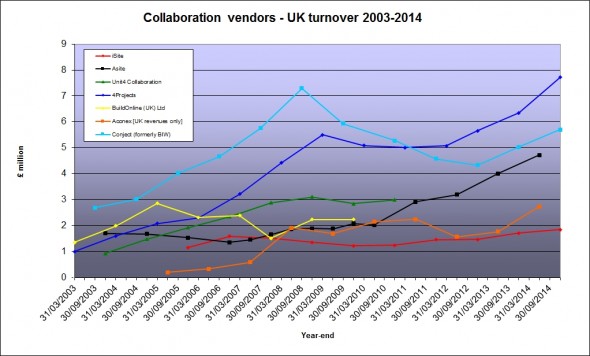
Viewpoint For ProjectsThe Newcastle, UK-based SaaS construction collaboration technology vendor 4Projects (now Viewpoint for Projects) grew its revenues 21.5% in the year ending 31 December 2014. The UK subsidiary of Portland, Oregon, US-based Viewpoint Construction Software has filed its annual report and accounts at Companies House, and they show revenues increasing from £6.351m in 2013 to £7.717m (c. US$11.99m or €9.86m) last year, during which, in December 2014, the company acquired Mobile Computing Systems.
uk vendor revenues 08Oct15

First loss

However, this acquisition does not account for the company’s first reported loss. After seven consecutive years of £1m-plus profits, the business has reported a pre-tax loss of £1.046m (c. US$1.62m or €1.34m) in 2014, compared to a £1.597m profit in 2013. The accounts show a sharp increase in headcount from 57 to 70, and a corresponding jump in payroll costs of around £0.9m, but these only partially account for the dip. The report explains this as follows:

“[There was] continued and sustained investment in all parts of the business. In particular the group invested significantly in R&D and growing our North American and Australian businesses to leverage our parent company’s significant presence in those markets. Given the subscription nature of our revenue the return on this intercompany investment will be felt more keenly in future years and in 2014 resulted in a planned accounting loss easily covered by our strong balance sheet.

Our investments in 2014 continue at a pace in 2015 and are already paying off in 2015 with strong growth continuing across all of the regions in which we sell.

4Projects saw revenues up around 14% in the UK (accounting for 75% of the company’s business), and up over 50% from the rest of the world, albeit from a relatively low starting point, said finance director Chris Baty. The Middle East was “undoubtedly strong”, and the growth had continued in 2015 (and “has the potential to accelerate again in 2016”). UK revenue growth is already accelerating, UK MD Alun Baker told me: “it’s above 20% and we’re seeing significant growth in infrastructure business”.

Product portfolio

Alun BakerAs well as international expansion, the business has also been expanding its product portfolio, Alun said. “4Projects used to sell just a single product; now we have three new areas: our mobile capabilities, our BIM capabilities, and, in the US, integration into Vista ERP.” He said this was “proving increasingly attractive to many contractor customers who are now looking more strategically at their IT portfolio, looking to integrate documents, BIM, site activities and back office.” He also feels Viewpoint for Projects is the “SaaS leader in the BIM marketplace.”

The 4Projects integration of MCS’s former Priority1, now Field View, into the product porfolio is “proving compelling in the market place,” according to the report. Baker says it was an important milestone for 4Projects, and after unifying sales and support functions, rebranding and promoting the combined offer, “it’s proved a very successful acquisition for us, with 50% growth in revenues this year and big international interest”.

Price pressure?

I asked Alun about competitive pressures (highlighted by Conject UK in their recent annual report; post). Not naming names, he told me:

“We find some competitors in their native geographies are defending their positions at the market rate, but when it comes to winning work in other markets it’s different. In the UK, we’ve seen them offer significant – and, in our view, unsustainable – reductions.”

He underlined again the attractiveness of the integrated Viewpoint for Projects portfolio to contractors and other customers. “This is allowing us to sustain our price point, and we have seen an increase in both our average order value and the duration of contracts.”

Mindful of US GAAP reporting rules, he would not be drawn on the size of the business’s order book, but said the company had seen its net actual new contract value totals tracking at over 140% of plan. This was encouraging Viewpoint – buoyed by its investment from Bain Capital – to invest in maintaining the SaaS business’s revenues, as these were distinctly different in character to revenues derived from traditional perpetual licenses.

Commentary

Allowing for the different reporting periods, ViewPoint for Projects’ 21.5% growth in 2014 plus its talk of accelerating growth in 2015, compares well to the 24% growth achieved by its international rival Aconex in the year to 30 June 2015. AEC SaaS vendors are growing revenues modestly in established markets such as the UK and mainland Europe (4Projects’ 14% UK growth is consistent with the 13% achieved by both Conject UK and Germany’s think project!), but – clearly – expanding into the Middle East and other developing markets is the key to significant revenue growth.

However, such expansion can hit profits. Australia-based Aconex’s experience suggests establishing a strong presence in a new market like north America requires significant investment in personnel and infrastructure, and attractive pricing to encourage early adoption. As a result, it may take time for that investment to generate a strong contribution to the bottom line (this Sydney Morning Herald article points out Aconex still lost Au$8m before tax [and accounting adjustments] in a market which remains a volatile ‘landgrab’ and where “being too conservative will almost certainly spell long term failure”).

I also note some convergence in the product strategies of these major players. With file sharing and document collaboration increasingly commoditised and rising competition at the SME end of the market (as well as ‘freemium’ solutions like GenieBelt, I have seen many low-cost solutions launched – a $15/user/month from BlueVue is just one recent example), the leading SaaS vendors are looking at the richer pickings of the enterprise market. They are marketing an expanded portfolio of services: workflow, mobile tools, BIM, integration with back office, business intelligence and financial reporting. With the UK government BIM mandate due to come into force in 2016 (and other countries following suit (eg: France 2017, Spain 2018), such more holistic offerings are likely to become more widely used. And the fruits of 4Projects’ prolonged investment in BIM could help boost its UK revenues, and make it attractive to customers and supply chains looking to deploy BIM in other markets.

Permanent link to this article: https://extranetevolution.com/2015/10/4projects-revenues-up-21-in-2014/

1 In 5 Aussies think stormy weather affects cloud computing

BIM in the cloudA news release just in from Servers Australia suggests Australians are still confused about cloud computing. While the notion of cloud computing (Wikipedia) has been around for decades, its use in the context of on-demand access to computer resources is around 20 years old, but it clearly has yet to be commonly understood.

Using Google consumer surveys, Servers Australia surveyed 1,000 Aussies, 1,000 Brits and 1,000 Americans on their knowledge of cloud computing. While 1 in 10 from the UK and America said stormy weather could have an impact on cloud computing, the figure doubled for Australians – with 22% saying they were sure it would have an effect. A further 1 in 5 (20%) said they didn’t know.

Jared Hirst, CEO, from Servers Australia said:

“A few years ago cloud computing was a relatively new term to us all and few understood what it was all about. Now, however, it plays a pretty big part of our lives. From smartphones to email and, from shopping to social networking – most of us use some form of cloud computing in our day-to-day lives.

“But, although most of us use the cloud, our survey data suggests that many people don’t even realise they’re doing so and that the terminology is still confusing us. Embarrassingly, Aussies seem to be even more clueless than our American and British counterparts – with twice as many locals thinking the weather could gum up the works!

“It’s important that people get to grips with this technology so they can ensure they’re acting safely, responsibly and securely online.”

Though more Australians felt sure that storms could wreak havoc on cloud based computing, Americans showed themselves to be more confused – with almost half (42%) saying they didn’t know. A third of Britons (35%) weren’t too sure either.

One hopes that understanding of cloud computing is more advanced among professional audiences than among the general population. The first construction collaboration software-as-a-Service vendors – including Australia’s Aconex – worked hard to educate the market about the concept of remotely hosted software and data (before it was called SaaS, it was application service provision). Resistance to the concept initially eroded gradually, but has diminished significantly in recent years as online storage services such as DropBox, and use of mobile devices accessing cloud-based applications via 4G or wifi, have become popular.

Permanent link to this article: https://extranetevolution.com/2015/10/1-in-5-aussies-think-stormy-weather-affects-cloud-computing/

Conject resists price-cuts, grows 13%

Conject UK resists competitive pressure to cut prices, and grows revenues 13% in 2014.

The Conject the ILM groupWoking, Surrey-based SaaS construction collaboration vendor Conject UK, the British subsidiary of the Munich, Germany-based Conject Group, has reported turnover up 13% in the year to 31 December 2014 to £5.696m, compared to £5.028m the previous year, continuing its double-digit recovery since its post-recession 2012 low-point.

The UK business reported a modest operating £40k operating loss (2013: £177.6k), which, with a little accounting magic, allowed it to declare an after-tax profit of £72.9k (versus a £75.6k loss in 2013). The firm’s order book position improved, with “future recognisable revenues” up just over £1m – or 9% – from £11.69m to £12.74m at 31 December 2014.

UK AEC SaaS vendor revenues September 2015

The results might have been stronger but for some aggressive domestic competitor action; the directors report:

“In the second half of 2014, we experienced some serious price-cutting from a number of competitors. We chose not to compete at these levels. As a result, a number of new business opportunities were lost.”

International performance

Steve CooperOperations in Singapore continued to expand, while “the Middle East, was, and remains, very active,” though “some contracts took some considerable time to conclude, resulting in a number of delays to project commencement dates” (and presumably reducing revenues).

The Middle East remains a key market for several vendors with significant untapped potential: Asif Sharif, the company’s Dubai general manager, recently wrote in in the region’s Construction Business News that 70% of the region’s projects were still not supported by ‘fit for purpose’ project collaboration systems. UK MD Steve Cooper, right, told me that UK or US-led projects were more likely to deploy a platform, but locally-based clients delivering projects with less onerous approaches to contract compliance currently found little value in online collaboration (Conject has today announced that its core ConjectPC platform will be used on the US$1bn Reem Mall project in Abu Dhabi).

In terms of headcount (2014: 52), Conject UK comprised just under a third of the parent Conject group, which in the year to 31 December 2014 generated revenues of €21.5m (c £15.94m or US$24.25m) – up 7.5% from 2013 (post) – and was profitable. Even on a conservative projection covering just two years of anticipated revenues, Steve told me the group had an order-book worth some €34m (c. £25.21m or US$38.31m). In Europe, the UK and Germany remain the most established markets, but France had also seen strong revenue growth of 30% (albeit from a low starting point); revenues in the group’s Asia-Pacific arm – which includes the Middle East – were up 55%.

(The group’s revenue growth lags behind that of fellow Munich-based SaaS construction collaboration provider, think project!, which grew 13% in 2014, achieving revenues of €20m, closing the gap on its rival. I hope to learn about the 2014 performance of Conject’s closest UK competitor, 4Projects, soon.)

UK customers

Alongside long-established Conject UK customers such as Gleeds, Mace and Lend Lease, the company secured new project and enterprise agreements with Ericsson (data centres projects, I believe), Cap Gemini and US contractor Paragon (adopting Conject’s defects reporting tool), and new programme appointments with Interserve, University of Manchester and Rise Management Consulting (an offshoot of Mace). The Conject platform continued to be deployed in the busy London market on both commercial and residential projects (Greenwich and Battersea schemes were mentioned), but traditional housebuilders are also adopting the system, Steve said, looking to roll-out projects more efficiently, automate reporting and save time on project reporting.

Permanent link to this article: https://extranetevolution.com/2015/10/conject-resists-price-cuts-grows-13/

iSite earns £900k in half year

iSiteStyles & Wood’s specialist SaaS information management subsidiary iSite has reported revenues growing. in the first half of 2015. According to an interim results announcement, the fit-out contractor’s IT arm generated £900k in revenues in the six months to 30 June 2015, up around 7% from £843k in the same period in 2014. Profit in the first six months of 2015 is given as £82k (up from £21k in 2014).

Since June, the business has announced a three-year deal with UK furniture retailer HSL which plans to open two new stores per month until 2018 to achieve a national network of 120 retail outlets. iSite’s Portal system will support the company’s store acquisition programme and its property portfolio management.

iSite usually reports a better second half-year, though 2014 was an exception (post). If it repeats previous years, on this performance, it should finish ahead of the 2014 full year revenue figure of £1.84m (profit: £192k), the best result in the Nottingham-based business’s history.

Permanent link to this article: https://extranetevolution.com/2015/09/isite-earns-900k-in-half-year/

Newforma launches community

Newforma logo 2015Having rebranded in July 2015 (see New look Newforma), US-based project information management (PIM) software vendor Newforma has announced the launch of its Newforma Customer Community: “an online location for Newforma customers to ask questions, find answers, join conversations, and contribute ideas.”

Newforma customer community Sep2015According to the Newforma news release, the community, built on Salesforce Community Templates, offers “numerous ways to engage with peers and Newforma representatives” – they can:

  • Post questions.
  • Find and share answers.
  • Suggest new products, features, and improvements.
  • Monitor and track open support cases.
  • Find release notes and updates.
  • Discuss best practices.
  • Discover new ways to enrich their professional lives.

Reaction

It’s nothing new. Seven years ago, when social media was still relatively new (at least in the construction sector, even in IT), Bentley launched its BE communities (May 2008), followed soon after by Adobe (June 2008). A year later, UK-based AEC SaaS collaboration vendor Asite was launching its own interactive community in June 2009 (Asite upgrades and updates; I revisited it three months later, and again in December that year). The interfaces may be a little slicker, but the basic idea of self-servicing online communities is little different.

Permanent link to this article: https://extranetevolution.com/2015/09/newforma-launches-community/

Load more