Going APE

Australia is fertile territory for mobile construction technology businesses. APE Mobile is a Perth, WA-based start-up automating contractors’ paperwork requirements.

APE LogoIt’s a familiar story. Experienced construction professional wants to use a mobile device; tests some examples and finds none of them do what he thinks is necessary; decides to develop his own mobile software instead.

Matt Edwards, a former Siemens Building Technologies executive with experience in the UK and Europe before moving to Australia, established a construction business consultancy called Applied Project Experience in Melbourne in 2009, and then moved to Perth. Following the launch of the Apple iPad tablet, he then began looking at the use of mobile technology to support construction business processes and developed a prototype application, called APE Mobile.

While his initial effort was, on his own admission, “a bit flaky”, he was encouraged enough to bring in a specialist software developer, David Hayward (founder and developer of ER Mapper, later ERDAS), and in November 2013, the first production release of APE Mobile’s Paperless Site app for contractors was launched. Contractor reaction to the Software-as-a-Service app was immediately positive, and the company quickly signed up several well-known international and Australian client businesses, including RioTinto, Colas and Monadelphous, plus a host of small- and medium-sized contractor businesses (see Tasman Civil case study).

APEmobile menu“Not a collaboration tool”

“APE Mobile is not a collaboration tool, at least not like Aconex,” Matt says. “It’s a tool for individual contractors to help them manage their own documents and processes across their project portfolio”. The application is broadly divided into five areas:

  • Memos – includes RFIs, site instruction, records of conversations, and captured responses
  • Forms – for internal paperwork
  • Actions – for defects, Non-Conformance Reports, etc
  • Drawings & Docs – includes annotation tools
  • Reports – for punchlists, custom reports, exports.

Adopting a single tenancy approach (creating dedicated storage spaces for each customer), APE Mobile hosts the application and collated information in a secure data centre so that the contractors don’t need to worry about data management; instead, their users can focus on using the mobile application to manage typical site information needs, including safety reporting, site diaries, etc, accessing and annotating drawings and other documents as necessary. The web-based back-end of the application can also be accessed by office-based users from laptops or desktops for administration purposes, and has most of the functions of the iPad app (“the office user can fill in and send forms; you can even start them on the iPad, save as draft, and complete them on the web, or vice versa”).

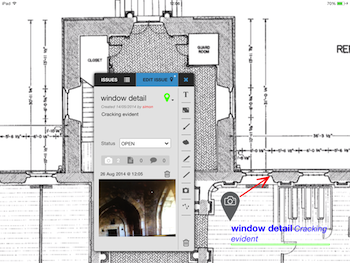
APEmobile annotateThe mobile app is currently only available for Apple iOS device users (Matt says they have yet to lose a sale because the app isn’t available on, say, Android or Windows), and has been designed to work even when there is no internet connectivity. All the information a user needs can be synchronised to the device, and either updated in the background where 3G signals are available, or synchronised once connectivity is regained (“useful when you are working on a remote mining project beyond the range of mobile devices”).

APE Mobile has been designed to be simple and intuitive to use. It includes form-builder tools so that familiar, previously paper-based processes are faithfully replicated online (“users are essentially doing their own paperwork, only more efficiently because of the automated data entry, drop-down menus, pick-lists, etc”), and is extensively configurable to suit different organisations’ needs without customisation of the core code. An open API enables easy data exchange with back-office business systems, ranging from ERP to Excel spreadsheets, while notifications to external users can be sent via email.

APE Mobile has extended beyond its Western Australia heartland and through recommendation and word-of-mouth has secured adoption by firms on the east coast of Australia. Encouraged by this, Matt is looking at funding options to expand the reach of the business, including taking it into new international markets, perhaps through partnerships with resellers or vendors of complementary technologies (and Matt includes SaaS collaboration platforms in this category). A free trial is available, with individual users supported from $65 per month, plus standard monthly storage allowances based on 10, 25 or 50 users (dubbed Gibbon, Chimp and Gorilla); enterprise deals (surely, King Kong!) can also be negotiated.

My view

The appetite for mobile-centric construction applications is clearly international. As I mentioned last week following my brief look at Basestone 2.0, there is a lot of development activity in the mobile arena – from BIM authoring software vendors, established SaaS players, long-time mobile specialists, plus startups. APE Mobile clearly fits into the latter category, alongside startups in the US, UK and mainland Europe, but – unlike most of these – it isn’t trying to compete with the collaboration vendors. Instead, Matt sees APE Mobile as complementing existing solutions, which may be a better recipe for survival.

Choice of device/operating system will also be a factor in the business’s future. The iPad may dominate site use among APE Mobile’s current Australian customers, but it may well be a different picture if/when APE ventures into, say, south-east Asia where Android use in construction is more widespread.


Permanent link to this article: http://extranetevolution.com/2014/10/going-ape/

Aconex raises size of IPO

Aconex logo 2014The Australian reports that Melbourne-based SaaS construction collaboration software company Aconex has boosted the size of its raising for its upcoming IPO on the back of strong investor demand. Aconex previously said its plans were to raise between Au$120m and $150m. But it will now raise between $232m and $264m. The company is expected to have a market value of Au$350m to $405m (see post).

The Australian Business Review says Aconex will sell 101.9 million to 105.4 million shares when its bookbuild gets underway on 27 October. The deal equates to an enterprise value for the company of Au$322.6m to $379.5m. Aconex will lodge its prospectus by 28 October before trading on 18 November.

Permanent link to this article: http://extranetevolution.com/2014/10/aconex-raises-size-of-ipo/

State of the (mobile) nation

Next week I will be attending the two-day COMIT/Fiatech conference at The Crystal in London’s Docklands (30-31 October 2014 – see previous post). COMIT’s previous conferences have seen a lot of content crammed into a single day, but this year’s builds on Fiatech’s successful European Summit and the two-day joint event will allow consideration of a wider range of technology subjects under the umbrella of “Efficiency Through Digital Projects”. Two ongoing projects underline the current surge of interest in mobile technologies in construction.

Mobicloud App ChallengeFirst, as part of the build-up to the event, COMIT is helping with a nationwide survey by academics at Loughborough University, looking to establish “The state of the nation” regarding use of mobile technologies in construction (to help with the survey, click here). Early indications of the results will be presented at the conference.

Second, the conference will take place in the final weeks of a competition being run by the MobiCloud Project: the MobiCloud Construction App Challenge. Basically, the project is looking for great ideas for mobile applications for construction. The idea judged to be the best by a panel of experts will be awarded a prize of  €1,000 (about £800). Development teams are also being sought to turn one of the submitted ideas into a commercial app. This project will be showcased at the conference (at 5.15pm on 30 October).

[Disclosure: I am a member of the COMIT management team.]

Permanent link to this article: http://extranetevolution.com/2014/10/state-of-the-mobile-nation/

Why the UK BIM toolkit is a key building block

The BIM ‘Digital toolkit’ should help UK firms, including SaaS vendors, adopt and then export BIM skills, practices, procedures and standards and apply them in other markets.

Just as sustainability saw an explosion in ‘greenwash’ – sometimes spurious claims about the ‘greenness’ of various products or services – so building information modelling has seen frequent ‘BIMwash’, with firms asserting that they are already delivering Level 2 or even Level 3 BIM. The fact that the Government’s BIM Task Group had not yet defined a full set of Level 2 components did not appear to hinder the hype. However, recent announcements will mean, from early 2015, that such BIM competence claims may more easily be substantiated.

NBS BIM toolkit

dPOW logoOn Monday 22 September, the Technology Strategy Board, now Innovate UK, announced that a team led by NBS had won a £1 million contract to take forward development of a “Digital Toolkit” for BIM, creating the last two building blocks of Level 2: the digital Plan of Works (dPOW) and a classification system for construction objects.

The award follows a two-stage competition to examine the feasibility of the project. The first stage, kicked off in February (post), attracted around 70 expressions of interest, including a strong submission from a pan-industry group of professional institutions (C8, which included the Institution of Civil Engineers*), but just three were selected to submit proposals for the second stage.

NBS – whose team includes the BIM Academy, BDP, Laing O’Rourke, Microsoft and Newcastle University – is contracted to deliver the first elements of the toolkit in early 2015, and then maintain it as a free-to-use industry resource for a minimum of five years. This commitment was too onerous for the C8 consortium, but NBS has since courted their continued involvement.

Richard WaterhouseRichard Waterhouse (right), chief executive of RIBA Enterprises, which owns NBS said, “We already have the backing of key organisations such as CIBSE, CIOB, ICE, IStructE, RIBA and RICS and we will be extending and widening this dialogue over the coming months.” The institutions will form part of a toolkit advisory board providing direction and also potentially undertake subcontracted work.

The dPOW will become an important resource to help technology vendors, particularly providers of SaaS construction collaboration platforms, provide a ‘common data environment’ to support sharing of structured data across a project. The classification development will see Uniclass 2 clarified, reworked and extended to ensure comprehensive and international coverage of all professions’ needs across all disciplines, including infrastructure projects, says Waterhouse.

NBS will ultimately be the ‘guardian’ of the BIM toolkit. It will be able to use expertise and experience gained in creating toolkit elements to offer other value-added products or services, but the ‘toolkit’ will remain freely available to UK construction (Waterhouse told me he expects it will need to be freely available for longer than five years as some sectors will lag in developing BIM expertise). NBS will be talking further about the toolkit at NBS live on 4 November in London (details here).

The resource should also help UK firms adopt and then export BIM skills, practices, procedures and standards – some, like PAS1192:2, set to become ISO standards – and apply them in other markets. This was something anticipated in Richard Saxon’s “Growth Through BIM” report for the CIC last year (see my recent post: A BIM boom for SaaS collaboration vendors?).

CapEx + OpEx = TotEx

While many UK architecture, engineering and construction businesses appear keen to exploit BIM, some have been adopting a ‘wait and see’ approach pending the completion of the Level 2 roadmap. Meanwhile, client owner/operator organisations are also beginning to realise that BIM can help improve the operation and management efficiency of their built assets across their life-cycles.

Ultimately, this is what will drive and reinforce BIM adoption. As clients start to insist on more efficient procurement, delivery and future management of their facilities (TotEx), their suppliers will be striving to innovate. Linking ‘smart’ built assets, connecting both historic and real-time data, aggregating it and integrating it with metrics from key business or organisation processes, will help owners identify what makes customers spend more, students learn more, patients recover faster, office workers be more productive, etc.

This may seem like utopian future-gazing, but it’s about owners’ business outcomes. Data will be the key connector, and the BIM toolkit is an important stepping stone towards that brave new world.

This is a version of a comment piece I wrote for Construction Manager’s recently launched BIM+ portal, published on 29 September. [* I am a deputy chair of the ICE’s Information Systems Panel.]

Permanent link to this article: http://extranetevolution.com/2014/10/why-the-uk-bim-toolkit-is-a-key-building-block/

Basestone 2.0 launched

Basestone’s new iOS mobile application features (it says) the market’s “most intuitive interface”, but in a busy market, integration matters as much if not more than interface design.

BasestoneAfter meeting Blue Ronin/Basestone‘s team in January 2014 (and at other events since then), I have kept an eye open for developments from the London-based startup. In early September 2014, it launched Basestone 2.0, the latest iteration of its iOS mobile-based application for viewing and collaboration on construction sites.

According to the company’s blog post, the biggest change is a complete makeover of the interface, recognising that “when you’re working on site, the last thing you want is to be fiddling around with confusing technology”. The new-look app features what Basestone claim is “the simplest and most intuitive interface of any on the market”.

Basestone interfaceInformation about a single issue is grouped together, aggregating data from multiple Basestone annotation tools and photos, allowing users to capture the progress of an issue from beginning to end, including interim snagging, and ‘before’ and ‘after’ photos. With the issues list, it’s now also easier to get an overview of all issues related to a particular drawing: who created them, how urgent they are and what their status is: simply tap on any issue to zoom into the detail.

Also new in 2.0 is the ability to create projects directly in the app, as well as via the basestone.io website back-end. Users can also import files from other applications, including Dropbox and Box, direct from an iPad. Pricing-wise: basic use of Basestone (enabling sharing of up to 50 drawings) is free; for over 50 drawings, a Professional account (up to 500 drawings) costs £19.99 per user per month, while unlimited storage comes with a £99.99 price tag.

My view

This is a busy and fertile market at the moment with a lot of development activity, sometimes across all the main mobile operating systems, sometimes just across one or two. The main BIM authoring software vendors (Autodesk, Bentley, etc) are creating mobile tools, as are the existing vendors of SaaS (eg 4Projects, Aconex, Asite, Conject) and other collaboration platforms (eg: Newforma’s SmartUse); there are also some long-established mobile developers (MCS Priority One, plus others focused on point solutions such as defects management), and then there has been a flurry of tools created by startups in the US (Plangrid, FieldLens), UK (Cadbeam, Sitedesk) and mainland Europe (GenieBelt), all seeking to make on-site collaboration including access to drawings and/or, in due course, building information models, easier.

The mobile-first developers can create applications designed from the ground-up for ease-of-use on site, focusing on what their end-users require most in terms of functionality, and optimising the connectivity and communication capabilities of the devices they work on. They can quickly attract bottom-up adoption, perhaps from site-based users frustrated at the sometimes over-complex, feature-bloated functions of rival solutions, which can try to squeeze all the capabilities of existing desktop or browser-based applications into the mobile experience. As such, I welcome the disruption of new startups like Basestone.

However, ultimately the security and reliability of the hosting environment and the ability to create and review archives of information captured during project delivery will be what matters most to main contractors and owner/operators. How well a mobile application’s data can be integrated with the rest of a project delivery technology ecosystem will guide its success or failure. As well as a shake-up, there will be a shake-out. While some new businesses may thrive, others will be acquired, or will wither and die. Just as we saw a flurry of construction collaboration businesses launched in the original dot.com boom, we are now seeing a mini mobile boom, and – as before – not all will survive.

Permanent link to this article: http://extranetevolution.com/2014/10/basestone-2-0-launched/

More on Newforma’s SmartUse acquisition

Newforma-logoI met up with Newforma CEO Ian Howell in London on Friday (10 October) and asked about the recent SmartUse acquisition (see post).

From his perspective, the deal was the next stage in Newforma’s “mobile-first strategy,” building on previous deals (2012) to add mobile and cloud-based capabilities to the Newforma portfolio, while satisfying the company’s VC backers that they could deliver the required growth. Buying SmartUse was primarily about acquiring “a software technology that allowed sheet sets to be rapidly synchronised to all devices and which allowed mobile cloud collaboration across them all.” Ian was keen to stress that this was also about helping constructors and owner/operators view and collaborate on drawing-based information:

“We are an AECO business: we started with the A and the E, and we’re now complementing this and helping the C and the O.”

SmartUse TableNewforma is not about to become a hardware vendor. While SmartUse’s A0 smartboards make it easy to view drawings full-size in the construction site office, the market for the product is already becoming ‘commoditised’ – many existing offices have smartboards already, there are other products in the market, and prices are dropping. The deal was about acquiring mobile-oriented software that could help users view drawings on any smartboard, plus a range of other mobile devices, Ian said.

We talked briefly about BIM too. Newforma’s view is that the UK BIM mandate is currently mainly focused on designers (“the A and the E”), whose needs the company is currently meeting through the Project Center platform’s support for sheet set export from Autodesk’s Revit. Ian also highlighted the platform’s integration with Bentley’s Projectwise (see June 2014 news release), stressing that enabling easy access to secure in-house installations and to Newforma-hosted data had to be better than uncontrolled corporate use of consumer-oriented solutions like Dropbox or Box.net. The current SmartUse mobile application is purely about 2D collaboration, he added; it doesn’t offer BIM viewing and collaboration support “yet”.

Permanent link to this article: http://extranetevolution.com/2014/10/more-on-newformas-smartuse-acquisition/

Aconex valued between $350m and $410m

Aconex logo 2014News reports from Australia (The Australian, for example) say SaaS construction collaboration software business Aconex will float as a public company on the Australian Securities Exchange in late November (see previous post) with a market capitalisation of between Au$351 million and Au$406.5m (£190m-£220m).

Joint lead managers Macquarie Capital and UBS priced the float at the weekend after analysts estimated the enterprise value at between $350m and $405m (this is towards the lower end of previous speculation). The pricing equates to $2.20 to $2.60 per share.

According to the reports, Aconex launched its roadshow in Sydney today (Monday) for an initial public offering of the business, earmarked for late November, and will raise between $122m and $135m from investors. The investor roadshow will end in Melbourne later this week and then head to New Zealand and Hong Kong.

Australian Financial Review says the size of the IPO raising will be clear once Aconex’s existing shareholders – which include co-founders Leigh Jasper and Rob Phillpot, VC firm Francisco Partners and several smaller investors – nominate how many existing shares they will sell at the float. Francisco Partners, which has a 24% stake, is expected to sell some of its shares.

A bookbuild for the business is slated for 27 October, and the prospectus will be lodged by 28 October.

My view

There is, of course, no precedent for this IPO, as no SaaS construction collaboration technology business has previously floated. We have had a number of mergers and acquisitions over the years, but none valuing a business at anything like the level of Aconex – but then Aconex is, by some distance, the only vendor achieving significant global revenues. In the year to June 2013, total revenues were Au$52.6m, c. £28.4m (see post); recent reports relating to the IPO suggest revenues are now around Au$66.2m (£35.9m), with losses down from Au$8.9m to Au$4.1m, and CEO Leigh Jasper saying the business is on track to move into profitability next financial year.

Aconex Revenues Profit/Loss 2005-2014

Talking with various competitors, UK and US-based, there is a view that Aconex invested hard to grow awareness and a strong presence in the US market, but hadn’t reached the penetration needed to do an IPO in the US, hence the Australian flotation. This may reduce pressure on Aconex’s balance sheet – it is six years since the company secured a Au$107.5m (then £48.8m) private equity investment from Franciso Partners. The business’s expansion since then has yielded one small acquisition (Grazer in 2012) and in a market that was also badly hit by the global financial crisis, Aconex has been accumulating losses since 2008 as well as weathering a few boardroom storms.

The Francisco Partners investment then valued Aconex at between Au$215m and Au$300m, then rating Aconex somewhere between five and 7.5 times revenues – not far short of the 7.6 multiple achieved by SaaS web conferencing business WebEx when it was acquired by Cisco Systems in 2007 (see my Valuing a SaaS business post). The 4Projects MBO in 2007 valued that business at around 6.7 times revenues (post). A more recent comparison might be the 2013 IPO of US-based SaaS construction payment management business, Textura (now opening in Europe), whose initial price was about 9.8 times revenues (albeit in a US investment market hungry for SaaS operators with industry-leading products).

Looking at the forecast valuation, therefore, it appears Aconex is valued at between 5.3 and 6.1 times revenues (AFR reported the IPO pricing represented “3.9 times to 4.6 times revenue on an enterprise value to revenue basis”) – on the face of it, slightly below previous deals, but, of course, we are dealing with different companies in different investment markets at different times.

Update (15 October 2014) – Are some Australian market-watchers and fund managers getting slightly twitchy about the Aconex IPO? For example, reporting on the IPO roadshow, Maggie Lu Yueyang writes that:

“Aconex is trying to persuade fund managers that it sees great global market opportunity for construction software, and its offshore expansion post IPO is not risky. …

“It is understood that Aconex sees the low penetration rates for construction collaboration software globally as an opportunity to grow its business after the IPO, estimating the global market to be worth around $5 billion.

The company is aiming to ease fund managers’ concerns around its offshore expansion plan, and will argue that it actually started offshore expansion 10 years ago and has become profitable in certain offshore markets.

The article goes on to mention various large-scale projects Aconex has worked on, including Hong Kong Airport, the Venetian Resorts in Macau, the Marina Bay Sands project in Singapore, the Panama Canal expansion (mentioned in a Conject blog article today) and the New York City Hall project.

Permanent link to this article: http://extranetevolution.com/2014/10/aconex-valued-between-350m-and-410m/

4Projects reports record revenues

4Projects turnover in 2013 reached £6.351m. The SaaS vendor reported its seventh straight £1m-plus profit, and sees BIM as a key to sustained future growth.

4Projects by Viewpoint - blueNewcastle, UK-based SaaS construction collaboration technology develop 4Projects, since February 2013 a subsidiary of US ERP vendor Viewpoint, has reported record turnover for the year ending 31 December 2013. It achieved revenues of £6.351m, generating a profit of £1.6m.

Direct comparisons with the previous year are slightly difficult as the business changed its financial year-end from 31 March to 31 December, so the latest accounts only show a comparison with the nine months from April to December 2012. However, I calculate the 2012 full-year equivalent numbers were turnover of c. £5.651m, and pre-tax profit of £1.489m (though this latter figure would have been higher but for exceptional items of £616k – “made up of employee incentive payments and professional fees relating to the acquisition by Viewpoint Inc. on 1 February 2013 and other non-recurring costs.”). On the full-year equivalent figures, the 2013 results represent a 12% growth in turnover (as indicated in September 2013‘s double-digit trading update), and profit up 7%.

UK vendor turnover

International operations

Most of 4Projects’ reported revenues – 80% – still derive from UK operations, but the overseas portion is clearly growing, up from 9% the previous year. In a conference call with MD Alun Baker, finance director Chris Baty and VP BD EMEA director Steve Spark, I learned that much of the growth was due to business in the Middle East (“we will see significant further expansion there in the next six to 12 months”), continuing growth identified by Chris in 2012 (post). Turkey and Italy were also identified as particularly strong market opportunities.

The report is also EMEA-only – it excludes revenues from selling the 4Projects solution – or Viewpoint for Collaboration as it is there known – in the Australasian and north American markets (“we are happy with the momentum achieved there”). This makes the increase in overseas revenues even more significant, and 4Projects is investing in its international channel partners programme to develop this still further (Michael Romero will be joining 4Projects from Asta to lead this expansion, I understand).

Steve told me 4Projects has also been benefiting from more customers adopting an enterprise approach to collaboration rather than thinking project-by-project. Another trend was that more asset owner/operators are starting to use the platform, in both the pre- and post-construction phases of the asset lifecycle.

4Projects 4BIM4BIM

Building information modelling is also a strong factor in uptake of the 4Projects solution, he said, particularly among asset owners. Having participated in Viewpoint’s user conference in the US last month, the team believed there was substantial American interest in the core product (“the market is now understanding the connection between collaboration and ERP,” said Alun), and in adoption of BIM-based approaches. The UK’s BIM programme is also opening doors for them; Steve told me:

“While some are interested in the big BIM picture, others just want the earlier base functionality, knowing that they can extend to the other 4Projects functionality, like BIM, when they need to.”

Alun talked of a five-year development programme at 4Projects which envisages growing numbers of organisations migrating to SaaS-based BIM solutions so that they can apply real-time collaboration approaches, integrate asset data with other business informatics (he mentioned ‘Big Data’ in this context), and provide “clear ROI measures to the whole value chain” (see my previous post: A BIM boom for SaaS collaboration vendors?).

My view

From the published results of all the leading UK-based SaaS collaboration vendors, it appears the corner has well and truly been turned, though some took longer to return to growth than others. If industry predictions about construction market growth are correct, we should see these upward trends maintained for the next few years, but the angle of travel may vary according to the relative strengths of the different solutions in a changing technology market.

As I suggested in my ‘BIM boom’ post, adoption of BIM is likely to prove only a gradual boost to the fortunes of leading vendors, but is also likely to change the complexion of the vendors’ customer base. As 4Projects are finding, asset owner/operators are likely to be more motivated to look at whole-life information management, and rather than leaving system selection up to their Tier 1 contractors, may mandate a selected system so that all their asset information is collated in one platform. This can then be integrated with other business systems to provide greater visibility of the impact of asset operations on business performance.

Update (4 November 2014) – Viewpoint has reported on its EMEA operations; see news release. It notes the company added 20 new team members in the last 12 months, and quotes EMEA MD Alun Baker:

Alun Baker“Our customers and the construction market recognize the commitment we are making to both product and team development and this shows in the number of new customers we’ve gained over the year. Much of our growth has been seen in greater adoption by asset owners and operators using the product in both the pre- and post- construction phases of the asset lifecycle, and also customers adopting the product at an enterprise level versus on a project basis. We have also recently increased investments in expanding and developing both our direct sales channel and our international channel partner programme.”

Permanent link to this article: http://extranetevolution.com/2014/10/4projects-reports-record-revenues/

A BIM boom for SaaS collaboration vendors?

Will there be a BIM benefit for the SaaS collaboration vendors? Yes, but it will happen gradually both in the UK and internationally, and then grow bigger as more owners require ILM services.

Within UK construction IT, building information modelling (BIM) is the hot topic. Even construction software businesses that previously thought it was irrelevant (I’ve talked to a few!) are waking up to the fact that BIM will have a big impact way beyond design and construction processes. As BIM begins to change how we procure projects, appoint supply chain members, specify materials and products, and link design to scheduling (4D), to cost control (5D) and to future asset management (6D), then it becomes clear that the impacts will be way more profound than the move from manual drafting to CAD 20-25 years ago.

BIM is part of a wider industry shift

As I have pointed out many times, it is not just a technology shift. BIM is also going to involve major changes in industry structures and processes and in the roles and skills required of the people involved. There will not be a return to traditional business practices afterwards; if anything, the initial changes due to BIM will seem modest compared to some of the shake-outs that will occur as wider industry trends take effect.

constructing excellenceFor example, responding to the UK Government’s Construction 2025 strategy, Constructing Excellence‘s vision for the industry sees even more radical shifts.* It believes transactional lowest price Capex-based procurement will increasingly be ditched by the industry’s major clients in favour of best value Totex (Capex plus Opex) approaches, with the objective not just to deliver built assets but to deliver the best business outcomes for the client. Such objectives can only truly be met by building closer, more long-term working relationships, and by innovating throughout the supply chain. Collaborative working through BIM and lean thinking will be enablers for such change, says Constructing Excellence, with the industry changed forever by the constant flows of data through and between all of our businesses.

The wider trends include:

  • economic pressures (it is clear that economic deficits and austerity measures will continue to constrain capital investments for many years beyond the Global Financial Crisis)
  • social and demographic changes (ageing populations put pressure on our welfare services, and we have an emerging cohort of more mobile, web-savvy people looking for work)
  • political changes (population growth, increased literacy, and resource shortages are creating new national and international tensions)
  • environmental shifts (climate change, declining fossil fuel and other natural resources, etc)
  • technological changes (even if we just look at IT ‘disruptions’, in addition to BIM, I would pick out cloud computing, mobile telecommunications, social media and ‘Big Data’ as key trends that are changing, and will continue to change, construction)

BIM as a competitive opportunity

Nonetheless, in the more immediate future, the BIM disruption in the UK may also deliver some competitive advantages to those businesses that successfully grapple with the challenges. It will support export opportunities for many UK clients, contractors, consultants, suppliers and manufacturers – and technology providers – as we take our BIM skills, expertise and experience and turn them into services and products for new markets.

The UK BIM IT opportunity

To gauge the potential immediate impact of BIM on the UK construction industry you only need to look at the volume of projects that are required by the UK government – the primary driver of the UK BIM programme. Centrally procured projects in the UK government’s current pipeline reflect 1,886 programmes and projects covering 16 sectors with a total estimated value of £116 billion.

If we then add the private sector, repair and maintenance use, asset and facility management, and use of BIM in real estate transactions, it has been estimated by Richard Saxon (see his 2013 Construction Industry Council Growth through BIM report) that BIM-related services will impact directly on nearly 15% of UK GDP.

Of course, the BIM products market will only account for a much smaller slice of this activity, as construction has, according to Gartner, historically only invested a very modest 1.35% of revenues in IT. Past industry surveys have suggested this equates to around £1 billion per annum in the UK, but the pan-industry BIM initiative may see this increase (the shortage of BIM expertise already means professionals with appropriate skills and experience are commanding above-average salaries).

I don’t think BIM expenditure will sky-rocket though; more likely it will grow gradually:

  • BIM investment will be staggered to match the replacement cycles of existing CAD and related software and hardware, and to match the rate of use on clients’ projects. In many organisations, early adopters are trialling BIM on just a few initial test projects, with roll-out expected to grow gradually as BIM skills and capacity extends (I talked to two client organisations yesterday who were sceptical about the BIM capabilities beyond their Tier 1 contractors and consultants).
  • BIM authoring is not a universal requirement – The cost of BIM authoring applications (and associated implementation, training and familiarisation costs) to replace CAD is a major expense for many with design responsibilities, but not everyone will need to create models. As with the pre-BIM world, many supply chain partners will simply need to collaborate (access, view, comment, mark-up) upon the BIM outputs – this is where the Common Data Environment, CDE, will be key.
  • SaaS adoption lowers hardware requirements – Processing power will remain a high priority for BIM authoring, analysis and rendering applications (which may partially be met by cloud-based services rented by the hour for as long as intensive processing is required), But BIM viewing, mark-up and commenting can and will increasingly be managed through web-based tools and ‘light’ apps that can accessed on internet-connected mobile and other low-cost devices.
  • BIM in the cloudAccelerating adoption of SaaS – While there is a large installed base of conventional client/server software, SaaS solutions (and similar subscription-based approaches) spread software costs over a longer period and reduce internal IT management overheads. Existing trends away from internal electronic document management systems (EDMSs) towards externally hosted platforms will continue. Similarly, use of document-centric collaboration will, over time, shift towards owner-operator adoption of model- and data-centric SaaS ILM platforms (first CDEs, and later Level 3 or iBIM) – but there won’t be a sudden UK “BIM boom” for the SaaS vendors in 2016. More likely, there will be a gradual ramp up as centrally-procured public sector (and some early adopter private sector clients) projects start to require CDEs.
  • Whole-life data management – Owner/operator organisations are beginning to appreciate that the BIM process can provide them with asset information that they can then exploit as part of their operation and maintenance regimes, and integrate more closely with their business activities. Updating of information about these assets will become a key business requirement. However, while some organisations do have whole-life information management (aka infrastructure lifecycle management, ILM) strategies, few – if any – will yet be drawing upon data created through BIM. Only as projects pass beyond completion and handover will this BIM-based information management opportunity begin to blossom.

Exporting BIMaaS capabilities

The UK construction market, however, will also be a ‘springboard’ market. As Richard Saxon pointed out, contractors, consultants and other service providers, including software houses, with BIM capabilities, expertise and experience will have strong export potential, taking the lessons learned, best practices and tested protocols, procedures and standards to international markets keen to develop their BIM capabilities.

In mainland Europe, for example, France and Germany are following the UK BIM initiative with great interest and are likely to adopt similar processes, including making BIM mandatory for public sector projects. Further afield, in the USA, south-east Asia and Australasia, industry clients, contractors and consultants see a big opportunity to apply UK BIM learning and adapt it to their regional market requirements.

As for the UK-based SaaS collaboration vendors, approaches vary. 4Projects and Asite have been marketing their BIM capabilities for some years, and have moved beyond simple model sharing and viewing, and integration with Revit, to create sophisticated model data serving platforms. Unit4 Business Collaborator also has a strong BIM roadmap that looks beyond Level 2 BIM (I recall them talking about the semantic web and linked open data in March 2013). Others (eg: Conject, McLaren) have been slower to play their cards and demonstrate competitive BIM offerings, but as the final parts of the Level 2 jigsaw drop into place (NBS is expected to deliver its ‘BIM toolkit’ (digital Plan of Works and classification system in early 2015), they should deliver capabilities required by their BIM adopter customers. Then there are some vendors who are seemingly content to focus on 2D file-based collaboration, increasingly a commoditised product sector (with two notable recent casualties – see posts on Woobius and Cadweb).

How the BIM-savvy UK SaaS collaboration vendors successfully exploit their BIM capabilities internationally will depend on the pace of BIM adoption beyond the UK. It will depend on how different countries define their BIM requirements (hopefully the emergence of British/ISO standards will limit the scope for ‘reinventing the wheel’) and how quickly those requirements are demanded. Just as I don’t think there will be a sudden BIM bonanza arising from the UK BIM programme, I believe the international BIMaaS opportunity will also take some years to develop.

But as it grows, it will also create a new market for businesses able to support owner/operator’s long-term asset information requirements. Post-delivery and then throughout the operational life of their assets, owner/operators will need constant access to data, and will increasingly entrust the storage and management of that data, and its integration with other systems, to SaaS ILM specialists.

[* I am a member of the steering group of Constructing Excellence, and a CE collaborative working champion. Part of this post was edited during CE’s member forum yesterday in London. Conject recently (re)joined CE – it was a member in its former BIW days.]


Permanent link to this article: http://extranetevolution.com/2014/10/a-bim-boom-for-saas-collaboration-vendors/

Newforma acquires SmartUse

Newforma expands its mobile construction plan review capabilities by acquiring SmartUse’s touch-friendly mobile platform.

Newforma-logoSmartUse logoUS-based construction project information management software vendor, Newforma, today announced it has acquired SmartUse, a Montreal developer of a touch-friendly mobile platform for construction project collaboration (the value of the deal remains confidential).

In the news release, Newforma CEO Ian Howell says:

Ian Howell“The SmartUse app is the most advanced mobile solution for viewing, marking up, auto-linking and sharing project plans. It allows contractors and owners to easily review plans on computers in their offices or on tablets on the job site. Because it also operates on a large, 55-inch touch screen, SmartUse enables an entire project team to interact with a set of documents as they collaborate in real time in a project office or job trailer. We are excited to add this new product to help contractors and owners better manage the thousands of plans they keep and reference for all of their projects. We are also delighted to welcome the extremely talented employees of SmartUse to the Newforma team.”

Founded in 2012, SmartUse was a subsidiary of Montreal-based mobile agency, NVentive. It had about 20 staff, who will now transfer to Newforma. SmartUse Founder and CEO Francois Tanguay has joined Newforma as vice president of business development. He says:

“SmartUse strengthens Newforma’s already strong product lineup by meeting the mobility needs of contractors and owners, not only in the construction industry, but in other industries where project plans need to be reviewed, marked up and shared. By combining forces with Newforma, we will be able to continue advancing our mobile collaboration solution, transforming how contractors and owners manage project information.”

SmartUse TableThe product will continue to be sold under the SmartUse name and will be marketed and supported by Newforma internationally.
The SmartUse application operates on Apple iPads and Mac computers, Windows 7 PCs, and Windows 8 devices, including a 55-inch (A0 size) workstation. It can be downloaded as a free viewer for unlimited users or as a fully-functional application on a 30-day free trial (pricing starts from $49/month/user).

Used on touch-centric devices, this provides PDF document and drawing review capabilities, with rapid document viewing, easy navigation between RFIs, submittals and detail callouts. For onsite/field tasks such as punchlists (aka defects, snagging), users can create pushpins and RFIs, manage and track changes, and get notifications. It is integrated with cloud storage and other services including Box, DropBox, Microsoft’s Sharepoint and OneDrive, Egnyte, construction SaaS vendor Aconex, plus WebDAV.

This latest acquisition extends Newforma’s mobile capabilities. In 2012 it acquired a SaaS business and a mobile applications development company (post), both helping to extend its platform reach beyond the office and linked corporate networks where it had first established itself.

This announcement comes just days after another viewing technology acquisition: on Friday, Nemetschek acquired BlueBeam Software for $100m, looking to create a powerful portfolio of BIM- and drawing-based workflow solutions.

Permanent link to this article: http://extranetevolution.com/2014/10/newforma-acquires-smartuse/

Load more