 Ecobuild: where 4Projects talked about an Open API to share BIM data, and I got on the samepage with Kerio.
The annual Ecobuild UK construction trade show marked its 10th anniversary this week (I’ve been to them all, I think) and now takes place at London’s ExCEL (giving me my annual – only – excuse to use the cable car at North Greenwich to cross the Thames). Client and meeting commitments meant I could only get along for half of the final day, but it was a useful trip nonetheless.
4Projects talking open APIs
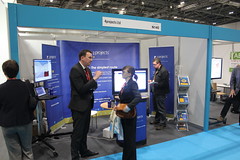 Previously 4Projects CTO, recently crowned global enterprise architect (post), Andy Ward tapped me on the shoulder and we had a brief chat, including talk of an open API (application programming interface). This was also mentioned more than once by 4Projects’ Ross McLaren who gave a lunchtime talk on BIM and collaboration in Ecobuild’s BIMTech theatre.
Ross described how the outputs of the Newcastle, UK-based collaboration vendor’s 4BIM research and product development project include an open API. In theory, this will allow easy integration and exchange of BIM-related data between 4Projects and other solutions used in the BIM ecosystem, but clearly (as he said to an audience questioner) its success will depend on the availability and willingness of other software vendors to offer similar APIs.
Samepage.io

 Walking past a stand displaying Vectorworks and Open BIM logos, I fell into conversation with the engaging Marino Vigliotti who introduced me to Kerio Technologies Samepage.io web-based collaboration platform. Having been thinking a lot about simple collaboration recently, I immediately ‘got’ Samepage. As the name implies, it provides a single webpage where all the participants in a project can share a single view of what needs to be done, using a Facebook-type timeline approach that is immediately familiar and easy to use.
It is a generic collaboration product bringing together elements of social business, project management and content sharing, with secure version control. It incorporates task and calendar lists, and it’s file-sharing capabilities provide a ready alternative to emailing documents or sharing Google Maps, photographs, videos, etc around a group of internal and external collaborators. Instead of multiple copies locally stored, users can access the latest versions in one location holding the ‘single version of the truth’. Marino told me a mobile app is also available but doesn’t yet have the full capabilities of the desktop web-browser version.
Launched in early 2013, Samepage is Kerio’s first cloud-only offering (its core business is delivering internal network management, phone and email systems) and the California-based company runs all its internal business processes (finance, HR, marketing, sales, business development, engineering, etc.) on Samepage, improving productivity and reducing inbound email; customers include the University of Tokyo and Autodesk. There is a free version, allowing up to 10 users to share up to 250 pages with a total of 50GB storage; the paid-for business edition starts at $100/per user per year (or $10/user monthly), with 250GB storage plus 10GB per user.
Skanska, Stockholm and Sharepoint
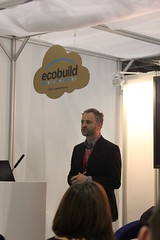 Ecobuild’s BIM seminars included one on asset operations, chaired by BRE and BuildingSmart’s Nick Tune, right, and which featured a presentation on the use of BIM in delivering the Nya Karolinska Solna university hospital in Stockholm by Skanska IT Nordic’s Adina Jägbeck.
The hospital is Sweden’s first public-private partnership hospital and, under the terms of the deal, Skanska will be responsible for maintaining it for 25 years, so the company is understandably ensuring a high quality of asset information is captured during the design and construction process to help future operation and maintenance.
Adina talked briefly about how the project had created a common data environment, similar to that envisaged in the the UK government’s recommendations for BIM implementation, and described how Microsoft’s Sharepoint was being deployed to help capture asset information, viewed using SharePointViewer. I think this surprised some people in the audience; I talked to two afterwards who both said they had avoided using Sharepoint due to the time and cost involved in configuring it for effective construction team use. Clearly, at least so far on this project, Skanska has been able to deploy it, though Adina did say it was still early days and they had only just started to export test data from the system to a Maximo CAFM system to see if that worked.
 FieldLens has been on my radar for about a year, and I wrote about the company in
 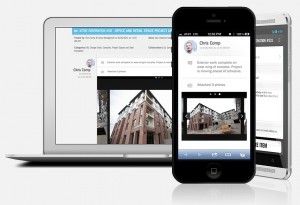 After more than a year of building our product, testing, listening to our beta users, rebuilding and even more listening, FieldLens has officially launched to the construction industry.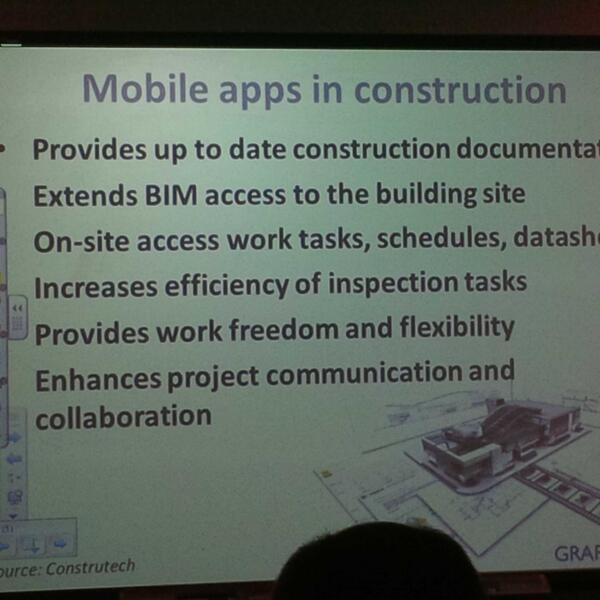
 On my
On my  Looking at the project management findings, the survey found larger firms were more likely to use project management platforms: 54% of respondents said they did, while some smaller firms were starting to use cloud-based storage tools like Dropbox. Of the project management tools used, Newforma was the most popular – deployed by 56%, or 240 respondents, of the sample, followed by Autodesk 360 (27%), ProjectWise (18%) and Aconex (9%). Prolog (5%), GTeam (4%), and 4Projects (4%) ranked just ahead of a group of also-rans (Asite, CMiC, Conject, Enovia “below margin of error” – really, the narrow distinctions after the top three are almost meaningless: the margin of error here is +/- 5%).
 The London-based UK operation of Australian-founded Software-as-a-Service construction collaboration provider
 And it may not stop with the mobile device alone. Paired with wearable technologies such as Google Glass, you could have a powerful way for the user to view context and situation-specific information from a building information model and relate that to his/her physical surroundings, and then perhaps hold real-time conversations with colleagues. Woobius Eye (
 Coincidentally, I met up with Bob (chief UX and strategy) and three of his new
 Despite the global financial crisis, e-Builder continued to grow its revenues steadily at around 40% per annum, and it expects to do the same this year. To support its growth, it has been expanding its workforce which now stands at just over 100 people, and will reach around 135 people by the end of 2014, with the additional personnel roughly equally split across software development, implementation and sales and marketing. President and CEO Ron Antevy attributed the sustained growth to their strategy of focusing on owner/operator customers rather than contractors: “The majority of our customers are in healthcare, education and government owners with ongoing capital programmes. Some survived the recession partly due to the stimulus funding put into the economy.”
 Since I last talked to e-Builder, the north American AEC software space has seen some significant activity. Co-founder Jon Antevy highlighted Oracle’s addition of Skire to its portfolio alongside Primavera; we also talked about Trimble (adding Sketchup and Vico to a buildings suite already including Meridian Systems –
  The call complements an existing competition to create a digital tool for building information modelling (brief), and also supports the UK’s current BIM initiative. It was launched at Coventry University’s Simulation Centre at an event featuring a keynote from Sir John Egan, whose 1998 “Rethinking Construction” report set the tone for greater use of collaborative technologies in construction (Egan was also chair of AEC SaaS vendor Asite, 2001-2004), and a presentation from David Philp of the UK BIM Task Group. (You can read more about the event via the tweets and photos captured in
 California-based

 Dome’s iSnag mobile defects management app was a logical extension of these capabilities to support its commissioning management, and was formally launched in mid-2012. The first iPhone version immediately attracted interest from UK main contractors including Mace (apparently frustrated by Conject’s by then dated BIW defects tool), Lend Lease, Sir Robert McAlpine, ISG, Overbury and Canary Wharf Contractors (it’s being used on 20 Fenchurch Street – the so-called Walkie-Talkie – for example), and the second major release (“iSnag2”, today also available for Android and Microsoft Windows 8) now forms part of a bigger suite of modular software tools that Dome is progressively rolling out during 2014.