AEC startup SpecifiedBy closes funding round

SpecifiedBy is another UK startup applying social media approaches to construction industry communications, and has closed its seed funding round.
specifiedby.com

In January 2013 I wrote about an AEC social media startup, SpecifiedBy, ahead of its UK launch. It has just achieved another milestone in its development, closing a seed investment round of £125,000, led by Northstar Ventures (also a backer of North Shields-based mobile asset management and surveying SaaS provider Kykloudpost) and IP Group, and supported by several business angels.

Founded by architecture technology graduate Darren Lester, Edinburgh and Newcastle-based SpecifiedBy plans to have a similar impact on the construction industry as TripAdvisor had on the travel sector. SpecifiedBy gives architects and other construction professionals an online platform that combines smart search, project management and access to the shared knowledge and recommendations of other industry professionals regarding building products and materials, plus all the associated building product information and design data, such as BIM and CAD content. Lester says:

Darren Lester

“The construction industry is not exactly renowned for its openness or sharing culture, so we’ve taken on a big challenge. But we believe that by giving the industry access to better data regarding building products and materials, better decisions will be made, which will ultimately lead to a better, more sustainable built environment.

“We’re not a review website as such, but we provide access to invaluable first-hand experience of working with particular products, materials and companies in the same way TripAdvisor gives you the inside track on hotels and restaurants.”

With investment in place, the company plans to further develop the platform, including a ‘private library’ version aimed at teams and practices rather than individuals, and expand the team with roles in content management, sales and marketing to be filled. Darren tells me SpecifiedBy has also agreed a partnership with the Chartered Institute of Architectural Technologists to promote the platform to its members and put SpecifiedBy in touch with CIAT members who can help with particular technical challenges.

Update (2 June 2014) – The CIAT support was announced in a 30 May news release; Kevin Crawford, Vice-President Technical said:

The SpecifiedBy website is a quality product, especially for those who are practicing within the discipline of Architectural Technology, and we are pleased to support this tool to enhance the work of our members.’

My view

Web-based construction product information resources are not a new idea. Several UK would-be AEC e-commerce sites were launched at the height of the dot.com boom back in 1999-2000, but almost all of them folded quickly as investor confidence in such ventures evaporated. Collaboration technologies proved more resilient, and we now have several well-established Software-as-a-Service vendors, and – with the emergence of social media in recent years – some of these are trying to be more ‘social’ in their modes of communication (Asite is perhaps the business which has tried hardest in this regard – see Asite: ‘cocial’ and ‘mocial’), and I’ve talked to other startups – like FieldLens (see 7 March post; see also my contribution to FieldLens blog) and GenieBelt (post) – whose approaches to SaaS construction software are strongly influenced by social media use and by mobile solutions.

Architects have been among the more enthusiastic users of social media in their industry work; my friend Su Butcher works extensively with architects and has identified how their use of Twitter and other Web 2.0 platforms has grown in the past couple of years (see How Architects Use the Internet and Why 44 percent of UK Architects might be using Twitter). So SpecifiedBy is pushing at an open door, at least so far as the ‘A’ of the AEC market is concerned. And as these extend to other professions and as shared social media-type conversations become more common and more real-time (replacing one-to-one, asynchronous email-type exchanges), I would expect more software vendors to adopt similar approaches.

Permanent link to this article: http://extranetevolution.com/2014/04/aec-startup-specifiedby-closes-funding-round/

Edocuments enabling O&M data in the cloud

Essex, UK-based Edocuments is looking to reuse AEC product data fragments to populate O&M documentation for owner-operators’ future asset management use.

Amtech logoI spent 1.5 days this week in the Siemens Crystal Building in London’s Docklands area, attending Amtech‘s second Crystal Clear BIM conference. Friends commended the first conference last year; I had other commitments then, but this year Amtech’s marketing guy Dean Bryans contacted me in good time and I ring-fenced as much time as I could.

When a building services software company organises a conference, you suspect you may be “hard sold” their solutions, but the Amtech event was low on hard-sell and high on networking and good quality, sharable content (see my Storify stream). OK, some of it came from corporate partners (stands included Soluis, SysQue, Concerto, Excitech and Faro), but there was also a good selection of UK BIM speakers – with the UK BIM Task Group‘s Simon Rawlinson and Rob Manning talking on the first day and David Philp on the second. The event was also not UK-centric – other highlights included some European BIM perspectives from the Netherlands and Norway.

Edocuments

EDocumentsSlightly coy about their relationship with Amtech, Chelmsford, UK-based Edocuments had display space at the conference. Founded in 2001 by Lester Morgan and Jamie Dupée, the company originally offered technical authoring and compliance documentation services, mainly to construction contractors (its customer base is still 70% contractors), helping companies compile paper-based operation and maintenance manuals for handover to a built asset’s owner/operator. At first glance, its acknowledged competitors here include Dome Consulting (post), Aconex’s acquired Grazer technology (post), and the O&M modules of solutions such as Conject.

Jamie DupeeApplications director Jamie Dupée identified that IT could streamline the O&M manual production process, but Edocuments has taken it beyond the delivery of Word pages or similar electronic documentation (and helped differentiate themselves from the afore-mentioned would-be competitors). The company determined that creating standard manual pages wasn’t efficient; instead, its Software-as-a-Service (SaaS) platform helps its users create all the information components that make up a document. These fragments (XML blocks) can be compiled on-the-fly into standard deliverables, but can also be data-mined and elegantly incorporated into different user views of the accumulated information. While they may look like documents, the ‘pages’ are created from databases of relevant information; Microsoft Azure is part of the technology platform.

Edocuments currently employs around 23 staff, and is still heavily dependent on its technical authoring and related consultancy services. However, Jamie told me that trials had begun with key customers to get their supply chains to use its online service remotely and submit information, completing standard templates. The Amtech conference included a CIBSE/Arup/Hoare Lea presentation about product data templates and product data specifications – so it’s easy to see how such standardised approaches could see COBie-based product data quickly assimilated into handover and FM information.

I asked Jamie if the technology could be licensed to other manual authors to help them compile O&M information. It could, he said, and we then talked about opportunities to license the technology to SaaS collaboration (and would-be common data environment) providers such as 4Projects, Asite and Conject, so that they could index content collated during BIM collaboration. He was open-minded about the prospect: “via an API, we could import the data, and then, as a value-adding business, validate the provided information,” he said.

The system is already being used by UK main contractors such as Laing O’Rourke (which has a long-standing relationships with SaaS collaboration vendor Asite); Edocuments’s Amtech exhibition stand also highlighted the system’s use on the Manchester Town Hall project – one of the UK’s pioneering public sector BIM projects.

Dochosting

When I learned Edocuments was based in Chelmsford, I was reminded of another AEC document management company, Dochosting, based in the same Essex town, which I briefly looked at nearly eight years ago (September 2006). Jamie told me they were unrelated though they have done some past work with Dochosting.

Permanent link to this article: http://extranetevolution.com/2014/03/edocuments-enabling-om-data/

think project! grows revenues 17% in 2013

Thinkproject-logoMunich, Germany-based SaaS construction collaboration technology vendor think project! grew its revenues 17% in 2013, achieving a turnover of €17.2m  [£14.4m] (up from €15.5m [£13m] in 2013) by building on engagement with customers in the construction, energy and automotive industries, as well as local, state and federal government.

think project! GmbH, says it “continues as the market leader for cross-enterprise collaboration in the construction industry throughout Germany and Europe, and number two worldwide.” (Its European market leadership claim was disputed last year by Colin Smith, the then CEO of its fellow Munich-based rival, Conject – see Conject CEO reclaims SaaS second place – though it still lags behind Australia-based Aconex). To extend its international expansion, think project! says it will be establishing an Istanbul-based subsidiary to develop the market in Turkey.

thinkproject-CaptureDuring 2013, think project! added an Adobe PDF service to enable consistent digital approval cycles, while automatically print details such as signatures, status, etc. onto documents. It added a QR code-based Mobile Version Check service, and Mobile Capture (August 2013 post), a front end for smartphones and tablets to enable immediate capture of photos, videos and other documentation of defects and incidents at project sites. CEO Thomas Bachmaier says:

“We are progressing this Collaboration Cloud Strategy in 2014, currently working on additional services such as for Building Information Models (BIM), as well as new integrations to more comprehensively support our customers’ project work in the future.”

think project!’s international sales organisation includes branch offices, associated companies and partners across Austria, Belgium, Italy, Luxembourg, the Netherlands, Poland, Russia, Switzerland, Spain and Turkey. Its customers are drawn from 20 sectors, including general contractors, the energy and automotive industries, and its user base is over 100,000 users across 8,000 projects in 40 countries.

Permanent link to this article: http://extranetevolution.com/2014/03/think-project-grows-revenues-17-in-2013/

Aconex appoints CMO (again)

Andrew SavitzThere has been something of a revolving door regarding Aconex chief marketing officers (see Aconex appoints a US-based CMO), and the latest to be announced by the Melbourne, Australia-founded SaaS construction collaboration software business is US-based Andrew Savitz.

The two previous appointments lasted roughly six months and one month respectively.

Savitz will be responsible for the company’s global marketing strategy and operations, including product marketing, demand generation, online marketing and communications, and reports to Aconex CEO Leigh Jasper. He was recently VP of worldwide marketing at KXEN, a provider of predictive analytics software and cloud-based big data applications (acquired by SAP) and before that led marketing efforts for salesforce.com’s Service Cloud.

Permanent link to this article: http://extranetevolution.com/2014/03/aconex-appoints-cmo-again/

Union Square: Workflow is everywhere (mobile and extranet too)

UnionSquare-logoUnion Square is now embracing the AEC ‘extranet’ world it once avoided, and is going mobile with its workflow.

Today’s 12th Union Square user group conference at the Royal College of General Practitioners in London saw the launch of the Nottingham, UK-based software vendor’s contract administration module, plus announcements about forthcoming mobile and ‘extranet’ functionality.

In its early days around 2000, Union Square rode the wave of construction interest in online project or document collaboration, but – in the face of stiff competition from pure Software-as-a-Service ‘extranet’ providers – it reverted to its core intranet business. As a result, it has grown a thriving business, now turning over £6.1m, up from £5m in 2013) based on delivering mainly on-premise document sharing software, predominantly to UK SME architectural firms, other AEC professionals and contracting businesses, plus project accounting functionality (expanding since its introduction in 2010).

Architect firm delegates comprised just over a third of the event’s attendee list (57 out of 147), with the balance equally shared between other professional services and contractors (45 each).

MD Richard Vincent welcomed delegates to the conference, highlighting the company’s continued growth and new customers. Union Square has got its first customers in north America (Integral) and Scandinavia (Tengbom), and now has 12 customers in its strategically important Australian market, he said, before starting to introduce the day’s main announcements where “workflow is everywhere“. These included a new contract administration module, plus announcements about mobile and extranet tools.

Changes to Union Square’s document management capabilities were reviewed, then document (drawing) lifecycle management – the interface all very Microsoft-ish in appearance, reflecting its software architecture and its integration with Outlook in many organisations. The system’s commenting/mark-up tool is no longer a plugin – a toolbar appears in the drawing view and the tools (cloud, arrows, etc) work straight from the browser (questioning revealed some users still use alternative and more highly featured viewing solutions).

Union Square Android mobile app

Union Square’s mobile application is not a cut-down version of the workflow toolset for the tablet, Richard said, before outlining their high level considerations:

  • apps need to work without data connections
  • apps must leverage the device capabilities (cameras, GPS, etc)
  • need to be rapidly configurable (few inspection processes, for example, are ever identical)
  • need to seamless fit into the larger process.

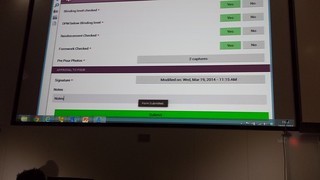
Concrete inspection data input via Android tabletThe first app is available for Android devices from Google’s Playstore, but Union Square is also going down the Apple iOS route (perhaps surprisingly, there was no mention of Windows, despite their systems’ Microsoft foundation; other AEC vendors have different OS preferences – Asite, for example, said on Monday its mobile tools were iOS first, then Microsoft, then Android). Richard demonstrated a site inspection process, showing how data could be synchronised before a user went out on site, how data could be entered into the interface, adding photographs, then signing off the process (signatures were time-and date-stamped, with GPS coordinates included to add further evidence of the site-specific, contemporaneous reporting). Upon return to the office, that data is synchronised, and all information and any associated photographs are immediately available to other users on the main Union Square platform.

Contract administration and extranet

Phil Shaw presented the contract administration and extranet overviews. He demonstrated configuration of typical request for information, RFI-type processes and how these could be routed for approval, reply and completion (all pretty much standard on the SaaS platforms I know), but there was no discussion of specific sets of workflows to support particular contract types (eg NEC3, JCT, etc;  this field is also contested by several SaaS ‘extranet’ vendors plus contract change management specialists such as Sypro).

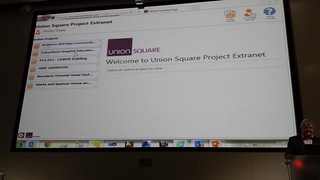
Welcome to Union Square Project Extranet

The extranet functionality, Phil said, was “A departure from the traditional Union Square model, allowing outside people to enter the secure, shared online environment and view and interact with information”. The extranet is typically created as a separate space from the document management system (so there may be some potential duplication of data held in internal systems); it can be internally hosted, or held in an external data centre (Stuart Bell told me that around 30 customers have taken this option, and that demand for the extranet module had been driven almost solely by the company’s contractor customers). It will typically be licensed on a per-project basis.

As with most other AEC extranet solutions, external users are issued with logins for access, and viewing, upload and other rights can be controlled at the individual level. When users access the system, they can view all the projects they are authorised to see, and – depending on their access rights – interact with other users, including via the contract administration workflows.

Futures

Union Square’s software development is plainly driven by the priorities of its users who are, for the most part, dealing with the ongoing challenges of managing day-to-day construction operations within which email remains the predominant communication channel. Opening up mobile and extranet channels to reduce some email traffic will clearly help, as will a planned public API to aid integration with third-party, mainly back-office applications.

However, it appeared that most of the company’s customers are collaborating mainly on documents and 2D drawing outputs. BIM was only discussed very briefly during the morning (I was not allowed to attend an afternoon break-out session where users were to discuss BIM experiences and needs); Union Square is setting up a customer BIM group, looking at IFC issues, and exploring how it might share model data via its extranet. I talked briefly with Union Square directors Richard Vincent and Will Yandell (over from Australia), and commercial lead Stuart Bell at lunchtime afterwards and they said few customers were actively discussing BIM – perhaps a reflection of current levels of BIM interest among their largely SME customer base.

Permanent link to this article: http://extranetevolution.com/2014/03/union-square-workflow-is-everywhere-mobile-and-extranet-too/

Asite: ‘cocial’ and ‘mocial’

Adoddle17 launch at Shoreditch Town Hall Asite’s product strategy highlights the growing importance of simple, social interface design coupled with mobile SaaS access.

Asite‘s London launch yesterday of its new SaaS corporate collaboration platform for the capital asset industry (aka architecture, engineering and construction and owner/occupiers, AECO) was a busy and ultimately, for some, boozy day in Shoreditch Town Hall. After attending the user conference, I stayed for the start of the launch party, but first attended a typically bullish press briefing by Asite CEO Tony Ryan. I jotted down a few points….

  • Asite is on a journey to simplify its product interface, to make it as user-friendly and intuitive to use as possible. Tony explained that the Adoddle cartoon character was introduced in July 2012 as part of a marketing strategy to position the product as simple (“easier than Facebook”) and friendly. He used the phrase ‘”cocial” networking’ – amalgamating ‘corporate’ and ‘social’ – a few times.
  • The company believes it has the right pricing strategy, opting for per-user charging while most of its UK rivals have adopted per-project approaches. For basic collaboration, the service starts at £15/user/month, rising to £65 for the full platform capabilities, but there is a lot of room for negotiation if companies want to become enterprise customers, he said. Asite adoption ranges from “five-man bands doing loft conversions” to multinationals like Laing O’Rourke with a claimed 6,000 users.
  • Asite has been profitable in recent years, and Tony expects full-year revenues of around £5.5m in Asite’s current financial year (ending 30 June), and forecast revenues rising to £7.8m in 2015 and £13m in 2016. Internationally, “Australia has gone ridiculous on us“, reaching £700k from nothing in 18 months, Tony said, but, after two attempts, the company still “needs to crack the US”. The Goldman Sachs deal was highlighted as a major step forward in raising their profile in north America (Asite appointed a US VP of Sales last July, and yesterday I met its other US representative, AEC industry veteran Paul Seletsky).

Reaction

adoddleI was, and to some extent still am, sceptical about the Adoddle cartoon character (for a product striving for corporate adoption in a serious and conservative industry vertical like construction it look somewhat child-like or frivolous – even Facebook, mentioned, remains blandly branded). However, I think Asite is right to want to make its product easy to sign up to and easy to use without training. Many non-construction SaaS applications offer immediate use online and users can quickly learn by doing; yet most SaaS solutions in the AEC space still tend to rely on a direct sales team, with consultancy and training support to get initial users up to speed with their platforms.

The expansion of Asite cMOB to smartphone and tablet-native apps is overdue. Asite was an early mobile mover, offering web-based access to its platform in the late 2000s, but, while being enthusiastic about social approaches to communications with its user community (see June 2009 post), Asite has lagged a little behind its competitors in offering mobile-native apps. This is a key area for future development, as users are increasingly likely to want secure access to their corporate systems via mobile devices, sometimes offline, and these also often require simpler interfaces than conventional lap/desktop interfaces with mouse and keyboard-based inputs.

Merging these two areas of social and mobile, I’ve used a slightly different word recently: “mocial“. Startups are eyeing the construction collaboration space, and I think real-time ‘mocial’ approaches adopted by FieldLens and GenieBelt (post) could challenge incumbents who don’t adapt (I wrote a guest post published yesterday on the Fieldlens blog on this topic).

Permanent link to this article: http://extranetevolution.com/2014/03/asite-cocial-and-mocial/

Asite announces Adoddle 17

Asite logo 2012London-based SaaS construction collaboration technology vendor Asite is officially launching version 17 of its cloud-based platform at a user group conference and ‘Hooley’ being held at Shoreditch Town Hall in London’s ‘Tech City’.

I will be live-blogging highlights during the day (and tweeting; hashtag #Adoddle17 – see also Storify stream). I got an early update from chief operating office Nathan Doughty in late January, but, following a further briefing on Friday, I know today will see a more detailed picture emerge.

Adoddle 17: systems integration-as-a-service

Tony Ryan at Adoddle17 launch11.00am update – Asite staff are conspicuous in their red shirts, with the morning event involving about 60 people. CEO Tony Ryan (right) outlined the company’s “false start” in the UK construction industry, the turn-around in the mid-2000s, and says v17 is a “fundamental step change” in Asite’s history that puts it “light years ahead of our competitors”.

COO Nathan Doughty says version 17 of Adoddle is a significant update of Asite’s core “corporate collaboration” platform, Adoddle, with a major upgrade of the user interface to replace a software experience that hadn’t been fundamentally changed since Asite first launched its own SaaS system in 2004. He stresses, however, it’s a service – successful collaboration is 80% people and process, 20% technology (a familiar refrain, of course!).

Growing information volumes across disparate information platforms is a major challenge; “Adoddle17 is built from the ground up to manage big data, and it’s in the cloud.” Adoddle aims to bridge the data gap between corporate systems and project (design) teams – “it’s a systems integration-as-a-service platform“, “a translator”, and a connector to back office systems (COINS, Sage, SAP, Oracle, etc).

Adoddle17 features

Nathan Doughty at Adoddle 17 launchIt is more than a “new skin” – the aim is to make it more intuitive to use for first-time users, to align it more with contemporary ‘sharing’ technologies (eg: social media), to help highlight the breadth of functionality available across the Asite eco-system. Keywords:

  • simplicity
  • mobility
  • federated search/”big data management” (spanning customer data held in Asite data centres in the UK, US and Australia)
  • “no more than two clicks to the data you need”
  • no plugins – HTML5-based interface, also allows right-click support to access additional functions; the new Asite viewer no longer requires a plugin, so is much quicker.
  • a complete Infrastructure Lifecycle Management (ILM) platform (“all in the cloud”)
  • a clear step towards collaborative ERP (enterprise resource planning) for the capital asset industry (AECO) – something that will interest UK-based competitors such as 4Projects and Unit4 Collaboration whose parent companies have strong ERP interests.

Key features include the search capability across an entire data set, quick links on each page to find key information, user-set favourites, a new Adoddle Navigator App, drag and drop upload support, tablet support for files and models (Adoddle Field is now available on the Apple iStore – Windows and Android apps will follow, in that order), improved user interface for cMOB (“fat finger friendly”), and ability to easily share links quickly with non-Asite using colleagues (email-oriented still; not quite ‘social’ – yet – but Nathan told me he didn’t rule this out in the future). Discussions are presented in a more social-style view.

Basic BIM in the browser is delivered in Adoddle 17, making it easy to add/edit project models online, while the separate Adoddle cBIM application is retained for richer BIM-related functionality.

New customers will be rolling-out v17 almost immediately, while existing users are being briefed (both today and in a rolling programme of client meetings) and will be able to make a controlled transition from the “Classic” version to v17 when they are ready (Nathan earlier told me he expected the migration could take anything from six months to two years depending on the client’s use of the system and the extent of supply chain adoption – some Asite customers have user-bases exceeding 1000; currently, Asite has some 105,000 active users, and over 125 ‘significant’ customers, including contractor Laing O’Rourke and the recently won Russian giant Gazprom).

Adoddle v17 interface tour

11.30am update: Professional services director Chris Peter co-presented the new Asite interface with Nathan. Users can, if permitted, flip between Asite “Classic” and v17 (same data available “under the bonnet”). The conventional document register view is completely customisable – columns can be moved around, etc. The Drag and drop is seamless, with information “dropped” from a hard-drive straight onto the Asite folders. Right-click functionality includes sharing ability: to send emails giving time-limited access to a file or form to users outside Asite. Simple page-top tabs allow users to find different types of data (files, forms, models, discussions, reports, etc).

Adoddle17 cBIM demoAsite cBIM offers a flexible BIM support environment (a Common Data Environment) that can be configured to support common BIM protocols (eg: BS1192). Models can be viewed in worksets (a la Revit), helping segregate discipline information, while also supporting coordination activities. BIM authoring tools are not required on the desktop to review or discuss the model files. Model views can be saved as “tiles” which can be associated with comments or design queries for collaboration purposes. Lists of information can also be created (eg: door schedules).

AppBuilder to App Library

12noon update: Product manager Denis Antony told the user conference about the Asite apps. AppBuilder has been part of the Asite eco-system for some years (see August 2010 post) and allows users to design their own online forms, to gather, share and reuse information, and connect securely to multiple web services. The Designer tool is built using Microsoft Infopath (a click and point form editor), and it is intuitive to use, he says, and it’s easy to include user company branding, or import Word or Excel files (no infrastructure or IT team required). It will help provide centralised business intelligence from across Asite tools and other repositories, encouraging reuse of data. And, Nathan added, if companies don’t want to design their own forms or processes, Asite can do it for customers.

Denis described the different apps in the Asite App Library (most of these are currently web-based, with some being “app-ified” to run offline outside a web browser). The project management tools included contract management (eg: supporting NEC – “used by Transport for London across the board,” says Tony Ryan; other products are, of course, available), project portfolio (track multiple projects), and a finance manager. Procurement and sourcing apps included a pre-qualification application, bid manager (secure online tendering across multiple parties) and procurement management (integrating to supplier catalogues where required). Field management – the first to be launched as an Apple app – covers site management, work orders, and health and safety. Supplier relationship management included tools to manage expenditure with suppliers, and a directory of potential suppliers. Asite also includes some simple tools including task management following meeting minutes, a HR timesheet app, and general project correspondence tools – and Denis said the range would continue to grow.

Going forward
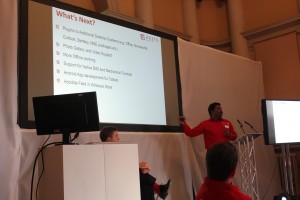
Asite roadmap v173pm update: After lunch and individual product workshop sessions, Denis Antony told the meeting that Asite’s strategic product development priorities are the simplified interface, mobility (no plugins; functionality across multiple devices), and collaborative ERP (a single platform to meet all business demands). Quarterly scheduled releases are planned going forward, and Denis invited feedback from the user group about what they want to see in the product set. He gave a taste of ongoing development threads: plugins to additional desktop systems, photo gallery and video support, more support for offline working, and support for native BIM and mechanical formats.

The company has been surveying users about what they like and dislike about the platform, and their wishlist, and they will continue this consultation work, through future user group meetings (bi-annual), newsletters, online workspaces, an online forum, product surveys, etc.

Tony Ryan closed the event by announcing that Bombardier had signed a deal to use Adoddle 17 for all projects in Australia (“so the product seems to have hit the nail on the head”). Its first projects will be up and running in two weeks, he said, reflecting that the company’s ongoing relationship with TfL positioned it well to win further work on rail infrastructure projects in the UK and beyond.

Permanent link to this article: http://extranetevolution.com/2014/03/asite-announces-adoddle-17/

Asktobi ceases to be

Asktobi[Post updated – 13 March 2014]

In January 2011, I wrote about a recently launched, Gateshead, UK-based business offering an “online business networking, e-commerce and information centre for the construction industry”. Alongside Asktobi‘s core offering of an online e-tendering system, were third-party take-off and estimating tools, stationery and publications, and a supplier database. The Asktobi website is no longer live; Nick Mason and his business partner Iain Walker, himself another Gateshead-based QS, and MD of Rockwell CS Ltd, intend to relaunch the business under a new name later this year (for this reason they applied to Companies House last year for the company to be struck off).

Meanwhile, a new company, Takeoff Live Ltd, was launched in November, after Nick and Iain purchased the rights to the software from its American owner. They tell me interest in the product remains high (though, due to a temporary BT infrastructure issue, some recent customers could not access the Takeoff Live website to buy or renew the software).

Challenging and changing markets

At the time of its launch, I was sceptical about Asktobi’s chances in the competitive e-tendering space. It faced competition from, among others, the RICS and from established vendors of online construction collaboration vendors whose platforms also supported tendering: 4Projects, Asite, Conject, et al. Other start-ups, such as DarleyeTender (post),* also entered the UK market (and since 2011 Aconex’s Bidcontender has been focused on etendering in Australasia; post).

Moreover, Takeoff Live (and other take-off/estimating tools) will also face other challenges. Traditional take-off processes will change profoundly with the adoption of building information modelling (BIM), where bills of quantities and other information can be quickly generated from model data, rather than by working off 2D drawings. So, over time, the conventional estimating software market will dwindle in size – though Nick and Iain are confident that demand from their bread-and-butter SME contractors, who they think will be largely unaffected by BIM, will prove resilient for some years.

* Incidentally, I note that the related DarleyDoc Health and Safety service is now part of the main Darley PCM offering; H&S documentation is also an area targeted by HandS HQ‘s mobile offering – see recent post.


Permanent link to this article: http://extranetevolution.com/2014/03/asktobi-ceases-to-be/

Alun Baker is new 4Projects MD

4projects - a viewpointcs company - logoViewpoint Construction Software company 4Projects has appointed Alun Baker as the new managing director of its EMEA region with effect from 10 March. Reporting to Viewpoint president Jim Paulson, Baker takes on the permanent role at the SaaS construction collaboration technology provider previously filled, on an interim basis, by Steve Spark and before that by the firm’s founder Richard Vertigan, who stepped down as MD in September 2013. 4Projects was acquired by US construction ERP vendor Viewpoint seven months earlier, in February 2013.

Alun BakerWelshman Alun Baker will be moving to north-east England to take up the role at the now Newcastle-based company.

He was previously EMEA MD/SVP at the business process outsourcing company Procurian, acquired by Accenture in December 2013. Prior to Procurian, Alun held various executive roles in technology infrastructure companies TIBCO Software and Datasynapse, and was a director/SVP in ERP software companies such as JBA, Oracle and Intentia/Lawson. He has also spent a total of 12 years as a non-executive chairman of two international infrastructure and BPO companies: Company-I (eventually sold to Symantec) and Citihub.


Permanent link to this article: http://extranetevolution.com/2014/03/alun-baker-is-new-4projects-md/

Exclusive: Kykloud ANZ launches SaaS surveying and asset management ‘down under’

UK-based Kykloud have turned to a successful SaaS reseller team to boost their platform’s penetration in Australasia.

kykloud ANZNorth Shields, UK-based mobile building surveying and SaaS asset management vendor Kykloud has launched an operation in Australasia, working with the same reseller team which successfully launched the 4Projects SaaS AEC collaboration platform into that region in August 2012. The Melbourne-based team of Milton Walters, Michael Tonov and Josh King have set up an Australian business called Survey Cloud* to market Kykloud ANZ in Australasia.

Kykloud conquers UK

kykloud-logo-whiteKykloud-ipadviewKykloud, founded by Ed Bartlett (ex Balfour Beatty Capital) and Nick Graham (former 4Projects CTO), launched its asset management platform, optimised for tablet use and featuring an enterprise-strength SaaS reporting toolset, in January 2012. Just over a year later, they released a Kykloud surveying application which significantly reduced the time surveyors spend on site by 50%, followed – three months later (April 2013) – by the launch of the first RICS-approved mobile templates for typical survey tasks, including dilapidation surveys, commercial building surveys, stock condition surveys, planned maintenance surveys, energy and carbon audits, housing surveys, and valuation surveys.

These tools have been extensively adopted by UK-based firms, with users across the UK, South Africa and Australia. Kykloud has disrupted a hitherto very traditional industry by integrating enterprise class mobile surveying tools and cloud-based asset management software. Field-collected data is stored in the cloud and used for QS schedules, capital planning, life cycle asset management and forward maintenance planning – immediately differentiating it from ‘mobile-only’ reporting solutions.

Kykloud has been used to survey and manage more than 500 million sq ft (50 million sq m) of assets in the past two years, including 6000 schools (a third of all schools in England) surveyed by AECOM for the UK Education Funding Agency’s “Property Data Survey”. Data stored in Kykloud is being fed into the planning of future multi-billion pound capital build programmes. Kykloud’s clients also include seven of the UK’s top 10 surveying firms as well as leading retailers, housing bodies, FM providers, investors, restaurant chains, water, petrochemical and rail companies.

Kykloud quotes

Kykloud ANZ MD Milton Walters said:

“We are very excited about introducing what is clearly the UK’s market leading building surveying and management product to the Australian and New Zealand market. The ANZ market is generally very receptive to technology and we believe we are well placed to promote widespread adoption of Kykloud in this region.”

Ed Bartlett, Kykloud CEO, said

Ed Bartlett“The ANZ market has always been our natural next step as many of clients operate there. The success of Milton, Josh, Michael and their team in the ANZ and Singapore market with 4Projects did not escape our notice when looking for an international partner to head up our southern hemisphere operations. They have won landmark deals with Downer, UGL, Changi Airport in Singapore [see also: ProjectCollaboration growing 4Projects in Australia] and in this last week a major port in NZ – impressive especially as it’s all been secured in the backyard of the global market leader for project collaboration, Aconex. This is clearly a team that develops deep relationships with their clients and operates in a totally professional manner.”

“In the short time since Kykloud ANZ has been in operation we have already closed deals with some of the leading building surveying organisations in Australia. Many of our UK clients have ANZ operations so we are now in a great position to offer clients a locally-delivered service….”

Nick Graham, Kykloud’s CTO, said:

“We knew that the beauty of SaaS meant Kykloud could quite easily be exported and we very quickly picked up some early clients in Australia, South Africa and the US. But as the former CTO of 4Projects I know how hard it can be to break new markets and fully maximise the opportunity without real local knowledge. This is why we have teamed up with a team who are local experts…. The team has successfully delivered a very different line of construction project collaboration software products and I am very confident … they will make Kykloud’s product a real success.”

Josh King, Kykloud ANZ Director of Pre-sales and Client Services, said:

“[W]e have seen an increased demand for mobile and web based asset management software products that help clients manage their existing assets over the long term. Kykloud does just that and allows us to differentiate from what is currently available in the ANZ market…; for example the product can deliver valuable RICS data content under an exclusive license and is accessible to all, as most competing products are tied into a surveying and asset management service offer. We will sell, train, implement and support locally but will never deliver the survey or asset management work in competition with our own clients.”

Kykloud ANZ will be officially launched at the British Consulate in Sydney on 21 May at 4pm. Kykloud’s founders, together with the Kykloud ANZ team, will be available to meet customers and demonstrate the product.

[Disclosure: I have provided consultancy services to Kykloud in the past.]

(* Not be confused with questionnaire survey provider SurveyCloud.eu or Hampshire, UK-based land and building surveying practice SurveyCloud.co.uk.)

Permanent link to this article: http://extranetevolution.com/2014/03/exclusive-kykloud-anz-launches-saas-surveying-and-asset-management-down-under/

Load more