Mobile development no longer just focuses on particular processes. Two firms seek to offer complete construction collaboration capability built from the ground-up for mobile devices.
 I received an email today from Don Speedie of Nevada, US-based FluidCM.com,* who wanted to tell me more about Fluid Contract Manager, a mobile construction management application which is due to launch on 1 November 2013.
Don has worked extensively as a project manager in British Columbia and California, and currently appears to divide his time between Telacu Construction Management and FluidCM, which he describes as the first mobile construction management platform built from the ground up for use on mobile devices. According to Don:
“Every step of the program was planned around a 100% responsive design…. Existing web-based systems stem from designs that work for the desktop and have then been modified for use in mobile situations.
“We designed the user interface to fit onto a smartphone-sized screen and then allowed it to scale up as necessary depending on the device you are using. This means that you can access the system through your web browser on any web enabled device. An iPhone and iPad app is also being released.
“From there, the project management process was broken down into small, bite-sized chunks that allows users to submit RFIs, Submittals, contracts, changes (and more) all digitally. The system allows you to digitally sign off on all documents and share documents no matter when you are, basically eliminating paperwork on the job site.”
Indirect benefits
By designing for the “small” screen first, several simplicity benefits were revealed:
- With limited screen real estate to play with, the user interface was broken down into simple elements. Project information needs to be accessed quickly so FluidCM has three tabbed headings and sub categories to sort the different forms.
- Spreadsheet-type views for logs are limited to a maximum of six columns.
- Simple and consistent step-by-step workflow for drafting up documents, reviewing and submitting them.
- Simplified training, help, and maintenance all lower costs and allow for a better end-user experience.
- One system to learn. Users are not required to learn how the system works on a laptop, versus their tablet versus their smartphone. The information is always in the same spot no matter what device is used.
Don says the program has been in design and testing for over two years and is finishing field trials. An iPhone app will be included as part of the initial release allowing users to take advantage of their smartphone camera and microphone features, simplifying the site documentation process.
Under the Software-as-a-Service model, Fluid Contract Manager is for clients that want a system that is easy to start-up alongside their project and is simple and easy to use for the entire team. Clients will keep all of their project-critical information in one spot in the Cloud where files are easily found when necessary.
The product is also simply licensed. Customers will get an annual all-inclusive license that includes unlimited users across unlimited projects.
GenieBelt and GeniePlanner
The old adage about waiting ages for a London bus and then two come along at once springs to mind. For yesterday, I briefly looked at GenieBelt, a Copenhagen-based company that is also developing mobile applications for construction. Its first product, a mobile inspection tool called GenieInspect is already available on the Apple iStore, but the developers are working on GeniePlanner, which, while still “under construction”, I understand is also intended to be a fully mobile-based construction collaboration platform working on a SaaS basis.
Rival approaches
Mobile is one of the key battlegrounds for construction collaboration vendors and we appear to have two, possibly three different approaches at play here. First, as mentioned at the time of 4Projects’ launch of 4Mobile, we have the developers of traditional desktop browser-based applications; some of these, like 4Projects, Aconex and Asite, are investing in new smartphone and tablet-compatible apps that allow mobile users to access the same back-end SaaS system as their desktop colleagues. Then we have their desktop rivals who have opted for enabling mobile browser-based access to their systems (Cadweb, for example) rather than going down the app route. And now it seems we have new businesses which are looking, not just at point solutions like defects management (post) or mobile surveying (post), but viewing the whole construction collaboration challenge from a purely mobile perspective and optimising their applications to work first on mobile devices and then translate their simplicity and responsive design into usability on laptops and desktops.
Both FluidCM and GenieBelt are at an early stage in their marketing approaches, but it’s an encouraging sign of some new and potentially disruptive approaches beginning to emerge (a thought: will it also see a shift from conventional email-type communication processes to mobile-friendly short-form status updates and messaging?). However, while the architecture, engineering and construction sectors are enthusiastic about mobile tools, they are also very conservative and risk-averse when it comes to adopting new solutions, and it may be some time before they trust any significant projects to this new generation of applications.
(* Not to be confused with Yorkshire, UK-based Fluid Creative Media, fluidcm.co.uk)
 I have long held that SaaS-based platforms are the natural home for BIM data. However, at the moment, much of the BIM debate is focused on the design and construction phases, and less on the data requirements of the ultimate owner or operator of the built assets. But the Twitter conversation (like the ground-breaking discussions about BIM, FM and Government Soft Landings at ThinkBIM in Leeds in
  In
In  Away from mobile devices, a new user interface for desktop users of 4Projects is set to be released on 12 October.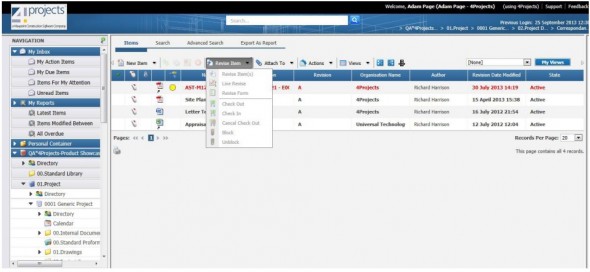
 Melbourne, Australia-based SaaS construction collaboration provider
  In an unrelated
 In the fortnight since
 Matt told me it was not unusual for a founder to leave a business once it was acquired, particularly if they could sense it was in good hands, and CEO Richard Vertigan had devoted some 14 years to growing an entrepreneurial company and now wanted to do something different (a view Steve, right, confirmed). Viewpoint is looking at both internal and external candidates – ideally, British – to run the 4Projects business, and is keen to have someone based full-time and living locally to Newcastle, where the company will be based in larger city centre offices from January. Steve is a local, has been at 4Projects since 2006, has been business development director since 2010, and says he would relish the opportunity.
 The next
  During the early 2000s, Nottingham, UK-based
  Sunderland, UK-based SaaS collaboration vendor
  With Viewpoint’s acquisition of 4Projects and the investment we are making in the product, the organization, and the business overall, Richard Vertigan [right], the founder of 4Projects believes he has found a good home for his company, so will be leaving his role effective 30 September, 2013. We have the utmost respect for Richard and the company which he helped to build and would like to place on record our thanks to Richard for his support during the acquisition process and beyond, wishing him all the very best for the future.
 Viewpoint yesterday also