Cereno nuVa

Two or three years ago, myself and a couple of other BIW colleagues were invited by contacts in Thales technology research and development team to go and see an experimental collaborative platform that it was developing in conjunction with people at Surrey University. That product, now branded nuVa, is now commercially available, with Reading, UK-based Cereno as the sole provider of this fully managed, hosted service.


The prototype that we saw what looked like a conventional drawing board surrounded by an array of cameras, but the product has now evolved considerably. At the core of the system is the nuVA huddle desk (no relation to Huddle software) – a large digital tablet around which colleagues can gather and share information with others gathered at similar devices in other locations (there is a desktop version, nuVA Innovator).

Essentially, the nuVa Collaborative Working Environment (CWE) system allows people to share information just as they might in a conventional meeting, by putting a document, photograph or drawing in the middle of the table and then discussing it and marking amendments, etc on the item itself, while related items can be arranged around the periphery of the shared space. The CWE incorporates a pen-type device for writing or sketching as well as a standard keyboard for typing, and its built-in audio and video means all conversation and outputs can be securely shared in real-time with colleagues using CWEs elsewhere (secure thanks to “Thales defence-grade encryption”).

On the face of it, this is a potential solution to the perennial gripe from some AEC designers about the inconvenience of doing design mark-ups on a conventional computer monitor (see Moaning architects). Cereno says it offers “a tax efficient lease option that eliminates the need for capital expenditure”, but will it be the cost-effective solution that so many in the architecture, engineering and construction space tend to be looking for? Getting every participant in the design process to lease similar equipment could significantly increase overheads across the fragmented multi-company project teams typical of construction projects (perhaps because of this the early marketing appears to be targeting the less cost-conscious oil and gas sectors).

It would be interesting if this technology could be integrated with some of the existing browser-based construction collaboration technologies currently employed on complex major projects, such as BIW’s Software-as-a-Service project control platform or those provided by various NCCTP members. Thus, architects and other designers might be able to hand-draw mark-ups and write comments, share them with other project participants who are more focused on incorporating the designers’ outputs into their day-to-day information flows, and help build up a complete and auditable information asset for use in future operation and maintenance.

(Update, 28 May 2009: nuVa now has its own website at www.mynuva.com. Thanks to Ben Pritchard.)

Permanent link to this article: http://extranetevolution.com/2009/05/cereno-nuva/

US structural engineers warming to BIM

I wrote recently (2D to 3D: still a work in progress, updated 27 April 2009) about US rates of adoption of building information modelling, BIM, looking at results – released by Cadalyst‘s Robert Green – focused mainly on US CAD managers. He concluded, somewhat gloomily, that 84% of the AEC/construction industry is 2D, identifying that part of the problem might be attributed to the slow pace of adoption by different parts of the design team. This results in teams reverting to 2D as an easy lowest common denominator.

Some AEC disciplines, though, are clearly warming to the idea of BIM. Another US survey, reported on GoStructural.com, shows that, in March 2009, structural engineers were rapidly gaining an understanding and awareness of BIM, compared to a similar survey three years earlier. “While not all firms are leveraging the technology currently, most respondents believe that BIM use will penetrate the AEC industry as a whole within 10 years.”

In my view, structural engineers have been ahead of the most of the AEC disciplines in adopting 3D, and their optimism regarding the pace at which BIM use will permeate the whole AEC industry is commendable. But other members of the project team will need to catch up with their structural engineering colleagues, and all will need to contribute to finding solutions to some of the training, procurement, contractual, intellectual property and insurance issues that need to be resolved to enable truly integrated project delivery. And perhaps due to the more fragmented and complex nature of UK teams and processes, this may happen earlier in the US than it will in the UK.

Permanent link to this article: http://extranetevolution.com/2009/05/us-structural-engineers-warming-to-bim/

Do StoreData results indicate slowdown in UK construction collaboration market?

With Asite‘s financial performance now less public following its delisting from London’s AIM earlier this week, it is more difficult to assess what impact the recession is having on collaboration vendors. However, troubled retail fit-out specialist contractor Styles & Wood has a support business, StoreData, which competes in the UK construction collaboration technology market, and its latest results suggest there may have been a slow-down in 2008.

According to a London Stock Exchange announcement of its final results today, Styles & Wood group revenues dropped 23% and a 2007 pre-tax profit of £11.8m was turned into a loss of £0.9m in 2008 (material contract losses and non-recurring items of £4.7m wiped out a modest £3.8m profit). The support services division “performed well in 2008” with total revenues of £31.0m (2007: £31.5m) generating an operating profit of £2.5m (2007: £4.2m); StoreData’s revenues were 10% down from £1.506m to £1.350m (no profit figure was given for StoreData alone).

If StoreData’s figures are representative of other collaboration technology vendors, these are worrying times, particularly as StoreData has been associated with retail clients, some of whom have been weathering the recession better than others. However, StoreData’s downward trend was evident a year ago – it suffered a 6% drop in revenues in 2007 putting it some way behind its 2006 peak of £1.594m (see StoreData stagnating in 2007).

Permanent link to this article: http://extranetevolution.com/2009/05/do-storedata-result-indicate-slowdown-in-uk-collaboration-market/

Woobius follow-up

Following my 22 April post, Whobius? Woobius, I met Bob Leung and Daniel Tenner in London to find out more about their business and to see a quick demonstration of their technology.

Background

Bob explained that he had started to work on a simply construction-oriented collaboration platform partly out of frustration with what he saw as the inadequacies of mainstream systems such as those provided by BIW, Asite and 4Projects – systems that he had used while working at architectural practice Foster + Partners (before he moved to Make); he also felt that existing generic online file-sharing platforms such as Box.net were less than ideal for AEC project-working.

The first version of Woobius was launched in early 2008 for use on some Make projects, with users giving developer Daniel feedback to enhance the product over the course of the past year. Initial development has been part-funded by some angel investors, but Bob and his team retain majority ownership of the business.

The name Woobius, partly inspired by the Möbius strip, was chosen to distinguish it from the “stodgy” brands currently associated with construction collaboration, Daniel said.

The intention was to create a simple-to-use web-based tool that required no training and which would allow designers to share drawings and other documents during the early conceptual stage of a project, up to the planning application stage. Bob accepted that once a main contractor or project manager was appointed to actually construct the scheme it might currently be necessary for the design to move from Woobius to a more sophisticated platform, though this might not be required for small projects with few project team interfaces.

The application and data is currently hosted by a US-based company, EngineYard, and Daniel said they were looking closely at how they maintained continuity, speed and reliability of service.

Set-up and use

A key distinction between Woobius and most of its main UK competitors is the no/low-cost, rapid start-up. Woobius is currently free and each project comes with 200MB of free storage (see updated pricing page). Should you need additional storage, then you can upgrade to get more, purchased online via a simple low-cost credit card transaction. The service is available to use in seconds, while the likes of BIW, etc, usually take a few days to get a project environment up and running. As demonstrated to me, setting up a new project (see the Woobius tour), uploading some initial files and inviting colleagues to view those documents took just minutes (implementation of the more sophisticated systems takes longer as vendors typically seek to generate dedicated URLs and tend to configure solutions to meet the requirements of each customer/team).

The Woobius interface is straightforward, comprising four tabs: Dashboard, Drop Box (for informal sharing), Vault (for formal sharing; see below) and Companies.

Co-workers receive an email invitation containing a link that takes them to the project environment; similarly, when documents are shared, co-workers are notified that the documents are available and can be downloaded from Woobius. We debated the pros and cons of email notification: in my experience, some users of construction collaboration solutions become irritated by multiple emails, preferring to get one email ‘digest’ summarising all items that require their attention.

At this stage, the focus is simply on file-sharing. Woobius doesn’t currently offer mark-up or commenting tools, but such functionality is in the pipeline, as is a facility for participants to get a post-project DVD archive upon completion of their inputs to a project (a ‘must have’, in my opinion). Archiving will include a full audit trail by default.

Competition

Asite already offers a low-cost starter option – Asite Key Lite, combining Asite Workspace and Asite Navigator – but while the pricing (£15 per user per month, minimum three months – half the cost charged when Workspace was launched in early 2007) is nowhere near as low as that of Woobius, Asite does offer online mark-up and commenting as part of the solution, and there is a migration path to the more advanced Asite solutions.

The other mainstream UK vendors don’t offer low-end products, and tend not to offer per-user charging, preferring instead to offer per-project or enterprise licensing arrangements that free team from being cost-conscious about just how many users they have (a sensitivity that can hinder effective collaboration). Woobius has no limits on the number of team members it supports.

Permanent link to this article: http://extranetevolution.com/2009/04/woobius-follow-up/

USACE contract requirements expose BIM interoperability shortcomings

I’ve just been reading another great AECbytes guest article, by David Edwards. He writes about the US Army Corps of Engineers (USACE) and how it is driving the adoption of IFC2x3 compliant building information modelling (BIM) in the US – something much discussed at recent IAI/BuildingSMART conferences (see my BuildingSMART conference, part 2 post, for example).

It appears that, while the USACE claims to be “BIM neutral”, in practice it usually means that firms must deliver designs in Bentley BIM format, as interoperability is “falling apart”. It is no longer a question of mapping parameters or variables from, say, Autodesk to Bentley, he says:

The USACE’s Bentley BIM Workspace contains thousands of directories and files. It specifies not only BIM object parameters, but CADD parameters, file directory locations, and a plethora of other “under-the-hood” system variables. The real question becomes: Can intelligent Bentley BIM objects be created with non-Bentley BIM applications and converted to match the USACE’s Workspace parameters? From all my research on this issue, the answer is “No.”

As a result, if AEC firms want to bid on USACE projects, they must do 100% of their work in Bentley BIM applications, and work with consultants who also produce 100% of their work in Bentley BIM. Such single application solutions may, David says, be detrimental to BIM’s future growth. He outlines vendor’s responsibilities but also stresses that clients should not require BIM deliverables from just one vendor. Otherwise, the industry’s adoption of BIM (already painfully slow) may come to an abrupt halt:

After spending enormous amounts of money on new software, new hardware, new personnel, and new training, firms are finding out that what they’ve been sold won’t work. We know BIM is where the industry is headed, but we’re finding out that it’s arriving there before all the pieces are in place for it to be workable and profitable enough to supplant current solutions.

Most of all, we must realize that this is a very radical change to one of the world’s largest and oldest industries. Small steps need to be taken before too much is set in stone that will constrain growth and advancement in the future. (my emphasis)

Permanent link to this article: http://extranetevolution.com/2009/04/usace-contract-requirements-expose-bim-interoperability-shortcomings/

End of the Asite AIM era

Today is the last day of trading on London’s Alernative Investment Market for construction collaboration SaaS technology vendor Asite (see Asite to delist from AIM to trim costs), which – following a name-change from Premisys – has been on AIM since January 2002.

It has not been a particularly helpful ‘barometer’ of the fortunes of similar vendors. Asite struggled to match the growth reported by non-listed UK competitors such as 4Projects and BIW [my employer] – see post. Its share price last topped 4p in early 2005, and even recent improvements in its performance (see Asite continues ascent) have not stopped the shares sliding. Volumes traded have rarely been high and, amid more general market turmoil, Asite’s price declined dipping gradually towards and then finally, this year, below the 1p mark (closing at 0.75p on Friday).

As previously noted (Asite Asides), the less public scrutiny of its performance will also mean that we will probably have to wait a while before we can glean what impact the current recession in the AEC sector has had on the construction collaboration technology vendors. Like most businesses reliant upon providing services to the construction and property sectors, I expect we will (eventually) see growth, turnover and profitability all down, as project cancellations and postponements hit project-dependent revenues.

Permanent link to this article: http://extranetevolution.com/2009/04/end-of-the-asite-aim-era/

Engineering the future of SaaS

I have always believed that the architecture, engineering and construction (AEC) world can learn lessons from application of technologies in other market sectors, and so it is gratifying to see that debates about moving design applications to a Software-as-a-Service model are also alive in the mechanical engineering world. I have just been reading an MCADonline article by Dr Peter Collins (right), CEO of UK-based company dezineforce – which aims to become the first global player to offer a fully integrated, SaaS-based engineering design optimisation service. (Regular readers will know that I have talked about the potential for AEC design applications to go SaaS-y several times – see BIM, the project information cloud and an AEC ‘Cluetrain’, for example.)

Delivered over the internet, Dezineforce can be accessed from anywhere in the world, by whomever the subscribing company chooses, facilitating collaboration between teams at different locations, he says. It has immediate advantages:

“Instant availability means subscribers can immediately focus on designing, rather than wasting time time in the definition, acquisition and configuration of commodity technology. Inbuilt flexibility of use enables immediate and essentially infinite availability to grow capacity in response to demand. No more the dilemma of whether to invest in additional capacity before winning the design contract, or losing delivery time after the win while procuring that capacity.”

Interestingly, he quotes research from Catalyzt (not to be confused with the online magazine of the almost same name, Cadalyst) that showed the SaaS approach was significantly less expensive than conventional approaches to computer-based design for companies engaged in the design of components, sub-systems and complete systems:

At low volumes, the cost is typically 40 percent less than that of conventional design approaches. At higher volumes, it rises to a massive 70 percent saving through multi-user exploitation of IT resource, including licences, hardware and support, higher designer productivity and better risk management.

Looking at Dezineforce’s website, it seems that its technology is already attracting some interest from businesses involved in the AEC sector; Arup was announced last November as a new subscriber to the service.

Permanent link to this article: http://extranetevolution.com/2009/04/engineering-the-future-of-saas/

Enter Colaab

Visit colaab.comAfter some Twitter conversation yesterday about Woobius (see post), I was recommended to have a look at another low-cost web-based file-sharing service, Colaab.

Right from the home page, Colaab claims the value of its browser-based system for design revew. It uses an enhancement of Microsoft’s Silverlight technology, Deepzoom (good primer here), to allow large image files to be downloaded and viewed almost instantly. Colaab also allows on-screen annotation and mark-up, but the range of supported file formats doesn’t extend to CAD files such as DWF (extensively used in many construction collaboration platforms), so designs would have to be saved in other formats (eg: PDF, JPG) if users intended collaborating on them.

Ignoring the free single user option, Colaab prices start from $24/month up to $99/month. The latter package allows 25GB of storage, unlimited workspaces and users, and includes conference calling capabilities.

Permanent link to this article: http://extranetevolution.com/2009/04/enter-colaab/

Whobius? Woobius

WoobiusWoobius is a new name in Software-as-a-Service (SaaS) construction collaboration, and appears (from, among other places, the company’s Scribbles blog) to be the work of three UK-based people: Make architect Bob Leung, technologist Daniel Tenner and user interface specialist Cliff Rowley.
While not a construction professional, one of Daniel’s Woobius Scribbles (Document Control – how hard can it be?) shows that he appreciates the challenge of sharing files between the numerous companies involved in a construction project, but on another blog he dismisses generic file-sharing solutions and lambasts industry-specific solutions:

There are some industry-specific solutions, but without exception they’re slow, bloated monsters that try to control every aspect of the project, and end up pretty much requiring full-time staff just to deal with them. They’re very hard and slow to use, so people end up bypassing them at every corner. And they’re extremely expensive, too.

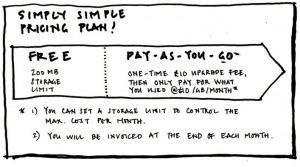
woobius pricingWoobius, by contrast, he says is “designed to be intuitive and easy to use, automates most common tasks to save time, and is more than an order of magnitude cheaper than the competition”. Daniel said (February 2009) it has over 2000 users – most recruited by recommendation by other users. How much cheaper? Well, the pricing page explains that, currently, Woobius is completely free to use, up to 200MB, and then just £10 per Gb per month.

There are, of course, reasons why industry-specific collaboration platforms “try to control every aspect of the project” – most of them to do with the lawyers and contracts involved, and with an intensely risk-averse industry culture that seeks to make sure every contribution to a project is securely recorded and auditable. And yes, there are people who work full-time at document control. On many projects, they are just as much a key part of the project team as architects or engineers, keeping a finger on the pulse of information flows across the team. As for “slow” – depends on your connection speed, of course; and people do not “bypass them at every corner”, particularly if the client/project manager/main contractor is rigorous in ensuring that the collaboration platform is the only place to exchange project-related information.

However, I think Woobius’s strength – simply file-sharing – is also its weakness. The leading UK solutions, such as [my employer] BIW and its NCCTP competitors, are increasingly focusing on managing complex AEC business processes (see my October 2008 post, The new ‘extranet’ battleground). Documents and drawings are part of the issue, of course, but they are usually associated with a wide variety of industry-specific workflows, both simple (requests for information, architects’ instructions, etc) and more complex (eg: supporting the requirements of the NEC3 suite of contracts). What Woobius might regard as “bloated” is down to the mainstream solutions’ support for this critical facet of many project team’s day-to-day working requirements. Also, all the mainstream solutions provide tools for users to collaborate upon drawings and other documents – ie: to create comments and redline mark-ups on CAD files; this doesn’t seem to be available on the Woobius system.

The US market has quite a number of simple file-sharing or plan-room solutions targeted at the AEC sector (I’ve noted Procore, Corecon, Coreworx and EADOC, among others, on this blog). Woobius seems to fit into the same cohort. Great for sharing documents on small projects perhaps, but falling short of the sophisticated workflow and collaborative capacities required for bigger, more complex schemes.

Permanent link to this article: http://extranetevolution.com/2009/04/whobius-woobius/

Asite confirms delisting

From a London Stock Exchange RNS announcement yesterday afternoon:

The board of Asite announces that at a general meeting of Asite’s shareholders held earlier today all resolutions were passed.

The cancellation of admission to trading on AIM of the ordinary shares in Asite will therefore take effect from 7.00am on 28 April 2009.

Recent related post: Asite asides (13 April 2009)

Permanent link to this article: http://extranetevolution.com/2009/04/asite-confirms-delisting/

Load more