Collaborative BIM developments

I visited the National Infrastructure Forum exhibition and conference at London’s ExCEL earlier this month and talked to staff on a couple of the technology vendors’ stands. Both the conversations focused on BIM and collaboration….

3D Repo

I have talked to people from London-based 3D Repo at various BIM events in recent months (and wrote about their BID4Free platform in March 2017). At the NIF event they were talking about a new version of their cloud-based BIM collaboration platform that offers additional support for leading software packages such as Autodesk Navisworks. It also provides enhanced support for large 3D models typical of infrastructure projects, as well as integrated VR functionality for applications such as training, safety and project consultation. CEO Dr Jozef Dobos said:

“The support for native file formats and software platforms further highlights our commitment to collaboration. We want to make project information as accessible and usable as possible, which is why we engage with as many open source and proprietary formats as we can, allowing users to share 3D models, issues and ultimately knowledge with the wider project team, in the cloud, but still in the context of the original model.”

The latest versions of 3D Repo’s Open Source, Starter, Professional and Enterprise packages include advanced integration with Autodesk Navisworks project review software. A custom plug-in (available free from the Autodesk App Store) allows data to be uploaded directly to the 3D Repo knowledge base without the need for file exchanges. Users can then view models and collaborate with the wider project team through their web browser, even on very large and complex projects. The Professional package is £100 per month for unlimited projects, issues and collaboration.

3D Repo has also announced support for the BCF file format, allowing import/export of collaboration and mark up data for issues tracking to software such as Solibri quality assurance solutions, Trimble’s Tekla product family and 3D architectural BIM software ArchiCAD (from the Nemetschek Group’s Graphisoft business).

Bluebeam

Over the years, I have talked to several organisations that use Bluebeam‘s Revu PDF creation, editing, markup and collaboration technology to support their design and construction workflows, but I haven’t dug too deeply into the application, primarily as it was originally a locally hosted, PC-based solution rather than a cloud-hosted application (my core focus). As a then US-owned business, Bluebeam also did not have a high profile in the UK or mainland Europe.

Nemetschek logoHowever, Bluebeam has been mentioned in this blog when other vendors talked about integration (Box.net and Motion Computing in 2010, for example) or about their competition (Plangrid in 2014, Combinder in 2016, for example) as mobile apps grew in importance; and, of course, I couldn’t overlook the US company’s acquisition by Nemetschek in October 2014 – particularly as this put Bluebeam alongside a host of design authoring applications collaboration products (including Allplan, Vectorworks, the above-mentioned Graphisoft, SCIA, DDS and Maxon), since augmented by other tools including Solibri (December 2015) and dRofus (December 2016), in a group publicly committed to Open BIM as a basis for collaboration.

Bluebeam logoAt the NIF event, I talked to Bluebeam staff about Revu, and, in particular, about Bluebeam Studio: a centralised collaboration platform included with every seat of Revu that connects project partners worldwide in real-time. This, of course, puts Bluebeam in competition with the SaaS construction collaboration technology vendors I’ve focused on, and not just in relation to conventional 2D documents and drawings, but also in relation to 3D BIM. For Revu CAD version also allows creation and markup of 3D PDFs from Autodesk’s Revit and Navisworks, plus Sketchup Pro and any IFC file. Bluebeam Studio Prime also has integrations with other collaboration products including:

  • Procore – hot on APIs (post), Procore users can create Studio Sessions for submittals
  • Egnyte – enterprise file sync and share (EFSS) services, and
  • Fieldlens – recently acquired by WeWork (post), Fieldlens can be linked to selected Studio Projects, used to monitor for changes and alert users when it’s time to sync – ensuring updated drawings are available instantly to everyone in the field.

I also think Bluebeam has potential to work as the collaboration ‘glue’ between the many design applications in the Nemetschek Group portfolio. The group has historically tended to let its acquired businesses continue to run relatively autonomously and I have written previously about some of its collaboration-oriented projects such as Nemetschek bim+ common data environment (November 2013) and, in February 2014, Graphisoft’s BIMx Docs app for iOS devices (in March 2014, Graphisoft also launched its BIMcloud platform).

Permanent link to this article: http://extranetevolution.com/2017/06/collaborative-bim-developments/

think project! raises French profile

think project! rebrands French subsidiary hoping to accelerate expansion in Europe.

Thinkproject-logoLascom AEC, the Paris, France-based provider of PLM (project and plant lifecycle management) acquired by the Munich, Germany-based construction collaboration Software-as-a-Service technology provider think project! Group in September 2015 is being rebranded to think project! France. The move will strengthen the think project! brand and, the business says, accelerate market expansion in Europe.

Lascom AEC has a strong customer base and growth position in France; customers include Vinci, Alstom, Eiffage, Technip, Setec and RATP. think project! CEO Thomas Bachmaier says:

“France as the second-largest economy in Europe with leading companies in construction and a significant number of private asset owners is an important market for our international expansion. With the renaming to think project! France, Lascom AEC becomes part of our international brand. Our focus is to ensure that our product portfolio covers all customer needs – not only for PLM but also for cross-enterprise collaboration.”

Sabine Noisette, managing director of Lascom AEC, says:

“With the renaming we will be more obvious part of a strong organisation with a large international presence and a clear focus on AEC (architecture, engineering, construction) businesses. We benefit from the experience and structures of the international project business of think project! as well as from synergies in technology especially in the SaaS business and with BIM. Our goal is to join forces to become a strong partner for digital transformation for our customers in France and internationally.”

Permanent link to this article: http://extranetevolution.com/2017/06/think-project-raises-french-profile/

A mobile Site Diary – at a price!

Script and Go’s Site Diary complements a mobile-first construction project management application but the suite is not competitively priced compared to others.

Since the 2007 advent of smartphones and the later launch of tablet products, the number of mobile applications designed for construction has grown and grown. I have seen numerous apps for snagging / punchlists / quality control – some stand-alone, others integrated with SaaS platforms – and talked to businesses about apps for health and safety, permits to work and other workflows (see previous post about construct.pm, for example).

Site diary applications have also occasionally featured in this blog (eg: Contract Communicator in 2009, and Note Vault in 2014), while a quick web-search for the term pointed me to, among others, Site Diary Plus and Tradies. A new addition to the market comes from Rennes, France-based software development company Script&Go.

Script&GoScript&Go already offers a mobile-first construction project management application BatiScript, which can be accessed by tablet, laptop or smartphone.

In September 2016, Script&Go acquired another application, Site Diary, from Appear Network (incidentally, a backer of an EU-funded project called MobiCloud which I have seen presented at COMIT events). In the last nine months this app has apparently been developed further and was launched on 21 June 2017, priced at €12 per month (c. £10.50 or US$13.70).

BatiScript pricing

(Updated – 17 August 2017) Strangely to me, the BatiScipt product appears to be licensed per device (see pricing) suggesting that if you want to access the BatiScript platform across all three platforms, you will pay €84 (Premium use on Tablet) plus €44 (back office on PC) plus €19 (on smartphone) – a total of €147 per month to rent the software (for a minimum of two years) or to purchase the software, a total of €2270 (€1290 + €690 + €290), plus 20% maintenance (€454).

However, the company’s Khaldon Evans (see comments) says:

“… We have to improve the pricing web page so it’s clear. Our highest price is €84 per month that’s it. With the €84 per month, the person doesn’t need to buy back office or smartphone. The smartphone version is if you have subcontractors and you want to have access to your site and collaborate with them about defects etc. You can negotiate with the subcontractors about who will pay the €19 per month.

The back office (PC version), is for people who work in the office and rarely to never go to the field. They will be able to manage the progress of their subcontractors, issues raised, create reports, assign task etc. A back office user doesn’t need to buy the premium €84 version for tablets.

Based on all the features that BatiScript offers, our price is less than the competitors.”

Reflecting on Khaldon Evans’s explanation, I would say that while the rental cost to individual users might be a maximum of €84 per month, the costs to a construction business may still aggregate to €147 per month if they have a smartphone user, a back-office user, and a subcontractor who quietly adds an allowance for €19/month to their invoices.

The rental approach (“… the ‘rental’ mode engages you in a 2-year commitment period”) certainly differs from the flexible, no minimum period, pay-as-you-go approaches of many other vendors of cloud-based construction software – which are often available at no extra cost on other devices (and would you commit to using this system if your construction project was, say, only 12 months long?).

Contrast this approach with, for example, Asite (one of the few UK-based vendors who don’t base their pricing on project-based licensing); the London-based construction SaaS vendor offers its basic product for just €19 per month, with the most expensive subscription still half that of Batiscript at €75 per month.

Permanent link to this article: http://extranetevolution.com/2017/06/a-mobile-site-diary-at-a-price/

Some Asite updates

Asite logo 2012London, UK-based SaaS construction collaboration vendor Asite has been pumping out a few announcements recently.

G-Cloud

Asite last week announced its involvement in the UK’s Crown Commercial Service’s G-Cloud 9 programme. This cross-government initiative was launched in May of 2017 as a means of enabling public sector bodies to buy cloud-based digital services directly off the shelf. The open framework is refreshed every 3 to 12 months, consistently bringing on new suppliers and services, and there are around 20,000 services on the framework.

Tony Ryan, CEO of Asite, said:

“Our appointment to the G-Cloud framework builds on our long-standing relationships, which provide project collaboration services in the cloud to the UK government.  Together with our longstanding commitment to supporting the government’s Construction Strategy and in particular to the achievement of Level 2 BIM with our cBIM service, we are fully committed to the improvement of procurement in UK construction.”

A quick browse of the listing shows several other construction collaboration SaaS vendors on the G-Cloud framework including Aconex, AQL (hosting provider to eviFile – post), Basestone, Bentley Systems, Business Collaborator, NEC3 contract specialist CEMAR, Idox (parent of McLaren Software), Trimble UK, and Viewpoint.

Redrow

This week, Asite has announced that listed UK housebuilder and contractor Redrow Homes has selected Asite’s SaaS platform Adoddle as its enterprise wide CDE (common data environment) solution in the UK. Redrow first adopted Adoddle’s platform in 2014 in south east England, and has now signed an enterprise agreement with Asite.

Update (29 June 2017) – The flurry of announcements continued with news of another enterprise agreement yesterday, this time involving technical services provider Imtech.

Clash detection

And, according to a Tweet today, the company is preparing for a July 2017 launch of clash detection in its CDE:


Permanent link to this article: http://extranetevolution.com/2017/06/some-asite-updates/

NBS launches BIM viewer

At this week’s Autodesk University in London, NBS – Newcastle, UK-based developer of the free BIM digital Toolkit (post) – has launched the public Beta version of the NBS Online Viewer (powered by Autodesk Forge, a WebGL-based viewer). According to BIMplus, the NBS Online Viewer makes it quick and easy for everyone working on a project to view a 3D model and associated specification through a web browser without the need for additional software (so long as you have a WebGL canvas-compatible web browser and a free NBS ID).

NBS chief executive Richard Waterhouse said:

“As part of our existing suite of integrated solutions, the NBS Online Viewer provides huge efficiency gains for designers, manufacturers, contractors and building owners/operators alike, by allowing everyone to be informed on a project regardless of technology barriers. By integrating the model and specification in the cloud, we will be providing a solution which provides and maintains critical data within the construction workflow and allows our customers to provide more value to their clients.”

NBS has been developed plug-ins for BIM design software for some years, allowing its customers to better coordinate their models and specifications. NBS director of research and innovation Stephen Hamil, said:

“Being able to view and interrogate this information from the context of a 3D model will allow for better, earlier informed decision making on projects, whilst providing the right content and information to the right people at the right time. We encourage all those working on BIM projects to test drive the NBS Online Viewer. The public beta phase will be open for the next few months and from there we will determine how best to build the first release to market with the help of our customers.”

The tool works by combining an Autodesk Revit or IFC model and NBS Create specification in the cloud without the need for the user to licence or install any software. To access and give feedback on the viewer visit www.theNBS.com/viewer

Permanent link to this article: http://extranetevolution.com/2017/06/nbs-launches-bim-viewer/

Construct.pm pushing compliance and reporting

Construct.pm is finding customers valuing it for compliance management and for accelerating project management reporting processes.

By coincidence, the day after WeWork acquired FieldLens, I visited a WeWork location in London’s Devonshire Square to talk to a tenant, Construct.pm (which also competes in the UK equivalent of FieldLens’s mainly north American target market).

Construct.pm logoI first talked to this mobile-first business in December 2015, learning how the Construct.pm form-builder and workflow platform could expedite the creation of processes and then allow users to track their progress. It was then also working with SaaS collaboration vendor Conject (now part of Aconex) to integrate simple sharing of drawings from Conject to users of the Construct.pm platform (see also October 2016 ISG case study).

CEO Ant Erwin and head of sales Mark Coates updated me on Construct.pm’s core strengths, which they saw as mobile data capture and reporting.

Compliance

The site-to-office mobile platform (currently iOS only, but the business is working on an Android version) is being developed to help project manager users accurately capture data while out on-site (“avoiding rubbish in, rubbish out”) and then re-use that data to manage workflows and to provide reports. One area they have particularly focused on is ensuring that any data collected is of high quality – for example, data is checked for completeness, and conditional fields and approval processes help ensure information is accurately captured in the right fields and formats.

Construct.pm in useConventional capture of field data using paper-based systems and/or manual entry into Excel spreadsheets is still commonplace across many construction sites, but increased digitisation, including the adoption of BIM, is making professionals more conscious about the need to capture, record and reuse data consistently, both within projects and across a businesses’ projects.

Construct.pm is finding its platform used increasingly for various previously paper-dominated process including permit-to-work workflows (for example, for ‘hot works’ such as welding or brazing) or for delivery tickets – speeding up the automated flow of information from site to head office so that project valuations can be updated in minutes and payments expedited.

Compliance is an increasingly strong point for us,” said Erwin. “Health and safety, environmental and quality issues have not always been dealt with properly by other apps out on the market, and we forget that some businesses are still getting their heads around Excel in the cloud.” (Other businesses in this sector that I have looked at in the past include HandS HQ and DarleyPCM).

“Many of our clients understand it’s not just about the forms,” Erwin continued. “Their efficiencies come from being able to manage the resulting workflows, being accountable, and avoiding hold-ups.” Construction and design programme improvements, avoidance of mistakes, higher individual productivity, faster approvals, and reduced admin costs are among the benefits reported by customers. Mark Coates also talked of one project which had been won because the contractor had demonstrated use of Construct.pm to the client, showing a commitment to visibility and to adoption of innovative technology that the client had been keen to see: “It’s good for reputation,” he said.

Reporting

Construct.pm is also finding its customers are valuing its platform’s reporting tools, said Erwin.

“More and more, we are surfacing the data. We’ve got the data collection; now it’s about using what we call ‘trackers’ to monitor actions and resulting issues, particularly if there are cost issues. Effectively, we can start to do part of the project managers’ jobs by producing coordinated reports for them. And we are using the latest live data, straight from site, to build these reports. … This means project managers can start to work entirely differently – being able to react based on live data as opposed to the old way, based on information that might be two weeks old.”

He also described how Construct.pm also interfaced with Microsoft Project through an open API to help project managers assess the impacts of issues on project programmes.

Coates said Construct.pm now had 100s of customers, most of them paying a monthly subscription to use the toolset across multiple projects. In some cases, up to 70 subcontractors may be using the platform at the request of the main Tier 1 contractor, but the business was also finding some subcontractors proactively opting to set up their own Construct.pm systems so that they too could report across multiple projects.

Permanent link to this article: http://extranetevolution.com/2017/06/construct-pm-pushing-compliance-and-reporting/

ShapeDo: change management in the cloud

Israeli startup ShapeDo has a powerful 2D drawing change identification capability to which it has added strong workflow management, making it an attractive contract change application.

ShapeDo logoWith most of the world’s construction industries still heavily reliant upon 2D drawings, Jerusalem, Israel-based start-up ShapeDo says it is finding a ready market for its software that helps manage design changes. Its software detects differences between drawings, and can then help manage associated workflows (requests for information, change orders, etc) and can help project managers track the cost implications of changes in contracts, budgets and other agreements.

Ari IsaacsI talked to ShapeDo co-founder Ari Isaacs about the company and its Software-as-a-Service application, which he said “has had a very high success rate” with contractors in the Israeli market. The company is now looking to expand overseas into markets including the UK, where – despite the recent growth in use of building information modelling (BIM) – he feels there is a lot of potential for the software’s use in dispute avoidance and resolution as well as for collaboration.
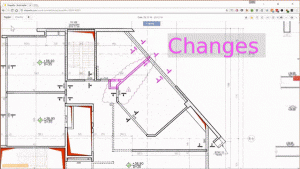
Spot the difference

“We create order in the drawings,” he said, demonstrating how a sequence of design drawings can be produced, with the differences between them prominently highlighted. These differences can be the focus of comment discussions that can be shared (as GIFs or PDFs) between designers during early stage design (work in progress), or, later in a project (during construction, say), can be discussed in RFIs, early warning notices, change orders, compensation events (Isaacs’s reference to NEC terminology underlines the company’s interests in the UK market).

ShapeDo ComparisonSuperficially, such ‘differencing’ is not new. Existing collaboration platforms (eg: Aconex, Asite, Viewpoint) already have ‘drawing overlay’ facilities (Ari also mentioned Bluebeam and Plangrid), but perhaps not to ShapeDo’s level of sophistication. Its comparison engine can review differences between drawings that are of different size, scale, scope, alignment or orientation – even import scanned images of drawings or other low-resolution views. The views of drawings also load very quickly, being created from initially low-detail ’tiles’ that incorporate more detail as users zoom into the detail (a la Google Maps) – ideal for viewing on mobile devices or where only low-bandwidth site connections are available.

Detailed differencingWhile viewing a design change, RFIs and other workflows can be quickly created. Isaacs said customer onboarding includes the creation of web forms and reports that replicate existing outputs (in Word or Excel, for example) – familiarity helping boost user adoption. New workflows can, he said, be created in five minutes instead of the 25 associated with manual creation of emailed forms and associated attachments, while future tracking and reporting via the application’s workflow dashboard is also quicker. On a typical project, 600 RFIs might be created, so the time-savings can quickly mount up (at 20 mins per RFI that works out at 200 man-hours, or around 25 days).
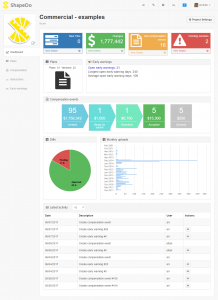
Dispute avoidance and resolution

ShapeDo DashboardWe discussed how the system can be used by either individual businesses or by project teams sharing information. Often, ShapeDo has first been used to help adversarially-oriented firms resolve a dispute. The sequence of production of design information – and any associated changes – can be quickly established, helping identify who did what and when, and what the impacts were on contracts and budgets, to provide evidence to support a claim or explain a delay. Once customers realise the power of such an audit trail, Isaacs said they often look to implement the system on future projects across teams and so encourage more timely identification of issues before they escalate into disputes (we debated the extent to which supply chain adoption of collaborative working and ‘expert clients’ would influence how the application is used).
Service provision

The ShapeDo SaaS product is normally licensed to a customer on a per-project basis, with no limit on the number of users or the amount of drawing uploads, etc. For a project in the £20m-£200m range, Isaacs said the annual fee would be £25,000 including initial implementation and creation of customer-specific forms, security provision, training and support. Enterprise deals can also be negotiated.

Hosting is provided via Microsoft Azure cloud facilities, and ShapeDo is expanding the locations where its servers are located. For sensitive projects, on-premise hosting can also be provided at extra cost, and the company also offers premium services to help customers engaged in litigation review the drawings and other documents involved.

I asked about support for BIM (in 2013 the company offered a service for sharing 3D objects); Isaacs said they had since (c. 2015) taken a strategic decision to focus on the 2D construction market: “For most project managers, their practical needs are focused on 2D information and supporting documentation.” The UK may be pushing forward with BIM (some momentum seems to have been lost since the passing of the government’s Level 2 deadline in April 2016, though NBS’s 2017 National BIM Report suggests progress continues), but most of UK projects are still reliant upon 2D drawings, especially on-site. “We will move forward with BIM when this becomes a market requirement,” Isaacs said.

My view

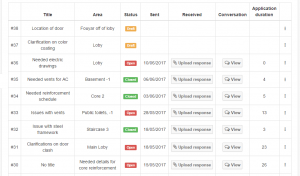
Early Warnings DashboardWhile our BIM conversation suggests that ShapeDo is not setting out to compete direct with vendors of ‘common data environments’ (CDEs), ShapeDo’s application bears comparison with other ‘project extranet’ platforms – most of which also have good process management tools. Its design change identification technologies and related notification processes seem particularly applicable, even complementary to, contract change solutions. Isaacs mentioned UK vendor CEMAR, formerly CMToolkit, which specialises in NEC3 contract event reporting; in a busy battlefield, other vendors include Sypro and MPS, the two [now expired] NEC-licensed content providers Viewpoint For Projects and Conject (now merged with Aconex), plus Asite, GroupBC/Business Collaborator and Oracle’s Primavera Unifier.

ShapeDo also faces something of a marketing dilemma. Should it position itself as a platform to help traditional contractors (or their claims consultants) retrospectively substantiate claims, or is it a platform that can help contractors demonstrate a more collaborative ongoing approach with their clients and suppliers to avoid claims in the first place? Or both? Most of ShapeDo’s customers to date have been contractors; if the platform was mandated from the outset by an informed owner/operator then it might be effective in preventing later nasty surprises – this might appeal to some contractors but dismay (more adversarial) others.

Almost as soon as I saw the drawing differencing capability, I asked if this was something that might be licensed to other technology providers. The drawing overlay functions in existing applications are fine when working with successive versions of existing drawings, but of little value when dealing with images that may have been uploaded from different sources, in different orientations, scales and resolutions. Vendors looking to improve the functionality of their viewing tools might be interested in incorporating ShapeDo’s core technology into their own platforms.

Permanent link to this article: http://extranetevolution.com/2017/06/shapedo-design-change-management/

FieldLens acquired by WeWork

Mobile construction collaboration developer Fieldlens has been acquired by WeWork, the New York-based provider of shared office and co-working space.

New York, US-based mobile construction management application developer Fieldlens has been acquired (for an undisclosed amount) by one of its customers: WeWork, also New York-based and a provider of shared office and co-working space.

Fieldlens logoFounded by Doug Chambers (raising over $1 million in startup funding) and Matt Sena, Fieldlens launched the Beta service of its mobile construction collaboration service – once dubbed the “Facebook of Construction” – in late 2013. Then I was particularly interested in its shift from the industry norm of email-type communication processes to mobile-friendly short-form status updates and messaging feeds (Should construction dump email?). Fieldlens formally launched in March 2014, and two months later closed an US$8m funding round. The Fieldlens app is available on both Apple iOS and Android platforms; the platform is priced at US$15/user/month.

Founded in 2010, WeWork designs and builds spaces where individuals and businesses can share space and office services and collaborate. It has locations in 19 United States cities and 12 countries including Australia, Canada, India, China, Hong Kong, France, the UK, Israel, South Korea, Mexico, Netherlands and Germany. In 2015, WeWork acquired BIM technology consultancy Case (read Wanda Lau’s piece for ARCHITECT), for an undisclosed amount.

Deal logic

In a blog post, WeWork chief product officer (and Case co-founder) David Fano explains the rationale behind the move, saying the company is opening 5 to 10 locations every month, becoming one of the world’s largest consumers of design and construction services, and recognising the importance of information in efficient building processes:

“WeWork is in a unique position as one of the only true end-to-end solutions that is involved in every phase of a building’s life cycle — from identifying, leasing, and designing to building and managing.

Our vision for the built environment is to develop a fully integrated solution where we source, design, build, and operate space for every one of our members.

With that in mind, … WeWork has agreed to acquire Fieldlens, one of the building industry’s leading project management applications. Fieldlens is six years into their mission of streamlining construction by empowering users with effective on-site communication.

WeWork is actually already one of Fieldlens’ biggest customers. As an early adopter, our product and construction teams have seen first-hand what connected front-line teams can accomplish and we could not be more excited about the future together.

With the Fieldlens team now part of our Product and Construction team at WeWork, we want to innovate on every aspect of our building process and break the silos within the industry to ensure clear communication and a free and easy exchange of information at every stage.

Fieldlens founder Chambers has also penned a blog post, and makes it clear that Fieldlens will retain its own identity:

“… we’ll be working together to create a new paradigm for the construction, management and operation of physical space. …

Construction, and the built environment as a whole, is a critical component to our economy and overall well-being. It is time for our industry to rise up and lead all of us forward, and together with WeWork we are going to do exactly that.

The Fieldlens application will continue to be offered as a stand-alone construction communication product and we will continue to iterate and innovate. As part of WeWork we’ll have more resources to continue to focus on our goal of making the work-lives of construction professionals more efficient.


Permanent link to this article: http://extranetevolution.com/2017/06/fieldlens-acquired-by-wework/

June 2017 collaboration news

International developments in mobile and web collaboration technologies for the architecture, engineering and construction sector… from PetroBIM, BIMSync, BaseStone and Bridgit….

PetroBIM helps on heritage

Petrobim logoLaunched three years ago in Oviedo, northern Spain, PetroBIM is a digital tool focused on historical heritage conservation projects and master plans. Despite its name, it is nothing to do with the oil/gas sector; it takes its name from petrology (Wikipedia definition here): “the branch of geology that studies the origin, composition, distribution and structure of rocks”. It addresses the life cycle of a historical building’s management (graphic documentation, analysis, design, planning, control, intervention and maintenance) using a database linked to 3D models and a viewer specifically designed for this application. According to an email I received:

“… it is possible to convert traditional cultural heritage master plans and restoration projects in a unique and lively 4D model in which an information system is implemented, allowing users to walk, navigate and interact with the building, create virtual sections, update information, generate filters for graphical and numerical queries of as many elements as there are in the model, as well as to generate searches for information.”

I am hoping to get a more detailed briefing on PetroBIM shortly. In the meantime, most of the resources I have been able to find online about PetroBIM (like the YouTube video below) are in Spanish, but it clearly aims to provide a visualisation tool for architects, archaeologists, historians, restorers and others involved in heritage projects – with the base data about the structure and stonework presumably captured using laser-scanning and/or photogrammetry techniques. In English, there is a blog post about PetroBIM on VisualARQ’s website, which describes how the solution can be used to view models imported in .3dm, .dwg or .ifc. A similar platform is apparently also being developed, focused on landscape models.

Update (8 June 2017) – In the UK, the North West BIM Region is holding an event on BIM for Heritage in Manchester on Tuesday 4 July – Register here.

BIMSync by Catenda

bimsync logoOslo, Norway-based Catenda are Open BIM devotees who have developed a BIM Collaboration tool called BIMSync.

A spin-off from SINTEF Building and Infrastructure, where its employees where responsible for research on buildingSMART, building process and knowledge system development, Catenda was established in 2009 to “give the AEC-Industry a simpler life and better products by connecting knowledge, processes and people, through the use of technology.” It is involved with buildingSMART both nationally and internationally and takes an active part in the development of IFC, IFD, IDM and BCF standards.

Built on these same buildingSMART standards while also supporting COBie, BIMSync lets users share, visualise and collaborate on BIM models, issues, documents and drawings in a standard web browser, without plugins or other installations. A hosted online service it allows stakeholders to collaborate, with issue management and secure digital data management features. What particularly stands out also is the company’s commitment to APIs, making it easy to embed and access BIM data from other software tools. BIMSync APIs enable 2D and 3D visualisation, issue handling using the standard BCF API and access to all BIM data through an intuitive REST API.

Basestone updates

BasestoneLondon, UK-based application provider BaseStone is continuing to develop its web and (iOS-only) mobile product set, adding new reporting features designed to reduce the administrative burden by letting users generate bespoke reports in one click. New features include time-stamped photos on reports, options to include or exclude items in reports (including attachments, comments, callouts, photos and signatures), and options to select issues across multiple drawings in reports (read the BaseStone blog for more on this).

Bridgit embraces Android

Bridgit logoTalking about mobile operating systems, Viewpoint recently announced (post) that its Field View application is now available on iOS and Windows devices as well as the Android platform upon which, as PriorityOne, it was originally developed. Expanding beyond a single platform is also the name of the game for Ontario, Canada-based Bridgit, whose Bridgit Closeout software was – like BaseStone’s – previously only available on iOS devices and the web.

Bridgit Closeout is now available as an Android app, allowing main contractors to automatically track and communicate tasks with their entire team, including subcontractors. Android users who previously used Bridgit’s web application will now be able to create and view photos and photo markups, have real-time access to task lists, and send updates from anywhere. Co-founder Lauren Lake says:

Lauren Lake - Bridgit“Bridgit was created to fill the gaps in communication on site. Bridgit’s tracking process saves time and money by automatically updating construction teams about tasks and deficiencies. Using an Android device shouldn’t be a barrier to this process—and now it isn’t. We’re delivering the same experience across iOS and Android, so everyone receives the same information, and the entire site is on the same page.”


Permanent link to this article: http://extranetevolution.com/2017/06/june-2017-collaboration-news/

CIAT backs DesigningBuildings wiki

DesigningBuildingsAs a long-time Wikipedian, I have contributed often to the English Wikipedia’s coverage of architecture, engineering and construction subjects, and have also taken an active interest in the UK-based Designing Buildings Wiki (launched in late 2012; read my post). Since then, it has grown, and now hosts over 5,000 articles (including a guide to BIMpost), attracting some three million users a year.

As a wiki, it is – like Wikipedia – “open access”, meaning anyone in the industry can edit and improve the wiki, the BIM guide or other articles. There are articles, for example, on project extranets, common data environments (CDE), and BIM collaboration Format (BCF).

The UK’s Chartered Institute of Architectural Technologists (CIAT) has just become the latest sponsor of Designing Buildings Wiki. A news release says the relationship will help bridge the gap between theory and practice, adding the practical knowledge of architectural technologists to the property, design and construction professionals already supporting the site. CIAT will be publishing key resources on Designing Buildings Wiki and will encourage its members to become contributors to the ever-growing resource.

Existing sponsors include the Institution of Civil Engineers, the Chartered Institute of Building, BRE, BSRIA, the Institute of Historic Buildings Conservation, Rogers Stirk Harbour + Partners, and U and I Group PLC.


Permanent link to this article: http://extranetevolution.com/2017/06/ciat-backs-designingbuildings-wiki/

Load more