If you have visited this blog recently, you my have noticed a lack of updates. Due to pressure of other work, I was struggling to write regular posts. And a growing voluntary commitment to the …
Former UK BIM Task Group head Mark Bew, also co-founder of the PCSG consultancy business acquired by Bentley Systems in 2020, has stepped down as CEO of Bentley’s Cohesive group. The opening day of Bentley …
At an in-person London event, UK-based collaboration technology Revizto gave insights on efficiently implementing technologies. Today, Extranet Evolution is at the Institution of Civil Engineers in London, attending a briefing to learn more about Revizto, …
Thanks to mobile apps such as Buildiro, Skrap and now TeekIt, London streets are increasingly busy with deliveries of equipment and materials to construction sites, large and small. In late 2020, amid the COVID-19 pandemic, …
UK Government is aiming to make open, standardised data drive an improved local plans system. Legislation will ensure data is delivered in consistent formats, and make some data publicly available and reusable. In June, I …
Keep taking the tablets… more and more construction-oriented apps are being delivered on mobile devices.
Last month, I wrote about SaaS specialist KyKloud and how it had extended beyond its initial focus on asset management to provide some powerful iPad-based mobile survey functionality. It’s not the only vendor looking at this market. In the past week alone, I have been in contact with two more, both from across the Irish Sea: Dublin, Ireland-based SmartBuilder1 and the more recently launched and Belfast, Northern Ireland-based GoReport. Both have cloud-hosted browser-based interfaces and mobile applications for capturing and managing data in the field and sharing it with team members online.
SmartBuilder1
Peter Daly’s business has just announced an upgrade of its flagship product, mainly used for snagging or defects management, which allows it to be used in facilities management and surveys. For example, the Android-based app (available only direct from SmartBuilder, not on Play Store) can be used to record assets or the completion and acceptance of a series of tasks, which can then be used by other in reactive or preventative maintenance. Photographs, comments, marked-up drawings and now ‘voice to text’ information can all be captured.
The SmartBuilder1 user interface has also been improved to incorporate the ‘voice to text’ capability, an image gallery on the data entry screen, the ability to mark up multiple drawings for each accepted item or defect, and inclusion of audio files.
GoReport
As a professional mechanical engineer undertaking numerous condition surveys, Conor Moran wanted an application that would neatly combine photographs with notes dictated during a visit to a site or facility and then quickly output a professionally presented report. Conventional tools and note-taking often meant a laborious half-day or more spent writing up a report, but he figured much of the digital manipulation of information could be managed more efficiently online. Smartphones and tablets were quickly identified as the ideal platform to complement a web-based system, and, after two rounds of fund-raising, Conor developed the application to the point he could devote himself full-time to the business, which was officially launched in the UK at a Building magazine-hosted event in November 2012 (article: The future of site reporting).
Its main purpose, Conor says, is to accelerate writing and production of qualitative reports (he sees a distinction between “high-quality report writing” and what he describes as the more quantitative asset management-oriented approach of Kykloud).
Companies can create standard templates (which also function as checklists) for their surveys and reports, and then their employees can use iPad functionality to capture information on-site. The GoReport service includes a voice transcription service which takes the engineer or surveyor’s verbal notes and turns them into text; this can be incorporated alongside manually entered text, photographs and sketches created on the iPad. Formatted reports, complete with covers, contents pages, appendices, and ISO quality checks, can be downloaded in Word or PDF format; tables can be separately exported to Excel, while data remains securely stored and backed-up in the cloud (GoReport uses UK-based servers provided by Rackspace). Early users have reported time savings of up to 70% in compiling reports, and as well as major consulting firms, he sees real opportunities for time-pressed SMEs looking to deliver a faster service to their customers.
Mobile Scorecard
While I was drafting this blogpost, I also tweeted an appeal for information about any useful construction apps on Android, and was followed by Milton Keynes, UK-based Business Net Solutions Ltd who offer an Android product called Mobile Scorecard. This provides audit and survey tools for any business whose work involves visiting remote client sites and gathering data, with tools covering hotel inspections, occupational health and safety, warehouse inspections, jobsite safety and electrical safety audits.
… And there’s more…
With other applications such as SnagR (post), Snag List (post), and Dome Consulting‘s iSnag (post), plus integrated complementary offerings from several of the main SaaS construction collaboration vendors (eg: Aconex; post) and on-premise providers (eg: Newforma; post), also out there, this is developing into a very competitive space. And it may not just be about Apple or Android; I met Newforma’s Dan Conery, VP of Construction Solutions, last week in London and he talked about the significant interest customers were showing in Microsoft’s Windows 8 Surface tablets.
SaaS platform Business Collaborator is a key component in Unit4’s strategy to integrate its business software with BIM, using linked data to manage asset-related processes.
I attended the Unit4 user 2013 user conference at the ICC in Birmingham last week, ostensibly to join the sessions devoted to its SaaS collaboration solution Business Collaborator, but – like last year – I also got a wider sense of how BC fitted into the bigger Unit4 picture.
The opening plenary session helped set the scene, with customer videos featuring Thames Water’s Paul Meredith talking about the utility company’s use of BC Assure (post), while Anwen Robinson, UK MD of Unit4 Business Software, underlined the growing importance of Software-as-a-Service and subscription models to the group, and suggested that other Unit4 system (Aggresso, Coda, etc) users might also benefit from adopting BC to manage documents and quality assurance projects. She also, again, mentioned building information modelling – an area where BC people are leading Unit4’s development plans.
BC v6.1
The conference was also the formal launch of BC v6.1 (post). Product manager Paul Houghton led a workshop showcasing the new features added to the platform in late 2012, and now available to BC customers:
Improved user interface – The interface has been refined in BC 6.1 to optimise use of vertical space so that users can see more documents at once, and can quickly find items they recently accessed.
Integration with Google Search Appliance – allows BC users whose organisations have deployed this Google device for document indexing to do familiar Google searches of content within their businesses
Web services – Back-office systems can be integrated with Business Collaborator via an OAuth and REST API. Paul highlighted that users could, for instance create a collaboration area that would be accessible from their ERP system (not just Agresso, but any system) – an interesting echo of my conversation the previous day with 4Projects and Viewpoint (post).
Document renditions – Given that some documents and drawings can be saved in different file formats (Word and PDF; DWG, DWG and PDF, etc), Business Collaborator now allows users to create bundles which link the primary document to all its derivatives.
QR codes – Machine-readable quick response codes can be generated and embedded into documents and drawings, and also printed as labels for attachment to physical assets for FM purposes. Paul showed how an asset’s scanned QR code could link to the relevant document; users are initially presented with a window showing the associated document(s), their type and file size (useful if the end-user needs to download over limited bandwidth), and a visual indication of their status. The notification would show a thick green border if the document was the latest version, a red border if it was an old version, and BC technical director Steve Crompton explained there was also an amber border for items that might be subject to changes associated with ongoing workflows.
Taxonomies – BC users can tag documents with hierarchical, ‘tree-based’ metadata (the tree structures can also be easily edited, eg in Excel, and then imported into BC), simplifying categorisation and improving document search and retrieval efficiency.
The BC 2013 Roadmap
Paul also presented the roadmap for the next two versions of Business Collaborator:
v6.2 will include advanced forms and improved workflow (including multi-step branching workflows); improved integration with Sypro‘s contract management solution (Sypro CEO Simon Hunt later did a 15-minute workshop on contract change management); and further interface improvements including multiple language support. This version is likely to be released in the second quarter of 2013.
v6.3 (if it’s called that) will include Dropbox-style sharing including offline synchronisation of folders; improvements to metadata editing and workflow reporting tools; and enabling scanned documents to be turned into searchable text. This version is likely to appear towards the end of 2013.
The Business Collaborator product management team is also echoing other Unit4 solutions (eg: Agresso) in establishing an ‘Ideas’ page. Users were invited to submit ideas for improving BC, which could then be discussed and voted upon by other users, helping guide the company’s product development (similar to Asite‘s crowd-sourcing of ideas from its community in 2009). This is “coming soon”, apparently.
The future: BIM and linked data
The conference gave me chance to talk to some BC users, including a retail customer (post to follow) and also to Sanjeev Shah, formerly MD of the Business Collaborator business and now innovation director for Unit4 Business Software. He is taking some of the Software-as-a-Service expertise from BC and extending its reach within Unit4, so that the BC platform becomes the main document management/control system. In addition, the BC Assure system is already being deployed for quality assurance purposes to manage implementation of Unit4 Agresso systems, and BC’s Rick Cooper and Steve Crompton are driving development of Unit4’s building information modelling (BIM) capabilities.
Sanj said there was a “massive focus on BIM” within Unit4, particularly as the business looks beyond the UK government’s 2016 target of ‘level 2’ BIM adoption. ‘Level 3’ adoption would potentially enable a significant tie-in with Unit4 ERP and financial applications, he said, with Unit4 Business Analytics also being used to report on data, FieldForce enabling mobile management of BIM data out in the field, and potential to manage procurement processes driven by BIM data. In fact, “data” was perhaps the most over-used word in our conversation; Unit4 is developing its capabilities in respect of linked data, considering how it can use the RDF format to connect different data (including a proposed national asset database) and power new transaction processes (this concept also featured in the future-gazing section of a later presentation by HM Govt BIM Working Group chair Mark Bew).
BC BIM roadmap
In parallel with the core BC platform roadmap, there is also a BC BIM module roadmap, again with two phases to its 2013 programme aimed at helping customers achieve ‘level 2’ with BC as the common data environment. Rick Cooper said the first phase would focus on data collation and validation, including import, validation and export of COBie files, with desktop visualisation using a WebGL-based interface. The second phase extends to data coordination and collaboration, looking at how BC can be used to securely manage and version-control ‘federated’ models, at managing workflow including using model snapshots and markup, then mobile visualisation, and also reporting tools. Steve Crompton also highlighted the use of linked data, talking about the platform adopting semantic web principles to deliver information.
My view
Since my first Unit4/Business Collaborator user conference a year ago, the BC team has developed a more detailed picture of how BIM fits into its product roadmap, both at the level of the core BC product and for integration with other Unit4 software platforms, and there is a strong corporate will to deliver this through the cloud. Unit4 has been an active participant in the UK BIM Task Group’s BIM Technologies Alliance (I understand from a conversation with CIRIA’s Bill Healey that collaboration competitors Conject, 4Projects and Causeway are also involved as are software authoring tool providers such as Autodesk and Bentley, who also provide collaboration tools), but – with the exception of 4Projects – it appears more ready to embrace open standards and to look at the wider integration opportunities, including ERP.
I was struck by the similarity of conversations I had with 4Projects and with Unit4, though the former are more focused on the opportunity within the AEC vertical, while the latter sees a wider picture embracing its numerous public sector customers. Both are well-advanced with their plans, have clear roadmaps to describe to their customers and prospects (while some of their rivals’ BIM strategies are less well defined), and appear keen to help set technology standards to support BIM-related collaboration up to ‘level 2’ and, importantly, beyond.
[Disclosure: my expenses to attend the Unit4 conference were paid by the organisers.]
Under Viewpoint ownership, UK construction SaaS collaboration vendor 4Projects is already recruiting to expand, and has strong BIM credentials to take to new markets.
I was recently invited to visit the Sunderland, UK office of construction collaboration technology provider 4Projects to meet both existing contacts within the company and representatives of its parent company, Viewpoint Construction Software. Viewpoint began looking at the collaboration market over a year ago, and acquired 4Projects last month, so this was an ideal opportunity to learn more about the company and its aspirations for its new venture. It was also an opportunity to get an update on 4Projects’ 4BIM developments.
Viewpoint eyeing international ERP and collaboration markets
Giving an overview of Coaxis and Viewpoint, Matt Harris, Sr, VP Strategy & Corporate Development, described the depth of experience among the senior management of the Portland-based company, which includes executives with backgrounds in companies such as IBM, General Electric, Xerox and Sage, and others who have worked at Viewpoint for over 30 years. The group now employs over 400, and is growing at around 50% per annum, and, according to Matt, prides itself on providing a stimulating culture for all employees, while remaining focused on its construction industry software specialism.
In recent years it has extended its capabilities beyond financial software (ERP), acquiring complementary content management and mobile solutions providers and then 4Projects, with targets carefully chosen not just for their ‘fit’ and functionality but also with an eye to their rapid integration with sister applications to maximise the opportunities for providing integrated solutions for contractors and cross-selling other portfolio solutions.
Viewpoint operates mainly in North America and Australasia, so the 4Projects acquisition has given it an additional footprint in the UK, mainland Europe, Middle East. Viewpoint is already investing in expanding 4Projects, with the UK software development team first to benefit (the company’s vacancies page currently lists five .Net web developer posts, a systems administrator, plus marketing and business development roles), though it will also be expanding its US team, and establishing a north America data centre – as it looks to capitalise upon Viewpoint’s growing reach, now 14%, into the ENR600 top contractors in the US (I was shown a graph of recent ERP wins in the US, underlining Viewpoint’s success in winning customers away from rivals such as Sage).
Matt (right) told me about the extensive research the company had undertaken among its ERP user base during 2012. Starting with its main user conference (a four-day event attracting well over 800 attendees the majority of whom were customers and users of Viewpoint software) and including a series of focus groups, Viewpoint had explored contractors’ collaboration requirements, which helped it identify that 4Projects was the ideal acquisition for a largely still untapped US market. Over the next year or so, Viewpoint will be promoting 4Projects (locally backed by dedicated sales, marketing, professional services and support staff) to its existing customers as well as offering it as part of its solutions portfolio to prospective customers.
Looking slightly further into the future, Viewpoint may use 4Projects’ footprint in the UK, Europe and the Middle East to market its construction software solutions to contractors in these regions. By 2017 the company’s CEO, Jay Haladay, has a vision to become a global company with over 700 employees serving some 15,000 customers.
4BIM
At Ecobuild last year, 4Projects’ CTO Andy Ward showed me a prototype of the company’s BIM viewer. With the UK construction industry moving inexorably towards adoption of building information modelling for all public sector projects (and, more than likely, a significant proportion of private sector projects), there has been growing interest in how collaboration platforms might provide the common data environment, CDE, required to support the UK government’s ‘Level 2’ BIM requirement. There are a profusion of BIM-related solutions on the market, but few of them provide easy access to detailed BIM data via a standard web-browser.
Introducing the latest iteration of 4BIM (post; the project is now half-way through its two-year duration), Andy loosely segmented the BIM solutions market into five broad and sometimes overlapping areas:
design authoring tools
model viewing and coordination tools
model serving applications
IFC and COBie services and tools
asset and facilities management tools
4Projects BIM strategy is to complement design authoring tools and place model server applications at the heart of collaboration, using open standards-based tools to enable controlled openness and transparency of model viewing, etc, in a web browser, without the need for plugins or additional software – in short, what I once dubbed BIM-as-a-Service (2008 BIMaaS post).
We discussed different model viewing tools (eg: Tekla BIMsight, Jotne, Asite’s cBIM, the now-defunct Octaga), most of which rely on installing software locally, or using ActiveX controls, and Andy highlighted the inputs they had received from the BIM “hotbed” of north-east England. Its partners in the TSB-funded 4BIM project include Northumbria University, home to the BIM Academy, and promoters of the open xBIM toolkit (I saw Northumbria’s Professor Steve Lockley mention xBIM during a BIM presentation at Ecobuild last week). Having spent a year working with xBIM, 4Projects has a strong understanding of its capabilities and has integrated it into its model serving environment.
Andy demonstrated live exploration of a 41MB model file in a browser window, flying through the building, stripping out elements to show different views of the building’s components, and then inviting another team member to share the same view in real-time, with COBie data also readily displayed and updateable via the model view, via a database table, or via ‘tree’ navigation, with any changes immediately echoed in the other views (“tri-directional”). Andy highlighted they could work with much larger models than this, and were developing strategies for handling even the very largest models. He also showed off collaborative communication around a model, where a user could send RFIs or Change Orders to another team member, with links to the components in the model. 4Projects is also developing various model query and reporting tools, plugins for design tool, as well as looking at delta “diff file” model updating, and planning further integrations with FM and estate management tools. It was an impressive demonstration of pure web-based BIM collaboration, quite the most powerful I’ve seen.
Update (14.30pm, 18 March 2013) – just seen that 4Projects has been shortlisted as a finalist in the BIM Initiative of the Year category of the 2013 Construction News Awards.
4Projects recent enhancements and key features
The company’s BIM push was one of the things that attracted Viewpoint, and it has also proved attractive to customers for its core collaboration system. Even though it is still at the development stage, I understand that customers are reassured that 4Projects has a strong BIM roadmap which encourages them, in the meantime, to adopt the SaaS platform for conventional collaboration purposes. However, this does not mean that the core system has not also been improved. Sales director Steve Spark quickly cantered through some of the recent enhancements and key 4Projects features:
Single log-in – for example, a subcontractor working on numerous client projects, can log-in to 4Projects and immediately view all notifications relevant to him across all projects.
4Projects widgets – home page can be configured with widgets to display, for example, a summary view and boxes displaying specific types of content notifications (eg: RFIs)
User interface – a document management user-interface that in places strongly resembles Windows Explorer, with the ability to create containers for specific types of content, including receipt of email (so information and attachments can be emailed to 4Projects and directed immediately to that container). Steve also described the platform’s use ‘virtual containers’ to help compile health and safety and operation and maintenance manuals
Strong workflow controls – 4Projects includes a simple-to-use workflow creation tool which can be used to configure and customise task processes (eg: RFIs, architects’ instructions, site instructions, technical queries, etc), including – and bearing in mind future potential Viewpoint integration – nodes that might link to ERP systems.
Discussion
During the meeting and over dinner and a few drinks later, I learned more about Viewpoint, its culture and people and we discussed the potential synergies between its core ERP business and its collaboration business. Inevitably, we also talked about various competitors, their relative strengths and weaknesses and why nobody yet dominates the construction SaaS collaboration sector. Matt and his team had analysed the potential collaboration market in the US (including data from Construction Financial Management Association, CFMA IT surveys) and identified it as a real opportunity. The lack of a dominant global player, however, is not just a characteristic of the collaboration space, it is common to most, if not all, construction software disciplines, and we debated some of the reasons for this (fragmented customer bases, strongly localised or silo solutions, status quo marketing strategies, etc).
Construction document collaboration has become a commoditised product; there are numerous products on the market and the barriers to entry are relatively low. In recent years, some vendors have begun to add new functionality – Conject‘s project cost control is a good example – that was difficult for others to quickly emulate and which differentiated them from competitors, but the ‘killer’ app has yet to emerge. However, the combination of pure web-based collaboration with leading-edge BIM functionality, plus ERP, could be a game-changer, particularly for businesses focused on the construction delivery cycle (alternative strategies include lifecycle management to support post-construction asset management). ERP systems generally require a more long-term investment for construction businesses than project-focused solutions, and an integrated collaboration capability could lock more customers into its long-term adoption and use. At the same time, of course, 4Projects is also an increasingly powerful and flexible platform in its own right.
The Viewpoint/4Projects relationship is officially only about 5 weeks old but the early signs are promising. The parent company has set about building a portfolio of complementary solutions (its M&A activities may not yet be finished) so that it can offer an integrated portfolio of services that meet a wider set of customer needs and which require different software architectures. 4Projects boosts its SaaS credentials – attractive to investors, currently – and builds its understanding of end-users’ BIM needs. BIM adoption will, almost inevitably, result in greater sharing of scheduling and cost data during construction delivery, so the ability to exchange data between project environments and corporate back-office finance systems will be attractive to customers.
[Disclosure: 4Projects paid my travel and accommodation expenses to meet with the team.]
After disposing of its US FM operations, Bricsnet is focused on project collaboration and will be consolidating its growing business under the ProjectCenter brand.
I was recently asked: “Whatever happened with Bricsnet?” As the question came from a former investor in the European SaaS construction collaboration pioneer, it was a little surprising.
The Bricsnet back story
Bricsnet was a solution offered by BricsWorks (founded in 1986 by architect Erik De Keyser) which began providing web-based software to manage design and construction processes in the late 1990s, notably, a solution called ProjectCenter (not to be confused with the Australian SaaS collaboration business, ProjectCentre, acquired by RIB Software in October 2012; post). Bricsnet was spun off as a separate company in 2002 – though De Keyser has since continued his involvement with SaaS-based collaboration through BricsCAD/Bricsys/Vondle/Chapoo (2007 post, 2012 post).
Bricsnet eventually became a subsidiary of the Madrid-based Torimbia group (2010 post), being careful to distance itself from an embezzlement case that resulted in a former CEO Ethan Farid Jinian being jailed for 64 months and fined $1.5m in October 2011 (post). It repeatedly sought investment, with a $10m investment round in January 2011 bringing the total invested in the company to around $65m (post).
2012 corporate changes
So let’s get more up-to-date and fill the gaps….
In July 2012, real estate software competitor Manhattan Softwareannounced its acquisition of Bricsnet FM America and its BuildingCenter solution. Craig Gillespie, CEO of Manhattan Software Americas, said “We welcome Bricsnet clients into the Manhattan global family and look forward to introducing them to our entire range of technology solutions”. The Manhattan news release continued: “key team members from Bricsnet will be brought into Manhattan Software to provide continuity and expertise,” and former Bricsnet CEO, David Karpook was one of those who moved to Manhattan Software (release).
Almost simultaneously, ProjectCenter LLC, a US-based entity, announced “its evolution from a business unit to an independent company”:
“ProjectCenter, a profitable unit of the Bricsnet FM has become an independent corporation fully owned by its long-lasting investor which has overseen the product and customer base growth for the last 12 years. The investment group with interests in Real Estate, energy distribution and technology sectors, with large multinational companies among its customers and partners, has assumed full control of this leading online collaboration solution used by thousands of companies around the world, following its strategy of investing in innovative and high growth potential businesses.”
I contacted Cristina Niculescu, Madrid-based managing director at ProjectCenter-Bricsnet, to clarify the details of these transactions and she confirmed the change of ownership of the BuildingCenter business. In 2010, the company had been targeting the US market with a product described as an Integrated Workplace Management System (IWMS), but it did not achieve the anticipated levels of adoption against competition from strong and less expensive point solutions, while the term ‘IWMS’ did not have the same recognition as facility management (FM) applications, Cristina told me. As a result, the owners let the BuildingCenter IWMS business go to Manhattan, and the associated US business (Bricsnet FM Inc) was subsequently liquidated.
Consolidating ProjectCenter
ProjectCenter LLC is a wholly owned US subsidiary of Torimbia, and mainly delivers the project collaboration product ProjectCenter in north America. The Bricsnet name is currently retained in Europe, with Madrid-based Bricsnet Iberia continuing to support ProjectCenter in Europe, south America and north Africa. However, Cristina said the Bricsnet name will eventually be dropped in favour of consistent use of the ProjectCenter brand across all operations.
Meanwhile, focused on project collaboration, ProjectCenter has weathered the global financial crisis and expanded its international reach. Cristina said:
“ProjectCenter has managed to grow in the last years despite the economic problems in Spain and other parts of Europe. One of the positive part of this crisis is that it pushed Spanish companies abroad, mainly to South America but also, to a lesser extent, North America. … Companies were opening offices and handling projects with team members scattered among different countries and continents and they were really forced to embrace collaboration. ProjectCenter is currently used in projects across 40 countries.”
“We noticed an increased interest in industrial and water treatment plants as well as infrastructure, which makes a lot of sense in emerging economies.”
Current clients include the retailer IKEA Iberia, petrol service station company Cepsa, and Petroleos de Venezuela. Power and industrial process plants and infrastructure projects are being undertaken in US, Canada, Colombia, Argentina, Venezuela, Panama, Guatemala, Brasil, Peru, Mexico, Bangladesh, Oman, Israel, Morocco, Algeria, Angola, Congo, Egypt, Ghana, Spain, Romania, Portugal, Italy and Armenia. Much of this international expansion has apparently been achieved through local partners, particularly in south America and Asia.
UNIT4 Business Software has today announced the launch of UNIT4 Business Collaborator (BC) 6.1, its web-based project collaboration software solution.
Key enhancements include:
a public API enabling the secure integration of third party software
provision of QR codes (for drawing version control, and for asset management)
the ability to link to different file types quickly and easily, and
support for taxonomy metadata fields which allows documents to be tagged with structured (hierarchical) metadata which improves categorisation, filing and retrieval of project information.
I am attending UNIT4’s user conference in Birmingham this week (post) to have a more detailed look at the new BC release, to talk to some end-users of the product, and get an update from company staff on other trends and developments with Business Collaborator.
I joined the thousands of built environment folk who travelled to London’s ExCEL for the three-day Ecobuild exhibition last week. As in previous years, it was a good opportunity to meet a few friends, gossip and get updated on key industry developments. I attended three sessions in the Better with BIM seminar room (one featured Ed Bartlett talking about BIM and FM from a KyKloud perspective; post) and also caught a few stand-based presentations, including ones at the RIBA Village and the Open BIM Network. Several of my former BIW colleagues were present on the latter, representing Conject, and I listened to UK MD Steve Cooper give a low-key Conject view on building information modelling.
Conject is clearly still developing its proposition for BIM, which is seen as integral to the next stage in the evolution of its Plan-Build-Operate application to reduce costs and carbon emissions. With other vendors – notably, but not only, 4Projects (post) – extending the boundaries of browser-based BIM viewing tools, Conject is looking beyond file-sharing, graphical documentation and COBie outputs, and stressing it’s about building information management.
Substantially more data is involved in BIM (“10-30 times as much”), and it needs to be more complete and fully interoperable if it is to help projects achieve the government target of Level 3 BIM adoption and support the operational phase of a built asset’s life-cycle, said Steve. Conject’s focus therefore appears to be on providing project control in real-time, offering an integrated view of time, cost, quality and carbon (nD) throughout the project. He stressed several times the need to manage workflows and to provide visibility of key management information, showing project dashboards with various graphs and information summaries for project leaders.
This was clearly a ‘helicopter view’ of where Conject is going with BIM. It is playing to its strengths in project cost control and project workflows, and is also pitching to client organisations who will need support for facilities management beyond handover (it is launching its SaaS-based FM platform in the UK towards the end of 2013; some Germany-based clients are already using it). I have been promised some further insights later this spring when the company plans to detail new services relating to BIM.
It seems I have been talking about facilities management a lot recently, but despite this I still managed to miss news that iSite‘s SaaS-based Assetology Hub, launched in October 2012 (post), won the ‘Commercial Services’ category at the annual i-FM Technology in FM Awards, presented recently. In winning the award, iSite MD Martin Ward said they:
“… showcased how Nationwide Building Society has used the Hub to underpin business change of its Property Services Division – the results have been transformational. It’s been something of a privilege to be part of such an industry leading initiative.”
Meanwhile, the deadlines for regional Constructing Excellence Awards are slipping by. Some closing dates have already passed, but if the project or business is in London or the south-east of England you still have time to enter the south-east England awards, which close on 11 March 2013. Regional winners go forward to contest the national awards, presented on 29 November in London.
[Disclosure: I am on the Constructing Excellence steering committee]
Athens, Greece-based company Intelen, which describes itself as “the leading start-up in building analytics and game mechanics applications for energy efficiency,” has sent me a news release regarding its participation at the forthcoming CeBIT exhibition in Hanover, Germany (5-9 March 2013). There it will be launching a building analytics product which is combined with a social engagement platform to involve the occupants of commercial buildings in a continuous social gamification process to save energy by changing their collective behaviour.
Using mobile apps to compete in energy-saving
Intelen’s platform collates building energy consumption data and makes it available to employee teams in real-time via their smart-phones. Adaptive smart mapping of building energy consumption is presented along with social profiles of people inside the building, who can then interact with system, responding to surveys and awareness tests and changing their energy use patterns to win rewards for energy-efficient behaviours. By creating friendly rivalry between different teams, Intelen hopes to encourage collective behavioural changes that optimise a building’s energy use.
The collation of building energy consumption data so that it can be made available to its users is nothing new. When I first met Pachube (now Cosm) founder Usman Haque some five years ago he talked about the power of data from the ‘internet of things’ to inform and change human behaviour, and other firms such as AMEE also talk about opening access to transparent, comparable environmental data to enhance business decision making, strengthen performance, and enable a more efficient and responsible use of environmental resources.
However, the addition of a social media gamification element may provide that vital additional stimulus to get individuals to adapt their activities, particularly if there is peer pressure to collaborate as part of a departmental or company team.
This could also move building owners beyond simple passive sharing of energy efficiency data – BREEAM or LEED credentials, for example (as shared by Honest Buildings; post) – and on to sharing real-time data regarding their energy consumption and their employees role in creating and delivering savings. It could be a very powerful demonstration of corporate social responsibility too.
Honest Buildings, launched in the UK today, may look like another business networking site, but this one puts the buildings themselves at the heart of its connections, with their sustainability open to scrutiny, and scope to integrate with other platforms.
Honest Buildings, a US-based property network that connects decision makers to service providers for millions of commercial buildings, is expanding into the UK, and, through a partnership with BRE Global, is displaying the environmental performance certifications of thousands of buildings that are certified under the BREEAM standard.
I first encountered Honest Buildings when its then sole UK representative Nick Katz spoke at the Be2Awards event I organised in London in September 2012. Since then, he has been busy marketing the platform to UK businesses; firms using the platform now include Aviva Investors, British Land, and Henderson Global Investors (among others; we’re talking 14.1 million square metres, or more than 9,500 commercial buildings).
Launched in New York in March 2012, superficially, it has similarities with social networks such as LinkedIn, but rather than linking individuals and companies, its main focus is on buildings. Planned, under construction or completed, buildings can have profiles created for them with which owners, consultants, contractors and other service providers can then associate themselves.
Over time, these profiles can be developed by the firms into online and app-based HB Portfolios of the work they’ve undertaken (echoing Woobius Showcase here; pwcom post). Equally, customers looking for consultants and other service providers for future projects can use Honest Buildings as a match-making service (HB Match) to source, qualify and select firms for their next schemes.
Mark Chadwick of London consultant Carbon Clear used HB Match to find an engineering firm for an energy efficient HVAC retrofit of a 10,000 square metre luxury hotel outside London:
“The speed and efficiency with which HB delivered was very impressive, providing qualified contacts with virtually no effort on our side. We expect to use the platform for rolling out this pilot and expanding to the rest of the hotel portfolio.”
Also, as part of today’s launch, BRE Global is, for the first time beyond its own website, sharing the BREEAM certifications of thousands of buildings online. Honest Buildings profiles will help users identify projects with good sustainability credentials, and also link to the firms that helped achieve the relevant BREEAM certifications. Large design firms such as Arup, WSP and Buro Happold already have profiles on the network, as do smaller specialists like Carbon Clear, and Carbon Saver UK whose MD Janet Becket says:
“The Honest Buildings Network is such a useful resource and so handy to display our portfolio of work. There’s the possibility to get discovered by all sorts of property decision makers, partners and others, as well as the unlimited upside of gaining new business from HB Match.”
The BRE Global partnership echoes similar relationships in the US, where Honest Buildings has worked with state governments to power their online platforms for building and energy efficiency initiatives. It powers a platform for New York State’s Build Smart NY initiative, which aims for a 20% reduction in energy use across 224 million sq ft of government-owned property by 2020. In London, Honest Buildings is based at the Open Data Institute in Shoreditch and collaboration there will allow Honest Buildings access to further data sets in the UK and beyond.
Collaboration and integration?
When I first heard about Honest Buildings I immediately thought there was an opportunity for re-use of information from the construction collaboration platforms used by project teams to plan, design, deliver and (sometimes) to operate and maintain built assets (and asset portfolios). Details about the supply chains involved are already stored in these mainly SaaS-based systems, along with thousands of documents, drawings, photographs and other files produced during project delivery. In my view it would involve a simple export/import process for data about a project to be re-used to populate a detailed building profile, and include links to all the relevant parties (perhaps even with peer review ratings and/or recommendation on their abilities).
Moreover, some of the certifications and associated documentation that might be used by Honest Buildings may already be stored in the system so retrieval of these for re-use will be straightforward. And where a platform is also used for operation and maintenance or facilities management purposes, then it could also be used to help share detailed information about energy performance or other metrics from Honest Buildings data partners (including perhaps asset management specialist KyKloud [post] – or ‘internet of things’ developers such as Cosm). This might also fit with the corporate social responsibility ambitions of some SaaS vendors (Conject, for example, has made a big carbon-neutrality pitch).
Relaunched in November 2012, the Ghent, Belgium cloud-based project information and collaboration platform Chapoo (formerly Vondle) will now be available to users of BricsCAD CAD software through an upcoming product release. Users will be able to open a .dwg file from a project on the Chapoo service, and to download and upload .dwg files from and to Chapoo (.dwg designs can be transparently stored on and accessed from the Chapoo service with or without dependent [xrefs, images, etc] files).
Claiming market leadership in BeNeLux, Chapoo was, until last year, a sister company of Bricsys, the developer of BricsCAD, so the relationship and integration is hardly surprising (it echoes past integration between, for example, AutoCAD and Autodesk’s collaboration platform Buzzsaw; third party SaaS vendors have also created plug-ins that enabled publication to their platforms from within AutoCAD and other CAD tools). However, Chapoo COO Mark Van Den Bergh clearly anticipates links to other software tools:
“Operating as a newly independent company, we are looking forward to establish similar technology relationships with other software vendors whose users can benefit from transparent access to our SaaS collaboration service.”
(The ‘divorce’ between Chapoo and Bricsys was clearly amicable. They now have totally separate development teams; finance and marketing still overlap, but will separate in due course.)
In Extranet Evolution, Paul Wilkinson covers the latest developments in SaaS, mobile, BIM, and other software technologies in construction. He also co-presents the #contech video news show AECTechTV.

 Peter Daly’s business has just announced an upgrade of its flagship product, mainly used for snagging or defects management, which allows it to be used in facilities management and surveys. For example, the Android-based app (available only direct from SmartBuilder, not on Play Store) can be used to record assets or the completion and acceptance of a series of tasks, which can then be used by other in reactive or preventative maintenance. Photographs, comments, marked-up drawings and now ‘voice to text’ information can all be captured.
 As a professional mechanical engineer undertaking numerous condition surveys, Conor Moran wanted an application that would neatly combine photographs with notes dictated during a visit to a site or facility and then quickly output a professionally presented report. Conventional tools and note-taking often meant a laborious half-day or more spent writing up a report, but he figured much of the digital manipulation of information could be managed more efficiently online. Smartphones and tablets were quickly identified as the ideal platform to complement a web-based system, and, after two rounds of fund-raising, Conor developed the application to the point he could devote himself full-time to the business, which was officially launched in the UK at a Building magazine-hosted event in November 2012 (article: The future of site reporting).
 While I was drafting this blogpost, I also tweeted an appeal for information about any useful construction apps on Android, and was followed by Milton Keynes, UK-based Business Net Solutions Ltd who offer an Android product called Mobile Scorecard. This provides audit and survey tools for any business whose work involves visiting remote client sites and gathering data, with tools covering hotel inspections, occupational health and safety, warehouse inspections, jobsite safety and electrical safety audits.
 The opening plenary session helped set the scene, with customer videos featuring Thames Water’s Paul Meredith talking about the utility company’s use of BC Assure (
 I was recently invited to visit the Sunderland, UK office of construction collaboration technology provider
  Giving an overview of Coaxis and Viewpoint, Matt Harris, Sr, VP Strategy & Corporate Development, described the depth of experience among the senior management of the Portland-based company, which includes executives with backgrounds in companies such as IBM, General Electric, Xerox and Sage, and others who have worked at Viewpoint for over 30 years. The group now employs over 400, and is growing at around 50% per annum, and, according to Matt, prides itself on providing a stimulating culture for all employees, while remaining focused on its construction industry software specialism.
 Matt (right) told me about the extensive research the company had undertaken among its ERP user base during 2012. Starting with its main user conference (a four-day event attracting well over 800 attendees the majority of whom were customers and users of Viewpoint software) and including a series of focus groups, Viewpoint had explored contractors’ collaboration requirements, which helped it identify that 4Projects was the ideal acquisition for a largely still untapped US market. Over the next year or so, Viewpoint will be promoting 4Projects (locally backed by dedicated sales, marketing, professional services and support staff) to its existing customers as well as offering it as part of its solutions portfolio to prospective customers.
 ProjectCenter LLC is a wholly owned US subsidiary of Torimbia, and mainly delivers the project collaboration product ProjectCenter in north America. The Bricsnet name is currently retained in Europe, with Madrid-based Bricsnet Iberia continuing to support ProjectCenter in Europe, south America and north Africa. However, Cristina said the Bricsnet name will eventually be dropped in favour of consistent use of the ProjectCenter brand across all operations.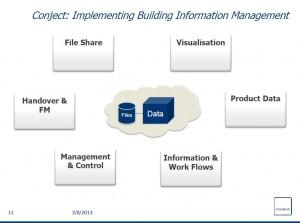
 It seems I have been talking about facilities management a lot recently, but despite this I still managed to miss news that


 Claiming market leadership in BeNeLux, Chapoo was, until last year, a sister company of