Hot on the heels of a €2m investment in Denmark’s GenieBelt, a US$5m investment in California’s eSUB shows enthusiasm for applications targeting the SME segment which dominates construction delivery.
In just about every construction market, most projects are reliant upon small and medium-sized businesses for project delivery; even if a bigger firm is the main or general contractor, a large proportion of the work packages will still be delivered by SME subcontractors – some of them self-employed individuals. With millions of such businesses participating in project delivery worldwide, and with accelerating adoption of mobile devices across most markets, this is therefore a potentially highly lucrative market for vendors of smartphone or tablet-based applications aimed specifically at construction SMEs. This is a market with many SMEs heavily reliant on manual methods (or on non-construction specific software (see this Software Advice analysis).
For example, I’ve looked at Denmark’s GenieBelt (which raised €2m in funding in September 2016 – post), Corecon and Jobsite Unite in the US, and Australia’s SmallBuilders in the past. And last month I talked about Australia’s TidyBuild and another US-based application: eSUB, which provides mobile and cloud-based project management and document control solutions for subcontractors.
 eSUB recently (20 December 2016) announced a US$5 million Series A investment from Revolution Ventures. The company was founded by industry veteran Wendy Rogers, now CEO, and Benny Baltrotsky, now chief strategy officer, and eSUB has been used by clients for major construction projects including the Facebook and Apple headquarters, the Moscone Convention Center in San Francisco, California, and the Freedom Tower in New York City. eSUB points out that subcontractors perform 99% of the work on large-scale construction projects and being able to accurately track their work in the field can make or break their profits. Rogers says:
“When changes occur in the field on construction projects, subcontractors often find themselves unable to accurately capture the work completed. They’re too busy doing the extra work to document it, but subcontractors don’t get paid for the work they do, they get paid for the work they document.”
eSUB says it solves this costly disconnect by implementing a cloud-based back-end solution that ties in with native applications and mobile devices in the field, giving personnel the ability to easily capture information on-site and share it in real-time with the back office for billing purposes and productivity tracking. They say using eSUB results in at least a 50% operational increase by replacing manual processes with automated workflows, and allows contractors to collect 100% on previously undocumented changes in the field.
Bobby Ocampo, Partner at Washington, DC-based Revolution Ventures, says:
“eSUB is revolutionizing the enormous subcontractor market that has yet to be adequately served by technology. We are excited to join industry experts Wendy, Benny, and their team to accelerate eSUB’s growth, which will benefit the subcontractor industry by helping them save time, increase profits, and reduce labor costs.”
eSUB’s Baltrotsky says:
“eSUB is designed for the hundreds of thousands of companies trapped with legacy solutions and inconsistent manual workflows, to make real business progress. eSUB is changing this reality for subcontractors in the U.S. and abroad.”
Since 2013, eSUB has grown its revenues by over 400%. eSUB plans to use the new funding to add over 40 team members, with a focus on hiring in sales, engineering, customer success, and marketing at its headquarters in San Diego, California.



 In May 2015, PAS1192-5 – “Specification for security-minded building information modelling, digital built environments and smart asset management” – became the latest addition to the suite of UK documents focused on building information modelling (BIM). Other documents – notably PAS1192-2 – cover the adoption and use of a ‘common data environment’ (CDE), and this has been a key area for construction collaboration technology vendors, but they will also need to help their customers and project teams address some of their security requirements.
 I have written occasional pieces for South Africa’s
 Trimble has also been holding a user conference, its bi-annual Trimble Dimension event held in Las Vegas last week, and there were some similarities with events at Bentley YII2016. While Bentley was talking about deepening its relationship with Microsoft and demonstrating Microsoft HoloLens, Trimble has launched Trimble SketchUp Viewer for Microsoft HoloLens. SketchUp, acquired by Trimble in
  rimble Dimension also saw the launch of a new edition of the company’s project controls solution, ProjectSight. This product was launched in
  The recent Bentley Year in Infrastructure conference in London passed with hardly a mention of the Initial Public Offering (IPO) first mooted in July 2015 – on 2 November, for the second year running, CEO Greg Bentley dampened IPO speculation, briefly citing continued market uncertainty. Of course, this didn’t stop journalists and other industry watchers talking about it privately (not least because Aconex’s IPO, and the subsequent share price climb, appears to have heightened investor interest in the AEC tech sector), with some talk about what had happened to technology giant Siemens – prominent at Bentley’s YII in 2013 and also seen by some as a potential acquirer.
 It now appears that a joint announcement with Siemens had been planned, but this was postponed to coincide with Siemens annual press conference on 10 November – at which Siemens and Bentley
 California, USA-based
  The dump dated back to the 1940s and the island’s occupation by the Japanese during the Second World War. After the island was liberated by US forces, the dump, originally in a small valley near the village of Ordot, continued to be used by the island’s authorities, and by the start of the 21st century had grown into a substantial mound. With the dump no longer able to accept new waste and creating environmental problems (polluting local water courses through leachate and releasing methane to the atmosphere), in 2004 it was decided to close the dump.
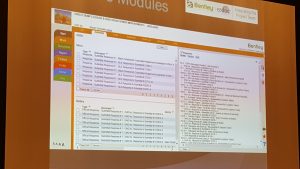 The GHD team estimated that the EADOC system saved over 400 hours through more efficient management of submittals and RFIs alone, and reckoned it also saved another 400 man hours relating to faster location of information and other process efficiencies. Feedback from the owner, contractor, designer, subconsultants and other team members indicated they also benefitted from the system; claimed benefits included a saving of over 100,000 sheets of paper.