US AEC market ripe for collaboration vendors

From talking to several of the overseas construction collaboration technology vendors targeting the US market, a familiar theme is emerging. It appears that home-grown solutions aren’t always attractive to US-based buyers – some of whom are happy to contemplate alternative solutions from, among others, the UK’s 4Projects, Asite or BIW, or Australia’s Aconex.

However, this may have a lot to do with the maturity of the US architecture, engineering and construction market so far as collaboration technologies are concerned. I have been browsing the 2011 ConstrucTech IT Playbook, and it seems that collaboration lags behind project management, bidding/estimating, and job cost/accounting software. Only 22% of the 315 respondents (295 contractors and 20 owners) to the survey gave collaboration technology a high level of importance. The report’s editorial suggested this was because:

“… the construction industry is still determining where and how this technology will work within their business processes. It takes tiime for a particular type of application to reach mainstream adoption. While the industry realizes the need to provide a greater level of accountability and transparency in realtime to all project participants, companies are still searching for the best solution with which to do so.

“Another reason … is because the industry still hasn’t defined the term collaboration. This could mean something vastly different from one person to the next. As this term begins to develop its footing in the industry, the technologies associated with collaboration will likely gain more momentum.” (p.4)

Looking at the technologies deployed by those who did rate collaboration as important, there was a strong tendency for companies to develop customised, locally hosted solutions, perhaps using SharePoint (p.9). But web-based solutions were gaining some traction as “an easier-to-use and cost-effective alternative to more traditional collaboration methods” (browsing the results, I noticed that SaaS-based Autodesk (Constructware) and e-Builder both figured in the commercial project management findings, while Aconex scraped into the document management category).

Opportunity

Given that the UK AEC has been developing collaborative approaches to construction projects for at least the past two decades (Sir Michael Latham’s 1994 landmark report was just part of a much longer drive to improve the industry’s efficiency, and the push continues today), it is not surprising that UK-based software businesses have taken – and, in the US, are taking – a leading role in promoting the technologies needed to support collaboration.

Since the late 1990s/early 2000s, the above-mentioned businesses have established strong domestic track records in collaboration, have successfully exported their platforms to other markets, including mainland Europe and the Middle East, and have done so by developing robust web-based software-as-a-service (SaaS) applications that can be quickly mobilised among geographically dispersed project supply chains without the latter having to worry about installing software, imposing costs on subcontractors or adding implementation and training burdens.

The ConstrucTech document stresses that, overall, “US construction companies will be more collaborative,” using such technology to connect all project team members, and also integrating with mobile technologies and building information modelling (BIM) and related nD solutions. This presents a window of opportunity, particularly for firms like Asite and Aconex whose platforms are increasingly being used to support BIM-based project work as well as conventional 2D-based collaboration. Such businesses each have 10-plus years’ experience in delivering solutions capable of managing large, complex projects; the challenge will be in adapting their experience to the people, industry structures and working processes of the US market, while – at the same time – retaining and expanding their support for BIM-based project delivery.

[PS: I am contemplating undertaking a similar piece of research in the UK market, if I can find some partners to help fund the project. Email me if you might be able to help.]

Permanent link to this article: http://extranetevolution.com/2011/06/us-aec-market-ripe-for-collaboration-vendors/

Aconex chairman in Hitler t-shirt row

Martin Hosking, chairman of Melbourne, Australia-based SaaS construction collaboration technology vendor Aconex, is also chairman of a totally separate online arts community, RedBubble (read his Wikipedia profile here). This has a sideline t-shirt operation which has become embroiled in a controversy about selling t-shirts with Hitler and Holocaust motifs.

The ‘Hipster Hitler’ controversy has now been simmering away for some weeks, and various Australian blogs and websites have started to take notice, including:

  • legal industry blog FirmSpy (reporting that RedBubble’s lawyers Arnold Bloch Leibler had ceased representing RedBubble because of its association with anti-semitic content)
  • J-wire – a Jewish online news website (which also reported the issue was being discussed with the B’nai B’rith Anti-Defamation Commission, ADC, in Melbourne) – and YourJewishNews.com
  • online business websites StartupSmart and SmartCompany, and
  • news and gossip site Crikey

Of course, the story has almost no bearing on Aconex but the company’s name has been mentioned by people who have commented on Mr Hosking’s involvement and judgment, and most online comment is unsympathetic towards Mr Hosking’s defence of RedBubble. I also understand that some people have written to Aconex directors and shareholders. When I asked Aconex about the issue, I was told:

“We are aware that Martin Hosking’s role as non-executive chairman of Aconex is just one of his many business responsibilities.  We are not involved in any of his other business dealings, and therefore cannot comment on those.  We can say that as Aconex chairman, Martin’s work is well respected and highly valued.”

Aconex also referred to Mr Hosking’s comments to StartupSmart.com.au last week, ie: that RedBubble is currently in:

“productive and friendly discussions with a range of Australian-based Jewish organisations, including the ADC (the B’nai B’rith Anti-Defamation Commission). Together we are working to craft a solution which balances the right to free expression against the legitimate restrictions on this. These discussions are ongoing and are drawing to a fruitful conclusion.”

This is the second time FirmSpy has figured in Aconex’s affairs, following the recent FirmSpy-stoked suggestions of conflicts of interest involving an Aconex director and its lawyers (see 10 March ExtranetEvolution post, and this 13 May FirmSpy update). A new post on FirmSpy today (1 June) also mentions Aconex and quotes both the t-shirt supplier and Martin Hosking discussing censorship.

Shareholder unrest

While it is a separate issue, I know at least one disaffected Aconex shareholder is using Mr Hosking’s current discomfort to resurrect leadership concerns aired at January’s EGM (post). I have been sent a copy of a letter sent to Aconex by a minority shareholder (which I reproduce on condition of anonymity) who writes:

“… it just reinforces the problems of Mr Hosking’s qualifications and business judgment or lack thereof and the inherent inconsistency between roles as CEO of a small online art/t-shirt business and Chairman of a larger construction software company.  However, Aconex’s poor financial results over the last several years and its continuing poor results, and Mr Hosking’s ultimate responsibility for the bad judgment that has caused these poor results, is a separate topic.  The relevant point here is that it damages Aconex to have its Chairman push the envelope on how pro-Hitler merchandise has to be before it becomes unacceptably offensive to sell. …”

Ouch!

Update (02 June 2011): … StartupSmart reports that online transaction provider PayPal is reviewing the RedBubble site following complaints, and [3 June] I understand MasterCard and Visa have also received complaints.

Update (06 June 2011): With adverse coverage of Aconex now extending to The Register (suggesting that shopping centre billionaire and Aconex shareholder John Gandel is among those putting pressure on the company), a terse, one-sentence blog post from Martin Hosking (‘Pilgrim’) tells the RedBubble community:

“Pending final outcome of our discussions with a range of organisations (including the Anti-Defamation Commission) we have decided to moderate a range of controversial work on the site related to portrayals of Hitler, the Holocaust and related events.”

Update (07 June 2011): The decision was subsequently reported by StartUpSmart, which also mentions Aconex:

Hosking refuses to comment on speculation that the board of Aconex … had put pressure on him to remove the Hipster Hitler merchandise.

… Hosking confirmed that the Aconex board had received the letter and was considering it independent of him.

Permanent link to this article: http://extranetevolution.com/2011/06/aconex-chairman-in-hitler-t-shirt-row/

The Docia interview

Denmark-based collaboration vendor Docia is growing and has appointed a UK-based partner, MPS, to market its AEC solutions in the UK.

From time to time, I talk to established construction collaboration technology businesses about which I know relatively little and it has been useful to conduct online interviews to learn more (see my conject and Bricsnet interview posts for example). The latest business I wanted to profile was Denmark-based Docia, and CEO Mads Bording kindly agreed to answer some questions for ExtranetEvolution.com.

1.     I first heard of ByggeWeb – is this the same as Docia? – in the early 2000s. Can you give a brief history of the company from its early days?

Our company – Byggeweb A/S – was founded in Copenhagen, Denmark in 1997. The name Byggeweb means (Bygge) to build and (Web) referring to it being web-based. Our mission ever since the launch of our first generation projectweb has been to offer productivity enhancing tools to the construction industry deployed from the Cloud or as SaaS – neither of the two terms were broadly used in 1997.  Even with rather low internet penetration in the late 1990s and a vertical focus on the construction industry, we soon found our software being used outside our home markets of the Nordic countries. This is why we introduced the name Docia as our international brand for use outside Denmark. Today, 15 years later, we still have the same focus and offer a full product suite to the architecture, engineering and construction (AEC) sector including a third generation projectweb.

2.     Have there been any mergers or acquisitions along the way?

From early on, we decided not to expand through M&A activities as a primary source to growth. We want our products and services to be truly modular, which requires two things:

  1. an open-minded philosophy towards being capable of integration with other systems, and
  2. developing our products and applications ourselves.

We are open to forming partnerships with other companies where they have a similar business approach and a market presence that will allow our services to be integrated with their solutions and sold to their customers. We are marketing solutions for Infrastructure Lifecycle Management – across the construction market.

3.     Can you describe the scale of Docia’s business?

Docia Denmark’s 2010 turnover was £3m in product sales. We have 21 employees in our Copenhagen HQ and are steadily growing.

Currently, our software is being used in about 16 countries, we are involved with over 850 construction projects a year, and 10 million square metres of space is being managed using our facilities management (FM) modules.

4.     Is the Docia business generating a profit, and how has it grown in recent years?

Yes, we have been a AAA credit company and profitable for more than ten years and currently operate with 35+% EBITDA.

5.     Where does Docia have offices? In which countries are there significant Docia user communities?

Our HQ is in Copenhagen, and we have offices in Aarhus, Denmark, plus Oslo, Norway, Ukraine and the UK. We are also attracting new attention due to our recently launched Docia Partner Program.

On communities, our corporate strategy is to be very close to our customers, to focus on innovation in the market and be able to co-create new products, applications and features with our customers. In short, we are very customer-driven in our approach. Our products and services must create substantial value to our customers and deliver easy cost savings. We see our products as easy-to-use, low-cost, with high impact: easy-to-use as a result of close relationship with our customers, low-cost relative to the cost of the assets and ROI, and high impact based on significantly fewer deficiencies, increased productivity and much better collaboration for all involved.

This is working well for us. It reflects a general realisation in the marketplace about collaboration in supply chains, about the scalable and flexible benefits from “in the cloud” solutions, and about web services that enable inter-systems communications. This is our generic approach to our markets, but as part of our Docia Partner Programme, we also have annual meetings with Docia Partners and have specific Customer Communities in the respective markets to ensure that all input is collected.

6.     What types of organisations are your principal customers?

We have a strong track record across all segments of the construction industry. In recent years we have been very good at creating deep integrated solutions for asset owners, developers, public organisations and consultants, but have also won business with architects and contractors [see Docia’s customer lists]. I think the key to this growth in almost all segments is the breadth of our modular product suite, which offers tools and applications that will enhance productivity or reduce costs no matter what your part of the industry is. We have been very good at creating a platform for construction projects that supports process requirements from design, tendering, construction management, commissioning and then FM. A very attractive benefit for the many types of organisations in these process operations in that our solutions are fully integrated and create value for our customer – no matter the size of their organization or their role in the construction and FM industry.

7.     What has been the reaction to SaaS-based solutions in the Scandinavian market? Has that view changed in recent years?

In general I think the Scandinavian markets have taken to Saas-based solutions with great maturity and now fully understand the benefits and economies of scale. Obviously it has been a journey since 1997 where we led on SaaS for our customers; today our software and service architectures are, we believe, among the best in the world. Over the years, misunderstandings about SaaS and “Cloud Power” have gradually reduced; firms now embrace the inherent benefits of professionally delivered SaaS. I’m excited that we have been a leader; we are now well placed to exploit this growing global movement.

8.     Where is Docia software development undertaken?

All early stage product development is undertaken at our HQ based on the input from the market or innovative opportunities we have cultivated. We have a programming department in Ukraine ensuring short time to market and high quality of the software production source.

9.     Who else do you regard as competitors in the collaboration sector, and how significant are they?

I think that there are many very capable competitors in our niche of the construction industry who also contribute to the way the construction industry works and their efficiency. But few have anywhere near our own long-term experience in the marketplace.

That said, I think that competition should be divided between various providers of hosting and file-servers and more AEC-specific professional solutions that deliver automated workflows, full audit trails, dedicated and secure file hosting and distribution, etc. In recent years, the AEC sector has been moving towards dedicated use of professional systems that manage the entire lifespan of a construction project and which reflect the changing needs of the various collaborative parties; the needs of the architect when designing are not the same as the needs of the contractor during construction. Our early adaptors have chosen systems that will keep create value for all parties involved throughout the entire lifespan of the asset – what we call Infrastructure Lifecycle Management.

We have recently entered into partnership with MPS Process in the UK who have more than 10 years of SaaS and collaboration experience, and we will work closely with them in  the UK [see 9 May 2011 MPS news release].

10.  Has the recent global financial crisis had an impact on your business?

With our markets deteriorating by up to 40% we had to do an assessment in 2008, whether to jump in the trenches for safety or use the crisis as an opportunity to gain new business opportunities. We decided to add to our commercial part of our organization and more aggressively go-to-market, showing existing customers the value we give them and new customers the opportunities in our products and services. With a much more customer-driven instead of product-driven focus we have grown in all aspects consecutively since 2008.

The overall construction market size is still enormous: what is driving the players and thus ourselves is a quest for productivity gains – to do as much but to do it for less. We feel we are ideally placed to help the market respond to this need.

11.  There has been lots of talk about Building Information Modelling (BIM) in the past couple of years. Is this something that you will be incorporating into Docia?

We are highly involved in various organisations working on standards such as BIM, IFC and others. As we firmly believe that our purpose is to develop and deploy efficient tools for quality and productivity improvements for the AEC sector, we cannot ignore the power of BIM. Today our solution is capable of working with model servers and distributes IFC files along with other BIM and 3D files. We are following progress closely to be sure how exactly to integrate this capability in our solution.

For example, we are working on new functionality, soon to be implemented, which will make the location of the file obsolete in the sense that work files in a project can be located locally or in the cloud, but still be a part of the project. This will reduce time used in the creation of working files in the design and allow more cloud power to be added to the collaborative effort in creating shared work files.

12.  And what about mobile functionality?

We have a clear mobile strategy! We want to make it easy to get data out of our solution and easy to put data in. Mobile functionality is an increasingly important and powerful technology platform that provides an interface to collaboration solutions, and we are exploiting mobile technology to deliver customers’ requirements. Both our Project Management and FM products have Docia Mobile apps available in the Android market and Apple IOS will follow soon.

We see great value in being able to use our solution on-the-fly, having mobile access to our products and services when the need is there, whether this is for documentation, error reports, latest updates, access specific documents or to contact key project members via your mobile or tablet.

13.  And finally, any observations on globalisation?

During the past 5-10 years I have witnessed consistent construction “best practice” evolve in local market sectors – eg: Scandinavia, UK, USA – and then get deployed internationally. Contractors such as Balfour Beatty are operating across the world and need solutions that can be deployed to support on any location worldwide, at anytime and increasingly in any language. I believe our solution and the SaaS service delivery capabilities offer key value and will give our customers – eg contractors, developers, asset owners – a home field advantage. Wherever they operate, they can deploy their own best practice through the use of project templates, enabling a fast start-up and proven functionality.  Docia has considerable experience in providing this type of support and in reflecting best practice in its solutions.

Permanent link to this article: http://extranetevolution.com/2011/05/the-docia-interview/

That Bricsnet embezzlement case – update

The Bricsnet embezzlement case I wrote about in January is nearing resolution. At the time, my understanding of the case was mainly based on some outdated and fairly lurid local reporting in California, but the facts have now been heard in court.

An eight-day jury trial – United States of America v. Ethan Farid Jinian – was held in San Francisco before the Hon. Judge Jeffrey S. White. On 25 May, the jury reached a verdict and found the defendant guilty of 13 (of 14) counts of wire fraud; in short, it was proven that one-time Bricsnet CEO Jinian set out to defraud Bricsnet of over USD$1 million. I understand that he is now awaiting sentence.

Hector Rodriguez, who had been a director since 2002 and was the chairman of AEC collaboration and real estate software provider Bricsnet when this case first came to light in 2008, assumed the CEO role, reported to the authorities and helped pursue the conviction while also stabilising Bricsnet over the following two-plus years and securing new funding (post). He very recently resigned from his 11-year tenure at the company in pursuit of other business interests in investment banking but assisted the US Government in bringing this case to closure. Former Tririga and Peregrine Systems executive David Karpook is now President and CEO of Bricsnet.

Long overdue update (11 February 2013) – Jinian was sentenced on 27 October 2011 to 64 months in prison and ordered to pay $1,587,860.04 in restitution for embezzling more than $1 million from his former employer, Bricsnet FM America (see FBI news release).

Permanent link to this article: http://extranetevolution.com/2011/05/that-bricsnet-embezzlement-case-update/

BIW, a conject company

Maybe it’s a sign of things to come or just a one-off, but I received an email from UK SaaS construction collaboration technology provider BIW Technologies this morning (about a sustainability survey) which had a slightly amended BIW logo at the top. The email had been distributed via parent company Conject’s email engine, and the familiar BIW logo had a subtitle “a conject company” underneath.

This was the first time I’d seen this; it hasn’t (yet) been carried through to the main BIW website, and comes some six months after BIW was acquired by conject in December 2010, at which time I was told BIW would retain its existing identity. It remains to be seen if this subtle change will be replicated across BIW’s website or other corporate branding.

(PS: BIW, isn’t it about time you updated the website to reflect the new ownership? Conject is only mentioned in the news pages – there is currently nothing about conject in “About us”, for example.)

Permanent link to this article: http://extranetevolution.com/2011/05/biw-a-conject-company/

4Projects in advertising push

I have just noticed that SaaS construction collaboration technology vendor 4Projects is advertising via the Construction Enquirer e-newsletter. The first sponsored edition landed in my in-box yesterday, with another today, and it appears 4Projects might be paying “from £300 per day” for the privilege.

A free UK-based and online-only industry news service, with 80% of its readership drawn from contractors, the Enquirer says the newsletter is currently going to 6,500 readers, “with 150+ new subscribers signing-up every week.” (I have written on my pwcom blog about Construction Enquirer.)

In March there were some P45s at 4Projects as the Sunderland, UK-based business made redundancies among its UK marketing team. This latest move suggests that, while its social media push might have stopped, there is still some focus on the UK market alongside 4Projects’ international ambitions.

Update (28 May 2011) – 4Projects’ promotional push on Construction Enquirer’s e-newsletter lasted five days; last one appeared on 24 May (though, it may, of course, yet be something they repeat).

Permanent link to this article: http://extranetevolution.com/2011/05/4projects-in-advertising-push/

A look at BidConTender

Two weeks ago (post), I noted the soft launch of an Aconex service branded BidContender, where the Australian SaaS construction collaboration technology provider is aiming to create an e-tendering portal that will allow contractors to distribute tender documentation and subcontractors to have easy access to that data. Last week I had a chat with Bernard (‘Bern’) Blake about the service, and he took me through its background and some of its features.

Supplier relationship management

Bern told me the platform has been in development for about a year; alpha testing started in July 2010, with a beta version released towards the end of the year, and a low-key commercial release made early this year mainly targeting smaller firms in the Australian architecture, engineering and construction market (the longer-term plan is to develop the solution and roll it out in other countries). He explained that the main Aconex platform, which includes an existing e-tendering option, already had substantial levels of adoption among the larger tier one and tier two Australian firms. However, the company had identified that tier 3-4 firms (businesses turning over $AUD5-20m per annum) were not well served by existing solutions when it came to managing their tendering processes.

BidContender aims to fill that gap, providing a stand-alone service for contractors to manage the distribution of documentation to their supply chain subcontractors, and to manage the flow of communications during the tender process. Aconex research had shown that contractors managed large volumes of tenders, bidding for multiple projects with a ‘win-rate’ of between one in four and one in ten, Bern said. The process was time-consuming and prone to quality issues; tender timeframes were around two weeks, with the majority of communications happening in the final two or three days before submission.

BidContender, he said, provided a rapid and easily auditable means of managing subbie tender responses and collating the final bid; it also provides a ‘supplier relationship management’ platform to maintain existing subbies’ contact details and records of past tender invitations issued to them. As well as managing existing supply chains, the web-based solution can also extend the contractor’s reach, if necessary, to new potential suppliers via “public tenders”. To date, around 13,000 firms have registered to use the system, and the number is growing rapidly, Bern told me (“50-100 a day”).

Simple to use interface

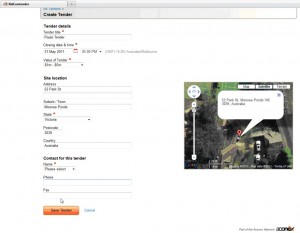
Bern demonstrated BidContender to me, showing me how he could manage the contact details of existing suppliers, and then creating a tender and issuing invitations to his selected subbies. Location details of the site are accompanied by a Google Maps image, and once the tender details have been completed, the issuer can select the relevant documents and drawings concerning the tender package.

Usually, Bern said, the contractor would have received a DVD of information from the architect and the contractor would simply upload copies of files to BidContender and associate them with the package. To help the contractor and designer keep track of what information had been issued and to who, Bern showed me a handy Packages Report that summarised in a single view what information had been associated with different work packages.

To manage ongoing tender processes, the contractor has an overview screen which shows the information issued on each tender and lists the subcontractors to whom it was issued; the desktop navigation features a “Manage” section where the contractor can view which subbies have opened the invitation and what requests for information have been submitted. Bern told me that user feedback suggested this and other features helped reduce administrative overheads by as much as 40%, with the time taken to issue tender invitations reduced from days to just a few hours.

Upon receipt of an email invitation, the subbie clicks on a link to the website and can then view tender invitations in the “Respond” section; if he is also looking for other work, he can also “Find work” from public tenders accessed via the BidContender home page.

How much does the service cost? Bern said:

“Tender managers pay an annual fee based on the number of tenders they are likely to need to run, which works out to about $AUD70-$AUD100 per tender, with no limitation on users. For an unlimited number of tenders and users within the same organisation it’s from $AUD8.5k per year. Tender responders (subcontractors and suppliers) have free access to tenders they have been invited to.”

The competitive landscape

As previously mentioned, there are several e-tendering solutions available, some integrated with SaaS collaboration solutions, others stand-alone, but the BidContender system differs slightly in its ambition to create an online marketplace. Here customers can deal with existing suppliers and find potential new ones, while subcontractors can pitch for publicly tendered work and get themselves onto the radar of new customers.

Looking at the SaaS collaboration vendors, UK-based provider Asite offers similar opportunities through its Company Directory functionality (which complements its pre-qualification, tendering and procurement manager tools), but the Aconex offering appears more seamless in its delivery to SMEs, and can be used in isolation (Asite’s tender offering is bundled with other solutions). Sarcophagus‘s stand-alone solution eTenderer does not provide a route for firms to be invited to tender, while other vendors’ solutions (eg: BIW, 4Projects) are primarily integrated with their core collaboration applications.

The stand-alone RICS etendering solution (I last wrote about this in February 2009) is mainly focused on the tender issue process, but contractors “offering to carry out building work or responding to invitations to tender can register free of charge”. Of the other stand-alone offerings I’ve mentioned recently, Australian start-up Tender.ly/Constrex (post) seems to have folded (MD Jason Langenauer is now working for an entertainment industry Ruby on Rails developer, PureSolo Ltd), but 2010 UK start-up Asktobi (post) would be in direct competition if Aconex launched BidContender in Britain.

In terms of price, BidContender appears to be significantly less expensive than its UK stand-alone counterparts. Sarcophagus’s lowest pricing, for example, costs its service at £200 per tender, while RICS etendering’s lowest figure is £325 per tender.  At current exchange rates, Australian firms are paying far less – under a third of Sarcophagus’s fees. Asktobi is paid for on a monthly subscription (not per tender; a two-user Silver license is £89.99 per calendar month), and would, I think, find BidContender stiff competition if it launched a similar service in the UK.

Permanent link to this article: http://extranetevolution.com/2011/05/a-look-at-bidcontender/

AppDirect will sell your B2B apps, er, direct

The cost and complexity of creating a new business-to-business software-as-a-service (SaaS) application has reduced significantly over the past decade, but the challenge of getting that carefully developed new software more widely known and then getting revenues from end-user customers can defeat some developers. Launched in the US in July 2009 (and recently seed-funded to the tune of US$3.25m), California-based AppDirect aims to help B2B service providers sell SaaS-based tools to their customers and manage incoming subscriptions.

AppDirect has created a Marketplace-as-a-Service (MaaS) platform so that B2B service providers can offer cloud services to their existing customer base quickly and economically. Initial take-up has been driven by telecoms providers (in Canada, Bell Business Apps Store services a significant base of SMB clients) and financial services businesses, but AppDirect’s Max Rhodes told me there was ample scope for channel partners – publishers or trade associations, for example – to create their own white label marketplaces populated by vendors keen to sell SaaS to their readers or members.

AppDirect has an “intelligent recommendation engine” that guides users towards the most relevant applications for their business, and customers benefit from having a single place to subscribe to applications, provision access to their colleagues, and pay just one monthly bill for all of their app subscriptions.

Via AppDirect’s API, developers can easily distribute their applications through the marketplace network (integration typically takes less than a week). Their SaaS tools are then promoted online to relevant target markets, with user feedback helping guide new users towards tools that are recommended by existing customers and/or end-users. And once tools are selected, AppDirect takes responsibility for subscription management (taking a modest commission on sales, of course); “this frees up the software developer to focus on creating really good apps and on managing customer support”, said Max.

SaaS construction opportunities?

Over the past decade, the success (or otherwise) of existing construction SaaS vendors has often depended on how effectively they have marketed themselves, managed their existing customer base – limiting ‘churn’ through good quality of service – and kept their overheads low. Like conventional software houses, they have tended to use direct sales teams, but this can be expensive and solutions may require some manual intervention before they are deployed for customers/end-users. UK-based collaboration vendor Woobius, for example, has tried to expedite the process by going self-service (post), but there is currently no easy route to market for most of the applications in this sector. Rival provider Asite has also floated the idea of its platform being used to host other, complementary applications: so-called Platform-as-a-Service (post; AppDirect is also interested in this opportunity).

In the early 2000s, various marketing alliances were attempted. For example, BIW Technologies partnered with BT to offer the BIW collaboration platform to ‘BT Build Business’ customers – 2003 release; a ‘project extranets’ minisite was created on the Construction News website; and the NCCTP saw eight UK-based vendors join together to help grow the market (among other reasons) – but none of these ventures had a dramatic impact on the collaboration sector, though it was still very early days for SaaS.

However, time has moved on, and an AppDirect-type approach could be part of the answer, particularly as the flow of new Software-as-a-Service tools targeting the construction sector seems to be accelerating, creating a “long tail” of specialist tools all targeting the same vertical market and so complicating the AEC customer’s task of identifying suitable applications. Moreover, if AppDirect promotes consistency in use of a particular programming interface, then it may find itself in demand as a PaaS solution, and – through its end-user rating system – provide a service to developers looking to identify popular applications with good potential synergies.

Permanent link to this article: http://extranetevolution.com/2011/05/appdirect-will-sell-your-b2b-apps-er-direct/

Collabor8online upd8s

I talked recently with Colin Barnes, CEO of Collabor8online, a provider of low-cost construction collaboration technology that I first wrote about 18 months ago (post), and just over a year since I last spoke to him (post). The conversation was prompted by some tweets about the business’s new website and about a new version of its application, released last month.

Web 2.0 marketing

The new website has been developed using WordPress as a content management system, and – as you might expect of the pre-eminent blogging platform – incorporates a blog which the Collabor8online team have been updating more frequently in recent months. Several of the blog posts feature YouTube videos about the application and its new features, while others focus on recently signed-up customers such as Rosebery’s and Smith Lam Architects.

The use of Web 2.0 tools and techniques forms part of a shift in Collabor8online’s marketing strategy, Colin said. Initially, the business had targeted SMEs in the mechanical and electrical services market and had relied upon conventional print advertising, but this was shown to be a “slow burn” after Colin agreed to experiment with an online campaign using Google Adwords. Combined with some organic search engine optimisation, the business had enjoyed a recent surge in sales enquiries from a wider range of organisations – though he accepted this might also have coincided with a general resurgence in the UK construction market after the credit crunch.

New features

Some of the new features on Collabor8online continue this Web 2.0 thinking, including the optional use of avatars in user profiles – these images then appear adjacent to any comments made by users, tasks assigned to them, and any actions they have completed on the “latest activity” feed on the application’s homepage. This level of personalisation will be familiar to users of application such as Facebook, Twitter and LinkedIn, and can make it easier for users to identify contributions associated with particular individual users.

Another simple change was to change from “comments” to “messages”. Colin said he felt this more accurately reflected the broad range of project communications within Collabor8online.

Recognising that some high-end SaaS collaboration systems can be difficult to use “out of the box”, Colin also highlighted a new two-minute Quick Start video guide displayed on the homepage of any new user added to the system. This gives a quick introductory overview of the product helping users “get started” quickly, and forms part of a new Video Help option in the top right hand corner of the home page.

Permanent link to this article: http://extranetevolution.com/2011/05/collabor8online-upd8s/

TSB launches £7m competition to boost UK construction ICT

The UK’s Technology Strategy Board (TSB) is to invest up to £12 million through three new research and development competitions that will stimulate innovation and support growth across the UK, with the lion’s share (£7m) of the potential pot being devoted to a competition for high-value manufacturing and construction (see news release).

As a business-led government body, the TSB’s role is to stimulate UK economic growth through innovation. The £7m investment is intended to stimulate the use of innovative ICTs in the UK manufacturing and construction sectors and so increase productivity and competitiveness. In the TSB’s view, “ICT has a major role to play in many critical capabilities in manufacturing and construction including and not limited to: automation; customisation; knowledge sharing across supply chains; and simulation and modelling.” The competition will open next month (June 2011).

The ICT KTN will be holding a dedicated event with the Modern Built Environment KTN to bring together the location, construction and manufacturing communities. Details will be announced shortly; I also hear the competition bid document will be issued via the TSB website soon.

ICTAcoverHaving spent the last decade and more in construction ICT, I have heard repeated calls for government to promote the use of technology to support more collaborative approaches to project delivery. Indeed, I was part of a National Platform for the Built Environment working party that undertook a scoping study suggesting areas for potential investment and research, published in early 2008 (see post); and the Salford-based SCRI forum produced a research report echoing some of the same points (post). I expect several individual companies, academics and industry associations such as COMIT will be taking a keen interest in this competition.

Permanent link to this article: http://extranetevolution.com/2011/05/tsb-launches-7m-competition-to-boost-uk-construction-ict/

Load more