Android-based Smartbuilder1 launched

Almost a year ago, I wrote about Dublin-based software developer SmartBuilder Software after managing director Peter Daly and I met up and discussed construction collaboration technologies and mobile solutions. At the time, he was developing his first iPhone application, but I later learned that he had decided not to continue developing on the Apple platform. Instead he switched to developing Software-as-a-Service based solutions on the Android mobile platform, and SmartBuilder1, a web-based mobile software system for the UK construction market, has just been launched (news release).

SmartBuilder1, which works on Android smartphones and tablets, is claimed to be:

“the first complete system of its type for the construction market… focused on saving contractors time and money and on helping them to bring in buildings with zero defects.”

SmartBuilder1’s initial three modules – Tracking Progress, Managing Quality and Sub-Contractor Close Out – allow managers on-site to update progress in-real time, to record reasons for delays, and alert people from site about issues that need their action. Conventionally, there have been slight delays as site-based staff have had to return to their site accommodation to go online, but by putting the tools literally at a user’s fingertips, SmartBuilder1 enables earlier issue identification and earlier alerts to fellow team members. SmartBuilder1 also apparently incorporates mobile web-based quality inspection tools (nothing new here: rival SaaS vendors have been marketing similar solutions since the mid 2000s), while the underlying SaaS architecture, hosted in the cloud by BT, provides a secure audit trail of all interactions with the system.

According to the release:

SmartBuilder1 has a desktop client as well as a mobile client and a database in a remote data centre accessed via the web where the data is stored and the application hosted.  The mobile works off line while in-field and then syncs wirelessly when connected again to the web.

My view

Obviously, the claim to be first will be contested by rival software developers. Smartphone access to SaaS-based construction collaboration applications has been around since at least 2005 when BIW first started field trials, and there has also been a steady stream of more recent announcements from both the major AEC platform vendors and from specialist mobile developers. For example, last month (May 2011) Aconex and Autodesk both launched iPhone/iPad apps, Aconex Mobile (post) and Buzzsaw Mobile (post) respectively, following on from earlier announcements from Business Collaborator (December 2009), Asite (May 2010) and Sword-CTSpace (October 2010); BIW sister company conject also has an iPhone app. In between, I’ve noted software releases from mobile specialists BuildItLive (December 2010), SnagR (March 2011) and Ennova (May 2011), among others.

I have been writing about the increasing importance of mobile data access and interaction for some years, and the continued advance of the smartphone has undoubtedly helped open people’s eyes to its potential. Globally, sales of smartphones (100m) overtook sales of laptops (94m)  in the final quarter of 2010, and smartphones now constitute almost half of all mobile phone sales in Europe. The construction industry has long recognised the potential of mobile communications (it was one of the sectors that helped make mobile telephony a success in the 1980s and 1990s), and – in my opinion – widespread adoption of SaaS-based technologies accessed through such devices has been inevitable.

Clearly, the mobile collaboration space is becoming increasingly competitive, and SmartBuilder1 faces stiff competition from established vendors of SaaS construction collaboration applications with large user-bases. One might argue that it is easier for them to build out from their collaboration platform strongholds to offer mobile workflow functionality than it is for SmartBuilder1 to make inroads into their SaaS platform markets, but Peter’s products may, if competitively priced (there is no pricing information on SmartBuilder’s website), find favour with small contractors looking to accelerate their site management processes without needing the full-on file collaboration capabilities of, say, Aconex or BIW. There is also a possibility that market incumbents might look at SmartBuilder1 as a potential interface that might be adapted to allow users access to their platforms rather than having to develop their own Android tools from scratch.

Update (5pm BST, 28 June 2011) – Interested in other Android apps for construction? Read The Best Android Apps for Construction Management, a recent blog post by Derek Singleton at US site, SoftwareAdvice.com.

Permanent link to this article: http://extranetevolution.com/2011/06/android-based-smartbuilder1-launched/

conject AG appoints Cesar Flores as CEO

conject AG, the Munich, Germany-based infrastructure lifecycle management technology business, has appointed Cesar Flores as its new CEO. Flores replaces conject founder Martin Reents, who is leaving after 11 years with the group to pursue new business interests.

Cesar Flores has led conject’s new business development activities in Germany, Poland, Switzerland and Italy, he was responsible for several successful acquisitions, and, according to a news report in the German Property Magazine, he will be keeping an eye out for further acquisition opportunities worldwide.

Under Reents’ leadership, conject established itself as a SaaS pioneer in the European construction and property markets; conject applications are used by 3,500 corporations and more than 170,000 users in Europe, USA, Middle East and Russia.

Parent group conject Holdings Gmbh also includes BIW Technologies, acquired in December 2010 (post). BIW CEO Colin Smith is CEO of conject Holdings Gmbh and told me Flores’ appointment ensures management continuity for loyal conject AG customers across these regions.

Permanent link to this article: http://extranetevolution.com/2011/06/conject-ag-appoints-cesar-flores-as-ceo/

Hawthorn Glen v Aconex: the rematch

Just over three years since an Aconex shareholder dispute with the management team was settled out of court, another legal action began on Monday in Melbourne – as I noted on Friday. The Australian construction collaboration technology provider is again being challenged by Hawthorn Glen and Ian Baillieu, this time over the conduct of an EGM in January 2011 (post).

This latest action appears to have arisen because Aconex has not allowed shareholders access to documents relevant to the EGM, after which there were allegations of conflict of interest involving lawyer and Aconex non-executive director Michael Robinson (see Aconex director under scrutiny). After the initial hearing on Monday, the case will be heard in court in late August. Meanwhile, it has prompted more interest and speculation from the Australian legal gossip blog, FirmSpy (see AllensGate Update: Shareholders Issue Proceedings Against Aconex, Shitfight Ensues).

Update (18,19 July 2011) – The pre-match sparring has started in earnest. Australian newspaper the Sydney Morning Herald (and The Age; see also SmartCompany) has been reporting more details of the background to January’s EGM. It quotes Aconex shareholder James Baillieu allegedly threatening to bankrupt former chairman Martin Hosking, and it is suggested that Aconex co-founder and CEO Leigh Jasper ”made no mention of a write-off by the company of $6.4 million or of cancelled bookings” during a presentation to shareholders on 28 January.

Company documents filed with the court show revenue for the three months to the end of December was $9.2 million, down from $10 million in the previous three months, but bookings for future work were up 43 per cent, to $16.4 million (see also my 17 February 2011 blog posts, Accounting for Aconex, and Aconex director under scrutiny).

Permanent link to this article: http://extranetevolution.com/2011/06/hawthorn-glen-v-aconex-the-rematch/

BIM – a new role for collaboration tools?

For the past few years, I have been writing about building information modelling (BIM); I have, for example, talked about the potential for BIM to be delivered via Software-as-a-Service routes (BIMaaS), and considered how current SaaS construction collaboration technology platforms might be used to manage the ‘i’ in BIM.

The latter is already beginning to happen; Aconex, for example, is seeing dramatic increases in the volume of BIM files exchanged via its platform, and sees its platform as one solution to the challenge of distributing increasingly large files to bigger groups of project team members (read Managing the data deluge), and Asite has been seeing growing interest in its collaborative BIM, cBIM, functionality. And this is likely to be repeated across other SaaS platforms, especially as UK government clients begins a powerful “push” to expand BIM adoption across the UK construction industry.

An industry Report to the Government Construction Clients Board on Building Information Modelling and Management has just been published by the UK Department for Business Innovation and Skills, BIS (see release). As part of the industry transition towards ‘Level 3’ integrated BIM, iBIM, it envisages collaboration platforms being used to help share information generated by BIM approaches.

This is not new, of course. Construction collaboration platforms have been used for some years by enlightened clients and project teams to provide a common data environment enabling the sharing of information generated by 2D and 3D CAD applications and complying with BS1192 (‘Level 1’ on the BIM maturity road-map). However, there will be new challenges. Instead of files, the focus will switch to managing the core data of BIM, and, according to the BIS document, the next stage is for these platforms to be used to provide a Data Management Server:

“A Data Management Server is required for the express purpose of collecting and processing delivered information. It must be available 24/7, reliable, secure and intuitive to use.  Its appearance and operation is to be similar to that of one of the existing “Collaboration” systems currently available in the market. Indeed it may be that during the mobilisation period we may engage the existing service providers to enable such a service.” (Appendix 13, p.77)

The document talks at length about the COBie data standard, which I saw last year as the bridge between BIM and collaboration technologies, and, while highlighting the suitability of cloud-based solutions, also discusses the need to create some industry standards and service specifications to meet government clients’ needs:

  • The COBie control server is likely to be hosted and fully managed in the cloud. This will satisfy the security, disaster recovery and high availability requirements of such projects.
  • It is possible for the server to be hosted on Premise (e.g. at the clients or Main Contractor’s offices/data centres). This may be required for projects that have an elevated level of security.
  • Publication of a standard and service specification that could be embodied in existing collaboration service provider’s offerings on behalf of HM Government. (Appendix 13, p.81)

Constructing Excellence* (see its response) is looking to position itself as the host organisation to provide an implementation team to support government clients, highlighting its industry neutrality, its routes to market, its experience in collecting data for the Construction Industry KPIs, and its broad engagement with both clients and suppliers at strategic and practitioner levels.

I would add that CE also has a track record in representing some of the collaboration technology vendors through its provision of secretariat services to the Network of Construction Collaboration Technology Providers (NCCTP). While this is now largely dormant, I think CE is well placed to help industry and the SaaS providers and other technology businesses develop the recommended standards and service specifications and to provide a clearer picture of the current and future state of collaborative IT in the built environment.  While the current focus is on BIM, it is also worth thinking about how the architecture, engineering, construction and FM sectors are adopting other technologies and approaches, including mobile computing, contract workflow and social business applications, which may well complement and enhance collaborative BIM.

[* Disclosure: I have been active in Constructing Excellence for some years, currently serve on the CE steering group, help its G4C group, and act as a CE Collaborative Working Champion, and was active in the NCCTP when I represented my then employer BIW.]

Permanent link to this article: http://extranetevolution.com/2011/06/bim-a-new-role-for-collaboration-tools/

Hosking steps down at Aconex

Martin Hosking resigned as a director and chairman of Melbourne, Australia-based construction collaboration technology provider Aconex on 15 June, according to a news release on its website.

Mr Hosking will now “focus on his role as CEO of RedBubble,” having over the last seven years helped increase revenue by over 15 times. He is succeeded as chairman by US-based Simon Yencken, a non-executive director of Aconex since 2008.

The news release makes no mention of the reasons behind the resignation, but, as previously covered in this blog (1 June, 12 June), Aconex has recently been drawn into media controversies regarding RedBubble merchandise through Mr Hosking’s dual role with the two firms. The move may also placate some Aconex shareholders who raised concerns about his leadership at an EGM in January (post).

Update (17 June 2011, 22.45pm BST) – Following Martin Hosking’s resignation, I talked to Aconex CEO Leigh Jasper and new chairman Simon Yencken this evening, not long after news emerged via The Register and Australian newspaper The Age of legal proceedings relating to January’s EGM.

Regarding the resignation, Mr Hosking told The Register that his decision was not due to Aconex pressure:

“there was no pressure on me from the Aconex board in relation to this matter. Aconex is an entirely separate business and they did not have any involvement in the decision.”

But the controversy clearly angered Aconex shareholders who had demanded:

“urgent attention before Aconex may suffer further, and possibly irreversible, loss and damage to its business reputation by its association with Mr Hosking.”

In the meantime, as The Age also reports, legal proceedings have been instituted in the Australian Federal Court by Aconex shareholders, including Ian Baillieu, alleging director misconduct, including conflict of interest, by Mr Hosking before and at the EGM. The latter’s resignation doesn’t appear to have halted the Baillieu/Hawthorn Glen action; The Age reports the court application “is the first step in a process that could ultimately lead to legal action against Mr Hosking”. A court hearing has been scheduled for Monday afternoon 20 June, and The Age adds:

Mr Baillieu is seeking to inspect internal Aconex documents ”addressing the potential conflict between the interests of Mr Hosking and those of the company”. Mr Baillieu has also told the court he wants to examine Aconex records related to how the company’s board directed proxies at January 28’s extraordinary general meeting of shareholders.

The Aconex board perspective

This evening, Leigh and Simon (right) were both keen to stress Aconex’s “major achievements” under Martin Hosking’s chairmanship, pointing out the 15x growth in revenues, the successful capital raising that brought in Francisco Partners in 2008 (post), and the big push into the US market. However, it appears there was already a plan in place for him to step down, probably later this year, in line with the board renewal and succession plan mentioned at the time of the EGM.

Leigh told me RedBubble had apparently been absorbing an increasing amount of Martin Hosking’s time, and as he had already served more than two three-year terms, he was contemplating eventual resignation as a director of Aconex. Meantime, the company has been engaged in a search for a new board member(s) – its constitution allows for a board of up to nine – ideally someone with good insights into the US market. This had proved time-consuming but, Simon stressed, there was no rush to appoint new people as the company had thrived perfectly well under a five-man board prior to Francisco Partners’ investment, and seven since then.

Would the change of chairman lead to a change of strategy? Not at all, I was told (or at least it would only “evolve slowly over the next 12 months”). “We are unanimous in pursuing our agreed strategy just as we were unanimous in our support of Martin,” said Leigh.

Continuing his support for Martin’s achievements, Leigh stressed that the company had under Martin’s leadership returned to growth after the tough times caused by the global financial crisis. He repeated some points from our February conversation (see Accounting for Aconex), adding that the company had withdrawn from Libya due to the ongoing civil war in the country. He reiterated that the north American market was growing fast for Aconex, highlighting a recent new client, Calgary-based Vista Projects (news release), and talking about client testimonials regarding existing projects at New York City Hall and in Denver (videos). He echoed my view (post) that the US AEC market was waking up again to the potential of SaaS-based collaboration applications after poor experiences in the early 2000s with some US-based service providers, with BIM likely to add further impetus to collaboration adoption there and in the UK and Australia.

I asked, of course, about Monday’s legal proceedings, but neither director was willing to comment, conscious that there could be legal implications if they did so ahead of the court hearing (mention of Australian contempt of court rules effectively ended that bit of the conversation).

My view

Two main points, I think, plus a minor one.

First, if Aconex had already determined that Martin Hosking would step down this year, I wonder why it didn’t act more decisively and earlier. It could have brought forward Simon’s succession, allowed Hosking to resign, and so underlined the separation between its operations and those of RedBubble. A prompt response when this controversy first surfaced would have prevented some of the reputation damage (and gloating by competitors) that we have seen over the past fortnight.

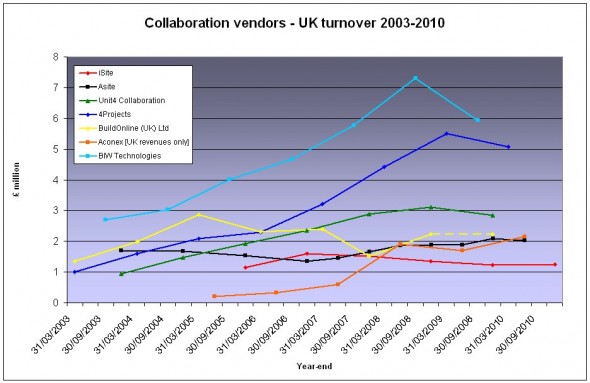
Second, shareholder/board tussles rarely benefit either side. The strong growth experienced by Aconex throughout most of the 2000s has certainly faltered in recent years as construction in many countries was affected by the global financial crisis. Aconex has fared better than some due to the wide geographic spread of its activities, so it hasn’t seen the big revenue down-ticks experienced by one or two UK-based competitors (eg: BIW, 4Projects). But its strategy of overseas expansion away from its stronghold in Australasia and south-east Asia has taken it into markets where there is stiffer competition and which – in the case of the USA – have required significant investment to build a credible regional presence. This – as I mentioned in February – led some shareholders to wonder when Aconex might deliver on its promises of growth and resulted in the EGM.

While the shareholders’ concerns might be understandable, the EGM, the related Allens Arthur Robinson issues reported in February and the unfortunate recent Hosking/RedBubble controversy will have:

  • diverted management time, energy and attention away from running the day-to-day business,
  • caused additional expenditure on legal advice, and
  • damaged Aconex’s corporate reputation.

If these impacts can be contained, then the damage may only be short-term, but another bout of legal action, if prolonged, won’t help disaffected shareholders achieve the return on their investments they desire, and may continue to distract the board from delivering its strategy for growth.

Finally, as a blogger and industry observer, it is difficult to avoid becoming part of the story. My main focus is on the construction collaboration technology market and I am rare in my focus on that sector. So, when a scandal erupts concerning a prominent player like Aconex, it is almost inevitable that this blog will be used by some to comment on the issues (I also received several emails, some from parties directly involved in different aspects of the controversy). I became concerned that, rather than just reporting what was happening, that the blog also became a channel for people – apparently including Aconex competitors – to voice their opinions (over 40 comments across the two RedBubble posts, to date) and fan the flames, so to speak. It’s something I will be thinking about….

Update (12 September) – Further adverse publicity for Redbubble in the Australian press (eg: Herald Sun article) suggests that, without Hosking’s resignation, the RedBubble affair could have continued to affect Aconex’s reputation.

Permanent link to this article: http://extranetevolution.com/2011/06/hosking-steps-down-at-aconex/

OpenBuildings.com: crowd-sourcing a building directory

OpenBuildings.com logoWhen I discovered the crowd-sourced building directory OpenBuildings.com I was immediately intrigued, not least because of its ambitious strapline: “Archiving the world’s built environment.” I have been a long-time editor of Wikipedia and am interested in how social media can be used in the architecture, engineering and construction (AEC) field to share and develop information and knowledge.

Founded in London in 2010, OpenBuildings says it is:

“an intelligent, filterable building directory for professionals, architecture-lovers, tourists and students and allows users to quickly and easily discover, learn about, discuss and share architecture that interests them.”

Last month, the company secured a $2 million Series A funding round led by BlueRun Ventures and Index Ventures, and will be expanding its team in London and in Sofia, Bulgaria, and improving its existing technology.

To date, the site has apparently attracted 50,000 registered users and holds data on over 40,000 buildings around the world. A related iPhone app has been downloaded over 250,000 times (an Android app is promised soon), and the site is using social media extensively to spread word about its services – its Facebook page has almost 14,000 ‘likes’, and each building profile can also be liked, tweeted or shared on other social platforms.

To submit a building, a user must first register (free), after which it is possible to do local searches, add images and videos, engage in conversations with other members of the OpenBuildings community, and create favourite collections. In due course, architectural practices will be able to create profiles of their firms (a paid-for functionality “coming soon”). And if you “want to learn about, monitor and influence your built environment”, OpenBuildings will be adding some ‘local’ functionality too.

Achieving critical mass

This project shares some characteristics with wikis. In 2008, I wrote about the Royal Institute of British Architects and its RIBApedia research and education project, and pointed out that it faced powerful competition from Wikipedia – which already has a wealth of information about architecture, buildings and architects. I also doubted that RIBApedia would accumulate sufficient numbers of users to create the necessary “wisdom of crowds”.

OpenBuildings, however, appears to have already gathered a large number of building profiles and attracted a substantial user base. Its user interface is also more modern and user-friendly than Wikipedia’s, which may make it more attractive to both information browsers and those uploading information.

Reusing Wikipedia content

OpenBuildings article on Charlton HouseHowever, the similarities with Wikipedia do occasionally run deeper. For example, I did a local search in my area of south-east London and found an entry for Charlton House – the text of which is copied from the Wikipedia article (this source is attributed under ‘publications’, alongside a similar Freebase article), while the photograph used is also copied from Wikimedia Commons. I found similar entries for other nearby historic buildings (eg: Morden College, and the Church Army Chapel, Blackheath). Freebase makes it clear when it uses Wikipedia content, eg:

The original description for Charlton House was automatically generated from Wikipedia.org licensed under the GNU Free Documentation License.

But, so far as I could see, there is no similarly prominent acknowledgement of the sources of information and images on OpenBuildings, nor is any Creative Commons License prominently mentioned (usually, one must attribute the work in the manner specified by the author or licensor – as Freebase attributed Wikipedia). I had to delve into the small-print of the Terms of Use to find a relevant reference:

Certain Content is displayed on the Website pursuant to the Creative Commons Attribution – NonCommercial-ShareAlike license. Under this license, reuse and sharing of such Content is allowed, subject to the requirements under such license, which you can find at http://creativecommons.org/licenses/by-nc-sa/3.0/. You may only use Content under such license that is clearly indicated to be governed by such license. Please contact us if you have any questions.

Permanent link to this article: http://extranetevolution.com/2011/06/openbuildings-com-crowd-sourcing-buildings/

First, Hitler. Next, serial killer t-shirts…

When a controversy about Nazi-related images on t-shirts is largely contained within the blogosphere, it is easy for companies to pretend that it’s a small issue. But if coverage then extends to the front pages of national newspapers, then it can become a major reputation problem.

Blog outrage about Hipster Hitler t-shirts on RedBubble led to criticisms of CEO Martin Hosking, who is also chairman of global construction collaboration technology vendor Aconex – see my 1 June post. In addition to the numerous comments on that post, I also received emails about other questionable RedBubble-marketed garments: baby and childrens’ clothes with images of serial killers on them. Other email recipients included journalist Susie O’Brien of the Australian newspaper, The Melbourne Sun Herald (print circulation c. 430,000; readership 1m+), which reported the story on its front page yesterday (11 June), and it is now being carried on several other news outlets in Australia; it has also been shared over 600 times on Facebook and on Twitter and LinkedIn.

However, it remains to be seen if this latest storm will impact on Aconex; the article did not mention Mr Hosking by name (though he has been mentioned online, eg: here), nor his other business interests. The next few days could be interesting….

Permanent link to this article: http://extranetevolution.com/2011/06/first-hitler-next-serial-killer-t-shirts/

Is no news bad news?

There seems to be dearth of positive news among the the leading UK-based construction collaboration vendors. A glance at their website news sections would have you wondering if they are still active, still winning work or still developing new applications. Excepting Aconex‘s international news and one or two client stories from 4Projects, there is a distinct lack of recent company developments and project wins:

  • Cadweb’s March 2011 news release looks at an update to an academic paper reporting research undertaken in 2002
  • BIW’s last news release was in February
  • Asite’s latest news release was last December
  • Sarcophagus issued its most recent news release in October 2010, the same month that Sword-CTSpace last issued a UK story
  • excluding parent group news, Unit4 Collaboration last issued a news release in September 2010 – the same month that Aconex last put out a release about a UK project and (excepting its other products) Woobius talked about its new project dashboard.

And the most recent “news” isn’t really news either. 4Projects‘ latest offering, 4Projects well placed to help deliver Government Construction Strategy Objectives, seeks to capitalise upon last week’s Cabinet Office publication and tries to make marketing capital out of it. Frankly, the points could be echoed by any of its rivals, and would be more appropriate for a blog post (but 4Projects’ blog disappeared after it downsized its UK marketing team – post; by the way, I’m pleased to report former VP Marketing Clare Watson is now at RIBA Enterprises).

As a PR and marketing professional who spent a decade issuing dozens of news releases for BIW (and a few for the UK vendors’ trade body, NCCTP), it is a bit dispiriting. It may indicate that the recession-hit UK is still a tough market for vendors, but I wonder if it also demonstrates the void created when businesses trim their marcomms budgets and end up with little or no access to professional marketing and PR support.

Permanent link to this article: http://extranetevolution.com/2011/06/is-no-news-bad-news/

Aconex UK increases turnover in “tough” market

Last August, I looked at the latest accounts from Aconex (UK) Ltd, the UK arm of the Melbourne, Australia-based construction collaboration technology vendor, noting the impact of the global financial crisis on its London-based operation, with revenues down 11% and a pre-tax loss. The latest report and accounts filed at Companies House, covering the year ending 30 June 2010, show turnover grew, but so too did pre-tax losses.

The report covers the same period as the parent group’s accounts, which I discussed with Aconex directors in February (see Accounting for Aconex). Then I was told the Middle East was a “weak spot”, Europe/Africa was also “a bit weak”, and the UK “was a bit tough for everybody”. This seems partly borne out by the figures. Aconex (UK) Ltd, which includes regional subsidiaries in Romania and Algeria, increased its turnover to £2.147m (up 27% from £1.688m in the year to 30 June 2009), pushing it above £2m for the first time, but losses increased almost five-fold, from just over £57k to £272,005. Operations in north Africa had been boosting the company’s revenues, but it is possible that recent regional unrest may have had an impact on the current year.

Asite comparison

Aconex (UK)’s turnover edges it ahead of UK AEC rival Asite, which in the same period achieved a similar increase in revenues, up to £2.021m, and a pre-tax operating profit of £0.133m (see Asite – steady).

From its latest filing to Companies House, it appears Asite curtailed its activities outside the UK during the year to 30 June 2009. UK-based operations accounted for 95% of its revenues, up from 86% in the previous accounting period, largely due to its almost complete withdrawal from the troubled United Arab Emirates market. Operating costs were trimmed partly by staff reductions, with average head count down from 67 to 60, and by cuts in directors’ remuneration (down from £375k to £250k), among other measures.

Permanent link to this article: http://extranetevolution.com/2011/06/aconex-uk-increases-turnover-in-tough-market/

HP ePrint and Share – as you were….

I travelled to Hewlett Packard‘s UK HQ in Bracknell, Berkshire today for an update on its strategy concerning the architecture, engineering and construction sector. My previous interactions with the company included the 2010 launch of its ePrint & Share service supporting large format printers (see post) and I was hoping to hear about some significant developments regarding its cloud-based storage.

However, it was a touch disappointing. While it was good to meet up with some familiar faces (HP’s Phil Oakley spoke at the Be2Awards earlier this year, and I renewed contact with some journalist friends), I had been anticipating the release of an application programming interface, API, that would ultimately allow users of third-party online collaboration platforms (eg: 4ProjectsAconex, Asite, BIW, plus Autodesk’s Buzzsaw – post) to print and share drawings from these “private clouds” as well as from HP’s own online storage system. Certainly, in Copenhagen last year I understood that HP would be talking with third party vendors so that HP printer users might upload, scan and share drawings direct to their preferred platform provider.

However, some nine months later, it seems this is still on the “wish-list”. HP remains focused on small- and medium-sized businesses that need modest file-sharing facilities to share CAD files with fellow project team members. Professionals working for larger firms, or on larger projects, employing non-HP-hosted solutions “in the cloud” will not be able to use the new touchscreen interfaces of HP’s latest web-connected printers to collaborate with their colleagues – at least, not in the near future.

I looked more closely at the HP touchscreen and at the PC-based navigation to see how users might select which files they shared. If a user had access to numerous different files, choosing files from the touchscreen would involve a lot of scrolling and/or a good memory for the exact file name. The PC-based interface was better insofar as users had some search capabilities (they could search for files issued to them by date, or by particular users or companies, for example), but it fell short of the advanced search capabilities of existing SaaS-based solutions. I also asked about audit trail functionality (eg: who issued what to who, and who opened what file and when), and – again – provision remains limited, at least in comparison with SaaS collaboration systems.

HP seemed to regard email and FTP as the principal competitors to its cloud-based storage (despite SaaS-based solutions being around since the late 1990s). While this may be true for many SMEs, there will be many projects which have deployed various third-party online tools, from simple plan-room systems to sophisticated workflow and document collaboration services (and the above-mentioned main providers each have tens of thousands of end-users). With these, supply chain partners won’t (yet) be able to use HP’s printer touchscreen and forthcoming mobile device interfaces to print and share their files. HP’s marketing talks about the mobile, web-connected, collaborative world, but – at the moment – HP printer users are restricted to using HP hardware and related HP print services. Not really all that collaborative….

Permanent link to this article: http://extranetevolution.com/2011/06/hp-eprint-and-share-as-you-were/

Load more