Prin-D: a CDE for CDM

Prin-D targets firms acting as Principal Designer under the UK’s Construction Design and Management (CDM) health and safety regulations.

Via a blog post by Imanuel Steele on the IET website (Tackling record-keeping challenges in the construction industry with technology), I learned about Prin-D, a Manchester, UK-based startup established in 2017 that has developed a ‘CDM2015 digital compliance platform’.

Prin-D: a CDE for CDM

It is described as “a client-led Common Data Environment (CDE) which assures compliance with Construction Design and Management (CDM) regulations throughout an asset lifecycle.” The solution enables the management of health and safety documentation as a built asset progresses through the design, construction, occupation, and refurbishment phases of its lifecycle.

The UK’s Construction Design and Management (CDM) regulations were updated in 2015 to introduce the role of the Principal Designer as a new CDM duty-holder.  The Principal Designer is legally appointed to manage health and safety risks and compliance with the CDM regulations. And new responsibilities may follow – the current post-Grenfell “Building a Safer Future” (BSF) review may lead to changes, some potentially relating to “The Golden Thread of Building Information”.

“A technology built for the role of Principal Designer”

Steele, formerly a project manager at Mace Group, identified that 40% of architectural practices are not offering Principal Designer CDM services. In his view, this was partly due to a lack of understanding about the role, but also the absence of tools or standard methodologies to support the role. He argues:

“What is needed is a technology built for the role of Principal Designer.  This system should provide a template for any competent designer to provide the role of Principal Designer on their projects through guided processes.  An extremely useful feature would be to give project members the information they need and prompt them to provide information in the correct format.  This tool would then act as a single location where documents can be stored, viewed, signed off, and recovered by anyone who needs them.”

Prin-D graphicThe Prin-D platform was developed to meet this need, guiding everyone in a project team to the documents and information they need to perform their role under CDM while storing the information securely and with permission access. “The platform has the ability to verify document versions, individual competencies, and signatures many years after a project is completed through the use of Distributed Ledger Technology (DLT), better known as Blockchain.”

An Extranet Evolution view

This is not the first solution to tackle such a requirement. Back in the early 2000s, BIW Technologies (later Conject and now part of Aconex)* developed functionality to manage progressive production of the project health and safety file and all its constituent parts. Previously, compilation of this resource tended to be assembled retrospectively as a laborious, paper-intensive end-of-project chore. However, by enabling relevant documents to be electronically ‘tagged’ as elements of the file as they were shared during design and construction, much of the finished file (now a digital deliverable) would be ready as completion and handover approached. While they may not offer a block-chain enabled audit facility, most of the UK-active project extranet/CDE vendors (eg: Asite, GroupBC, Viewpoint, etc) today offer a similar functionality.

Extranet Evolution has also covered various other vendors also working on health and safety-related point solutions:

  • In 2011, for example, UK-based Darley PCM launched a CDM health and safety documentation service; the company has since rebranded as HASpod, and in 2017 it launched hasTalk, a health and safety training toolset.
  • In 2014, EE talked to HandS HQ, a London-based startup that aimed to streamline subcontractors’ completion of risk assessment/method statement (RAMS) documentation.
  • London-based CreateMaster‘s O&M platform also manages Health & Safety Files (October 2016).
  • Finland-based Congrid entered the UK market with a mobile quality and safety measurement app in May 2019.
  • EE has also covered overseas vendors offering health and safety functionality, including Australia’s WiseWorking (August 2018), HammerTech (April 2019), and SafetyCulture (July 2019), and Singapore’s Novade (May 2020).

(* Disclosure: Paul Wilkinson worked for BIW Technologies from 2000 to 2009.)

Permanent link to this article: http://extranetevolution.com/2020/10/prin-d-cde-cdm/

Plan early with Plannerly

The California-based Plannerly SaaS platform provides a ‘virtual BIM expert’ to help teams create and deliver leaner, smarter BIM processes and outcomes.

Plannerly-The-BIM-Management-Platform-LogoWhile based in California, BIM management SaaS software provider Plannerly has some strong UK connections, having been started by some of the ex-Graphisoft people who founded Vico Software in Woking, Surrey in the late-2000s (2007 post). Vico was acquired by US giant Trimble in November 2012, as Trimble expanded its software portfolio to cover more of the design-build-operate cycle coverage of its portfolio. Trimble created a ‘Trimble Buildings’ offering, contrasting its ‘open BIM’ approach with the proprietary offerings of competing solutions from Autodesk, Bentley and others (post).

LOD Planner

Clive Jordan - PlannerlyExtranet Evolution talked to Plannerly co-founder Clive Jordan about his latest business, which was previously known as LOD Planner.

In a BIM context, LOD stands variously for ‘level of detail’ or ‘level of development’. In 2013, the American Institute of Architects published a ‘Level of Development’ framework, with levels defined on a progressive scale. This ranges from LOD 100, symbolic representation of model elements (the ‘concept’ stage in UK parlance), through to LOD 500, field-verified representations of model elements (‘as built’). However, ‘LOD Planner’ was, Jordan said, not particularly helpful branding; it was jargon focused on a problem – defining levels of development – not on delivering a successful business outcome.

With co-founder David Porter, and with inputs from former Vico colleague Olli Seppänen (now an advisor to the business, and an academic in Finland), Jordan considered other brand-names. Some of these incorporated ‘BIM’, but – again – they felt they might lack longevity, particularly if BIM simply became digital business-as-usual. They identified that their core strengths were in managing content and supporting workflows as teams develop live projects. “However, it all starts with having  a plan, ideally as early as possible,” Jordan said, “so we decided to brand the business Plannerly – ‘plan early’.” The newly branded platform was launched in November 2019 (news release).

Plannerly modules

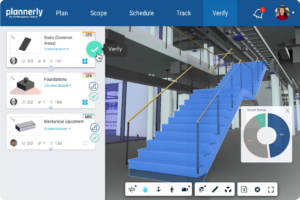
Plannerly Project DashboardPlannerly (dashboard right) essentially comprises five modules that support its ‘sweetspot’: BIM implementation in compliance with ISO 19650, its various national supporting annexes and guidance, and other international standards, classification systems, object libraries, etc. The interface is currently provided in 20 different languages (a single project might have users spread across multiple countries, but each user can tailor the interface to their local needs). Users can also import their own templates of the various elements, building a powerful resource for efficient planning and collaboration aligned with users’ corporate needs. “We try to make it super easy to start, with easy drag-and-drop tools to help people assemble their plans, schedules and other deliverables.”

“A guiding  principle is that every piece of information has a customer, and someone tasked with putting that information in place,” Jordan continues. “Plannerly provides a lean, smart tool to manage those information transactions and workflows.

  • Plannerly Verify ModulePlan simplifies the development of BIM execution plans and contracts.
  • Scope provides a visual and collaborative framework to define geometry, documentation and information requirements.
  • Schedule enables teams to collaboratively build a timeline for their BIM process delivery.
  • Track deploys a ‘lean’ approach to project management using Kanban boards to monitor progress on key tasks.
  • Verify (right) simplifies BIM compliance, connecting models and the client’s asset and information requirements.

Users can start with a single module and then add others as they need them. Plannerly’s pricing is flexible – users can get started with a single project (from US$39 per calendar month), however the most popular option are its Company plans with BIM 360 add-on and the customer’s logo and colours.

Integrations

Customers include architects and contractors but also airport operators, universities, and retail chains. “We are attracting owner-operators who appreciate BIM, and who have a long-term interest in information management,” Jordan says. “Our platform can also be integrated with common data environment solutions deployed on their projects. We are taking an extremely neutral position and have no ambition to become a CDE provider. Plannerly can, for example, share information to and from Autodesk’s BIM 360.” (Discussions are under way with other CDE providers.) Similarly, Plannerly is not competing with model checking and validation applications such as Solibri, but looking to integrate with various tools.

Jordan sums up: “Plannerly is both a tool and a process. We provide that virtual BIM expert who can look over your shoulder and keep you on track“.

Permanent link to this article: http://extranetevolution.com/2020/10/plan-early-plannerly/

AECTechTV reaches milestone

AECTech TV, the video contech news magazine launched by “Extranet Evolution” and “AEC Business” on 4 September 2020, now has over 100 YouTube subscribers.

AECTechTV 102 subscribersThey are modest milestones and it’s very early days, but AECTech TV, the video contech news magazine announced in late August (Covering the contech space: AECTech.TV) and launched on 4 September 2020 (AEC Tech TV goes live), has reached almost 1000 views. Its first 200 minutes of programming has already prompted over 100 YouTube subscribers.

I co-produce and co-present the weekly news show with Helsinki, Finland-based friend and fellow blogger and construction digital evangelist Aarni Heiskanen. And in a busy digital space where podcasts and other digital offerings are mushrooming rapidly, it seems our niche focus has begun to secure a small but growing online following.

AECTechTV: Five episodes and counting …

Five episodes have been produced to date, each between 30 and 45 minutes, and we have been testing different formats. After experimenting with some in-depth news stories (both self-produced and developed with contributor partners), we then tried being a bit more ‘newsy’. Presenting some quick-fire digests of topical news and event updates seems to be working (both for us and for viewers). Our latest shows have each had around 10 items. Some are short pieces about forthcoming events; some review recent product launches, or other news about digital construction. Some expand on material Aarni and I have produced for our respective blogs; others are entirely bespoke for AECTech TV. Content has included:

Coming soon: AECTechTV content and season sponsorship options

AECTechTV is far from perfectly polished. We are producing this during a global pandemic, with all the constraints this imposes on both us as producers and presenters, and on our contributors. We are learning about the limitations of some hardware, software, file-sharing platforms and social media (while also continuing to work on our respective ‘day job’ projects). And we are also looking at ways to fund the project. Aarni obtained funding for the production of the initial four episodes, but we are now considering various sponsorship and paid-for production package options to help fund the continued costs.

Of course, the show would not be possible without the ideas, the time spared for interviews, and the additional content shared by our guest contributors, so we plan to produce a mix of editorially-curated and sponsored items. The editorial items will reflect our view of what’s newsworthy; we will talk to the people and organisations concerned and present their views as part of our own analyses. We are also in selective discussions with potential partners about sponsored co-produced packages that might be included in AECTechTV.

If you would like to be featured in AECTechTV or are interested in a sponsored co-produced item, please email info@AECTech.tv.

AECTechTV – Episode 3

AECTechTV – Episode 4

AECTechTV – Episode 5

Permanent link to this article: http://extranetevolution.com/2020/10/aectechtv-reaches-milestone/

The NBS Construction Leaders’ Summit

In a busy month for events, NBS’s October 2020 Construction Leaders’ Summit has a stellar roster of keynote and supporting speakers.

NBS logoNBS is one of the UK’s leading construction information services businesses, capturing information from construction product manufacturers for use by designers and specifiers, and also managing the Uniclass classification system. It has also monitored the expanding use of building information modelling (BIM) through an annual survey (2018 post; the 10th edition of the survey was completed earlier this year), has surveyed AEC technology adoption trends, including those for ‘extranets’ or ‘CDEs’ (Feb 2019 post), and is pushing to put its data and cloud-based tools at the heart of digital transformation (2 Sep 2020NBS Chorus, Uniclass and CDEs).

Construction Leaders’ Summit

On 13 and 14 October 2020, NBS is hosting a Construction Leaders’ Summit – and this is perhaps a conference that (in contrast to some others) genuinely justifies the use of the word ‘Summit’. It has a stellar roster of keynote and supporting speakers, including a UK government minister, a former chief construction advisor, major figures involved in the modernisation and digitisation of the construction industry, and an eminent architect who once led Autodesk’s BIM developments:

  • Nadhim Zahawi MP, Parliamentary Under-Secretary of State for Industry, will talk about construction and political change, and how it will influence future policy.
  • Dame Judith Hackitt will cover the Draft Building Safety Bill, the upcoming regulatory changes, including the much discussed ‘Golden Thread of building information’, and discuss the impact they will have on the industry.
  • A decade ago, Paul Morrell was appointed the UK Government’s first Chief Construction Adviser with a brief to champion a more coordinated approach to affordable, sustainable construction (Nov 2009: An open letter to the new Chief Construction Adviser), and he did much to kickstart the UK BIM revolution from 2011 onwards
  • Mark FarmerMark Farmer, right, conducted the 2016 Farmer Review, an independent government review of the UK’s construction labour model entitled ‘Modernise or Die’. Also a co-chair of Constructing Excellence, in 2019 he was appointed as the government’s champion for Modern Methods of Construction in house-building.
  • Architect Phil Bernstein is also a technologist and educator. Formerly Vice President at Autodesk, he set the company’s future vision and strategy for BIM technology.

Countering pandemic and recession

NBS says:

“The double-whammy of a pandemic and a recession has made 2020 one of the most challenging and disrupted years in living memory. But the bright spot, in an otherwise battered economy, is construction, which forms a major part of the UK government’s “Build Back Better” campaign. In July, Britain’s construction industry grew at its fastest rate in almost five years, as business picked up after the coronavirus-related shutdown. However, existing challenges persist as the sector re-establishes itself, stymying progress, particularly digital adoption, or lack of. While COVID-19 has quickened the pace of technological uptake and integration in a host of industries, UK construction still lags behind the curve. A move to digital transformation, driven by legislation and a new focus on safety, will become key priorities in a post-pandemic world if the industry wants to keep up pace with the changed business landscape.”

For those looking for discipline-specific sessions, the second day will be split into two streams, one for specifiers and the other for manufacturers – but both looking at the future of the industry.

NBS Richard WaterhouseRichard Waterhouse, NBS’s chief strategy officer says:

“There’s no doubt the COVID-19 pandemic has quickened the pace of digital adoption. Currently, the construction industry lags behind the technological curve and large pockets of the sector are playing catch-up. While there are many players taking full advantage of the benefits of digital, there’s still some way to go. We wanted to curate an event which brings together the latest thinking and brightest and best minds to look at the construction ecosystem and the opportunities technology offers to build a better world.”

Taking place on the mornings (9.00 am to 1.00 pm BST) of 13 and 14 OCtober), the Construction Leaders’ Summit is online and free to attend. To register and for more details – click here.

Construction Leaders' Summit

Permanent link to this article: http://extranetevolution.com/2020/10/construction-leaders-summit/

Making data standards more discoverable

Finding the right information in the right format at the right time heightens the need for data standards, says a recent report from the UK’s RED Foundation.

With the explosion in creation of data and the resulting challenges this poses for finding the right information in the right format at the right time, two recent UK reports have highlighted the need to improve discoverability.

The first was the CKTG’s metadata standard for discoverable construction knowledge, published in August 2020 (see Standardising discoverable construction knowledge). The latest is a report from the UK-based Real Estate Data Foundation, which explores the role of standards in the flow of data across real estate, and explores some of the standards available in the UK today, including a good many that are also internationally used.

RED Foundation

RED Foundation logoThe RED Foundation is an initiative set up to ensure the real estate sector benefits from an increased use of data, avoids some of the risks that this presents and is better placed to serve society. It looks to connect people, projects and initiatives around the topic of data in the built environment, and to raise the sector’s engagement with the ethical challenges that the use of data can present. Another foundation project is looking at compiling a directory of UK public data relating to real estate.

The foundation is supported by supported by the British Property Federation, Geovation, the Institution of Engineering and Technology, the Institute of Residential Property Management, RICS, the Property Ombudsman, the University College of Estate Management and the UK PropTech Association. (In August 2020, the IET published a report on data – read: Engineers seek ‘Good data for the public good’.)

The report, The role of standards in enabling a data driven UK real estate market (downloadable here), was funded by the UCEM Harold Samuel Research Prize and produced by Dan Hughes of Alpha Property Insight.

The role of data standards

The report argues that in an increasingly digital and data-driven world, how the built environment adapts will be key for its success. The sector is seeing exponential growth in the data that is available, and greater emphasis on outcomes and on lifecycle views of decisions. The paper helps set the scene for a sector-wide discussion on what is available, what is needed and what people may need to do.

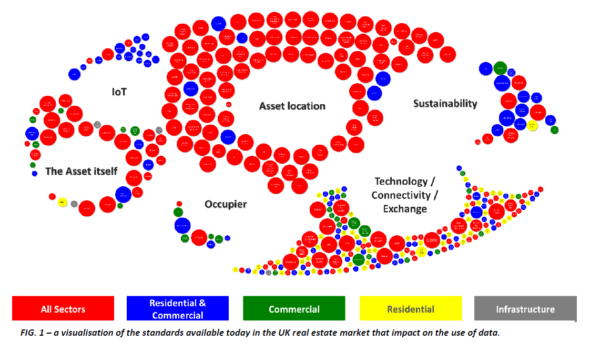
Hughes undertook a high-level review of what standards (interpreted in the broadest sense of the word) are available in the UK and which have an influence over creation, management or use of data. The report provides a visualisation of the many well-established standards, but highlights that they often tend to be focused on either a specific stage of the building lifecycle or job function. It argues: “As data is increasingly needed to inform decisions beyond the building stage or job function within which it was created, standards will need to facilitate data increasingly being used by an ever-wider variety of people.”

RED Foundation report data standards visualisation

The report also identified that awareness of all the standards available in the market was not high beyond the sector to which they were originally applied. This means that adoption and wider use of data is limited., and also leads to some overlapping or similar standards being created in isolation.

Headline findings

RED Foundation data standards report coverBeyond the flow of data, there are other challenges that the sector faces such as the discoverability of the standards available, and clarity about who is responsible for what. The report wonders how do we make sure that the flow of data works when the application of standards for collecting, managing and using data is often by very different parties.

The six key headlines from the report are summarised:

  1. Real estate has a well-established and robust set of standards about the creation, management and use of data.
  2. This often leads to an increased quality of data available in the sector.
  3. To truly realise the benefits of data in the future, data must be able to flow freely across the whole
    sector beyond the existing silos; standards have a key role to play in this.
  4. Existing standards need to be more valued and more easily discoverable to ensure wider adoption and to avoid reinventing wheels.
  5. The value and cost of standards and data needs to be recognised fairly, especially when the value might be recognised by a different party other than the one incurring the cost.
  6. It will become increasingly complex for a professional of the future to be able to have clarity or take responsibility for the data that they use and the standards that influence this data.

Next steps

The report recommends future steps in four areas:

  • Improve discoverability – industry and standard setting bodies should work together to improve the discoverability of standards relating to the creation, management and use of data. This should cover all aspects of the real estate sector.
  • Increase connectivity – standard setting bodies should explore ways of improving the connections between standards. For example, this might include a small number of agreed elements or items that are common to all standards moving forward.
  • Understand value – industry bodies and standard setting bodies should carry out a campaign to raise awareness of the value of standards across the real estate sector. This should include highlighting the cost of maintaining standards and governance.
  • The role of people – the whole real estate sector must come together to clarify the role of people in the use of standards. As the volume and variety of data used increases, who is responsible for ensuring that standards are applied correctly must be considered.

As well as the report, the RED Foundation has also published a spreadsheet of the data assembled during the report’s preparation (download here).

Permanent link to this article: http://extranetevolution.com/2020/10/making-data-standards-more-discoverable/

Former ‘Facebook for Construction’, FieldLens closing

FieldLens, the New York City-based mobile construction management technology provider, acquired by WeWork in June 2017, is set to shut down.

Fieldlens logoFieldLens, the New York City-based mobile construction management technology provider once dubbed the “Facebook of Construction” is said to be closing down. The business largely disappeared after being acquired by WeWork in June 2017 (FieldLens acquired by WeWork), and Yves Frinault of San Francisco-based rival FieldWire has talked about FieldLens’ closure on social media, saying:
Fieldwire logo

“I am pretty bummed about Fieldlens’ closure. It often takes multiple companies to change an industry and in our quest to improve the lives of craftspeople in the field, they were definitely a worthy competitor.”

Meanwhile, the FieldWire blog also invites former FieldLens users to explore its products (Why Fieldwire is the Best Fieldlens Alternative).

FieldLens backstory

FieldLensFieldLens was founded by Doug Chambers and Matt Sena in 2011 and launched the Beta service of its mobile construction collaboration service – once dubbed the “Facebook of Construction” – in late 2013. It was one of a handful of vendors who looked to change from the industry norm of email-type communication processes to mobile-friendly short-form status updates and messaging feeds (Should construction dump email?). Fieldlens formally launched in March 2014, and two months later closed an US$8m funding round.

When it was acquired by WeWork, the property business was looking for a toolset that it could deploy to support its stream of new office fit-outs. WeWork was then opening 5 to 10 locations every month. It was becoming one of the world’s largest consumers of design and construction services, and recognised the importance of information in efficient building processes. Chambers said FieldLens would also be offered as “a stand-alone construction communication product”. But it was no longer marketed as overtly as before, and began to fall from view.

WeWork logoWeWork downsize and sell-off

Since 2017, WeWork – once a £47 billion unicorn – has faced some major challenges. It filed for an initial public offering (IPO) in August 2019, then cut its valuation down to as low as $10 billion. It removed the flamboyant Adam Neumann as CEO, and then delayed the IPO indefinitely while also planning to layoff up to 6,000 employees – about 30% to 50% of its workforce (Forbes). Then the COVID-19 pandemic hit, and 100s of once-busy WeWork co-working spaces became ghost towns, barely occupied by the startups and SMEs that were once its lucrative lifeblood.

As well as cutting staff, it appears the business has also been offloading some of its proptech and other acquisitions, sometimes at huge discounts to their purchase prices. MeetUp was sold to a venture capital firm, and (according to the Real Estate Daily Beat) the “Selling spree of failed acquisitions continues: Managed by Q, Flatiron School, Unomy, Spacemob, Fieldlens, and Welkio –the list goes on and on“. However, without the energy and commitment of its founders, starved of marketing, and with many property project sites idle, it seems keeping the FieldLens business alive has proved impossible.

(Thanks to Asite CEO Nathan Doughty for the tip-off; the Asite NYC office was 11 blocks from FieldLens’ office.)

Permanent link to this article: http://extranetevolution.com/2020/09/former-facebook-construction-fieldlens-closing/

Bentley Systems’ IPO aims for $5.5 billion valuation

Bentley Systems has revised the targeted price range for its upcoming initial public offering (IPO), which could value the company at about US$5.49 billion (c. £4.28 billion or €4.68 billion).

Bentley logo 2017US-based architecture, engineering and construction software and services provider Bentley announced in August 2020 (Bentley raises IPO prospect again) that it had filed a registration statement with the US Securities and Exchange Commission for a proposed initial public offering (IPO) of its Class B common stock. Last week (15 September 2020), the company gave more details of the offering.

One Liberty Plaza, NYCBentley announced it would comprise 10,750,000 shares of its Class B common stock – all being sold by existing stockholders of Bentley. The selling stockholders expect to grant the IPO underwriters (who include Goldman Sachs & Co, BofA Securities and RBC Capital Markets) a 30-day option to purchase up to an additional 1,610,991 shares of Class B common stock from the selling stockholders. The estimated IPO price was given as between US$17.00 and US$19.00 per share. Bentley had applied to list its shares on the NASDAQ Global Select Market under the symbol “BSY”.

Today, however, the estimated IPO price was revised upwards, with the shares now targeted at a range of US$19 to $21 per share (Reuters); Bentley subsequently announced shares would be offered at US$22). At the US$21 level,  the IPO could therefore raise up to US$225.7 million, potentially valuing Bentley Systems at about US$5.49 billion (£4.28 billion or €4.68 billion). [Post updated to include Bentley pricing announcement.]

(By comparison, Autodesk and Trimble – both also NASDAQ listed – currently have a market capitalisation of around US£50 billion and US$11 billion respectively.)

Update (30 September 2020) – After strong interest in Bentley Systems shares, the IPO closed at US$22 a share on the first day (see ENR‘s report), generating US$236.5 million in IPO proceeds. Neither the company nor its directors sold shares in the IPO. The five Bentley brothers own about two-thirds of the economic interest and vote about 85% of the shares (co-founders Keith and Barry, plus Raymond and Greg, are directors; a fifth, brother, Richard, retains a 5.3% stake after selling 848,996 shares of Class B stock in the IPO). Ruling out plans to retire, CEO Greg Bentley, right, said: “We chose the ticker symbol BSY to connote ‘staying busy,’ doing what we’re doing.”

[Image: One Liberty Plaza, NYC (NASDAQ HQ) by Erik Drost via Wikimedia Commons.]

YII2020_Conference_Banner

Permanent link to this article: http://extranetevolution.com/2020/09/bentley-ipo-aims-5-5-billion-valuation/

UK publishes National Data Strategy

The UK Government’s National Data Strategy underlines the needs to improve data interoperability and to develop agreed standards if we want more effective use of data across the built environment

National Data StrategyThe UK Government has launched a National Data Strategy and has set out actions it will take to support the use of data in the UK (news release). The strategy puts data at the heart of the country’s recovery from the COVID-19 pandemic “so companies and organisations can use it to drive digital transformation, innovate and boost growth across the economy.”

The strategy lays out five priority ‘missions’ the government must take to capitalise on the opportunities data offers:

  • Unlocking the value of data across the economy
  • Securing a pro-growth and trusted data regime
  • Transforming government’s use of data to drive efficiency and improve public services
  • Ensuring the security and resilience of the infrastructure on which data relies, and
  • Championing the international flow of data

The government’s plans for a thriving, fast-growing digital sector in the UK include the appointment of a new Government Chief Data Officer. This person will lead a whole-government approach to transforming its use of data to drive efficiency and improve public services.

“A leading digital nation”

The UK is already a leading digital nation, the strategy says. Data-enabled UK service exports were estimated to be £243 billion in 2019, or 75% of total service exports.  The strategy commits to developing a clear policy framework to determine interventions needed to unlock the value of data across the economy and help the UK recovery from the COVID-19 pandemic. This demonstrated the power of technology to respond to rapidly changing health demands, to keep supermarket shelves stocked and transport moving, and to support people working from home. Existing UK strengths can be leveraged to boost use of data in business, government and civil society, the strategy says. Notably:

It proposes an overhaul in the use of data across the public sector and the government will launch a programme of work to transform the way data is managed, used and shared internally and with wider public sectors organisations, to create an ethical, joined up and interoperable data infrastructure.

Dr Jeni Tennison of the Open Data Institute said:

People and organisations of all kinds are facing big challenges over the next few years. Data can help us all to navigate them, increasing our understanding of our changing world and informing the decisions we make. Data can also cause harm, for example through over-collection and inappropriate use. At the ODI, we want data to work for everyone, which means ensuring it both gets to the people who need it, and that it is collected, used and shared in trustworthy ways.

This National Data Strategy consultation is an important opportunity for us all to explore and influence how data should be used to support the UK’s economy, environment and communities, and we look forward to the debate.

(The strategy is not set in stone; consultation questions are included throughout the text.)

Construction and BIM

In a list under the strategy’s first mission (Unlocking the value of data across the economy), construction is one of the sectors with most to gain from better data availability. And the strategy highlights the need to improve coordination and interoperability, saying:

The lack of basic coordination and interoperability both within and between organisations can drive inefficiency, a lack of accountability and an inability to thoroughly evaluate or plan. Data that is not usable, linkable or comparable between organisations means that, nationally, we lose out on … the ability to pool data from multiple sources and sectors to create new economic opportunities, or to save lives.

“Indeed, even those working on advanced technologies report that poor data foundations can be a real blocker for driving the transformative power of data.”
BIM (sic)The paper says poor data quality and, relatedly, a lack of agreed standards are clear barriers to the effective use of data, with evidence of a lack of (central) ownership of data standards/ metadata/ APIs, a lack of skills in managing data, fragmentation in the systems used to manage data, and ongoing resourcing issues linked to set up and maintenance costs. It acknowledges that these costs could be especially burdensome for smaller organisations, or for organisations who make data as a byproduct of their operations rather than as a discrete business product.

BIM: building data foundations

In section 4 – Data foundations: ensuring data is fit for purpose – the strategy talks of construction’s progress with BIM (which it misnames), but observes:

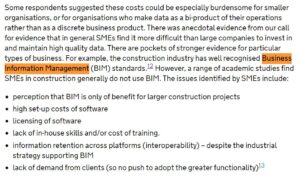
“There was anecdotal evidence from our call for evidence that in general SMEs find it more difficult than large companies to invest in and maintain high quality data. There are pockets of stronger evidence for particular types of business. For example, the construction industry has well recognised Business Information Management (BIM) standards [sic]. However, a range of academic studies find SMEs in construction generally do not use BIM. The issues identified by SMEs include:

  • perception that BIM is only of benefit for larger construction projects
  • high set-up costs of software
  • licensing of software
  • lack of in-house skills and/or cost of training
  • information retention across platforms (interoperability) – despite the industrial strategy supporting BIM
  • lack of demand from clients (so no push to adopt the greater functionality)

Digital Twins

Data for the Public GoodBIM is a fundamental building block for digital twins of infrastructure assets. The strategy follows its discussion of BIM with observations on how location data and data about the built environment have helped the UK’s National Digital Twin Programme (NDTP). It highlights the Centre for Digital Built Britain’s Gemini Principles. These set out some key steps (including more open, interoperable information) to support better decision-making across the whole life of built assets for the benefit of the wider economy, society and environment.

One of its illustrative case studies covers joint research between the Singapore government and Ordnance Survey to develop its 3D ‘digital twin’ of Singapore. Another relates to the National Infrastructure Commission’s Data for the Public Good report, and the NDTP’s ongoing development of an ‘Information Management Framework’ (IMF). It says:

“The IMF will create and enable the adoption of the common information management components to enable the integration of data in a consistent, resilient and secure manner across organisations and sectors. As the IMF is developed and approved, its parts will be made available nationally to progressively enable a UK system of trusted, decentralised and interoperable information exchange. This will create a data infrastructure for the built environment, and pave the way for the National Digital Twin.”

The Extranet Evolution view

This National Data Strategy continues the digital push that has been evident for over a decade. Even the hitherto digitally lagging construction industry is being pushed towards digital transformation. The launch of the 2011 UK Construction Strategy (post), for example, fired the opening shots in pushing adoption of BIM – championed by Paul Morrell, the government’s then Chief Construction Advisor (2009 post). Sadly, perhaps, construction no longer has such an advisor – though the government clearly thinks digital working warrants the appointment of a Chief Data Officer.

Good Data for the Public GoodIt is encouraging that ‘interoperability’ (along with ‘interoperable’, cited 38 times in the strategy) is regarded as a key requirement. This has been a recurring theme in the construction industry for years. However, there are now concerted efforts in the UK to look at the issue, particularly as it relates to BIM (see Engineers seek ‘Good data for the public good’), with a Construction Innovation Hub-backed BIM Interoperability Expert Group (BIEG) exploring the issues. But the mention of high set-up costs of software and licensing issues surrounding BIM is also a reminder of recent industry conversations about some software providers’ commercial and product strategies (Design firms demand change at Autodesk).

The Digital Secretary Oliver Dowden talks about helping British businesses make the most of the digital revolution over the years and decades to come, and positioning the UK as a global champion of data use. This echoes the ambitions of one of his ministerial predecessors, Francis Maude when he launched the UK’s BIM push in 2011 (post). Supported by Paul Morrell and his successor Peter Hansford, that BIM push helped UK prototype standards become the foundations of international standards. Many UK AEC businesses are now helping other countries improve their built environment digital capabilities.

SME digitalisation is key

As mentioned above, however, BIM adoption has not been universal, particularly among SMEs. Some businesses remain wary of investing in digital transformation (perhaps even more so now, with some businesses concerned about recessionary pressures), or sticking to the ways they’ve always done things (a GoReport survey, May 2020 post, found 39% of businesses content with traditional methods and 33% fearing change). Despite what is sometimes expressed in a few construction businesses, information technology is no longer a ‘necessary evil’, an overhead to be kept as low as possible, or simply a tactical concern (in 2018, 26% of businesses in a Plangrid survey admitted to having no technology strategy, while 36% simply bought tools on an impromptu basis – post).

The National Data Strategy will need to drive change and create opportunities at all levels. A compelling case will need to be made if BIM and other digital technologies are widely to become business as usual. In a highly fragmented industry largely serviced by SMEs, some industry practitioners will need to relax their old ways and embrace the new. As Dowden says: “… data and data use are opportunities to be embraced, rather than a threat to be guarded against.”

Permanent link to this article: http://extranetevolution.com/2020/09/uk-publishes-national-data-strategy/

AEC Tech TV goes live

AECTech.TVThe first episode of AEC Tech TV went live on 3 September 2020. The construction technology video magazine show is co-presented by Extranet Evolution editor Paul Wilkinson and Aarni Heiskanen of Finland-based AEC Business (see Covering the contech space: AECTech.TV).

AEC Tech TV episode 1

Topics covered in the first show included contributions from Europe, the United States and Australasia:

  • immersive collaborative virtual reality (VR)
  • the UK IET report “Good Data for the Common Good” (EE post)
  • Building information modelling (BIM) for FM
  • the challenges of running a virtual AEC Hackathon, and
  • Bimspot.io, an Austrian BIM technology startup.

Aarni Heiskanen, co-presenter of AECTech.TVAudience reaction to the first show has been positive, and a stream of contribution enquiries has started to flow. Heiskanen, right, says he has already recorded two items for the second episode with further recordings scheduled ahead of the next release: on 10 September 2020.

“This is a new venture and we learned a lot in creating the first show,” Wilkinson says. “There were a few rough edges, but we aim to get more polished as we expand our knowledge and work with new contributors on existing and new content slots.”

Contribute

AEC Tech TV is a weekly online show that features people and companies that envision, develop, and implement transformative digital technologies for the built environment. Each recorded show is also available via the AEC TechTV YouTube channel for online viewing 24/7 – where viewers can also quickly shift to the segment(s) that interest them most.

To share your experiences, insights, and ideas on the show, email info@aectech.tv to learn how you can contribute.

Update (11 September 2020)

AEC Tech TV episode 2

The second show includes items on:

  • International BIM standards and the UK BIM Framework
  • A Loughborough University research report on COVID-19 and construction
  • Paul Doherty talking about COVID-19
  • The RIB Nordic Connex BIM mobile viewer application (EE post)
  • A view on blockchain from Digibuild
  • Plans for a virtual hackathon run by Garage48 in Estonia

Permanent link to this article: http://extranetevolution.com/2020/09/aec-tech-tv-goes-live/

Norway’s Fonn attracts $3m, targets UK and US

Fonn, a Norwegian sofware startup raises $3m to help fund its continued expansion in US, UK and European housebuilding markets.

Fonn ConstructionNorwegian construction SaaS software startup Fonn has announced a US$3m (c. €2.5m or £2.25m) funding round led by Oslo-based venture capital firm Idekapital. Aidiom, Investinor, Skagerak Maturo and Oxer Kapital were co-investors in the business, which is based south of Bergen. It aims to “reinvent project management for construction” globally.

Fonn foundations

Fonn Construction was founded in 2016 by Jan Tore Grindheim after he had first-hand experience of poor communications, lack of documentation and inefficiency when he commissioned his own house. Looking to improve collaboration and information sharing among the various subcontractors involved, he created Fonn Construction. The prototype application was developed with support from his brother (chairman of Lean Construction Norway) and from a friend with a PhD in information technology and user experience. Backed by some investment from Innovation Norway, their initial focus was “What does the site worker actually need to get his job right?

Fonn's GrindheimThe business was launched commercially in 2018, aiming to provide site workers with an intuitive and easy to use solution that could be accessed via the web and on mobile devices (iOS and Android). It puts the latest information literally at the fingertips of site-based personnel, while providing a hub for managing communications. In less than two years, Fonn Construction was reported to have signed up over 50% of major home builders in Norway. Subcontractors started using the system for refurbishments and small projects,  and larger commercial contractors embraced the mobile and user-friendly tool on their sites. Grindheim, right, says: the firm’s success “is based on Norwegian principles of quality, and an extreme focus on user-friendliness in an industry that is lagging in digitalization.”

In 2019, a seed-funding round helped the company to grow further, and to expand into other, larger markets outside Norway. Extranet Evolution understands it has a three-strong team in the UK (including former BuilderStorm CEO David Lawrence; post) and four people in the United States. In total, the company now has over 20 FTE staff – 10 in Norway, plus some developers and support staff in Spain and Poland.

Fonn fundraising

Fonn devicesFonn was previously supported by Innovation Norway and Connect Norway and financed by investors from BAN Bergen. This has helped it grow in the UK and US to the point that around 80% of Fonn’s new sales come from these markets. Investment manager Frida Rustøen explained why Idekapital led the latest fund-raising round:

“We have been following the construction industry for a while and have met with several software companies aiming to improve project management in the space. We’ve worked closely with the management team for months, we have tested the solution, and talked with many industry players. We were amazed by the satisfaction level of their users! Fonn has made wise choices for their product by focusing on usability, and our impression is that Fonn has the best solution available. We were instantly impressed by the professional and go-getter team and the growth they have proven over the past few years.”

Jon Øyvind Eriksen, CEO of Aidiom, said: “We invested in Fonn because digitalization of the trillion USD housing sector represents a huge market opportunity. The value added from the construction sector contributes to 4% of the US GDP in 2019. Applying software to improve productivity, Fonn is positioned to become a leading platform for the residential construction industry.” Fonn says around 85% of US home builders are not using any project management software.

International growth

Fonn - Daniel SkotheimThe company’s chief sales and marketing officer Daniel Skotheim says:

“With the new capital, we intend to triple our recurring revenue over the next 12-18 months. We will continue our international growth, and at the same time strengthen our position in the Nordics.”

EE has covered other Nordic startups targeting the housebuilding sector, including Finland’s SME application HomeRun, the quality and safety management tool Congrid, and project management app Derigo (post). Skotheim, right, continues:

“Fonn is well placed to be a success in both the US and the UK for a number of reasons. The product is well-designed, easy to use and accessible to a wide range of companies – with an excellent feature set for the SME market – a market that has often been overlooked. Immediately finding a product-market-fit, we have already scaled our international presence in the US and the UK. Focus now is to further strengthen these teams with new resources.”

Market positioning

In the UK, the company featured in a recent Construction News report about the COVID-19 pandemic. As previously mentioned, the feature said technology has “proved key in the crisis,” citing use of generic video conferencing tools such as Zoom and Teams as well as industry-specific tools such as Fonn, Autodesk’s Plangrid, and Procore. UK-based Lawrence believes Fonn will be competing against tools like BuilderStorm, BuilderTrend and LetsBuild (post), saying the UK  SME construction market is still a large and hitherto largely untapped marketplace.

Small builders and subcontractors, however, are increasingly targeted with a range of different solutions. Earlier this year, for example, EE covered the London launch of Buildiro, and, in May 2019, the Snaffle mobile app – both enabling tools and materials purchasing by tradespeople. And EE recently reported the August 2020 launch of Skrap – a construction hire marketplace connecting construction businesses with on-demand skip and construction hire-related services.

Fonn’s pricing is based on the size of the customer company, and once implemented includes unlimited projects, unlimited users, and unlimited storage at no extra cost. For small businesses with revenues under US$2m, the subscription is US$149 per calendar month.

Permanent link to this article: http://extranetevolution.com/2020/09/norways-fonn-attracts-3m-targets-uk-us/

Load more