NBS Chorus, Uniclass and CDEs

Formerly part of RIBA, NBS is positioning itself to be a ‘common data environment’ technology provider, with NBS Chorus building on its Uniclass and BIM toolkit data heritage. 

Until June 2018 a wholly-owned subsidiary of RIBA Enterprises, Newcastle, UK-based NBS has been actively involved in electronic publishing and then software projects since the 1990s.

Initially, it extended its conventional ‘National Building Specification’ publishing activities to produce electronic resources for architects and other designers and specifiers. In parallel, it was also commissioned in 1997 to develop a classification system, Uniclass. This helps industry professionals find different types of related information defined by their subject matter.

Uniclass 2015 back story

CPIC Product Information guideThe Uniclass story dates back to the 1980s. Then several UK professional bodies (RIBA, RICS, BEC and ACE, representing CIBSE and ICE) established the Building Project Information Committee. (This was later renamed the Construction Project Information Committee (CPIC), and included the CIOB, CIAT, UK Contractors Group and the Landscape Institute.) It was formed to produce guidance on efficient preparation of project specifications and production drawings. In 1987, the Committee produced codes of procedure for building works covering project specification and production drawings, plus guidance on a Common Arrangement of Work Sections (CAWS) for Building Works, and a guide to Co-ordinated Project Information. These codes and guides created principles since used in the production of other industry guidance. Examples include the National Building Specification and some of the building blocks of UK and international BIM standards.

Uniclass was a logical extension of this guidance work, intended to organise library materials and to structure product literature and project information. “It works like the Dewey decimal classification system used in libraries, ” NBS chief strategy officer Richard Waterhouse told Extranet Evolution. “Specifiers can find related or alternative product types. It can also help designers who are looking for products that satisfy particular performance requirements. It’s also valuable for contractors and facility managers when they need to explore product variants.”

As industry professionals started to digitise their tasks, Uniclass incorporated CAWS and an electronic system for structured product data and product literature, EPIC (Electronic Product Information Co-operation). The first Uniclass editions emerged in 1997 but were essentially paper-based systems, and were heavily criticised for inconsistencies between the labelling and depth of tables, and for poor coverage of civil engineering works. Uniclass 2 was released in 2013, and then superseded in 2015 by Uniclass 2015.

BIM standards

Uniclass 2015 is kept under review and updated quarterly under NBS’s stewardship, Waterhouse says. “Improvements are constantly being identified – recently, people from the HS2 project and BIM4Water initiative have suggested helpful changes, for example.” Uniclass 2015 is also being mapped to other industry tools including SFG20 (the Building Engineering Services Association’s standard for planned maintenance) set to be published shortly – and RICS’s international construction measurement standards. “Partly as a result, Uniclass 2015 has not just been adopted in the UK, but in countries including Australia and Canada,” says Waterhouse.

The CPIC standards development work also led, through the Avanti initiative, to production of industry guidance on document and drawing naming and numbering conventions. To support efficient information exchange and so facilitate collaboration, it was agreed project teams needed common methods and protocols to communicate information (including how information might be managed via SaaS-based collaboration platforms – see Avanti reality check for extranets, September 2005). The outcome, eventually (and despite some scepticism – see EatYourCad Babbage Award goes to … Avanti, December 2006), was BS 1192:2007. This British standard was quickly supported technologically by several of the UK extranet vendors, and became one of the foundations of the UK’s BIM Level 2 requirements.

BIM toolkit

In parallel, NBS was also extending its work on product data to develop a BIM object source, the NBS National BIM Library (rivals included BIMStore, SpecifiedBy, Sweden’s BIMObject, and Cobuilder’s GoBIM from Norway, among others), launched in 2011. NBS was also part of a consortium commissioned in 2014 to develop a “BIM toolkit“, creating two building blocks of Level 2: the digital Plan of Works (dPOW) and a classification system for construction objects (see Why the UK BIM toolkit is a key building block, October 2014). NBS was also one of the technology vendors in the UK BIM Task Group’s BIM Technologies Alliance (a predecessor of the UK BIM Alliance‘s Technology Group* – of which NBS recently became a member).

Richard WaterhouseAt the time of the ‘BIM Toolkit’, Waterhouse said the dPOW would become an important resource to help technology vendors, particularly providers of SaaS construction collaboration platforms. It would provide a ‘common data environment’ to support sharing of structured data across a project. Classification development would see Uniclass 2 clarified, reworked and extended to ensure comprehensive and international coverage of all professions’ needs across all disciplines, including infrastructure projects, he continued.

NBS was set to be the ‘guardian’ of the BIM toolkit, using the expertise and experience gained in creating toolkit elements to offer other value-added products or services. It aimed to ensure the ‘toolkit’ would remain freely available to UK construction. Six years later, Waterhouse says NBS remains committed to supporting the toolkit, not least to ensure it fits with the growing suite of ISO 19650 standards and related guidance in the UK BIM Framework.

NBS Chorus and ‘CDE 3.0’

NBS Chorus devicesAugust 2020 marks two years since the launch of the NBS Chorus Software-as-a-Service application – NBS’s first cloud-based platform – incorporating specification, classification and BIM standards. This is one of  the “value-added products or services” developed through application of NBS’s accumulated knowledge, and, in Waterhouse’s view, Chorus can effectively perform as a ‘common data environment‘.

We are starting to see the move to ‘CDE 3.0’ – from documents to data. This is being driven by both technology and by regulatory requirements (including provisions to support Dame Judith Hackitt’s ‘Golden Thread of Building Information’, now included in the draft Building Safety Bill). It is important, though, to recognise that CDEs are not a single system solution – no more than you could ‘buy BIM in a box’ – but are about linked and dynamic data with the ability to record and compare versions of datasets.”

Waterhouse believes NBS has a suite of cloud based applications that can evolve to be this new view of the CDE:

“The BIM Toolkit can set the project requirements and identify roles / responsibilities and outputs at each stage of the project. Then NBS Chorus refines these requirements through the decision-making process, linked to the geometry models, product data (in NBS Source) and standards / regulatory data.”

Persistent product data

He continues:

NBS Richard Waterhouse“Product data is consistent in geometric (object) and data formats. It has unique IDs for products and includes links to data sheets, catalogues, etc for future reference. NBS Chorus can already function as a collaboration platform, with multiple parties given tiered levels of access. As well as design and construction team members, manufacturers and specialist contractors can be invited to write and record details of their products and systems. This improves accuracy and data capture when particular products and systems are known to be used.

“Critically, persistent product data can be maintained for the operational phase of the building, when products and systems must be maintained or replaced. This ensures that any new products at least meet the original design performance requirements. The persistent data is also critical to maintaining consistent data over time. We maintain versions of the product data so that, in the future, users can refer back to the original documentation.

“Over time, we will see the concept of ‘documents’ moving to be ‘model’ or ‘data’ views, each recorded at a date and time. NBS has already reshaped the integration between the geometry model and specification / product data in the UK, and this is also interesting customers in international markets. There is a logical extension to this integration with many of the process and audit-trail requirements of a ‘CDE’ (as we currently use the term).”

[* Disclosure: I am chair of the UK BIM Alliance’s Technology Group and a member of the Alliance executive team.]

Permanent link to this article: http://extranetevolution.com/2020/09/nbs-chorus-uniclass-cdes/

Engineers seek ‘Good data for the public good’

In ‘ Good Data for the Public Good”, the Institution of Engineering and Technology has called for AEC software vendors to adopt a more open approach to data in the 21st century.

The UK-based Institution of Engineering and Technology (IET) paper, Good Data for the Public Good (downloadable here) has been written by members of Autodesk’s EMEA Engineering Executive Council, and calls for software vendors to help their customers and end-users of data to support whole life working.

Good Data for the Public Good“To deliver operational benefits for owners, operators, occupants and users of built assets throughout their whole life, we need data that’s perpetually accessible while also being securely managed. Simultaneously, to deliver wider social, economic and environmental benefits, we also need data to be open. This doesn’t mean free; the openness of data is about its interoperability and ease of distribution.

“These aspirations inevitably challenge existing industry practices and some entrenched commercial positions. As industry practice has begun to shift from document sharing to data sharing, the role of established technology providers may also need to change. Today’s architecture, engineering and construction (AEC) software providers will need to review how they might best capitalise on the rapidly changing nature of built environment data in the 21st century.

Good data for the public good

Data for the Public GoodThe paper’s title is a conscious expansion on the UK National Infrastructure Commission’s November 2017 report’s title Data for the Public Good. That set out a roadmap towards a ‘national digital twin’ for the UK’s national infrastructure enabled by secure sharing of high quality, standardised data. The Centre for Digital Built Britain’s Gemini Principles followed a year later, expanding industry discussion about connected data, artificial intelligence, machine learning, etc (read EE February 2019 post AI, Machine Learning, construction and bots), including an article by one of the IET report authors – Neil Thompson of Atkins – in Building magazine.

The report’s other authors – Marius Jablonskis, Cathrine Morch, Joop Paul, Andrew Victory and Alain Waha – are also drawn from prominent European engineering firms active in the built environment: Norconsult, Sweco, Arup, Arcadis and Buro Happold, respectively.* In their executive summary, they say:

“To deliver operational benefits for owners, operators, occupants and users of built assets, we need data to be:
– Maintained obligatorily throughout their whole life,
– Aligning asset and asset data ownership, and
– Perpetually accessible while also being securely managed.
Simultaneously, to deliver wider social, economic and environmental benefits, we also need data to be:
– Mutualised: to be open, connected and easily shareable, and
– Long term accessible.
To achieve this, stakeholders in the built environment will have to reconsider their strategic choices, especially software providers that may overhaul their current technology business models.”

Breaking down proprietary data silos

Particularly in its section about delivering societal benefits, the report highlights how data silos – between disciplines, and between proprietary software applications, including BIM tools – have hampered effective collaboration and data sharing. It cites internet and web standards as classic examples of how open approaches can foster efficient communication and data exchange, but says standardised AEC data approaches are still in their infancy. “The long-term aspiration has to be an open digital twin model architecture rather than proprietary data scheme solutions.

On long-term data accessibility, the report continues:

“Built asset and related business operation data, therefore, needs to be collected and stored in a form that ensures it remains securely accessible by asset owners and their partners over the long-term – resiliently and reliably outliving changes in hardware, storage media, software and operating systems.”

How might software vendors evolve?

The report discusses different scenarios about how asset owner-operators, the AEC industry and especially its software providers might need to adapt.

1. Tool-maker – do software providers want to remain focused on helping industry professionals create and combine design inputs?
2. Market/integrator – should software providers be the technology platforms used by teams to integrate design inputs into built asset outcomes?
3. Data holder/broker – could software providers become the ‘digital twin’ hosting hub, connecting, aggregating and delivering whole life data about built assets?
4. Technology hub – could software providers be a GitHub, a place to manage public and private repositories of built environment and data software?

The authors wonder if vendors might need to shift from their current positions:

1. Status quo – do software providers remain a strong defender of its proprietary data format, viewing this as centre of a life-cycle platform to which others can contribute?
2. Visionary – do software providers become an advocate of open data formats, backing database management systems (DBMS) research, and making all products fully Industry Foundation Classes (IFC)-compatible?
3. Evolutionary – do software providers adopt an ‘inbetween’ option, reluctantly bending to external pressure to be more open?

The report finishes by suggesting Autodesk might need to overhaul its business model;

autodesk logo“AEC software providers like Autodesk are uniquely placed to influence how operational outcomes can be enhanced through innovative use of applications and data. However, in an increasingly globalised and connected world that faces major urban, social, economic and environmental challenges, late 20th century technology business models may need to be overhauled.”

An Extranet Evolution perspective

The IET report is a timely contribution to industry conversations about interoperability, the future of data, digitalisation and whole life approaches to built asset information. As previously mentioned (28 July post),  recommendations from the CDBB’s BIM Interoperability Expert Group (read the BIEG final report here) received widespread approval following consultation across the sector. And a series of workstreams  have since been instigated by CDBB to implement the BIEG report recommendations.**

The IET document is also timely for its discussion of 21st century software business models. A growing number architects’ firms have publicly expressed their unrest about Autodesk about the costs of Revit software, its lack of development, and its poor support for interoperability (see More designer unrest about Autodesk). This started as a UK-led protest, but it has gathered momentum across Europe and led to revelations about similar disquiet among architects in Australasia and South Africa. The IET paper does not mention Revit directly, though it does touch on software issues (saying  BIM “effectiveness is hampered by silo mentalities, poor interoperability and variable support for open data models”). However, the report is a sign that some of Autodesk’s most prominent EMEA engineering customers also feel that the vendor might need to change its data philosophy and so help engineers to deliver long-term data for the public good.

Disclosures:
* I provided some technical author support to the Autodesk EXC group working on early drafts of the document.
** Representing the UK BIM Alliance’s Technology Group, I am supporting a CDBB BIEG workstream looking at the “AIM CDE”.

Permanent link to this article: http://extranetevolution.com/2020/08/engineers-seek-good-data-for-the-public-good/

Skrap: automating construction hire

Self-proclaimed skip hire disruptor, London’s Skrap has raised £1.2m and plans expansion to cover other construction hire needs.

Skrap logoSkrap, a London-based startup, has raised £1.2m in seed funding as it sets out to transform how everything is hired in the construction industry by making it available on-demand. It claims a reputation as a ‘skip hire disruptor’ and plans to innovate in other parts of the industry including concrete, portable toilets, and machinery.

Founded in 2017, Skrap is a construction hire marketplace connecting construction businesses with on-demand skip and construction hire-related services. The entire process is managed via a mobile app (Apple iOS or Android).

Skrap teamFounders Marwan Field, Hussain Hilli and Ahmed Rao experienced problems while running a construction business. Logistics were unorganised and fragmented; prices were asymmetric, and the marketplace of suppliers and brokers were doing everything manually.

Skrap was founded with a vision of allowing SME builders to order any construction hire service at the click of a button. Skrap says its 25-strong team is building the world’s first app dedicated to automating construction hire. It has been trialled with 100s of suppliers across London, Manchester and Birmingham to complete over 10,000 deliveries to 1000s of construction companies, large and small. Skrap aims to automate entire construction hire supply chains across major cities globally over the coming years.

According to Skrap, almost 100m tonnes of construction waste is collected in the UK annually. Construction businesses spend £5bn in collecting this waste, and a further £15bn on other hire services.

Skrap’s funding round

The fundraise was led by Vanneck Investments, with participation from a host of entrepreneurs and angels investors including Charles Songhurst, Eamon Jubbawy (Onfido), Anil Stocker (MarketFinance), Paul Huntingdon (ARM), Adrian Beecroft, Dennis Stevenson, Peter Brodnicki (MAB), Jay Radia (Yieldify, Reachdesk), and James Hind (Carwow).

Skrap graphicHussain Hilli, co-founder at Skrap commented:

“We’re thrilled to have some amazing investors on board and look forward to leaning on their expertise as we broaden the horizons for Skrap. Our team has huge ambitions to scale across the UK and globally. Having laid the foundations in skip hire, we are fast expanding in all construction hire verticals. Skrap is making its mark in industry by introducing the first mobile app that makes it simple and convenient for construction companies to access resources they need.”

The UK construction hire industry is a £20bn market, yet it is poorly served with services not fit-for-purpose in a digital age. Skrap is well positioned to bring innovative solutions to help transform the industry and make it one beacon of industry once again”.

SME appeal

Corecon logoThis is the latest in a long series of occasional Extranet Evolution posts looking at SME-oriented solutions in construction. Earlier this year, for example, EE covered the London launch of Buildiro, and, in May 2019, the Snaffle mobile app – both enabling tools and materials purchasing by tradespeople.

Most construction markets are fragmented and heavily dependent upon small and medium-sized businesses. Other solutions aimed at small builders include Australia’s Tenderfield, and SmallBuilders, the UK’s BuilderStorm, California’s eSUB and Corecon, and New Zealand’s TidyBuild,

Browns skip truckLast month (July 2020), Corecon announced a new mobile application geared specifically for construction field staff who often travel between office and jobsite. As it uses the same APIs used by Corecon’s browser solution, information can be entered in either solution, eliminating the need for data synchronisation across devices.

Update (30 September 2020) – Skrap is not unique in trying to connect skip-hiring services; some individual waste management firms are looking to do the same. For example, Stoke-on-Trent, UK-based skip-hire firm H Brown Recycling worked with Nottingham-based digital marketing agency Adtrak to offer a similar facility.

Permanent link to this article: http://extranetevolution.com/2020/08/skrap-automating-construction-hire/

Permanent link to this article: http://extranetevolution.com/2020/08/standardising-discoverable-construction-knowledge/

Covering the contech space: AECTech.TV

AECExtranet Evolution is collaborating with Finland-based AEC Business to launch a new video magazine focused on the construction technology sector: AECTech.TV.

Paul Wilkinson and Aarni Haiskanen have collaborated in the past on podcast projects. The duo are now compiling an initial series of weekly magazine programmes. They aim to cover the game-changing technologies and trailblazing companies which are redefining the future of architecture, engineering and construction.

AECTech.TV

Aarni HeiskanenHaiskanen, right, says AECTech.TV will be a video channel that’s on the pulse of the digital transformation:

“Technologies evolve much faster than our capacity to make use of them. Will technology make or break your AEC business? It is more important than ever to know where technology is headed and what opportunities it creates for new and existing businesses. So this is the perfect time to critically rethink how you operate and make money in the built environment sector.”

Wilkinson says

“I have collaborated on an increasing number of podcasts, webinars and videos in the past couple of years. Like most people during the COVID-19 pandemic, I have seen growing use of video tools as people work from home. So, AECTech.TV aims to capitalise upon that new willingness to use do-it-yourself, low-cost audio-visual technologies. We want people talking about their businesses, their projects or their key issues. AECTech.TV is a magazine-style programme where contributors can voice opinions, share case studies, talk about their startups, or walk us through their projects or even their offices.

AECTech.TV is a weekly online show that features people and companies that envision, develop, and implement transformative technologies. The first edition is scheduled for release at 4pm BST on Thursday 3 September 2020, but each recorded show will also be available via the AECTech.TV YouTube channel for online viewing 24/7.

To share your experiences, insights, and ideas on the show, email info@aectech.tv to learn how you can contribute.

Permanent link to this article: http://extranetevolution.com/2020/08/covering-the-contech-space-aectech-tv/

RIB launches Connex platform

RIB Software’s Scandinavian development team in Copenhagen has been extending the capabilities of the former Docia toolset, applying an ‘open BIM’ approach to delivering new Connex BIM functionality.

RIB software logoStuttgart, Germany-based RIB Software, now part of the French Schneider Electric group, has expanded through a series of acquisitions in recent years, while also growing its Software-as-a-Service capabilities. A lot of the corporate focus has been on RIB’s enterprise solution, MTWO. However, the group has also continued to invest in its existing product portfolio, developing building information modelling (BIM) and other capabilities that will, in due course, be extended to the MTWO ecosystem.

The Docia ByggeWeb back story

In July 2014, RIB acquired Docia, the Copenhagen, Denmark-based provider of a SaaS collaboration platform, ByggeWeb (see this 2011 EE interview) for around €20m (c. £16m). This helped RIB grow its SaaS earnings (previously also boosted by the 2012 acquisition of Australia’s ProjectCentre – post). It was also exploring ways to extend cloud adoption among contractor customers of its on-premise iTWO enterprise resource planning solution.

Mads BordingIn 2018, Extranet Evolution talked again to Mads Bording, right, former Docia CEO now COO of RIB, about the next steps in RIB’s software development (RIB plans further cloud expansion). Docia and iTWOcx (the former ProjectCentre) remained part of the “iTWO ecosystem”, Bording said, supporting document management customers in their respective regional markets. He then described how the the company had invested in re-coding its core client-server iTWO 5D platform so that it could also be deployed as a cloud-enabled platform. In May 2018, the company had engaged with Microsoft as a development partner to offer RIB via the Azure cloud, as MTWO (rather than iTWO), with hybrid on-premise hosting as an option where customers required more stringent security.

The long-term vision, according to Bording, was to consolidate everything into the core platform. All software development would be focused on the same technologies, creating a Platform-as-a-Service capability, with an ‘open BIM’ philosophy and open APIs to connect to complementary applications. In 2018, RIB Group revenues grew 26%, boosted by its SaaS operations, with the Microsoft partnership expected to grow its SaaS user base ten-fold in 2019. Fourteen M&A deals were completed in 2019, a year in which RIB grew revenues 57% and increased its MTWO/iTWO 4.0 user base from 3,000 to 69,337.

RIB’s Connex BIM

RIB Connex portfolioHowever, other parts of the RIB product portfolio have not been starved of R&D investment. Nicholas Holst, chief product officer of RIB’s Denmark-based operation, talked to Extranet Evolution about its new Connex BIM platform. Complementing the Byggeweb platform (aka RIB Project), the new Connex tools include a a process management platform, BIM capabilities and mobile device functionality designed to break down data and inter-disciplinary silos within and across project teams.

According to Holst, construction project teams typically use numerous different applications, many of them point solutions which lock users into proprietary data silos. These hamper information sharing inside projects, and also prevent companies from exploiting data across multiple projects. His team (which includes Pavel Antonov, formerly at Kapio – post, and Lucas Graversen) has developed Connex process management, a workflow engine that ‘out of the box’ provides various standard workflows, plus the ability to customise these workflows and develop new ones.

RIB Connex project viewThe user interface features a dashboard view of tasks related to an individual’s role and responsibilities. From the top-level view, users can drill into individual projects, with the status of different tasks evident from PowerBI pie-charts
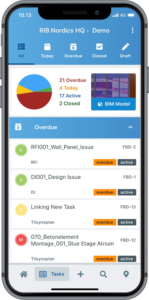
RIB Connex mobile workflowsIn parallel, Connex BIM has been developed using open IFC standards to provide rich BIM functionality, including support for BIM-related processes (Antonov explained how an IFC model could be imported and then used to propagate workflows related to particular zones in the model, for example). The team is also developing ISO 19650-compliant processes that will provide RIB with a ‘Common Data Environment’ product in 2021; as part of this work, the platform will also support BCF open standard-based workflows.


The RIB strategy of open APIs is also evident: Holst described how various RIB ‘micro-services’ can be used to connect to third party solutions (similar to Autodesk’s Forge approach), allowing easy export and import of data, and outputs to other project solutions including Trello, BIM 360, BIMCollab, and SharePoint. And RIB’s platform-based approach also means that Connex tools and micro-services will be capable of incorporation into its MTWO/iTWO systems.
RIB Connex mobile BIM

September 2020 launch

Connex BIM launchMuch of the new Connex functionality is being made freely available (subject to some caps on certain features and on usage volumes), as RIB seeks to foster pan-project collaboration by a community of users. Usage is not confined to computer web browsers, as RIB has also developed mobile applications (Apple iOS and Android) to encourage site-based use to manage individuals’ tasks.

A Connex BIM 3D mobile viewer has also been developed, and is set to be launched on 1 September (register for the  online launch event), with a browser viewer scheduled for release in late 2020.

Permanent link to this article: http://extranetevolution.com/2020/08/rib-launches-connex-platform/

Bentley raises IPO prospect again

Bentley logo 2017On Friday 21 August 2020, US-based engineering design and collaboration software-as-a-service vendor Bentley Systems announced it had filed a registration statement with the US Securities and Exchange Commission for a proposed initial public offering (IPO) of its Class B common stock. The shares of Class B common stock to be sold in the offering will be sold by existing stockholders of Bentley. The number of shares to be offered and the price range for the offering have not yet been determined (though a figure of US$800m has been bandied about). Bentley said it intends to list its shares on the NASDAQ Global Select Market under the symbol “BSY”.

Monica Schnitger has written a quick note summarising her initial analysis of the offering.

Since 2016, Bentley has been cultivating a strategic relationship with Germany’s Siemens (post). The company had built a 9% holding in Bentley’s voting stock by early 2018 (post).

The latest Bentley announcement follows a registration statement tabled in February (13 February 2020 press release) – the same day as Schneider Electric announced a €1.4 billion (c. £1.16 billion or US$1.52 billon) bid for RIB Software – since completed. Also in February, California, US-based construction collaboration SaaS technology provider Procore also filed registration documents with the SEC for an IPO of its common stock (news release) just before the COVID-19 pandemic sent financial markets plunging (Procore IPO in for prolonged coronavirus lockdown?).

Technology response to COVID-19

Construction was also pushed into a widespread lockdown across most developed economies, with governments spending billions to keep businesses and projects alive (UK construction firms claimed £2.9 bn in furlough support up to 31 July). Most projects have, however, resumed – helped by the 1000s of businesses who have used technologies to enable digital remote working. In the UK, for example, a recent Construction News report said technology has “proved key in the crisis,” citing use of generic video conferencing tools such as Zoom and Teams as well as industry-specific tools such as Autodesk’s Plangrid, Procore and a Norwegian construction management application Fonn. But site-based safety precautions have continued to affect construction productivity and, facing a recession, a growing number of UK construction firms have been making redundancies. So, while the value of construction technology has proved key, it is by no means certain that it can entirely mitigate the continued economic impacts of the pandemic across the sector.

Procore report graphic

(Procore has published a report on the Future of Work based on a survey of 250 UK construction managers.)

Permanent link to this article: http://extranetevolution.com/2020/08/bentley-raises-ipo-prospect-again/

More designer unrest about Autodesk

The recent UK-coordinated criticism by architects’ firms of Autodesk and its software development and licensing practices is nothing new. Similar approaches have been made in Australasia and South Africa.

autodesk logoUnrest about Autodesk and its market dominance has been building for some years. Even before the company was criticised by 35 named architects last week, rumblings of discontent have been heard for at least a decade. And London-based Iain Godwin’s coordination of an open letter to Autodesk is not the first time that architects have come together to voice concerns about the rising costs of ownership of Revit and other Autodesk products, lack of development, and complexity of licensing.

Asia Pacific and South African Autodesk agitation

ANZ letterGodwin says that six years ago, in 2014, a 12-strong group of large Australian and New Zealand practices sent a letter to Autodesk’s sales director for its Asia Pacific region, stating:

“We feel that the value for the money that we have been spending on the software subscriptions has been diminishing steadily, most noticeably in the last 2 or 3 years. We also feel that the annual enhancements to the software are not being sufficiently driven by existing user requirements – it appears that marketing driven changes are much more dominant.”

The whole letter has been shared on Linkedin. As well as the 12 signatories, several others offered support but were not prepared to sign for fear of compromising their relationships with Autodesk (surely a troubling sign of the levels of trust between the vendor and its customers). As well as additional subscription costs, it also noted an unfavourable pricing differential between US firms and those in Australasia, and highlighted issues affecting collaboration and interoperability:

The annual change in file format and lack of backward compatibility of Revit versions prove to be an immense challenge to our requirements for collaborating with a varied group of consultants on different projects.”

Apparently, the net response from Autodesk was ‘”no letter, no email, no phone call. Nothing!”

In South Africa, a few weeks before the UK Open Letter to Autodesk was sent, a group of architectural firms got together and requested a session with their local Autodesk representative to express their concerns on the same topics: cost and lack of development of tools. This apparently resulted in a number of Zoom meetings and email exchanges, eventually being escalated to a call with Autodesk executives in Barcelona. However, one of the IT directors involved told Godwin the end result was just “a political response”.

Updates

(10 August 2020 – 7.30pm BST) –  The open letter to Autodesk group has now been backed by a further 14 named architectural practices, including firms in the UK, South Africa, Netherlands, Italy, America and the Czech Republic. In addition to the total of 49 signatories, an additional 15 firms have anonymously backed the survey, wary of repercussions.

(20 August 2020) – Anthony Frausto-Robledo, editor-in-chief at Architosh.com has written about the Open Letter (An Unhappy Marriage: Autodesk Revit Users Unite Around Open Letter), talking to the several members of the original group, plus 3DRepo’s Jozef Dobos. Meanwhile, 37 further signatories* have been added to the open letter bringing the total to 86, plus 17 additional anonymous supporters, making 32 in total. And, on 17 August, Autodesk CEO Andrew Anagnost provided his own response: Autodesk and the Architecture Industry.

(11 September 2020) – Iain Godwin reports an additional 35 practices signing up to back the letter. This brings the total to 166: 118 named and signed, with another 48 firms backing the survey anonymously. Godwin says Autodesk has also held two ‘listening’ meetings, one with Autodesk executives and another with the AEC/ Revit development groups.

[* “To streamline the process, the ‘Letters to Autodesk’ website now has a section where applicants can easily fill in their practice name, details and any notes, to be quickly added to the signatories.”]

Permanent link to this article: http://extranetevolution.com/2020/08/designer-unrest-autodesk/

Asite supports Africa’s Exceptional BIM

Growing Africa’s BIM capabilities is facing new challenges due to COVID-19, but Exceptional BIM, an online learning portal backed by Asite, is aiming to maintain momentum.

BIM Institute logoBIM adoption in southern Africa has historically lagged more developed markets such as Europe, the US and the Asia Pacific region (Dec 2016: South Africa lagging …). However, there is a thirst for BIM knowledge, says Vaughan Harris, until recently president of the Cape Town, South Africa-based BIM Institute.

In July 2020 (announcement), Gregory Mofokeng, secretary-general of the Black Business Council in the Built Environment (BBCBE) and also a member of the Engineering Council of South Africa, was appointed as the new director of the BIM Institute. Harris says, as part of its transformation, the institute’s education and research arm, BIM Academy Africa will remain the official training partner of the BIM Institute.

NAVBIMHarris, the BIM Institute and BIM Academy Africa have worked hard to expand industry adoption of BIM across the continent. In 2016 Harris launched a construction software journal; in November 2018, a new African BIM portal: NavBIM was launched; and in early 2018, he published an e-book promoting BIM in southern Africa. While interest in BIM has been growing, Harris told Extranet Evolution that the COVID-19 pandemic is threatening to slow progress, particularly as it has hampered conventional face-to-face BIM education efforts.

Exceptional BIM

For the past four months, trying to build new momentum, Harris has been developing a new online BIM learning platform, integrated with the NavBIM portal, called Exceptional BIM.

Exceptional BIM tiersHe has applied gamification and social networking approaches alongside his own interests in martial arts to create a tiered approach to BIM learning. A newly enrolled learner will be a BIM Ninja. As they complete courses they must earn learning certificates and BIM badges (Active Member, Commentator, Extroverter) and progress, first, to BIM Warrior and then, via more certificates and badges to BIM Samurai. After completing the third tier, successful learners will be BIM Sensei. The martial arts phraseology also extends to a ‘BIM Dojo’. This is a group of experts, some drawn from supporting businesses (including Ireland’s Arcdox, UK-based BIM training provider White Frog, and US-based Plannerly – coincidentally, Extranet Evolution recently spoke to Plannerly’s co-founder and CEO Clive Jordan).

Exceptional BIM logoTraining courses are competitively priced – on the first tier, for example, the offer is “Pay for ONE and get ELEVEN courses FREE”, at a cost of US$100. Companies can invest in training packages for their employees who can then pursue their chosen courses at their own pace. Interestingly (and perhaps a recognition of the continent’s connectivity issues), Exceptional BIM recommends users follow the courses on mobile devices.

To date, Exceptional BIM has trained over 1,000 professionals in BIM and provided more than 750 students with learning programmes.

Asite backs Exceptional BIM

Asite logo 2012Active in South African since 2014 (post), London, UK-based SaaS construction collaboration technology provider Asite is sponsoring the online learning programme. Ritesh Narain, Asite EVP for India and MENA, said:

“Asite is delighted to be part of an initiative that promotes the use of BIM throughout the continent of Africa, helping to upskill workers and give many their start in BIM.

“For years Asite has been at the forefront of the integration of BIM across the sector. As such, we have seen BIM grow and develop to become one of the most exciting aspects of the industry. There is no doubt that BIM Academy Africa will play a crucial role in achieving this same level of excitement across the region, and we are thrilled to bring our expertise to the growing conversation and drive real change.”

Harris, once a business development manager for Asite, says:

Vaughan Harris“Africa needs guidance during these transformative times. Most companies need to move in a new direction: start-ups must professionalize, product and service innovations must be accelerated, and competitive positioning must be strengthened. I am proud to give Africa a launchpad to assist them through this journey.

“We are a living entity within our digital built environment, and we all have a professional role to play. With remote-working technologies presenting industry opportunities for many organizations across the globe. Together with Asite, we believe that Exceptional BIM can educate and grow an enthusiastic industry to build back better together! Fortune favours the brave.”

Permanent link to this article: http://extranetevolution.com/2020/08/asite-supports-africa-exceptional-bim/

Resolving extends mobile-first approach internationally

Well-established in France, Resolving is extending its mobile-first application to support international markets and BIM-based processes. The solution captures field progress, conformity inspections, commissioning and other field activities.

There have been numerous changes of ownership among the leading vendors of Software-as-a-Service construction collaboration technologies in recent years. The spate of mergers and acquisitions has also been accompanied by frequent moves between companies. Some of these are forced – the acquirers may replace existing personnel with their own appointees. Other moves are voluntary – employees may grab the opportunity to take their skills and experiences to new employers, some of whom may be keen to recruit industry-leading expertise.

In the 30 months since Oracle first bid to buy Aconex (December 2017: Oracle set to buy Aconex) – a US$1.2bn deal finally agreed by Aconex shareholder in March 2018 – several staff from Aconex and its various buys (including the UK’s BIW Technologies*, Germany’s Conject, US-based Worksite and Australia’s Grazer) have moved on (read: Oracle launches Aconex Model Coordination). A handful are now with Paris, France-based construction project management software provider Resolving, helping it to target English-speaking markets.

Resolving – a digital accelerator

Resolving describes itself as a “digital accelerator” of real estate and construction sectors. It is a mobile-first platform designed to support design, construction, operation and deconstruction (decommissioning) phases (thus appealing to customers interested in circular economy thinking – French multinational Suez is one example – news release). Resolving combines construction process management, document management and open BIM (it is a member of BuildingSmart France) with powerful reporting dashboard features and APIs to connect with all existing vendors.

Around 40% of its French customers use Resolving as a single platform for field management and document management. Many of these (general contractors, asset owners, project management and engineering firms) also use Resolving to support BIM-driven projects as their ‘common data environment’ (CDE) and to digitise their internal processes (field quality control and data capture).

The company was founded in Lyon in 2003 and was initially focused on the French market. But in recent years, the now 50-strong business has started to market itself more internationally, opening offices in London and Hong Kong, with a Middle Eastern base starting soon. It is looking to disrupt competitors including France’s FinalCAD, Autodesk’s BIM 360 Field, Viewpoint’s Field View, Aconex Field and Snagr, and claims to have tripled its revenues in the past 18 months.

Mobile-first

Franck MeudecOne of the key figures in this recent shift is Franck Meudec, right, the founder of Wapp6, acquired by Conject in 2014, who joined Resolving in April 2018 as vice-president and CEO (news release). Meudec is a veteran of the SaaS construction collaboration scene, having worked with BuildOnline in the mid-2000s (September 2006: Changes at BuildOnline) and its rebranded successor CTSpace, acquired by a French buyer, Sword Group, in December 2007, and later bought by the UK-based Idox Group (November 2011: IDOX acquires CTSpace for £11.6m cash). Once at Conject, he led the company’s rapid development of its mobile defects and inspection management tool, launched in May 2014 (Conject fleshes out its mobile defects offering), and stayed with the business through its 2016 acquisition by Aconex, only leaving after Aconex was bought by Oracle.

Meudec has been joined at Resolving by other veterans from the BIW/Conject/Aconex/Oracle business: Nick Sansome, Richard Moyle, Chris Woodbridge and Hervé Hamelin. They are helping to internationalise the Resolving platform to suit English-speaking markets (the company has already won customers in the US, Middle East, Africa and Asia on hotels, residential and transportation projects), and to develop its functionality to support BIM process demands, welcoming the company’s investment in R&D (comprising 15 of the company’s 50 staff).

Resolving screengrabs

High-resolution interface

Resolving’s solution initially targeted existing asset owners and was first developed on the Apple iOS platform. An Android version quickly followed, and a full Windows mobile app is also in development. The interface offers high-resolution views of detailed floor plans (some projects have thousands – one project in Macau had 30,000; among its reference customers, Resolving is the client standard for Mandarin Oriental Hotels), allowing users to view DWGs and PDFs. When used for defects management, Resolving offers conventional ‘Pin to Plan’ features, with data capture streamlined through 100s of templates for standard types of defects (dents, scratches, stuck doors, etc). It also has powerful control forms with high levels of field-level security.

The Resolving processes also work in a BIM-enabled environment, supporting IFC and native Revit, with issues managed using BIM Collaboration Format (BCF). A COBie export tool is also in development. Models can be viewed in the mobile application, and used for data capture processes (checksheets, inspections, progress-checking) as well as access to associated documentation. 2D viewing is also offered, with workflows for reviewing, comment, mark-up and comparison.

(* I was head of communications at BIW Technologies from 2000 to 2009, working with several of the current Resolving team.)

Permanent link to this article: http://extranetevolution.com/2020/08/resolving-mobile-first-collaboration/

Load more