‘Internet of Things’? BMSs have been streaming data for years. Data for post-occupancy evaluation? Ditto. London-based Demand Logic builds collaboration around energy data.
 When I first heard of Demand Logic, my initial thought was that it might be a startup business riding the crest of the current new-build BIM boom in the UK, but the more I learned about it from chairman Sonny Masero and CEO Joe Short the more I realised this is a company whose application and services are just as relevant to many existing buildings, regardless of whether they have been designed using BIM or not. It also features strong collaboration and data analytics capabilties attractive to organisations involved in Smart Cities initiatives (Demand Logic is also a successful graduate of the Cognicity Challenge – see previous post).
SaaS-based data analytics and visualisation
Over a coffee near their Islington, north London office, Joe said the idea of Demand Logic first emerged in the late 2000s, but it took a few years to turn this into a functioning product. One of the first customers was London’s King’s College University who started testing a “minimum viable product’ in January 2013, retrofitting it in a mix of buildings of different sizes and ages across three London campuses. In the first nine months, the University identified £390,000 in energy savings alone, plus other benefits, including recommendations on energy management, maintenance and occupant comfort (see case study). Other customers gradually followed suit, and the last 6-8 months have been “ballistic,” Joe said.
 Demand Logic involves the installation of a small piece of hardware (a DAD – data acquisition device – roughly the size of a small book, with installation taking less than half a day, sometimes less than 25 minutes) that plugs into a building’s existing building management system, BMS. But the company is not a hardware provider – the DAD is merely a ‘gateway’, a data collector for Demand Logic’s core Software-as-a-Service application. The DAD helps the software gather data about all the BMS assets, starting first with a “major plant review” capturing the major heating, ventilation and air conditioning (HVAC) items – eg: boilers, chillers, pumps – but, after a few days, gradually extending to a complete map or record of the entire system down to terminal units – eg: thermostats and similar controllers. (We talked briefly about Asset Mapping, another London-based startup which I saw present at a London data event in January and which has been collaborating with Demand Logic.)
 Data can be collected from most BMSs almost regardless of their manufacturer or vintage. “We are a neutral data partner, able to collate lots of very granular data from all types of BMSs including many originally installed in buildings in the 1980s,” said Joe. “And we have found that, despite this data being available, many organisations have never capitalised upon it.” Was this due to apathy or ignorance, I asked.
“Not really. The main issue has been that building controls guys or facilities managers have been under-resourced – many organisations don’t appreciate their HVAC systems are the equivalent of small factories; a chiller can use as much energy in half an hour as might be saved by a year of user behaviour changes.”
Demand Logic is now capturing over 20 million data points a day from a range of buildings. As well as educational institutions, its systems are now monitoring clients‘ office buildings, a data centre, banks, a national newspaper, and several blue-chip corporate HQs.
Data-based collaboration
Customer staff and authorised supply chain partners can login to the Demand Logic HTML5 web interface (so accessible across multiple mobile devices) and start to review and analyse data, stored in a secure cloud environment, about their buildings’ systems. The interface offers a range of data presentation tools from timelines to scatter diagrams to help summarise trends and to identify anomalies. Users can also use the platform’s social collaboration features – which has an interface clearly influenced by social media – to discuss issues, agree actions and test out hunches based on both current or historic data. Maintenance, repair or upgrade tasks can also be managed from suggestion stage right through to completion.
Inevitably, perhaps, we did talk about BIM, and it seems growing awareness of the power of data and of ‘Government Soft Landings’ has seen an increase in the number of enquiries from businesses involved in new-build projects and looking at whole-life costs and post-occupancy evaluation. “We find organisations wanting large glass buildings increasingly need an agent-based Big Data ‘lens’ to provide real-time insights into their energy use,” said Joe. Demand Logic is therefore being used on more commissioning projects, helping designers and occupants understand the inter-relationship between building fabric, systems, people and their behaviours.
Demand Logic charge a fixed fee for hosting and providing its service. Equipment is free. The business is confident the energy and maintenance savings will pay back within a few months.
 Previously based mainly in Finland before opening a US office in Dallas, Texas, hybrid on-premise/cloud-hosted enterprise content management software vendor
 The platform was
  Mention of Platform-as-a-Service reminds me strongly of London, UK SaaS construction collaboration vendor
 The
The  Basestone
 Hackathons also feature as part of the ‘fringe’ to the
 “We realize that all levels in the construction supply chain will need to demonstrate BIM Level 2 compliance in the next year and we are focused on helping contractors on government projects, as well as private sector contractors, meet these requirement. By allowing entire project teams to walk through models and quickly coordinate and update information, identify risks, and quickly assign, track, and manage tasks to resolution, we help customers meet this compliance. The 4Projects BIM solution also helps project managers save time by identifying and validating whether the information they are receiving is what was requested, avoiding errors and interruptions later on. …”

 Conject UK’s latest


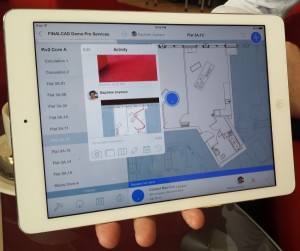 I met Baptiste Joyeaux, head of international development in London last week and he demonstrated the application to me. Its interface is similar to other tools such as 4Projects’ Field View (
 A simple colour coding system then helps the user keep track of the issue’s status. An un-synched issue is blue; once synched it turns green; when the recipient of the notification starts to work on the issue it turns yellow; the issuer then might receive a notification that the issue has been fixed and if they then confirm it has been resolved, they can close it out, and the blob turns to grey. Baptiste demonstrated the rapid relay of notifications from issuer to contractor and back again, showing me the report outputs summarising the status of issues by project zone, by contractor, etc. All interactions are captured in a secure audit trail.