Proposed EU changes to national Freedom of Panorama (FoP) rights could affect individuals and organisations taking photographs or videos of construction works and sharing them in commercial platforms.
Freedom of Panorama (FoP) is a somewhat obscure provision in copyright law that allows people to take photographs or video of buildings and and other works in public places without infringing any copyright, and to publish such images. This right prevails in the UK and in certain other parts of Europe (the Netherlands and Germany, for example), but not in others (eg: France, Italy, Greece). However, our continued freedom to take photographs and to use them (in brochures, on websites, in social media, etc) is threatened under proposals tabled by members of the European Parliament (see my PR blog post: PR use of public images under FOP threat; UK national newspapers are also now picking up on the story too – see today’s Daily Telegraph and Daily Mail pieces for example).
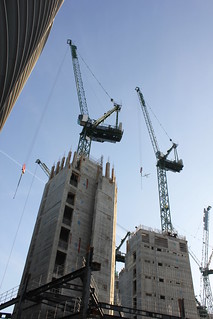 Briefly, copyright reformers led by a German politician Julia Reda MEP would actually like to introduce UK-style FoP across the EU. But other MEPs are proposing a non-commercial limitation clause in the FoP rules which would make it useless. As a result, taking shots or video for PR, professional or educational purposes against the backdrop of well-known public buildings, or even posting your snaps on commercial platforms such as Facebook, Flickr or Instagram, could potentially breach the building designer’s copyright. For a great many construction businesses, for example, limiting UK FoP could mean their marketing collateral breaches copyright – many companies showcase past and current projects in brochures, datasheets, case studies, websites, blogs and other social media (#ProtectFOP or lose your marketing collateral).
This got me thinking about other use of photographs and video in construction. Plainly, construction professionals today use photography and video extensively to document (for both personal and company use) the different stages of a construction project, from the earliest planning stages through to project completion and beyond. While some of these progress images will be captured within the construction site perimeter, technically there may still be issues if they show neighbouring buildings outside the site. And on many projects, site progress shots and time-lapse videos are often taken from public spaces outside the site boundary; if UK FoP rights are changed, architects and other designers may need to approve image use by others (or at least perhaps grant a license to project team members allowing images to be used for project purposes), including in online construction project management applications.
According to newspaper reports, the RIBA opposes the proposed changes. The Daily Mail reports a statement to The Times:
We are concerned that the well-intentioned proposals to ensure that architects are paid for the use of images of their work by commercial publishers and broadcasters would instead have negative implications and represent a potentially damaging restriction of the debate about architecture and public space.
Reactions to my first blog post on FoP were broadly incredulous: “bonkers”, “scary”, “unworkable”, “unnecessary”, “extremely worrying”, “ominous”, etc. I seriously doubt that architects, engineers and other design firms will be keen to, or even capable of, administering a potential flood of incoming copyright license applications. And, even if the FoP changes were enacted by the European Parliament, I suspect the UK might somehow seek an exemption to preserve the status quo.
(A lobbying campaign on behalf of cultural and heritage organisations, ahead of a crucial vote on 9 July 2015, is being coordinated by Wikimedia UK’s Stevie Benton [email].)

 City-Insights has created an HTML5-based toolset that works across all popular smartphones and tablets, along with a supporting cloud-based content management system (Tim said clients can learn to use the system “in anything from 25 minutes to four hours”; the company can also manage content for its clients, if they prefer). In Tim’s words, the mobile application “tells stories about places”.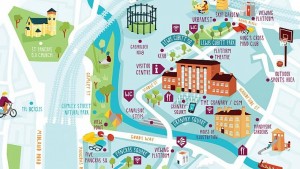
 In collaboration with housing associations such as Octavia Housing and Family Mosaic, City Insights has explore new ways of delivering information about equipment and buildings to housing tenants and subcontractors.
 And – showing the toolset can be used equally for different phases of a development – Overbury is also planning to use it for handover support; for example, when a tenant or new owner starts to occupy a space, the tool can be used to provide online ‘how to’ information about installed equipment (potentially saving numerous face-to-face briefings).
 Second, many professionals in the built environment sector are increasingly focused on capturing and reusing data, particularly to support future occupation and use of built assets (‘soft landings’ was mentioned a few times). BIM has started to focus people’s minds beyond construction and handover, and – in the process – we are creating data that can be efficiently re-purposed for reuse by owners, occupiers, visitors, tourists, maintainers and others.
 The application potentially complements platforms such as StickyWorld (
 Styles & Wood’s specialist information management subsidiary



 “The new website is key to improving awareness that there are Conject solutions to support any built asset throughout its lifecycle, whether it be plan, build and/or operate phases. … The website provides an up-to-date user experience, and is now also in line with the advanced security provided by our software infrastructure.”
 Introduced by a mutual friend now working at associated Australian company
  However, the advanced mathematics, scheduling and geo-spatial analysis applications are managed in the cloud; in line with the Biarri strapline, Joe told me end-users of this Software-as-a-Service get a simple, intuitive user interface. This helps them deliver greater productivity in designing and constructing complex new infrastructure programmes; Render Networks was recently selected by
  When faced with the challenges of delivering at scale, Dan explained how he had been frustrated by the conventional delivery of major telecommunication networks, which he saw as unnecessarily time-consuming and labour-intensive, partly due to the traditional delivery models, and the often low-tech, adversarial and inflexible attitudes of contractor organisations (and clients too). Render Networks helps streamline the process, he said, and, “being evangelistic,” demands more progressive approaches from the supply chain (we talked briefly about
  He used the example of fibre-optic ‘splices’ – tasks commonly allocated to contractor teams out in the field. Through the SaaS application (readily accessed on smartphones and tablets), teams are sent details of each ‘splice’, and they then report their progress on completing the task. Information is presented in recognisable Google Map-style views, with details also displayed in spreadsheet and Gantt chart views. As tasks are completed and signed-off, the as-built data is then captured for future asset management.
 Project managers use Render Networks to monitor and actively manage the task allocations, specifying work options relevant to each team’s location and reacting to how efficiently they work. For example, if a team has 10 ‘splices’ to do in three days but completes them all in two, it can be given suitable additional work nearby, ensuring committed resources continue to be deployed, thus increasing the contractor’s revenues. Dan highlighted how the system provides project managers with real-time reporting and benchmarking on team efficiency, helping them reward the most productive contractor teams by giving them further work.
 A repeated thread during last week’s “

 This week’s 2015
  Almost coinciding with the conference, the latest release (15 May) of Viewpoint’s