Finalcad – from BI to BIM

France-based Finalcad is helping French construction benchmark its quality performance, and building its BIM capabilities.

Finalcad logoLast week’s Ecobuild exhibition in London gave me chance to catch up with Paris-based Finalcad, developer of a mobile-first construction quality management application. Readers may recall that I talked to the business’s Baptiste Joyeaux in the summer of 2015 (see Finalcad expands beyond France), and that its product – widely used in France and in Singapore – had also been deployed by property developer Mount Anvil on a multi-storey residential project in London (post). At Ecobuild, marketing director Aurelien Blaha updated me on two areas of Finalcad data exploitation.

Business intelligence

Finalcad had entered the market primarily as a snagging (aka punchlisting, defects management, quality reporting) platform, and – like some similar tools – it had also expanded to cover other common site-based processes. Most vendors in this space have focused on summarising this information to managers of individual projects; some have expanded this to enable customers to see reports across multiple projects; Finalcad has taken an additional step to publicly benchmark the performance of hundreds of workers across thousands of projects.
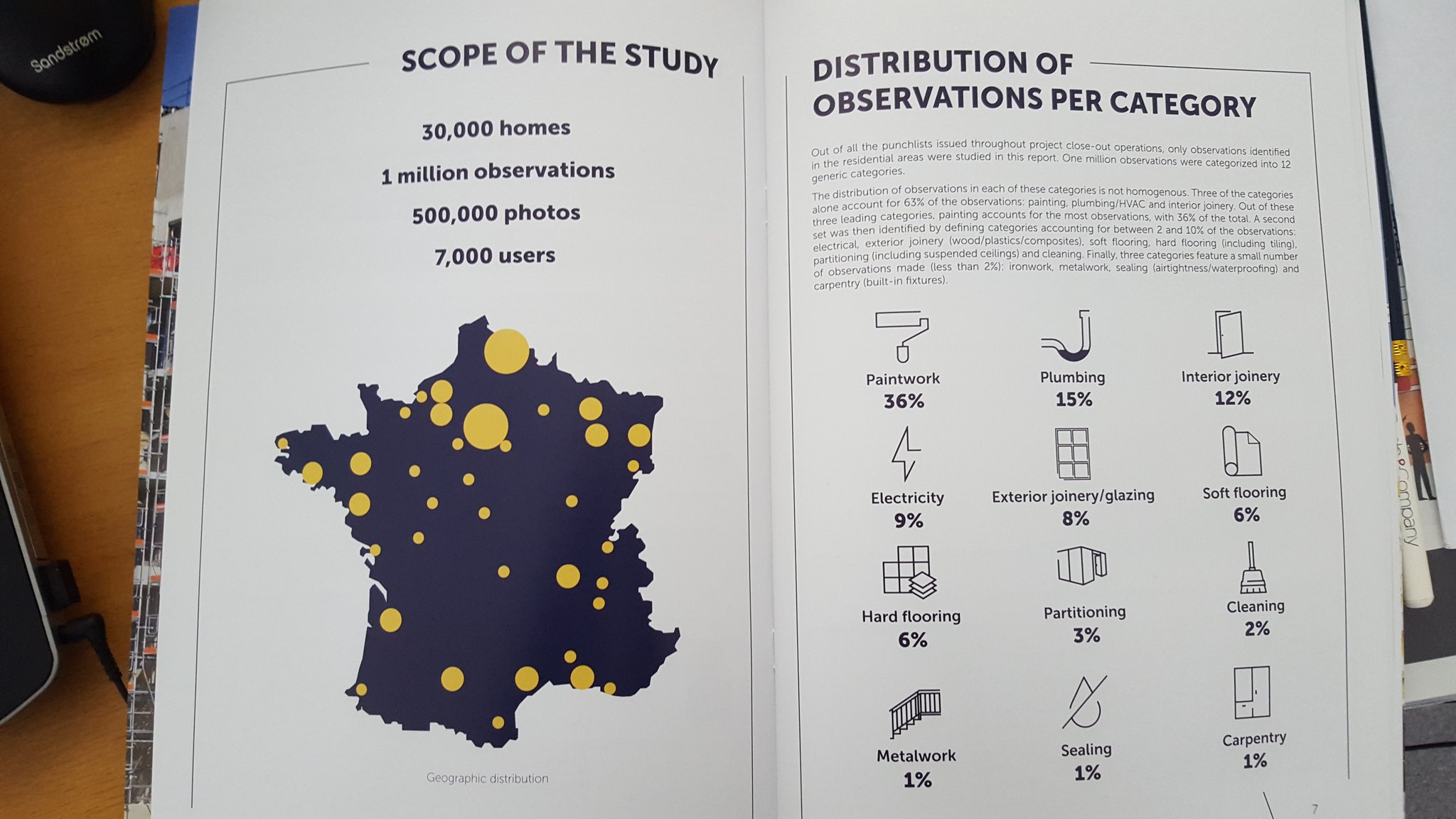
Finalcad construction observatoryIn September 2015, it publilshed its first ‘Construction Observatory’ report (download here, email registration required), looking at public housing construction across France. The study was compiled from a million defects reports, including 500,000 photographs, captured by 7000 users in around 30,000 homes. Among other findings, the study identified that painting, plumbing and carpentry accounted for 63% of all observations gathered in homes.

By aggregating the information, the sources and locations are anonymised, and the data becomes a neutral benchmark of industry practices – valuable to:

  • Construction firms, designers, project managers and clients, who can compare their performance (who produces most defective work, who is most proactive in resolving it, etc?) against the national average
  • Insurers interested in quality issues and their impact on completion warranties
  • Public stakeholders keen to ensure value for money and operational expertise

Highlighting such information will also, Finalcad believes, contribute to pan-industry exchanges leading to action plans to improve quality levels. The company intends to produce further Observatory studies, developing new business insights and predictive analytics.

In the meantime, of course, Finalcad is also providing customers with data reporting services (1 March 2016 news release):

  • A new GetMyData service enables information systems managers to retrieve data collected via Finalcad. With one click, a user with credentials can access notes, snags, quality controls and an image database through a secured web interface. This data can be downloaded directly in CSV format and integrated into the company’s existing big data systems.
  • With FinalBIM, managers can now monitor project progress with compiled statistics in real time from a web platform. This platform provides an overview of how observations are distributed by trade, a ranking of the most recurring observations (by trade), project process in the form of an interactive site map, and a photo gallery featuring observations collected by Finalcad users in real time. FINALCAD algorithms harmonise this data in order to generate instant analyses.

“BIM with Boots On”

FinalBIM indicates the direction of travel at Finalcad. It is looking towards a future where BIM-originated design information can not only be interrogated from the field and used for reporting, but also for live updating of as-built information. At BIM World in Paris next month (6-7 April 2016), Finalcad will be launching a BIM with Boots On white paper, outlining closer integration of office-based design work and on-site activities.
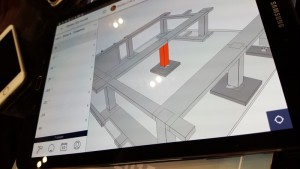
Finalcad BIM structuralFinalcad has developed BIM solutions for structures and for finishes. Aurelien demonstrated how BIM data about individuals objects or elements (individual pile caps, or doors, for example) could be accessed in the field. As-built variations against the design can be reported back from the field and reported directly to the model authoring application – “challenge the ‘as-planned’ model with the ‘as-built’ model.”

The company’s heavy use of photographic evidence has also helped it to develop “image recognition” tools that can automate steps in site reporting. Finalcad is experimenting with deep learning and neural network approaches that enable its software to recognise objects on site and to automatically apply relevant metadata to them, so that the user has fewer fields to manually complete, Aurelien said, explaining their “three tap” user interface philosophy. The image recognition also extends to optical character recognition so that written data (equipment model and serial numbers, for example) can be captured and reported back to the model.

Permanent link to this article: http://extranetevolution.com/2016/03/finalcad-from-bi-to-bim/

Growth slows at Asite

SaaS collaboration vendor Asite is still profitable, still growing revenues but slowed slightly in 2015.

Asite logo 2012London, UK-based SaaS construction collaboration technology vendor Asite has published its annual report and accounts for the year ending 30 June 2015 (Asite news release). It increased its revenues by 12.2% to £5.289m (2014: £4.715m). Operating profit for the period increased by 19.2% to £0.757m (2014: £0.635m).

UK vendor revenues Feb 2015

However, the revenue growth suggests a slight slow-down from 2014 when it reported 17% growth. And recent reports from competitors show Asite may be lagging behind in a buoyant market – Germany’s think project! reported revenues up 33% last week, while the global market leader Aconex announced revenues up 46%. In October 2015, Viewpoint for Projects reported 2014 revenues up 21% with 2015 revenue growth “above 20%” in the UK.

International performance

Asite remains heavily reliant upon the UK market which accounts for 78% of its 2015 revenues. North American revenues grew from £218k to £377k, but Australian revenues fell slightly again (from £536k to £519k). Asite said:

We continue to expand into new markets whilst expanding our product and service base in line with our growing number of clients and the requirements they bring. We have invested in the opening of two new offices namely in Africa and the Middle East to boost our global footprint and revenues.

(Before the Global Financial Crisis, the Middle East was once Asite’s second biggest market, accounting for 10% of its revenues reported in 2009.)

Headcount

Asite staff numbers continue to grow. The previous annual report showed average monthly headcount up from 104 to 139 employees; this year’s report shows a further jump, up 30% to 181 – again largely accounted for by expansion of the India-based technical team. Asite said: “The Group continues to invest in research and development. … The directors regard investment in this area as a prerequisite for success in the medium to long term future.”

Added analysis (24 February – updated 26 February 2016)

Tony Ryan (Asite CEO)An email from an Asite shareholder reminds me that two years ago, Asite CEO Tony Ryan talked very bullishly about future revenues. He told journalists and bloggers attending the Asite user conference in March 2014 that 2014 revenues would be around £5.5m; this proved optimistic – Asite delivered revenues in the year to 30 June 2014 of £4.7m (post). He also forecast revenues rising to £7.8m in 2015 and £13m in 2016. As we’ve seen this week, the 2015 figure proved to be £5.3m, and with revenue growth faltering, Asite will certainly not be doubling its revenues to get anywhere close to £13m in the current financial year. Nonetheless, Tony today (26 February) insisted to me that the business was still on track, still hitting its targets, and “nailing every quarter.”

Tony Ryan on Asite’s International prospects

Tony’s 2014 optimism was, I think, based on the post-recession bounce-back of construction in the UK and on the early positive results from Australia (but after a healthy £0.557m in 2013, revenues have fallen in both the next two years). As skills shortages have affected the UK market, he told me there had been a slowdown, particularly in recent months (eg: December 2015, January 2016); a similar slowdown in the natural resources market in Australia had impacted revenues, he said, but “we have a decent pipeline out there, particularly in civils and infrastructure, which we expect to grow”. With a new US client (New York DOT) recently secured, and a new New York office established, Tony was also confident about the north American market: “the US will be a big focus for us in the next two to three years,” he said.

… and on the UK market

The company’s heavy reliance upon the UK market, where competition among the SaaS vendors is particularly fierce, is also a factor. Rivals Conject (post) and Viewpoint (post) have both talked about price pressures leading to “serious price-cutting,” and bidding wars won by offering “significant … unsustainable reductions.” Downward pressure on vendor pricing will certainly impact on both revenues and margins, and Tony said, that with collaboration now commoditised, competitors were “giving stuff away“. He also insisted rivals were reliant on revenues gained through acquisition rather than organic growth, but added Asite were “talking to one or two interested parties” (ie: acquisitions to add to the Asite portfolio).

On BIM, he claimed Asite was “light years ahead of the likes of Viewpoint”, insisting other cloud collaboration vendors were trying to catch-up with Asite’s model server, which he said also delivers intelligent data to drive procurement.

Update (posted 14 March 2016) – A comment from Tony Ryan says: “Just a minor correction – the numbers I was quoting in 2014 were in $dollars and that is exactly what we achieved.”

Permanent link to this article: http://extranetevolution.com/2016/02/growth-slows-at-asite/

Aconex SaaS growth continues

Impressive 2015 revenue growth underlines Aconex’s AEC SaaS leadership position.

Aconex logo 2014Melbourne, Australia-based SaaS construction collaboration technology provider Aconex has announced an impressive set of half-year results, covering the six months up to 31 December 2015. They show the business grew its global revenues by 46%, from Au$38.1m in 2014 (see A rosy Aconex financial update) to Au$55.7m (c £28.5m or US$40.3m).

It attributes the growth to “continued business expansion across key customer markets, continued product releases and enhancements, and the business acquisition of the INCITE Keystone collaboration business from the CIMIC Group.”

The directors report the company has continued to win significant new projects and new enterprise agreements across regions and industry sectors, with strong revenue growth across all regions led by EMEA and Americas, with 64% and 51% revenue growth respectively, and 39% in ANZ and 29% in Asia. Analysis of the detailed report shows these markets respectively account for 28%, 18%, 43% and 11% of company revenues.

Net profit after tax (NPAT) was $4.6m (c £2.4m or US$3.3m) for the half year ended 31 December 2015.

Leigh JasperAconex says it is developing its connected cost management solution from its July 2015 Worksite acquisition – CEO Leigh Jasper says “We’re already starting to see benefits from the Worksite acquisition. We’ve won a number of deals because of it and some customers are looking for that cost functionality.” And it is integrating the INCITE Keystone collaboration platform into the Aconex platform.

Australian newspapers (eg AFR) report the company is planning further acquisitions in 2016 “to bulk up the company’s capabilities in delivering mobile solutions and building information modelling“.

Predictability and reliability of revenues

Aconex shares had been rising fairly steadily since the December 2014 IPO on the Australian Stock Exchange, but suffered recently from a global pullback on technology shares. These strong results will boost the company’s reputation in not just the Australian financial community, but remind investors worldwide of the predictability and strength of the SaaS revenue model.

Reflecting the company’s BIM strategy, Leigh Jasper’s vision is one in which construction customers will not only get a physical built asset but also its “digital twin” (Sydney Morning Herald, January 2016). This digital model, in my view, will not be just a static archive, but the core of an asset management platform that the asset owner/operator can use throughout its life-cycle.

This adds to the potential value of the Aconex offering. Historically, such SaaS solutions have tended to be focused on the design and construction phases, and therefore prone to the cyclical ups and downs of the construction industry. However, building and other asset owners have to operate their facilities whatever the economic situation, and if Aconex takes on the role of data steward and asset management application provider for the life-cycle of the built assets then it will have more reliable and predictable long-term data-as-a-Service and SaaS revenues.

Competitive scale

By revenue, Aconex is the largest pure SaaS vendor operating in the architecture, engineering and construction market (Autodesk, Bentley and Trimble also have SaaS offerings, but revenues from these are not separately reported alongside their other software applications). Aconex’s six-month revenues already exceed the total annual revenues of Germany’s think project! which reported last week.

Permanent link to this article: http://extranetevolution.com/2016/02/aconex-saas-growth-continues/

Bentley EADOC expanding

Expect EADOC SaaS functionality to grow and extend to other Bentley CONNECT Edition solutions, says Eric Law.

Bentley eadoc - logoThe November 2015 Bentley Systems Year in Infrastructure conference in London provided the perfect opportunity to get an update from Eric Law of California, USA-based EADOC, acquired by Bentley Systems in March 2015. I was also able to see a presentation from a Be Inspired Awards “Innovation in Construction” finalist, engineering firm HDR, who presented their work on the Los Osos wastewater project in California, which deployed EADOC, and this case study helped explain the fit between EADOC and its new sister products.

EADOC and Bentley convergence

Eric LawEADOC founder Eric Law is now a senior director of product management at Bentley, applying his project management software experience to a Bentley Project Delivery solutions portfolio which includes EADOC, ProjectWise and Navigator. The EADOC capital project management cloud-based solution helps construction managers and infrastructure owners gain real-time visibility into risks and costs.

Eric retains key responsibilities at EADOC including development of the EADOC software user interface so that it will reflect the Bentley look and feel; for example, its project performance dashboard is expected to resemble the dashboards of other Bentley software products. At the same time, Eric anticipated some of the EADOC cost management functionality beginning to surface in other Bentley CONNECT Edition products, alongside scheduling information.

Care had been taken to position EADOC as a construction management product separate to the ProjectWise collaboration platform, with the two products regarded as complementary not competing. More generally, now as part of Bentley’s sales effort, global visibility of the EADOC product had also grown, Eric said, with account managers in Europe, the Middle East and Australia now familiar with an increasingly internationalised product previously only marketed in the United States.

As a SaaS, multi-tenant, web-based tool, Eric also expected the EADOC product to develop as a real-time mobile tool too (potentially with location capability – it is already integrated with ESRI GIS, used at Los Osos).

Los Osos

Los Osos mapFollowing a moratorium in place since 1988, the County of San Luis Obispo, California, undertook construction of a US$180m wastewater treatment system consisting of 49 miles of pipelines, 580 manholes, 4,700 laterals, 21 pump stations, a 1.2 million-gallon-per-day tertiary treatment plant with 34 storage ponds, and 100 percent recycling through irrigation and groundwater percolation.

A major goal for HDR, Ron Perkins said, was to minimise the impact of construction on residents, who had opposed the project. EADOC was used to connect the geographically dispersed project team, exchange information, and conduct public outreach through its GIS interface – with teams challenged to complete streetwork sections in under 40 days, and progress tracked through red (in progress), amber (imminent) and green (completed) RAG reporting.

Los Osos EADOC UIThe EADOC toolset helped reduce costs associated with building the project and managing public relations, and is expected to help reduce future costs for operations and maintenance. Eric told me EADOC Archives can be output for the client as parsable XML data – not just in static PDFs – capable of being shared with other applications.

Post-script

This week (11 February 2016), Bentley has underlined the attractiveness of Bentley’s EADOC to water-related projects, announcing that California’s Carollo Engineers has chosen the cloud-based construction management software as its corporate standard for capital project management. However, it would be wrong to think it’s just for water projects – EADOC is also used extensively for other civil engineering projects.

[This is the latest of several blog posts held over from 2015 due to pressures of other work. I’m slowly catching up….]

Permanent link to this article: http://extranetevolution.com/2016/02/bentley-eadoc-expanding/

Trimble acquires green SaaS vendor

Trimble continues to grow its cloud capabilities targeting the whole design-build-operate cycle, acquiring London-based Sefaira.

Trimble has announced its latest AEC software business acquisition: London and New York-based Sefaira, adding this cloud-based sustainability design application to a portfolio already boasting considerable cloud potential.

Background

Trimble logoLast month (20 January) I did a short presentation about common data environments (CDEs) and the current state of the cloud-based construction collaboration market to an audience at the University of Westminster in London (where I am a visiting lecturer). My overview of the market included the usual SaaS players, and vendors better known as design authoring software providers (Autodesk, Bentley, Nemetschek), plus Trimble – who I described as “acquisitive” and “a growing force”.


I based this view of Trimble, previously better-known in the UK for its GPS and mobile hardware systems, on around 10 years-worth of observations of its software expansion:

  • in 2006, the company made its first foray into the SaaS field, acquiring US-based Meridian Systems
  • in 2012, it acquired SketchUp from Google, completed its acquisitions of Tekla and Vico, and consolidated these solutions under its Trimble Buildings banner (post) while also supporting the Open BIM initiative
  • in 2014, it acquired Manhattan Software and then Gehry Technologies’ GTeam (post), and within three months was offering its own cloud-based collaboration platform, Trimble Connect, plus a low-cost mobile project management system, ProjectSight, marketed through its expanding international BuildingPoint business.

Web-based design for sustainability

Sefaira logoThe latest deal adds to its cloud capabilities. London and New York-based Sefaira was founded in 2009 by Peter Krebs and Mads Jensen, aiming to provide a new way to design and create buildings via the web. Its cloud-based analysis platform was voted the most promising new technology at London’s Ecobuild in 2011, and, having raised $10.8 million in funding, the company formally launched the Sefaira sustainability analysis web application in July 2012. This performs whole-building physics-based analysis of water, carbon and renewable energy potential, allowing designers and architects to explore design options, and supports – significantly – SketchUp, plus Autodesk Revit. The application is used by designers at more than 500 firms globally.

Trimble says the acquisition (terms not disclosed) of Sefaira expands its Design-Build-Operate (DBO) portfolio to include tools for designing high-performing buildings early in the crucial conceptual phases of a project. Users can estimate, compare and optimise the energy, water, carbon and financial benefits of different design strategies, helping maximise capital efficiency, minimise energy and water use and create high performing sustainable building designs at low cost. Chris Keating, general manager of Trimble’s Architecture & Design Division, says:

“Architects rely on SketchUp to understand conceptual design choices and develop constructible models. But today, design is no longer just about aesthetics. Architects need to consider building performance in a more intuitive way, and be able to collaborate better with the engineers who design the systems that make buildings work. We have been a development partner with Sefaira for years now, and we are excited to increase our commitment to this space by adding Sefaira’s tools into Trimble’s portfolio of products for building designers and engineers.”

Over the next year, Sefaira and Trimble will work together to integrate Sefaira more closely with SketchUp, 3D Warehouse and Trimble Connect — as well as with numerous products from Trimble MEP.

Permanent link to this article: http://extranetevolution.com/2016/02/trimble-acquires-green-saas-vendor/

German SaaS player reports 33% sales growth

Germany’s think project! reports strong 2015 sales as it confirms focus on BIM and digital collaboration.

Thinkproject-logothink project!, the Munich, Germany-based provider of AEC SaaS project collaboration technologies, grew its sales revenues in the year to 31 December 2015 by 33% to €25.4m – that’s around £19.8m or US$28.4m (see news release). In 2014, it reported group revenues of €20m (post).

The company still regards itself as “market leader for cross-enterprise collaboration within Germany and Europe and number two worldwide” – behind Australia-based Aconex. It argues that its near neighbour in Germany, Conject (which also has a substantial operation in the UK), is reliant on non-SaaS products for a proportion of its German revenues. In October 2015, I noted the closing gap between think project! and the Conject group, which in the year to 31 December 2014 generated revenues of €21.5m (could 2015 be the year that think project! finally tops Conject’s revenues?)

Collaboration 4.0

According to think project!, a major component of its surge is due to its EPLASS and planConnect brands – acquired in 2011 – which both occupy market-leading positions within their segments in Germany. More recently, in September 2015, think project! acquired a 60% stake in France-based Lascom AEC. Two months earlier in 2015, the company rolled-out its BIM Collaboration solutions (post), which it now describes as part of its “Collaboration 4.0 strategy” – similar to Industry 4.0 (as defined by Wikipedia):

“Collaboration 4.0 places digitalisation and networking to the forefront. Both strategies are seen by think project! as the success factors in construction projects. BIM as starting point for optimised collaboration and integrated digitalisation is a critical focus.”

Thomas Bachmaier, think project! CEO says:

Thomas Bachmaier“Within our core segment we see project collaboration as a key technology for the construction industry, above all due to the close integration of BIM. Therefore, we are continuing to place strong emphasis on further expanding digitalisation and networking. With the acquisition of Lascom AEC, we entered the French market for CEC in the construction sector, which also enabled us to further develop our international business and gain PLM expertise within the Group.”

Permanent link to this article: http://extranetevolution.com/2016/02/german-saas-player-reports-33-sales-growth/

Envision expanding capabilities

Australia’s Envision has developed into a powerful data hub well-suited to mega-projects.

Envision logoIt’s almost five years since I was first contacted by Ennova’s Hugh Hofmeister to talk about the Brisbane, Australia-based company’s Envision construction project management platform (see May 2011 post). Then, a mobile-first approach to cloud-based construction management was relatively new, as was applying lean thinking, and integrating mobile devices with 3D, scheduling and time management tools, and Hugh was keen to develop integrations with other application – including complementary SaaS construction collaboration tools such as Aconex – rather than to compete with them.

QC LNGQCLNG mega-project

In late 2015, I talked with Hugh again and it was clear Envision had moved forward. It had been adopted for use on several mega-projects. For example, the company had completed a major project with Australian mining and natural resources giant, Thiess (part of the former Leighton Holdings group, renamed CIMIC in early 2015; see also Aconex CIMIC deal absorbs SaaS rival). According to an Envision case study, the Au$2.5 billion Queensland Curtis LNG (QCLNG) project saw over 1000 individual users of Envision, processing at the project’s peak over 3000 people’s timesheets. Achievements included:

  • Envision Activity TimelineFast-tracking the improvement cycle by an estimated one to two months
  • Enabling labour productivity to be calculated for each facility and plotted against time, based on the effective project start date
  • Supporting a massive 30-40 per cent improvement in labour productivity
  • Showcasing relative improvement in construction time comparative across the 14 separate projects under management using Envision

Following the successful completion of QCLNG, Leighton Contractors has rolled Envision out on three other major projects, QGC Surat North, APLNG Gas Gathering, and the design phase of West Connex Stage 1.

Other Envision customers include Australian pipeline construction contractor  Murphy Pipe & Civil, and resources industry equipment and services supplier FLSmidth (using Envision to track equipment maintenance and servicing). Its customers also include subcontractors, attracted by the Envision promise of an activity-centric single version of the truth detailing the hours and resources expended by every discipline employed on a project. Hugh sums up Envision:

Hugh Hofmeister“Envision today is a collaborative project delivery platform for design and construction projects that enables near real-time, site-based capture of project data and the continuous integration of that data into the decision-making process. It gives optimal visibility of a project’s schedule, progress, change and costs – drawing on the latest field information and collaboration among project participants, from field teams to design and construction offices and more – driving faster and more informed decision-making.”
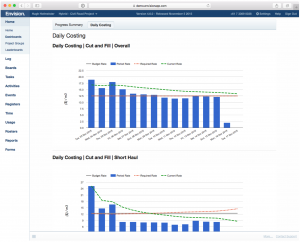
The platform supports different stakeholders from the client at the top of the supply chain, through multi-disciplinary teams of contractors and suppliers, to individual supervisors – enabling them to review timesheets, payroll reports, equipment utilisation, and to manage issues (eg: defects, aka punchlisting), using mobile devices to combine text, images and GIS data. Live API integrations are in place with ArcGIS and iCuro Workforce management, with BIM integration coming soon following a proof of concept integration demonstration with iConstruct at a recent multi-vendor hackathon, Hugh told me.

Envision as data hub

Daily Production RatesIndeed, Envision can effectively function as the data and reporting hub of a constellation of applications and web services, from Autodesk and Bentley BIM authoring tools, SaaS document management (Aconex, the former INCITE Keystone, and QA Teambinder), scheduling (Primavera, MS Project), estimating (Exactal), financial reporting (SAP, Oracle) and payroll and timesheeting applications. Hugh showed me project dashboards incorporating earned value management (EVM) curves as well as conventional bar charts and spreadsheets (Conject strengthened its EVM capabilities during 2015, while Aconex acquired Worksite to bolster its financial reporting toolset). Envision retains its ‘social’ stream of status updates, and the core platform can report multiple datapoints across 100s of thousands of pieces of equipment deployed across a project.

[This is the latest of several blog posts held over from 2015 due to pressures of other work; again, I am aiming to publish the remainder of the backlog during January 2016.]

Permanent link to this article: http://extranetevolution.com/2016/01/envision-expanding-capabilities/

AECOM takes project collaboration global

AECOM’s ProjectHub programme puts a consistent user experience of Bentley ProjectWise at the fingertips of up to 100,000 knowledge workers worldwide.

AECOM logoOne of the Be Inspired Awards finalists at the 2015 Bentley Systems Year in Infrastructure conference was the international multidisciplinary consultancy AECOM. As noted in November, AECOM had signed an enterprise deal to extend its ProjectWise corporate commitment, and its (winning) entry in the “Innovation in Project Delivery” category related to a global ProjectWise implementation extending the reach of the collaboration platform across some 600 offices in 160 countries worldwide, supporting a potential user-base of 100,000 knowledge workers.
Bentley YII2015As one of Bentley’s strategic partners, AECOM worked closely with the software business to expand use of ProjectWise via a network of seven data hubs (six currently operational in north America, Europe, the Middle East, southern Africa, southeast Asia, and Australasia, plus a further hub to come online in south America). Integrated with AECOM’s intranet, CRM system (Salesforce) and other corporate systems, the ProjectHub system gives AECOM staff a consistent ‘window’ into the company’s back-office and project delivery systems, with rapid and reliable access (at LAN/WAN-type speeds) to the most up-to-date information on any project – maintained by cache servers using delta file transfer.

Phoenix-based AECOM global project collaboration manager Kevin Albright presented the various constraints the business faced – company-wide adoption of BIM, the laws of physics (“basically we can’t share information faster than the speed of light”), security, the need to support multiple languages, helping workers be self-sufficient in IT, eliminating disciplinary or information ‘silos’, and creating a common user experience – and he started this supported by just 2.5 (full-time equivalent) staff.

AECOM PW setupHe said ProjectWise was “the obvious choice”, “the most mature tool”, scaleable, and almost infinitely flexible (over one million configuration options) but wasn’t dependent upon everyone using other Bentley products (“ProjectWise is application-agnostic – we have lots of Revit users too”). It was also simple to start using; Albright showed the simple system icons and ‘software wizards’ used to help set up projects consistently on the system, and described his team’s philosophy of “Just in Time learning – what you need when you need it”, incorporating written help, graphics and video guides that anticipate commonly asked questions. The system’s support site is hosted by Bentley but populated by AECOM materials crowdsourced from its users.
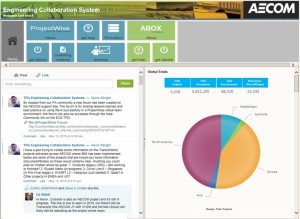
ProjectWise was already used within AECOM (sufficiently widely that no other vendor could realistically be considered, Albright told me later) but the number of early adopters grew rapidly (400%) to over 20,000 in just over a year (a ‘dashboard’ screengrab showed over 3000 projects, around 6m documents, 68,000 user accounts and 23,000+ active users). The system was not mandated within AECOM but the impressive growth was achieved organically by grassroots adoption.

AECOM PW landingpageBenefits already identified include reductions in lost information, less rework from working on the wrong information, and the creation of a history and knowledge base for each asset. Automating, simplifying and reducing project administration tasks has cut the time associated with project start-up. And the use of local hard-drives has been replaced by the ProjectWise cloud, helping also to centralise system administration to a handful of individuals worldwide. Albright said “If the system increases resource utilization by just 2 percent, AECOM will save hundreds of millions of dollars on an annual basis.”

Talking to him after the finalist presentation, he underlined the importance of security:

“With unrest in the Middle East and concerns about east/west relationships, our clients want to know where their data will be hosted and which geographies it might pass through en route. When users set up a project they select the hub most appropriate to their project needs and client data is only hosted in that centre.”

Arup use ProjectWise for BIM

Another finalist in the same category was another multidisciplinary practice, Arup, who described their ProjectWise-based approach to developing and maintaining a BIM template for their UK-based operation, looking to help its people apply consistent and compliant business processes relating to BIM. While not as wide-reaching as the AECOM implementation, Arup identified significant benefits including rapid mobilisation of new BIM projects (a 2-10 day process could now be completed in under two hours (saving an average £1000/project), a 10 percent efficiency saving in use of draughtsman time (worth over £160,000/year), and delivering a marketing advantage.

My take

It was interesting to hear an enterprise case study on a ProjectWise adoption, but this is on a vastly different scale to most implementations. It looks to emulate the scalability and ease of startup and use claimed by some of the pure-SaaS construction collaboration vendors but reflecting exacting company-specific requirements and retaining the core infrastructure within the enterprise.

Other corporates have opted for rival solutions such as Aconex – the Australian SaaS vendor did three major deals, with Bechtel, Lendlease and John Holland, in June/July 2015, for example – which effectively allows them to outsource some risks relating to hosting to a specialist external provider. However, the AECOM/Bentley relationship is clearly close and committed on both sides, with Albright saying they were “co-developing” new capabilities to support their partnership.

For me, it was also a useful reminder that SaaS is not “the only game in town”. Two major consultancy organisations may use other platforms when required by their clients, but otherwise their corporate policies (and an aspect of market differentiation) are to host their clients’ data using a cloud solution that is retained within their own IT set-up.

[This is one of several blog posts held over from 2015 due to pressures of other work; I aim to publish the remainder of the backlog during January 2016. – Disclosure: I attended the Bentley Year in Infrastructure conference as a guest of Bentley Systems, who paid my hotel expenses. I was also a juror in the BE Inspired Awards, and judged the ‘Innovation in Project Delivery’ category.] 

Permanent link to this article: http://extranetevolution.com/2016/01/aecom-takes-project-collaboration-global/

Sypro CAM (not a webcam)

NEC3 software specialist Sypro Management has launched a new compliance and asset management application.

Sypro logoHumberside, UK-based Sypro, best-known for its NEC3 contract change management Software-as-a-Service application (one of several competing in the NEC battleground, and a former software partner of Business Collaborator), launched a new product: Sypro Compliance & Asset Manager in late 2015.

Sypro CAM is, according to a Sypro e-newsletter, “an easy to implement, simple to use format that allows estate and facilities managers to effectively and proactively manage their assets therefore ensuring legislative compliance.” Sypro’s website adds:

Wilmslow High SchoolCAM has been developed with a modern, graphical approach, ensuring information and data is simple to understand.

As a web-based solution, Sypro CAM monitors, tracks and records asset data to ensure all are compliant, serviced and maintained in accordance with the relevant legislation or policy. The software can be used by public organisations such a schools, academies, health and care organisations/companies.

Sypro CAM is built for ease of use and to ensure that users can clearly identify actionable alerts relating to assets and compliance regulations. Live and instantaneous reports are readily available to assist the operative and responsible person with task management and adherence to legislation and guidelines.

The website also gives some case studies of Sypro CAM use in healthcare, leisure and education sectors – including Wilmslow High School (above).

Permanent link to this article: http://extranetevolution.com/2016/01/sypro-cam-not-a-webcam/

A quick mobile AEC catch-up

Mobile-first SaaS construction collaboration vendors Cadbeam, Finalcad, Sherlayer, BaseStone and GenieBelt continue to compete for attention in the UK.

The thirst for mobile applications in the architecture, engineering and construction market shows little sign of being quenched, and there is scope for new start-ups to carve out a niche for themselves. Competing with relative veterans such as Viewpoint for Projects Field View, other SaaS specialists who have embraced mobile (eg: Aconex, Asite, Business Collaborator, Conject, Newforma, Zutec [previous post]), and domain experts who’ve branched out into software (eg: Dome), are several young businesses targeting the UK market with mobile functionality.

Finalcad speeds up Lexicon

In May 2015, for example, I wrote about another London-based start-up Cadbeam, also offering site-based issue management and integration with MS Project; in the same month, I also covered SherLayer. And in July 2015, I looked at a recent arrival from France: Finalcad. It recently completed a project with London-based residential developer Mount Anvil, working on the 36-storey Lexicon project in the Islington area, where supply chain members used Finalcad competitively to close-out their defects as quickly and efficiently as possible – one user estimates a time saving of 60-70% over using traditional paper-based processes.

Basestone builds profile…

I have also written fairly regularly about Basestone since I first met founder Alex Siljanowski in January 2014. This start-up’s solution has been used by Crossrail, and Alex recently spoke at the Rail Industry Association’s “Unlocking Innovation” event, delivering an “Elevator Pitch” covering the importance of connected data and collaboration for engineers, and innovations such as machine learning to intelligently work with Big Data on projects (Basestone blog post). Meanwhile, there is a new Basestone iOS app, its PDF functionality has been improved, and the London-based firm even featured in the capital’s Evening Standard.

… and GenieBelt gets proud

Meanwhile, just over a year since launching its Free Forever collaboration offering (unlimited users, unlimited tasks, but a maximum of 50 shared files), Copenhagen-based, but with a strong British contingent among its team, Geniebelt continues to push its workforce focus, urging individuals and teams to be “Proud of their projects” (GenieBelt blog post). The mobile-first SaaS business quietly launched its document management capabilities earlier this year.

Overseas providers eyeing UK…

However, it would be unwise to think that Europe-based vendors are always the first choice for UK mobile collaboration solution customers. The SaaS revolution has eroded international boundaries and made it easier for both vendors to reach new markets and buyers to test and adopt new products. As a result, I have been writing regularly about startups in Australasia (APE MobileProgressClaim, and SmallBuilders, for example), the US (eg: Plangrid, FieldLens) and other markets.

Bridgit logoOne of the most interesting north American businesses is Canada’s Bridgit (see August 2014 post Bridgit launches Smartglass push). Among other things, this has been pushing forward with wearable technologies, and attracting a lot of attention – last week, for example, it won a special Google Demo Day challenge competing against 10 other startups all started by women. According to co-founder Mallorie Brodie:

Bridgit wins at Google Demo DayPresenting at and winning Google Demo day was yet another great opportunity to showcase just how much construction technology is changing, and how quickly that change is happening. 2016 is going to be a huge year for software adoption across the entire construction industry. On-site and in-office construction teams now have the appropriate tools (iPads, smartphones, larger data plans, etc.) to use software in their day to day.

For Bridgit, we are already seeing the impact of this, with sales growing at over 20% month over month and sustainable long term growth opportunities. What are we planning for 2016? Expect to see a larger product offering that caters to more stakeholders in the industry. We’ve proven that the construction industry loves our software, and in 2016 we’re bringing it to a significantly larger audience.

Right now, Bridgit has its eyes set on US expansion. Over the past couple of months we’ve been building our customer base in New York City and Google Demo Day was a great opportunity to continue growing our U.S. network.

Permanent link to this article: http://extranetevolution.com/2015/12/a-quick-mobile-aec-catch-up/

Load more