Bye-bye, BIW. Hello, conject

I visited the Woking office of SaaS construction collaboration technology vendor BIW Technologies recently and there was a very tangible sign (literally! – right) of an impending change. As anticipated 15 months ago when Munich, Germany-based conject acquired BIW, the UK business is – like previous conject acquisitions – being rebranded as conject. The process actually started around May 2011 when the BIW company logo started to carry a small endorsement: “BIW, a conject company,” and reflects a broader re-alignment of the people and products within the conject group.

My Woking trip included a briefing from BIW CEO Colin Smith, now also CEO of the group’s parent company, conject Holdings GmbH, where he explained the logic behind the rebranding process (the company has also posted a video interview with Colin).

http://youtu.be/X53eNtSm2rc

Group changes

The name-change is perhaps the most public sign of the merger, but there have been other significant shifts in the operations of the group’s companies, Colin told me. He highlighted past management changes such as the departure of Martin Reents and the appointment of Cesar Flores as CEO of the German business conject AG, and the appointment of himself and long-time fellow BIW director Steve Cooper to the board of the holding company.

Governance of German-based businesses is much more rigorous, so Colin’s role has come under greater scrutiny from its shareholders including VC companies EarlyBird Venture Capital and Seventure. Alignment of the combined business’s operations has seen one or two of conject’s old products sidelined, but BIW’s flagship Project Control platform remains a core offering in the conject portfolio, alongside all its related modules such as NEC3 contract change management and the recently upgraded Commercial Management. For most BIW customers, therefore, the only immediate perceptible differences will be a new logo on the application, some amended email addresses and – from April – a new look to the company’s website and collateral.

Product and growth strategy

Longer-term, the benefits of the acquisition will become clearer to existing customers and end-users, Colin said. The larger group (employing 145 people and with annual revenues in excess of €18m [£15m]) is now building relationships with new technology partners who wouldn’t previously have considered cooperation, and there will be more cross-selling of the product portfolio across the previously largely separate markets. UK users, for example, can look forward to developments in BIW’s support for building information modelling (BIM) and a broader offering to support facilities management (expect a new SaaS FM product in late 2012) and other operational aspects of built assets; the BIW commercial management tools are also being enhanced to support central European construction management and accounting practices. But it won’t just be about portfolio extension and organic growth – the video and the conject rebrand FAQs document also talk about potential future acquisitions.

As the mainland Europe operation currently generates most revenues and employs more people, it seems logical to rebrand BIW to conject rather than vice-versa. However, from a personal perspective, I will be sad to see the BIW branding disappear. I was part of the team that developed, implemented and managed it a decade ago, but it obviously isn’t an efficient use of marketing resources to maintain and deliver a portfolio under two different corporate identities.

[Disclosure: I worked for BIW Technologies from 2000 to 2009, and have since undertaken occasional consultancy projects for the company, including some PR support for the rebranding programme.]


Permanent link to this article: http://extranetevolution.com/2012/03/bye-bye-biw-hello-conject/

Mace adopts BIW Commercial Management

Woking, Surrey, UK-based Software-as-a-Service construction collaboration technology vendor BIW Technologies has re-launched its Commercial Management application (formerly BIW Financial Control), with Mace one of the first major construction businesses deploying the module (see news release).

Essentially, BIW Commercial Management supports both site-based staff with responsibility for overall management and control of individual project finances and corporate financial teams who want real-time visibility of their financial exposure across multiple capital projects.

BIW began to build financial management functionality into its platform in the early 2000s when Bovis Lend Lease sought a replacement for its in-house Hummingbird project extranet. This is one of a range of capabilities that BIW added to extend its reach beyond document collaboration and to differentiate it from other vendors, and it remains one of the company’s strongpoints, with little direct competition from its main UK-based SaaS rivals.

The latest news release confirms Mace has followed Lend-Lease in using BIW’s financial management, quoting Mace operational director Crawford Patterson:

“Many of our workflows run across our different project disciplines and project functions. Therefore, the ability for teams to collaborate on the same platform is most important to us. BIW’s Commercial Management provides us with direct visibility into our commercial activities offering auditability whenever required.”

Permanent link to this article: http://extranetevolution.com/2012/03/mace-adopts-biw-commercial-management/

NEC3 partnership by Sypro and UNIT4

UNIT4 Business Software’s SaaS construction document collaboration solution Business Collaborator is being teamed up with Sypro Management’s NEC3 management platform, the two companies have announced today. The launch of the partnership has been timed to coincide with the annual NEC User Group conference at the Institution of Civil Engineers in London.

The ‘fit’ is straightforward. The BC solution did not include a contract administration module, while Sypro is a stand-alone NEC3 management tool that focused on contract changes without providing all the documents and drawings that might relate to a particular contractual process.

Previously in the keenly contested NEC battleground, BC lagged behind rival vendors such as 4Projects (post) and BIW (post) – both, since December 2010, official NEC licensed content partners – and others such as Asite and Aconex whose platforms offer contract administration support but without the endorsement of the NEC. Sypro’s direct rivals include MPS which has similarly sought document collaboration support through a partnership with Scandinavian SaaS provider Docia (post).

Sypro has also launched a free Sypro NEC Lite solution – as the name implies, a slightly less functional version of the full product, but which can still be used to manage Early Warnings, Programme Management and Acceptance, and General Communications.

(Disclosure: I have undertaken past consultancy projects for Sypro Management and Unit4 Collaboration.)

Permanent link to this article: http://extranetevolution.com/2012/03/nec3-partnership-by-sypro-and-unit4/

Open BIM, 4BIM … and potential ‘BIM-wash’

A London conference on building information modelling (BIM) on Wednesday, organised jointly by Constructing Excellence and the Construction Products Association, featured two announcements.

Open BIM

First, we heard that BuildingSMART International, various Nemetschek companies, Tekla, Solibri, and other major construction software vendors (but, perhaps critically, not Autodesk or Bentley [yet], nor any construction collaboration technology vendors) had joined forces to launch a global programme to promote Open BIM collaboration workflows throughout the global architecture, engineering and construction (AEC) industry. According to the news release:

Open BIM is a universal approach to the collaborative design, realization and operation of buildings based on open standards and workflows. Open BIM is an initiative of buildingSMART and several leading software vendors using the open buildingSMART Data Model.

Other AEC software vendors as well as designers, engineers, contractors and building owners are being encouraged to participate and use the Open BIM logo as a promise of successful and streamlined collaboration (see also the Graphisoft blog).

4BIM

Second, there was a brief mention of the establishment of 4BIM, an initiative being driven by a consortium comprising Sunderland, UK-based collaboration vendor 4Projects, Northumbria University/BIM Academy, specialist technology consultancy AEC3 (involving Nick Nisbet – alongside me at the conference), contractor VINCI Construction and construction products manufacturer Kingspan. 4Projects’ website describes how it aspires to extend its core SaaS solution to offer new cloud-delivered BIM services, including:

  • a browser-based viewer for 3D BIM models, supporting open Industry Foundation Class (IFC) model files, as well as secondary support for industry standard 3D BIM formats.
  • a browser-based review system allowing items and assets within an IFC model to be reviewed and tagged with data
  • an integrated model server, allowing multiple BIM files from multiple disciplines and organisations to be merged together for collaborative viewing, review and further processing.
  • a BIM reporting system to allow interrogation of model data
  • a facilities management handover service, delivering O&M and other BIM data, and using the open COBie data interchange format, and
  • a mobile application for accessing BIM data in 4Projects

Technical advances or marketing hype?

Reading the 4Projects description, it repeatedly describes 4BIM as a collaborative project, but the purpose seems largely focused on expanding the capabilities of 4Projects’ platform. While 4Projects does mention IFC and other open approaches, I wonder if 4BIM will, for example, be open to collaboration with other SaaS collaboration vendors in developing this technology? Or is this a 4Projects’ marketing pitch to counter the cBIM drive that rival SaaS vendor Asite has been mounting over the past couple of years, the recent BIM360 push with Buzzsaw from Autodesk, and renewed promotion of ProjectWise as part of Bentley’s BIM product portfolio (see this week’s Ghafari Associates news)? Other collaborative flavours of BIM are also available….

It is easy to get overwhelmed. I spoke to one particularly jaded contractor earlier this week, and he shared a weariness among some UK industry folk about apparent “BIM-wash”, where technology businesses seek to position themselves as offering BIM solutions whereas the reality is currently little more than marketing hype or pushing existing proprietary tools. Perhaps buyers will soon need to beware of “BIM vapour-ware” just as they had to be careful of vendors’ empty promises at the height of the 1999-2000 dot.com boom?

Permanent link to this article: http://extranetevolution.com/2012/03/open-bim-4bim/

think project! revisited (and visited!)

Already highly configurable, think project! functionality is set to expand over the next year, with BIM and mobile access high on the agenda.

When I profiled Munich-based Software-as-a-Service construction collaboration technology vendor think project! last month, I said I would be taking a closer look at the platform. In fact, I was invited out to Germany last week and was given a detailed insight into the platform. I also attended the company’s internal developers conference, held amid stunning Bavarian scenery overlooking the icy Lake Tegernsee, where I learned more about the company, its product and its future plans (not all of which I can share, of course).

the think project! platform

While think project! is a relatively unfamiliar name in the UK, it has been deployed on this side of the North Sea. At a meeting at the company’s Munich head office, head of product management Jochen Maurer (like his fellow co-founder, CEO Thomas Backmaier, a former Nemetschek employee) told me of his trips to UK power station projects for E-on. He also spoke of the Second Forth Crossing project near Edinburgh, where technology from the group’s Eplass subsidiary (acquired in 2011) is being used. Mainly across Europe, some 5,000 currently active projects are managed by the think project! system.
The overall look and feel of the platform is similar to most of its rivals in the construction collaboration sector, being inspired (if that’s the right word) by the layout of Excel spreadsheets commonly used for document control. Jochen stressed the platform was devised as a centralised communication platform capable of handling a wide range of different types of messages, correspondence and file types. The core of the system is a SQL relational database, while drawing viewing and mark-up duties are managed using Oracle Autovue (formerly Cimmetry; also used by Aconex and Maclaren/CTSpace, among others). Hosting is managed from two data-centres, one of them in Munich, and projects to date have generated some 350 terabytes of data, Jochen told me.

Like other platforms in this sector, the core think project! technology is deployed from a common code base across multiple projects for multiple clients, but project teams can configure the solution to match their particular project requirements. Jochen demonstrated some of the configuration capabilities to me, and they are extensive, allowing teams (or, more usually, think project! consultants) to finely tune how different forms and workflows are delivered, so that electronic communications almost exactly emulate the disciplined paper-based processes that teams previously used.

We also talked about the German market for construction collaboration. It sounds as though it is a mature market, with most projects using some kind of electronic collaboration platform. think project! and conject are the leading players, both offering enterprise-class solutions, but facing competition from CTSpace, Frankfurt’s Cadac Organice (post) and a handful of smaller businesses (including AwaroConclude, Conetics and Poolarserver), some of which charge less for their solutions.

Future developments

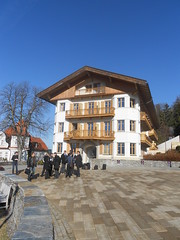
Das Tegernsee HotelDas Tegernsee Hotel hosted the two-day think project! international meeting, an annual gathering conducted in English and attended by over 40 of the group’s consultants, sales, development and management staff.

The 2012 meeting included personnel from recent acquisitions: the afore-mentioned Eplass (formerly SEIB ITC) and Dresden-based planConnect (a document control service provider); both of these will be retained as brands within the group, said CEO Thomas Bachmaier. The company’s focus remains central Europe and Benelux, plus Spain, but its clients often deploy the solution in other locations such as Russia and the Middle East.

After reviewing some of the functionality added to the company’s October 2011 release, version 6.0 (which included a multi-upload tool, a drag-and-drop ‘desktop connect’ and integration with Microsoft’s Outlook email client), Jochen outlined some of the future product strategy. This included some familiar aspirations, such as development of mobile solutions and support for building information modelling (BIM); he also talked about integration of Adobe PDF Connect into the solution, instant file-sharing for more spontaneous or temporary file-sharing, and some social media-type functionality (my session keynote at the event focused on this area and its potential to support collaboration – it caused ‘ripples’ according to one attendee who tweeted me later!).

For obvious reasons, I cannot share the details of what I saw and heard about the product pipeline, but some of the new capabilities are very imminent. A more streamlined development process will see new functionality released more quickly, said R&D chief Dirk Lutzeback, with some scheduled to appear before the end of 2012.

Over coffee before and after the opening session, I spoke to several individuals – from Poland, Switzerland, Austria and the UK, as well as Germany. Most of them enthused about the value of the event in sharing information and helping build the company’s strong team culture and sense of direction. In addition, think project! also runs various events for its customers and its super-users, tapping into the experiences and ideas of its user-base. I know some UK-based vendors hold user conferences, but I don’t think many would invest in doing such an impressive internal event. It gave me a brief but striking insight into the culture and running of the company.

(Disclosure: I received a fee for my presentation at the conference; my travel and accommodation expenses were also paid by think project!)

view from Hotel 'Das Tegernsee'

Permanent link to this article: http://extranetevolution.com/2012/03/think-project-revisited-and-visited/

Asite grows revenues and profits

London-based software-as-a-service construction collaboration and e-procurement technology vendor Asite has published its financial results for the year to 30 June 2011. Revenue was up 44% to £2.914m from 2010 (£2.021m) and overall operating profit for the period more than tripled, up from 2010’s £0.133m to £0.422m.

Looking ahead, Asite says it is continuing to invest internationally, and also outside its core focus on the architecture, engineering and construction sector (within which it says there is “significant interest in its collaborative Building Information Model (cBIM) solutions”).

Analysis

In posting the news, Asite is stressing that 2011 was the company’s most successful financial year to date. There is no argument about this. Last year was the first time revenues rose above £2m and the first profitable one after nine years of losses, so the ensuing 12 months have seen the company continue the upward trend very positively, apparently due to a strategy focused on enterprise deals and international expansion (notably, in the US and Middle East markets). The revenue result puts it hot on the heels of Unit4 Collaboration, but still some distance behind BIW and 4Projects.

The result is also significant as it bucks a trend of recent flat results from rival UK vendors (including 4Projects and BIW), though it isn’t clear how much of Asite’s revenues are derived from its collaboration platform and how much from its e-procurement solutions (last year, CEO Tony Ryan told me the latter comprised about 20% of its revenues).

The continued growth in Asite profits also pushes the company just ahead of Unit4 Collaboration’s 2010 result.

(Note: I am conscious that I have been inconsistent in my previous reporting of vendors’ profits; in some cases, businesses such as Asite focus on operating profits, while for others I have discussed pre-tax or EBITDA).

Permanent link to this article: http://extranetevolution.com/2012/03/asite-grows-revenues-and-profits/

HP expands ePrint & Share capabilities … a bit

HP has expanded the printing options available to users of its ePrint & Share service. I wrote about its launch 18 months ago, and its June 2011 strategy update, and, in between, I also wrote about Autodesk’s AutoCAD WS tablet/smartphone app.

So it was interesting to see that the latest HP announcement includes an extension of the firm’s partnership with Autodesk to enable printing to HP devices – via ePrint & Share – to web-connected HP large-format Designjet ePrinters and eMFPs. Once registered, AutoCAD WS users can now use a new Plot to Print function to print their designs and automatically archive a copy on any web-connected HP printer, with full control over plot styles, paper sizes, layouts, etc.

http://youtu.be/R5L7Lg0z6ds

Additionally, the HP ePrint & Share mobile application has been updated to enable users to send PDF e-mail attachments to print (not just documents in one’s ePrint & Share library).

Still no sign, however, that HP will extend this functionality to allow integration with widely used AEC Software-as-a-Service solutions. Their users are still excluded from the HP view of collaboration, where people have to use HP hardware and related HP print services. As I said last June: not really all that collaborative….

Permanent link to this article: http://extranetevolution.com/2012/03/hp-expands-eprint-share-capabilities-a-bit/

UNIT4 in UK Gov Cloudstore coup

A week ago, the UK Government launched Cloudstore, a new ‘app store’ to help small businesses offer IT services to the public sector, and to encourage public organisations to purchase services on a ‘pay-as-you-go’ basis, rather than being locked into lengthy contracts (see BBC news article). The site features over 1,700 apps provided by more than 250 suppliers, and there is already at least one SaaS construction collaboration technology available via Cloudstore: UNIT4’s Business Collaborator (I did a quick search for other candidates, but found none).

UNIT4 already has considerable experience in delivering cloud-based ERP (it is servicing 150,000 users in Sweden with 150 out of 170 organisations being government bodies – news release), while Business Collaborator has been marketed as a SaaS application for over a decade. As I learned two weeks ago, UNIT4 has considerable levels of public sector adoption for its ERP and financial management applications, and I expect some public sector customers will be persuaded to extend their UNIT4 portfolio to include document management and related architecture, engineering and construction-oriented workflows to deliver and manage their built assets.

The launch of the Cloudstore catalogue also marks a strong endorsement of Software-as-a-Service (as well as Platform- and Infrastructure-as-a-Service) approaches to software delivery – something that would have been regarded as, er, cloud cuckoo land just a few years ago. And, as with BIM, a public endorsement of SaaS may well encourage previously reluctant private sector client organisations to follow suit.

In the meantime, Cloudstore is currently working to assure and accredit all the listed products and services. Any government ICT procurer can use the online database to find suitable suppliers without having to go through the laborious and lengthy OJEU route. It’s a coup for UNIT4 to be among the first to be listed, but the framework is also going to be opened to new suppliers and products shortly (March/April 2012), so I suspect other construction collaboration technology vendors will be looking to get themselves added to the catalogue.

Permanent link to this article: http://extranetevolution.com/2012/02/unit4-in-uk-gov-cloudstore-coup/

neXadyne develops “world-first accredited training courses for document control”

Perth, Western Australia-based neXadyne has launched what it says are the world’s first accredited training courses for document control. The company, experienced in the mining and oil and gas sectors, has developed its courses in collaboration with leading Australian companies, and the qualifications have been accredited by the Training Accreditation Council Western Australia.

neXadyne’s Deborah Wilson stresses the qualifications are focused on document control rather than records management, and are not affiliated with any software or vendor (Melbourne-based SaaS collaboration vendor Aconex launched its own courses last year – post). She continues:

“To date there has never been a qualification for Document Controllers that has been accredited by a government body. Our courses address this issue and set benchmarks by which companies can use to gauge relevant experience of potential and existing Document Control employees.

“Western Australia is currently experiencing a boom in the Mining and Resource sector. As such, industry demand for qualified Document Controllers is at an all-time high. With companies investing billions of dollars in new projects, there has never been a better time than now to ensure that project documentation is being correctly handled by trained and qualified staff.”

Permanent link to this article: http://extranetevolution.com/2012/02/nexadyne-develops-world-first-accredited-training-courses-for-document-control/

EADOC-ation

SaaS makes it easy for AEC students to learn about web-delivered software

A virtue of most software-as-a-service applications is their ease of deployment, while they often require nothing more than a web browser and a working internet connection for end-users to start using them. As a result, this makes it easy for SaaS vendors to offer free use of their platforms for test, demonstration or education purposes, and this can include use by university students (with vendors hoping, of course, that a positive experience might lead to adoption on real projects once the students graduate).

Latest to offer such a service is EADOC Software, the California, USA-based vendor of construction management applications for the architecture, engineering and construction sector (post). It has just announced an education partner programme providing free access to EADOC for universities and technical schools offering construction management courses. This was a tactic pursued a decade ago in the UK – for example, almost exactly 10 years ago, BIW Technologies [my then employer] allowed free use of its SaaS platform by students at Newcastle University, and continued the practice at several other UK universities (eg: Reading, Loughborough, Nottingham Trent) – sometimes supported by lectures from me. Good to see the practice continuing and spreading.

Permanent link to this article: http://extranetevolution.com/2012/02/eadoc-ation/

Load more