ICT 4 Construction conference, 28 October 2010

Through a link in an article on Wikipedia (hardly the most obvious place to market an event but it worked for me!), I learned about a forthcoming London conference on construction and ICT. Being held on Thursday 28 October at Central Hall in Westminster, ICT 4 Construction is sponsored by AceCAD, with Constructing Excellence is listed as a partner.

From a construction collaboration perspective, the conference programme includes John Pomeroy from Sword-CTSpace and Richard Vertigan from 4Projects; other speakers include Robin Wilkin from MPS and someone from Union Square, plus talks from RedSkyIT, AceCAD, EliteSuite, Arup and IBM.

Construction IT conferences have been in short supply in recent years so it is good to have an opportunity to network and hear what these speakers and others have to say. More importantly, it is refreshing to see a construction event priced realistically – at just £79.95 per delegate place – which will hopefully ensure a good number of industry attendees. And if this conference is a success there won’t be long to wait for the next one, as the organiser, Recep Saffet (who I know from when he organised events for Construction Computing), is already promising two further events in 2011:

  • Document & Knowledge Management – 21st February 2011
  • Mobile Computing – 24th June 2011


Permanent link to this article: http://extranetevolution.com/2010/09/ict-4-construction-conference-28-october-2010/

Aconex (UK) Ltd – revenues down in 2009

Almost exactly a year ago, I looked at Aconex (UK) Ltd and noted that the British operation of the Melbourne, Australia-based construction collaboration technology vendor was on the upturn. Twelve months later, the UK recession appears to have had an impact, knocking revenues down by nearly 11 per cent.

The London-based subsidiary generated revenues in the year to 30 June 2009 of £1.688m (as against £1.909m the year before), returning a pre-tax loss of £57,161 (compared to a restated pre-tax loss of £271,323 in 2008 – a note to the accounts says there was a change in accounting policy: “The effect on the 2008 results was to increase losses by £227,835”).

The 11 per cent drop in revenues is not as bad as the 19 per cent drop experienced by [my former employer] BIW Technologies (post), but – along with the figures just released for iSite (post) – shows that most of the leading UK-based construction collaboration vendors that have reported figures for 2009 were hit by the downturn in construction activity in the UK market – Asite being the exception so far (post).


Permanent link to this article: http://extranetevolution.com/2010/08/aconex-uk-ltd-revenues-down-in-2009/

An update on iSite

Following last week’s post about iSite (the construction collaboration – sorry, make that property management – technology business formerly known as StoreData), I have been looking at the business’s recent financial performance – as revealed in the latest interim report (PDF) from parent company Styles & Wood, published last week.

In the six months to 30 June 2010, the business performed at a similar level to last year, generating revenues of £0.582m (compared to £0.589m in 2009 – see post), with the £0.105m profit (up £2k from £0.103m last year).

Twelve months ago I noted a trend across several of the UK collaboration vendors, showing a slow-down or even a reversal in fortunes due to the impact of the recession. The UK construction industry – or at least the retail-dominated sectors in which iSite competes – clearly hasn’t bounced back sufficiently to boost the business’s performance since last summer. Certainly, the talk I hear from vendors is one of continuing price pressure.

Permanent link to this article: http://extranetevolution.com/2010/08/an-update-on-isite/

Oversight on iSite

A significant development regarding the Styles & Wood business formerly known as StoreData happened earlier this year – and I missed it! I admit I have been very busy over the last four months so haven't kept my eyes on changes affecting the UK construction collaboration software sector's smaller players (but maybe the vendor's PR operation isn't switched on to blogger relations either).

Any way, StoreData is now known as iSite, and instead of a rarely-changing page on the parent group's website it now has its own domain: iSitePortal.co.uk.

My first thought on seeing the new iSite brandname was: it's very similar to UK rival vendor Asite (possible recipe for confusion if dealing with fast-talking salespeople?).

Second thought: the website justification for the rebranding states:

The corporate re-brand of StoreData to iSite sends a clear message: that we intend to be an increasingly significant player in the property management market. [my emphasis]

Hitherto, I think this business has tended to be associated with the construction sector (its parent, after all, is mainly known as a retail fit-out contracting business), so there is now an attempt to position itself in a slightly different market – a logical step, not least because its most notable implementation is Tesco's MyProperty platform. This may also further distance its technological background from its origins. Its software platform was, I understand (see November 2006 post), developed from Union Square's Workspace – extensively used as an intranet solution in the UK architecture, engineering and construction (AEC) sectors.

Third thought: the adoption of a completely new corporate identity and a new website also makes me think that perhaps this is a subsidiary business that is being put up for possible disposal by the parent company (something I wondered about in a March 2009 post)?


Permanent link to this article: http://extranetevolution.com/2010/08/oversight-on-isite/

Asite’s Appbuilder and Platform-as-a-Service

UK-based construction collaboration software developer Asite is looking to emulate Salesforce‘s Force.com Platform-as-a-Service (PaaS) offering by creating a platform to host construction-related applications built using its Appbuilder development framework. This is the latest development in the competitive world of construction collaboration technology, but is likely to be quickly emulated by Asite’s key rivals.

Background

Ten years ago, the early construction collaboration applications were mainly focused on sharing documents and drawings online. Over time, though, the main vendors (the UK ones at least) quickly began to add functionality to support key project processes or workflows. Initially, the platforms delivered simple web versions of what used to be paper or email-based forms (requests for information, change orders, submittals, etc), with routing between the various project team members involved, and audit trails so that project managers could monitor and report on progress.

Greater sophistication followed; in 2003, for example, my then employer BIW released its collaborative process management (news release); and, by 2005, 4Projects, BIW, BuildOnline (now Sword-CTSpace) and Sarcophagus all had tender management platforms. In 2008, I identified contract management as the new ‘extranet battlegound’ (post), with other leading application providers – including 4Projects, Aconex, Asite and Business Collaborator – following BIW’s lead and expanding support to cover complete contracts such as the New Engineering Contract (NEC). This extension strategy that also sought to attract business away from rival approaches such as MPS‘s CCM system that lacked high-end document management capabilities to track related information (other businesses focused on contract change management have also emerged; a year ago I blogged about Contract Communicator, for instance).

For the mainstream collaboration vendors, creating these online processes was originally something usually undertaken internally by implementation consultants and software developers, perhaps working in partnership with industry firms. But the creation of workflows has gradually evolved to enable external users to begin to specify and customise their processes (varying the content, branding, routing and timescales, for example) to suit their individual, corporate or project team needs.

Asite’s AppBuilder

In June last year, Asite’s Summer09 release included the launch of its Appbuilder – “Now you can simply build your own Applications to run within Asite” (Asite news) – as well as a library of process applications, including NEC Manager, Finance Manager and Risk Manager. At the time, I was more interested in Asite’s new social media functionality and its trading update (post), but I have continued to monitor the activities of Asite and other vendors with respect to application programming interfaces, APIs, enabling third parties to develop specific applications, including tools for mobile platforms (in March this year, I identified both APIs and mobile solutions among my top 10 construction IT trends in Construction Manager).

A couple of months ago, I had coffee in London with Asite chief executive Tony Ryan (right) and he talked about the “game-changing” potential of AppBuilder, which by then had already been used to help create some of Asite’s cMob tools (post). He was also excited about the potential to create the construction equivalent of Salesforce’s Force.com cloud platform.

A key difference, Tony said, was that AppBuilder does not demand significant IT or programming skills to create a usable application. He believed it could be used by industry professionals to recreate or mould a process in much the same way as users might manipulate a Word file or Excel spreadsheet. He told me of examples already created using AppBuilder, including tools for expenses management, snagging, cost control and simple project management. AppBuilder could also be used to create procurement tools that would work with Asite’s eCommerce platform, he said, and he claimed that adding mobile access to the tools was a simple step taking seconds.

Given these impressive claims, I recently met Asite product development director Paul Markovits for a detailed look at AppBuilder.

From simple forms to complete management systems

“The starting point for AppBuilder was our wish to avoid a ‘one size fits all’ solution,” said Paul. “We decided to refactor the Asite platform and make it even more end-user-oriented, pushing the boundaries of what they could do on the platform. Asite will still manage all the usual categories of information – user details, tasks, documents, drawings, etc – but is now also a software platform, capable of delivering specific customisation through mini-applications. These can range from single form-type processes like RFIs or task lists through to complex multi-form tools to manage finances or NEC communications.”

The AppBuilder development framework is based around the Microsoft InfoPath XSN format; InfoPath is a form creation and data gathering toolset that enables users to quickly design electronic forms and gather related information without writing code. Paul showed me how an Asite user could quickly create a simple form interface and then populate it with data pulled from the Asite platform. The system also allows for automatic distribution of information to recipients identified by the user, and automatic creation of data, perhaps for use in other forms. Being a Microsoft Office application, InfoPath-based forms can also be used to generate Word or Excel files, including use of macros.


Paul demonstrated the creation of a simple form to specify and display data in the browser of a laptop, and then created another version of the same form to show the same data in a browser on a mobile phone. “We are a Software-as-a-Service business after all, and our strength is in delivering tools and data in browser-based environments,” he said. “And today this means also delivering mobile SaaS tools so that users can access data anytime anywhere on any platform.” The whole process of creating and branding a simple form took less than 20 minutes to demonstrate to me, including creation of a mobile view (with its own mobile-optimised navigation buttons to drill-down for more information).

Paul also showed me how processes could be configured to present data from other processes, thus enabling more complex, multi-step workflows. Such apps use data connections between the forms, and use the Asite Webservice API to call data between them. By aggregating and presenting such data from within the system, dashboards, graphs and other indicators can also be created on the Asite platform to give users and managers real-time performance metrics about their projects.

Paul also talked about the impact of Google Gears and the future importance of the HTML5 in supporting efficient data delivery and user interaction with the Asite system, stressing that Asite’s apps are not the kind downloaded to specific hardware (eg: iPhones), but apps that run on particular platform (in this case, Asite’s platform) and deliver views of information as web pages. Asite is thus moving towards a PaaS (Platform as a Service) offering. Paul also pointed out: “These apps could also be easily integrated with other applications to create mash-ups. We already have these with Google Earth, Memoori, Microsoft Virtual Earth, Onuma Planning System, etc.”

My analysis

As something of a SaaS purist, I have been keen to keep as much information as possible accessible through standard web browsers, so I welcome Asite’s focus on the creating views of data that can be accessed and worked with in both PC and mobile phone browsers. Given the closed, platform-specific nature of iPhone apps and other apps aimed at particular hardware devices, surely creating apps that deliver data and interactivity via standard browsers across different hardware platforms must be better?

Watching Paul create a process, I also thought back to last month’s video of SmartBuilder‘s SiteCleanUp iPhone application (post) and pondered about how long it would take a proficient Asite user to knock up something similar. Moreover, such an Asite-delivered app would already be integrated with a SaaS platform.

And it’s not just SmartBuilder’s app either. Other vendors have created hardware-specific applications to manage particular processes (BIW and BuildOnline had defects management tools, for example, that allowed inspectors to collate information, synchronise it with their core platforms, and drive workflows to and from package subcontractors involved in rectifying work).

Of course, the Asite apps are designed to run only on Asite’s platform. While the company has apparently turned a corner, reporting its first (unaudited) profit last year (post), it still lags behind competitors such as BIW and 4Projects in terms of UK adoption, and Aconex is perhaps the most widely used AEC SaaS collaboration platform internationally. Arguably, AppBuilder gives Asite a marketing edge when it comes to showing users how they can create tools that do exactly what they want on the Asite platform, but such a marketing advantage might not be sustained for long if rivals decide to develop similar application development systems for their own platforms. Looking back over the the past decade, whenever a collaboration vendor has released functionality that appeared to give it a decisive lead over its competitors, those rivals have quickly got down to bridging that gap, and I can foresee the same process being repeated here. What Asite does have, though, is a window of opportunity during which it and its users can develop a library of applications that help give it more market traction.

Permanent link to this article: http://extranetevolution.com/2010/08/asites-appbuilder-and-platform-as-a-service/

4Projects now targeting Middle East

The recruitment by a construction collaboration technology vendor of a new sales guy wouldn’t normally prompt a blog post, but the vendor here is 4Projects and the target market is the Middle East. According to a news story picked up by my Google Alerts, the Sunderland, UK-based company has appointed Mohammad Irfaan as Vice-President, Middle East.

This is a strategic shift for 4Projects which avoided the mid-2000s rush to Dubai joined by UK competitors such as Aconex, Asite and BIW. When I interviewed 4Projects’ FD Steve Nelson late last year (post), he explained that the company was in a good financial position partly because it had consciously avoided its rivals’ over-exposure to the Middle East market and to the changing market conditions in Dubai in particular. The situation in Dubai has largely stabilised over the past year, of course, so with confidence gradually returning to the region, then it seems 4Projects figures the Gulf market is now worth targetting.

Irfaan is a University College London graduate in Information Management who has specialised in project information management solutions for the construction industry, having helped several UK and US companies establish a commercial footprint in the region.

Permanent link to this article: http://extranetevolution.com/2010/08/4projects-now-targeting-middle-east/

Collaboration and ‘the black economy’

I hadn’t previously considered the ‘black economy’ as a potential market for a collaboration platform, but, according to a recent article about US-based software-as-a-service provider MyOnlineToolbox (see post), the recession could boost uptake of simple collaborative applications for tradespeople doing untaxed work. In the Entrepreneur Magazine article, MyOnlineToolbox’s Brian Javeline says many small-scale US contractors never declare themselves on government forms, tackling small scale repair or refurbishment jobs during off-hours from other professions and getting paid in cash or by cheque.

“These off-the-radar contractors are ideal candidates for MyOnlineToolbox, Javeline says. The platform’s viral collaboration elements create an expanding network of skilled, reliable peers across different specialties such as plumbing, electrical repair and carpentry. Members can advertise for bids and refer others for jobs.”

Hmmmm. The recent recession on both sides of the Atlantic is likely to have increased the number of such contractors, but UK tax and benefits authorities take a dim view of people earning undeclared income, and I suspect their US counterparts will feel the same. Would such ‘black economy’ workers use an online service, especially if it meant that there was potentially a detailed electronic record of their transactions and of other people in their business networks? Great, of course, for legitimate business purposes, but ‘black economy’ workers might need to be careful about identifying how ‘reliable’ their network partners are.

Permanent link to this article: http://extranetevolution.com/2010/08/collaboration-and-the-black-economy/

OpeningDesign.com

Partly through my involvement with Be2camp and partly because of my interests in online collaborative spaces, I was contacted by US-based architect Ryan Shultz of Studio Wikitecture to have a look at a very early, ‘alpha stage’ website concept, OpeningDesign.com.

As Ryan candidly admits, this application is still experimental, and is currently a combination of a professional social network like Linkedin, a service marketplace like Elance.com, and a discussion forum:

“In short, we would like to create the digital equivalent of yelling these types of questions across the office to fellow coworkers, but, of course, the ‘yelling’ will be done through things like online whiteboards and digital file sharing. We’re calling this digital office, our SketchSpace.

“Over time, we also envision OpeningDesign.com acting as a hub where professionals can outsource small, production oriented tasks to other professionals — tasks like ‘bathroom elevations’ or ‘presentation renderings’, for example.”

The OpeningDesign team are keen to get some feedback and opinions about the application and what it should or could be – or shouldn’t be (as it’s still at a very early stage of development I haven’t posted any screenshots of the front-end prototype).

Perhaps most fascinating of all, they have also floated the idea of a virtual currency, ODEs (“equivalent to some varying amount of ‘know-how’ in the construction industry”), that can be used for exchange among site members as they trade work or ideas – though Ryan freely admits this is “an experiment that might evolve over time, or be discontinued, outright, if it doesn’t seem to work”.

The virtual studio?

The idea of an online construction workspace is, of course, nothing new (we’ve had intranets in architectural practices since the 1990s), and approaches include:

  • closed LAN/WAN-based team spaces devoted to single companies
  • ‘virtual companies’ (run, for example, on Ning – I mentioned Amonle architect John Allsopp and his “virtual design studio” business last year; I talked about the future role of ‘virtual teams’ in my book back in 2005)
  • simple file-sharing and/or messaging platforms, eg: Woobius, or SliderStudio’s prototype StickyWorld.com (posts here and here)
  • more advanced, multi-company professional collaborative platforms (aka ‘extranets’: 4Projects, Aconex, BIW, Constructware, etc) – some embracing a strong social media approach, eg: US-based Kalexo (post) or Asite (post) in the UK
  • vertical industry social networks (eg: the UK’s tCn – the Construction Network – currently revamping its website)

And as well as Elance, outside of construction there are other Web 2.0-inspired sites that have emerged to commission design work, including crowd-sourcing-based branding or product design services – eg: NameThis.com, 99Designs, Ponoko – so I see no reason why similar activities in the architecture, engineering or construction (AEC) space couldn’t also be shared out among an online community of qualified industry professionals.

Plainly, there are many potential directions that OpeningDesign could go in, and, being social media practitioners, Ryan and his team are reaching out to industry professionals to see what they want. Will it become a design marketplace, a virtual studio or a social network, or a combination of two or more of these, or something else altogether?

If OpeningDesign.com was only one of the following, which one would you prefer?
1.  An online whiteboard and an associated IM (instant messaging) to collaborate with your AEC colleagues/consultants in real time. …or…
2.  A ‘place’ on the Internet where you could ask other reputable AEC professionals technical questions
…or…
3. None of the above, you are looking for something entirely different (just in case we’re barking up the wrong tree all together)

Difficult to say, of course, but – in my view – it is good to have people prepared to venture some new ideas and continue the debate about how we deliver collaboration in the AEC sector in the 21st century.

[Disclosure: I am a former employee of BIW, and have undertaken paid consultancy work for Woobius, Slider Studio and tCn.]

Permanent link to this article: http://extranetevolution.com/2010/08/openingdesigncom/

CAD in the cloud

Two interesting articles by Robert Green in Cadalyst’s CAD Managers’ Newsletter, both focused on CAD in the cloud, caught my eye. The first, What is cloud computing, and does it make sense for CAD users? gives a brief overview of the pros and cons of using CAD on a Software-as-a-Service (SaaS) basis. The follow-up article, Cloud-Based CAD, Part 2, contrasts the negative and positive views – with the optimists apparently outnumbered five-to-one by the pessimists. Robert suggests:

“The percentage of negative comments I’ve received tells me that CAD software companies have a long way to go before cloud computing is widely viewed as reliable and trustworthy!”

I have discussed the potential of what I called CADaaS previously (see CADaaS Continued (2), for example), looking at the experiences of fragmented and geographically dispersed project teams sharing construction drawings via SaaS-based collaboration platforms. These online systems have been around now for ten years, and have continued to grow in importance while the speed issues that used to hamper acceptance have gradually diminished. As Robert points out, it’s not just the reliability of the software vendors that’s important, it’s also the quality and speed of the broadband connection used to access that software (on Friday, I talked with a long-time friend from one of the UK collaboration vendors and we reminisced about how platforms were optimised to deliver information over the 56kbps dial-up modems often used ten years ago!). Robert concludes with a forecast of “partly cloudy” solutions, ruling out cloud-based solutions as “being unacceptably slow and risky because of their dependence on the public-domain Internet”.

Of course, it’s not just about if and how we might manage CAD in the cloud. It will, increasingly, also become a debate about if and how we might manage building information modelling (BIM) in the cloud, or BIMaaS, as I have dubbed it (see Archicad 13 and BIM collaboration, for instance), with talk about the potential, individual and collectively, of ‘differencing’ technologies and other server acceleration technologies to help overcome latency issues, etc.

Permanent link to this article: http://extranetevolution.com/2010/08/cad-in-the-cloud/

Panama landmark project for Aconex

Yesterday I talked to Aconex‘s Dexter Bachelder (VP Americas) and Frank Carron (VP marketing) about a major deal that, for me, is a landmark in the adoption of web-based construction collaboration technologies. Australia-based vendor Aconex announced yesterday (see news release) that it had been selected to provide collaboration support services to the US$3.2 billion Panama Canal Third Set of Locks Project.

This mega-project is the latest in a series of major international schemes upon which Aconex has been appointed; it underlines that the company is now a major player in global infrastructure projects. Perhaps most crucially of all, though, it underlines that Software-as-a-Service (SaaS)-based collaboration platforms, not internally-hosted applications, have an increasingly central role to play in promoting collaboration and information-sharing across geographically dispersed, multi-company, multi-disciplinary teams.

The project

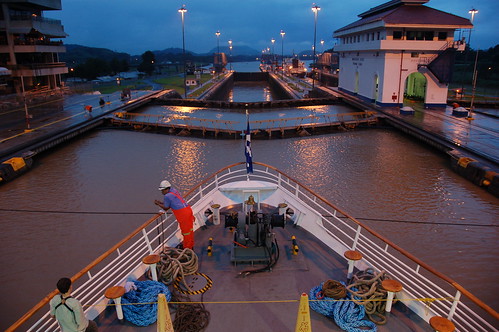
The Panama Canal Miraflores Locks, by Scott Ableman (via Flickr) The news release explains the significance of the project:

The new set of locks, at the heart of the $5.25 billion expansion of the Panama Canal, will allow the waterway to double its shipping capacity by 2025. The project involves the construction of two new lock complexes – one on the Pacific and one on the Atlantic side of the Canal – that will be 40 percent longer and 60 percent wider than the originals. Each lock will have three chambers and each chamber will have three water recycling basins. The expansion program is scheduled for completion in 2014, 100 years after the canal first opened.

As an American, Dexter was in no doubt about the economic significance of the project: “Around five per cent of world trade is routed through the Panama Canal, and it is hugely important to the American economy,” he said. “In terms of revenues, the Canal generates about $5m a day, and so hitting that opening date in 2014 will be critical. The operator, the Panama Canal Authority, had to get government backing through a referendum for the project to proceed, and transparency and good project governance will be vital if the project is to retain public support.”

Frank pointed out that the Panama Canal Expansion project was not Aconex’s only mega-project. “We have started to work hard, sometimes for months on end, to target strategic international schemes. These also give us big reference projects for major players in the US market.” He cites recent wins to provide collaboration services for the US$6bn RTD Denver FasTracks project and Italy’s US$7.2bn Strait of Messina Bridge project (which includes some companies also involved on the Canal project) as examples of their success.

The Panama Canal team

The project is being developed by a multi-national team including contractors and consultants from across the Americas and Europe; the news release says:

“The Panama Canal Authority (ACP), which operates the Canal, appointed CH2M Hill of the United States as Program Manager. Grupo Unidos por el Canal (“Grupo”) – a joint venture consortium of Impregilo of Italy, Sacyr Vallehermoso of Spain, Jan de Nul Group of Belgium and Constructora Urbana of Panama – was awarded the design and build contract. The design consortium, CICP, is led by MWH Global and includes participants from the US, Argentina, Italy and the Netherlands.”

Aconex is not only supplying software – and the usual configuration, training, consultancy and support services – to the project; it is also supplying some manpower. Dexter told me that Aconex will be deploying two Aconex employees to work on the project’s document control. “Worldwide, we now have 35-40 people that we can bring into projects to work as document controllers, usually for the start-up phase, but we find that some customers, particularly on the bigger projects, want a permanent presence” (I may cover this service in another blog post in due course).

Integration with other software

Good collaboration between the different consortia and joint ventures designing, constructing and project managing the Canal expansion project would not be possible unless there was one application that helped draw all the project’s team together, Dexter argued. Rival bidders for the project had promoted alternative systems, often internally hosted, but the successful team had opted to use Aconex as an interface across the project team. “We will provide integration with Microsoft SharePoint and with Oracle Primavera P6,” Dexter said.

“SharePoint is an interesting case. We used to see SharePoint offered as a straight alternative to an externally-hosted SaaS application like Aconex. Today, people are  more likely to see them as complementary. We know that, for governance reasons, companies will sometimes insist on having a record that they can store locally of their inputs to a project. On the Canal project, they can continue to capture information via SharePoint, for example, but Aconex will be used as a neutral, externally-hosted platform for overall collaboration, helping them capture a comprehensive picture of the project. It hits the project’s ‘sweet spot’ – the keys have been about delivering transparency and collaboration at every level: between people, between companies and between consortia and JVs.”

Aconex’s international experience has already seen its application delivered in different languages, and the Panama project will be no different. The platform will be available in English, Spanish and other languages. Aconex’s international network of offices will also be brought into play to provide local training and support to team members based in different countries.

Not just mega-projects

I asked Frank and Dexter whether these recent mega-project wins marked a shift in Aconex’s direction. Frank was adamant that Aconex remained committed to providing collaboration services to a broad range of customers and project sizes, both regional and international:

“Although we are less reliant on the Australasian market (which now accounts for about a third of our revenues), it has proven quite resilient as a market when other countries were suffering. One reason for its resilience has been a healthy mix of larger and smaller projects – we definitely value having a strong pipeline of bread-and-butter deals, alongside some really large ones. We also learned a lot from establishing bases in south east Asia, the Middle East, Europe and north Africa, and these helped give us exposure to contractors and consultants like MWH and CH2M Hill. They have now appointed us to work on big, iconic schemes like the Panama Canal, and the visibility of these projects will, we hope, lead to further work in the US and other markets where they operate.”

My analysis

Rival collaboration vendors’ strategies have largely focused on establishing a strong presence in their domestic markets, perhaps going overseas to support domestic clients,
consultants or contractors as they expanded into neighbouring markets. For example, UK players such as BIW and Asite opened operations in the Middle East (and suffered when the Dubai market slumped). More recently, 4Projects and BIW have joined Aconex in specifically targeting the north American market (post). However, Aconex took a different tack once it moved outside Australasia in the early 2000s, starting up small, satellite operations – often little more than one or two people – in numerous countries. These ‘beach-heads’ gave the company exposure to a wider range of potential industry customers – invaluable when some of these customers have joined together to work on mega-projects such as the Panama Canal expansion.

This international expansion also, I think, informed Aconex’s software development. I debated this with Frank and Dexter, who agreed that the leading UK vendors have really pushed the boundaries of collaboration away from a focus on document collaboration towards integration with process management (workflow) and compliance. Individually, document-sharing, cost control and project management are still strengths of rival products, but few have the all-round capabilities of platforms developed and deployed in the demanding UK construction market and in overseas markets which share its complexities.

It is also significant, I think, that such mega-projects have shifted the balance away from internally-hosted collaboration platforms towards Software-as-a-Service applications. On smaller-scale projects, major contractors or consultants might be able to insist that a client stick with the platform that they already use internally, but when a client is dealing with several JVs there will be no consensus about what system to use, and companies may not want to entrust their mission-critical information to a system hosted by a third party (a point Aconex’s Rob Phillpot makes in his latest blog post). In such circumstances, therefore, they may retain an in-house system for internal governance reasons but opt to use a neutral, third-party hosted system for collaboration with the client, JV partners and other project team members. (And, who knows, once companies see what a SaaS platform can do, maybe they will consider it for their future projects too? Such ‘viral’ marketing certainly proved successful in the UK during the early 2000s.)

Update (31 August 2010) – Dexter talks in more detail about some of these issues in an AECbytes Viewpoint article.

(Panama Canal photograph by Scott Ableman, via Flickr)

Permanent link to this article: http://extranetevolution.com/2010/07/panama-landmark-project-for-aconex/

Load more