From AsBuilt to Exquando

From time to time, I get asked about non-UK collaboration vendors operating in mainland Europe. I can talk with some knowledge about Munich-based Conject (see The conject interview) and Madrid-based Bricsnet (see The Bricsnet interview), but otherwise I generally struggle.

However, a little bit of this information gap has recently been filled with respect to Belgium. I have exchanged communications with Marc Ansoult about AsBuilt (which he described to me as “the ‘Belgian Buildonline’ but built on OpenText” – the same enterprise content system, LiveLink, used by UK-based Causeway for its collaboration application) and its successor Exquando.

It appears AsBuilt was a construction collaboration technology consultancy venture run by Marc and other people within BIAC, the company operating Brussels Airport, and today is a business unit of Fujitsu Services. The main service offering was groupware based on OpenText’s LiveLink, with Cimmetry’s AutoVue used for drawing mark-up and commenting. From the content of its press pages, it looks like it won quite a few projects in the early 2000s (for clients including Dexia Bank, Fortis Bank, Alstom Power and Hydro, Fabricom, GlaxoSmithKline Biologicals and Solvay) but not much from about 2005 onwards.

As AsBuilt withered, Exquando was formed by Marc and ex-GSK IT executive Dara Duong in late 2009 and appears to be a consultancy focused on delivering professional content services, including information management. No technology partners are mentioned on the website (yet), so presumably the team are still evaluating potential vendors they can work with.

Permanent link to this article: http://extranetevolution.com/2010/05/from-asbuilt-to-exquando/

Corecon releases V7

I last wrote about California, US-based SaaS construction software vendor Corecon Technologies almost two years ago (post). In 2008, Corecon’s, er… core business management capabilities were being expanded to include online file storage and collaboration capabilities (though not document markup/red-line or commenting capabilities). At the time, Corecon president Norman Wendl was hoping to launch v7 later that year, but the development clearly took much longer than he anticipated (either that, or perhaps the market downturn prompted the company to delay the upgrade).

So, let’s say about 18 months later than originally envisaged, Corecon has finally announced the release of v7 (see PDF news release): “the company’s first software release on its second generation platform and the largest upgrade in the company’s history”.

Norman says Corecon has completely rebuilt the core platform to take advantage of the latest Microsoft Web technology stack (ASP.NET 3.5, AJAX and Silverlight), incorporating numerous improvements and new features. The application remains firmly focused on business process support (business development, estimating, contract administration, procurement, time-tracking, financial reporting, correspondence, scheduling) rather than on document collaboration. It also remain competitively priced at US$40-$60 per user, per month (with discounts for five or more users).

Permanent link to this article: http://extranetevolution.com/2010/05/corecon-releases-v7/

Aconex expands in north America

It looks like north America is the new battleground for a handful of SaaS construction collaboration technology vendors more usually associated with operations in Europe and other regions.

Along with UK-based 4Projects (post) and BIW Technologies (post), Australian company Aconex is rapidly expanding its operations in the US. According to a news release issued today, Aconex has appointed two “industry veterans” to lead its sales operations in north America: Paul Cardone (formerly of Skire) and Darryl Pettinelli (from Deltek) have been recruited to help Aconex take advantage of an apparent bounce-back from the recession (post) in the US market.

Dexter Bachelder, Vice President, Aconex says:

“The last 12 months have been really exciting for us, as we have won a number of major clients and high profile projects. We have already established 10 offices in North America, which give us a coast-coast presence, and we are hiring aggressively from within the construction and engineering communities to support the demand we are seeing from clients.”

Permanent link to this article: http://extranetevolution.com/2010/05/aconex-expands-in-north-america/

Asite’s Spring release

UK-based construction collaboration technology vendor Asite has released an updated version of its platform. The Spring ’10 release went ‘live’ during the evening of Friday 14 May 2010, meaning all Asite users subsequently had access to new functionality (see PDF), including:

  • Asite’s new cMOB interface (see previous post), including mobile-enabled versions of Asite Site Manager for snagging, project risks and opportunities, and Electronic Goods Receipting (GRN). Mobile platform support apparently includes: Windows Mobile, iPhone, Android and Blackberry.
  • support for access from the Safari 4.0.4 Web Browser
  • enhancements to Asite’s portal, including search for building industry news and information using a new search portlet from Memoori (I am particularly pleased about this as I met Memoori’s Jim McHale at the first Be2camp event in October 2008 and have kept in touch with him ever since)
  • improvements to Asite’s Workspaces
  • numerous Document Manager enhancements.

If you are an Asite user and you didn’t find improvements you wanted in this release, there is a new poll in Asite’s community forum allowing users to vote for what they would like to see in the next release (participants go into a draw to win an iPod Nano). Ideas include:

  • Add ability to specify the folders in scope when searching
  • Same User Profile with Photo across all applications
  • Prince 2 Application within App Library
  • Automatic login from Link
  • Allow access to the forum and other parts of Asite at the same time
  • Improvement to Asite icons

Permanent link to this article: http://extranetevolution.com/2010/05/asites-spring-release/

4Projects team expanding

I’ve just been reading a newspaper article (Software firm 4Projects continues with recruitment drive) about how UK construction collaboration technology vendor 4Projects is expanding its team. The company has added nine employees to its 60-strong team since the end of 2009, and says it is likely to add as many again by the end of this year – if it can find the talent it needs in the local market around its Sunderland base.

(That figure of 60 was slightly down on the 63 employed nine months earlier – see Good numbers from 4Projects – though this is likely due to normal fluctuations in staff numbers rather than any impact of the UK recession; rival [and my former employer] BIW, for example, was forced into some redundancies last year – see my post “A tough year for BIW” and Nathan Doughty’s BIW on the back foot?).

The article also mentions that the firm is celebrating its 10th anniversary this year, an anniversary that it shares with some other vendors, including BIW.

Perhaps most interesting, though, are the clues given by Marketing VP Clare Watson about 4Projects’ geographical expansion plans. 4Projects has long adopted a cautious approach to the Middle East market (see 4Projects and profitability), about which Clare says: “There’s a lot of infrastructure work going on in the Middle East and we have a presence out there”. She continues:

“We’re very seriously approaching the US market, and we have a new sales manager based in Washington DC. Our plan is to roll out new offices in the States, moving westward.”

4Projects was among the first UK-based vendors to seriously target the US market, planning bases in Houston and Calgary in 2008 (post). Since then, BIW has also established a partnership with the north American construction arm of Sage (post), based near Portland, Oregon.

Permanent link to this article: http://extranetevolution.com/2010/05/4projects-team-expanding/

Construction IT spend still very cost-conscious

An article by Stephen Kennett, Construction is second worst investor in IT, in Building magazine (registration required) last week highlights that the UK construction sector is slowly improving its approach to information technologies, but the picture revealed by the NCC/Construct IT survey varies depending on what type of organisation you look at.

Construction firms still spend less on IT than most other British industry sectors (health was the worst performer): £2,556 per head, compared to retail’s £2,951, transport’s £4,800, and manufacturing’s £2,790.
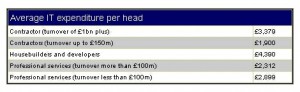
Building-ConIT tableA detailed report is to be published next week by Construct IT, based on a survey of construction’s top 200 companies, including building and civil contractors, developers, house-builders and designers. It shows that contractors and consultants such as architects spend the least (£2,685), and house-builders and developers spend the most, with an average of £4,390. The focus on the top companies may, however, have skewed the picture as construction is, of course, a sector heavily dominated by small and medium-sized enterprises, many of which are still suffering the effects of a savage recession (the vast majority of companies have turnovers much, much lower than £100m or £150m) – a point made by a National Federation of Builders spokesperson:

“Contractors are aware of the benefits IT can bring to their businesses, particularly in terms of increased efficiencies, but the biggest barrier at the moment is finding the capital to invest in upgrades. This is particularly true for SMEs, even those with full order books.”

Prospects

The survey apparently reveals a bleak outlook for IT spending for the next three years, with 90% of firms predicting no increase in their IT budgets this year, following drops in capital spending in many firms in 2009, plus freezes on non-essential investments, reduced staffing and support contract reviews.

Having long been an advocate of externally-hosted, web-based IT, I was pleased to see that internet-based hardware and data storage services were being increasingly favoured over in-house systems. Software was the only area where IT expenditure was predicted to rise:

“Newer technologies being looked at to cut costs include “cloud computing” – shared resources that can be accessed by any internet device – and “virtual desktop infrastructure”, where all the computer applications are held on a central server remotely.”

Corporate readiness to embrace Software-as-a-Service (SaaS) has clearly changed substantially from the early-mid 2000s when it was common for organisations to be wary of web-based application service providers. But I suspect the industry’s cost-conscious tendencies will also, unfortunately, result in companies sometimes looking for lowest-price rather than looking at quality and best long-term value of a service.

I understand, for example, that some construction collaboration technology vendors are finding it a very competitive marketplace at the moment, with wafer-thin margins and downward pressure on prices. Just as with other industry relationships, I hope this doesn’t result in a legacy of disputes and litigation arising from cheap solutions that ultimately turn out to be incapable of delivering the required quality of service. As I have written many times before, purchasing SaaS isn’t just about the technologies, it’s also about the company, its finances and people, their expertise and the infrastructure they have at their disposal. In short, it’s not about the Software – it’s about the Service.

Permanent link to this article: http://extranetevolution.com/2010/05/construction-it-spend-still-very-cost-conscious/

COBie – the bridge between BIM and collaboration technologies?

My previous post, It’s been about collaboration all along, highlighted some emerging similarities between UK and US practices with regard to collaborative working – partly driven (at least in the USA) by the need to rethink industry approaches to management of people and processes as building information modelling (BIM) looms larger on the industry horizon.

However, while the “Big BIM” business model of integrated project delivery (IPD) requires a consistent collaborative approach, the realities of adopting new technologies and of ensuring systematic take-up demand some technological standards that extend beyond the core BIM platform. This point is made quite persuasively in the latest AECbytes Viewpoint by Ontario, Canada-based consultant Al Douglas. He draws our attention to the need for a developing open standard called COBie – Construction Operations Building Information Exchange (COBie).

This complements the IFC standard, providing a format to publish a subset of a BIM, regardless of project type. It allows information to be stored in an accessible format throughout the planning, design, construction and commissioning process and delivering ‘as-built’ information to the asset’s owner upon handover for use in computer-aided FM systems (more information in this NIBS article). The key point is that this information is not stored in a BIM but in whatever platform is used to support team collaboration.

Al talks at length about enterprise content management (ECM) systems, for example (though I would suggest construction project data normally extends well beyond a single ‘enterprise’, so we might be best thinking about slightly different terminology to describe our project collaboration platforms – maybe here the ‘enterprise’ is the built asset project, not the corporation we normally associate with the term?). He argues that such systems have a role to play with regard to BIM: tracking the different stages of the model, providing an audit trail with time, date and access. He also helpfully points out that, beyond the BIM, there is a mass of project-related documentation that is generated and needs to be managed throughout the lifecycle of the asset, for example:

  • Contracts: contracts between the owner and the architect, contractor, project manager, etc.
  • Project communications: general communications, meeting notices, agendas, meeting minutes, requests for information, etc.
  • Design documents: conceptual design, BIM models, presentation renderings, etc.
  • Procurement documents: issued for bidding or negotiating before signing of an agreement.
  • Contract documents: that describe the work of the project.
  • Resource documents: that show existing conditions, or new construction related to the work, but are not included in the contract.
  • Submittal documents: Contractor submittals, subcontractor submittals (insurance certificates, product sheets, shop drawings, etc).
  • Construction site-related documents: Health and safety, accident reports, site photographs, etc.
  • etc

I have to confess that COBie isn’t something that I have read much about before (and I expect many other UK professionals will say the same), but I expect it will be looked at increasingly closely as more clients, teams and their technology vendor partners look to assimilate BIM into their project requirements.

Permanent link to this article: http://extranetevolution.com/2010/05/cobie-the-bridge-between-bim-and-collaboration-technologies/

It’s been about collaboration all along

I have been a member of the UK change organisation Constructing Excellence‘s Collaborative Working Champions for some years. My interest in this area started in the 1990s when I worked in what was then Tarmac (now Carillion) Professional Services and my line manager was Shonagh Hay. She was a member of the  Reading Construction Forum (a forerunner of Constructing Excellence), which was in the vanguard producing industry guidance on partnering in the construction industry, and she inspired me to think more deeply about overturning decades of adversarial practice in favour of more collaborative approaches. And my thinking on the technology dimensions of this issue developed further while I was at construction collaboration technology vendor BIW Technologies.

However, trying to turn the industry around while remaining focused on document management and design practices centred around 2D design has proved difficult. Instances of real collaborative working facilitated by collaboration platforms remain relatively few and far between (one of the best examples of teams successfully addressing people and process issues, and utilising supporting technologies – the MOD Andover North project, an ITCBP case study (PDF) – is now almost a decade old and I still hear industry people talk about its other innovations such as a single project bank account).

Constructing Excellence remains committed to the principles of collaborative working and is also aware of the need to embrace changing industry information technology, notably building information modelling (BIM). It has a working party developing industry guidance on the issue, and I am sure this group is aware of the efforts of BuildingSMART and other organisations in this field, both in the UK and in markets such as the USA – where thinking about integrated project delivery is steadily advancing.

Only yesterday, I found a very readable article on the upFront.Ezine (via Ralph Grabowski’s WorldCAD Access blog) about building information modelling (BIM) and integrated project delivery. In it Robert Anderson, Nemetschek North America’s Vice-President of integrated practice, talks about “Big BIM, Little BIM” (software is Little BIM, business model is “Big BIM”, or IPD), and therefore the need not just to change technology but to change business models.

He suggests tackling the contractual issues – people/process interfaces – will require a collaborative approach, and the elements of that approach (summarised below) sound very similar to the recommendations (integrated teams, early supply chain engagement, etc) that Constructing Excellence has been promoting for the past decade or more:

  • Owner, architect, consultants, contractor, subcontractors and suppliers commit to working as a team.
  • All are involved as early as possible.
  • Compensation structure rewards early involvement.
  • Project goals are developed early.
  • Responsibilities are clearly defined in a no-blame culture to resolve problems, not determine liability.
  • Open and interoperable data exchange is essential.
  • Appropriate technology specified at project initiation.
  • High Performance buildings are the result

So, while the US might be slightly ahead of the UK in its adoption of BIM, one might argue that the UK is more advanced in developing ideas about the critical people and process issues.

Permanent link to this article: http://extranetevolution.com/2010/04/its-been-about-collaboration-all-along/

Thoughts on those Australian AEC software start-ups

It is apparently no coincidence that I had enough material to write three consecutive blog posts this week about Australian software businesses targeting the architecture, engineering and construction market. Sean Kaye, now back at Leighton Holdings as General Manager, Group Strategic IT after a stint as CEO of its Incite subsidiary, sent me an email on the recent surge:

“… the number of startups targeting the Australian construction market is BOOMING!  I’m hearing from all kinds of interesting small start-ups with ideas they want to pitch to Leighton.

Unfortunately, I don’t think most of them will survive which is a shame – the market is not the quickest adopter of technology and much of what I’m seeing isn’t really solving a problem.  I also think some of these start-ups are wasting their time calling companies like us – if you’ve never fished before, you don’t go hunting a whale.

I think these companies need to try out their wares on a few small builders before trying to get involved in multi-billion dollar projects with tight contracts.  I appreciate there’s no harm in trying or as the Aussies say, ‘Having a go’, but the truth is, for most of these companies, even if they were successful and were adopted on a massive project or by a huge company, they simply wouldn’t have the support capability to sustain the customer.  Walk before you can run.”

Permanent link to this article: http://extranetevolution.com/2010/04/thoughts-on-those-australian-aec-software-start-ups/

Urban Circus

Having earlier today written briefly about the virtual world of Second Life (Daden post) and about two Australian companies (All Over Geo post; Tender.ly post), it somehow seems fitting to write about Urban Circus.

This Brisbane, Australia company (it also has a UK outpost) proclaims itself to be at “the cutting edge of 3D Virtual Reality“. Its solutions are used to support design, engineering and communication across industries, but particularly in transport projects, and it says:

Our valued clients are winning projects, managing teams and stakeholders, inducting and training, designing, validating and auditing, communicating and building projects faster, better and smarter.

Urban Circus apparently creates bespoke solutions to suit its clients’ needs, so it isn’t a populated, virtual world like Second Life. Instead, it appears to be a highly detailed, realistic, real-time 3D rendering that is created for specific projects, and, as such, requires more than a little computing power to display the resulting graphics effectively. Outputs include 3D virtual reality, VR videos, VR images, VR panoramas and – perhaps most interesting from my perspective – self-directed web or kiosk environments.

High quality but not Web 2.0

For projects requiring a highly life-like visual experience, perhaps to win client, regulatory or local community support, such a platform must be very powerful. It is easy to imagine how a building information model (BIM) might be created and re-used to show project stakeholders how the design might look, etc.

But the high quality imagery may not be enough for everybody. It isn’t clear from Urban Circus’s website how its technology might, for example, enable community feedback on proposals (the ‘communicate’ images seem to suggest that Urban Circus is used to support ‘door-to-door’ and ‘community hall consultations’, etc, where audience or stakeholder responses are presumably gathered by the presenter).

Other environments or applications, by contrast, may not deliver such fantastic graphics but by displaying adequate – and user-navigable – images might offer greater opportunities for democratic feedback, particularly via the web. For example, I have seen how Second Life or less graphic-intensive tools like Slider Studio‘s YouCanPlan can enable people to share context-specific comments openly and transparently with others in their community via a standard web browser.

Permanent link to this article: http://extranetevolution.com/2010/04/urban-circus/

Load more