Websites overhauled at BIW and 4Projects

The corporate websites of UK construction collaboration technology providers 4Projects and BIW Technologies* have both been refreshed recently.

Despite my past involvement with BIW, I think the changes in 4Projects’ online presence are more extensive, building on website changes that the company instigated on its subsidiaries 4Retail and 4Exergy sites last year (post). 4Projects appointed a new VP marketing, Clare Watson earlier this year (her appointment is noted in a 7 July news release about general company expansion – post; I met Clare for a coffee in February), and the ‘refresh’ of the main 4Projects site is perhaps the most visible of the changes she has achieved to date (the company is using some social media tools too, and through these you can also see how 4Projects’ refreshed branding is being used in its literature, six items of which are being shared via SlideShare).

Looking back over the past three years, I think I have written about rebranding and website upgrades for most of the leading UK vendors, several of whom have incorporated some social media into their communications (perhaps most notable in this respect is Asitepost). Perhaps the only one that don’t appear to have overhauled its website for some years is Cadweb (though it does tweet occasionally).

I am minded to do a detailed comparison of the main collaboration vendors and their use of social media tools – similar to ones undertaken elsewhere in the industry looking at the Web 2.0 activities of leading contractors and housebuilders (see my pwcom blog post, Construction companies could do better on social media).

[* I worked for BIW from 2000 to early 2009, and have since undertaken occasional PR and marketing projects for the company, including website copywriting.]

Permanent link to this article: http://extranetevolution.com/2010/07/websites-overhauled-at-biw-and-4projects/

Site Clean-up iPhone app

Earlier this year I met up in London with Peter Daly, founder and MD of Dublin-based software developer SmartBuilder Software Ltd, and we talked about the future of construction collaboration technologies and about mobile solutions in particular. I recently met Peter again when he talked about his first iPhone application at the Be2camp East 2 unconference in Chelmsford in June. He demonstrated Site Clean-Up to me (and others) and said a YouTube video, filmed in Dublin, was in production.

Today, I learned that the video is now available online (with a very eloquent site manager!):

Peter tells me that SmartBuilder has a pipeline of apps, and the next one is in development: “the focus is very much on creating applications that save builders money not just on automating existing processes for its own sake or having ‘cool apps’ (which I doubt cuts much ice with builders)”. He also says the application can be easily ported to Android and other platforms, having been created in Javascript using the Appcellerator Titanium framework. SmartBuilder is also planning to release a Software-as-a-Service (SaaS) collaboration application, and these mobile tools are intended to be ‘tasters’ that will also help build a database of qualified sales leads ready for the launch of the SaaS application.

Permanent link to this article: http://extranetevolution.com/2010/07/site-clean-up-iphone-app/

Construction in year 2030

Last November, I wrote (post) about a SCRI report on the future of construction ICT, which put collaboration at its heart. That message has been reprised in a paper by Carl Abbott, Bilge Erdogan and Ghassan Aouad just published by the Royal Society: Construction in year 2030: developing an information technology vision.

Section 4, A glance at the future, builds on discussion of four different scenarios – some optimistic, some more pessimistic – and presents a vision for ICT built on four strands: people, processes, technology and places:

The construction industry is supported by tools and technologies which are fully compatible, developed using open standard software and that put people at the centre of focus, thus enabling creativity, creating integrated business processes that are consistent and compatible; and facilitating less geographically dependent ways of working.

The discussion incorporates a view of ICT that enables construction professionals to focus on what they do, rather than how they do it, and (something to excite my friends in facilities management and connected environments, eg: Pachube) anticipates the emergence of ‘intelligent buildings’:

“… it will be possible to manage self-healing/self-correcting buildings through embedded sensors in the buildings. Smarter management of facilities and construction spaces that is responsive to people and their behavioural preferences will be seen as a result. Rather than sending maintenance people to check whether there is any problem, intelligent built environments will automatically detect the problems. Cutting down carbon, energy and cost of climate will be possible through IT systems that enable user-centred design and intelligent built environments to provide a better future for people.

“Intelligent or semi-intelligent software will improve themselves through automated double-loop learning facilities based on evidence from the actual use of buildings in operation.”

The vision also talks about ideas that are already being investigated by firms like Daden (who are using Second Life for something similar – post)

“IT will be used to train people in any area they need to be trained. Learning will be achieved through games and role plays. For example, site inductions providing a walkthrough in three-dimensional site models. Rather than sitting in a porta cabin and trying to work out which activity needs to be carried out when and where from a blueprint, the information will be accessed much more easily and intuitively through these techniques.”

Thrilling stuff – if (and it’s a big IF) the industry has the foresight to bring it about!

Permanent link to this article: http://extranetevolution.com/2010/07/construction-in-year-2030/

Carbon calculation

Almost two years ago, when I was helping (un)organise the first Be2camp ‘unconference’ event in London, the sustainability theme that underpins this built environment/social media advocacy movement attracted contributions from several people with an active interest in calculating and then reducing the carbon footprint of the architecture, engineering and construction, AEC, sector (we had talks, for example, from Jamie Andrews of AMEE and Tom Chance of BioRegional – both extolling the virtues of carbon calculation). This has been a recurring theme at Be2camp events since 2008; for example:

  • Usman Haque has talked about Pachube‘s connected environments using sensor data to provide real-time energy use data
  • Alex Albon has incorporated carbon calculation into the business proposition for EarthExchange‘s construction waste reduction and recycling community platform, and
  • Be2camp Brum 2009 heard from Claire Hardwick about how Family Housing Association was helping Summerfield residents reduce their energy use, through use of smart meters.

Since 2008, AMEE has developed a web-based tool that accurately records the carbon footprinting of construction client fit-out and refurbishment projects, piloted by fit-out company Overbury (case study). And fellow Be2camp co-founder Martin Brown is one of the people behind the release of ConstructCO2, developed through Evolution-ip, “by construction people for construction use” (see his blog post). All of these efforts have the potential to contribute to the low carbon construction agenda championed by the UK’s chief construction advisor Paul Morrell (see my pwcom blog posts here and here).

CarbonCalculated.com

I was interested therefore when I got an email from Croydon, UK-based CarbonCalculated‘s Jason Green inviting me to look at his company’s online offering:

“We offer a Construction Carbon Calculator which calculates the embodied emissions of construction projects. It is the only system of it’s kind available and can be used for small builds, re-furbishments, civils projects all the way up to massive construction projects.”

While one might quibble about the claim to be ‘the only system of its kind available’, the Construction Carbon Calculator offers some simple-to-use online tools to calculate embodied emissions on construction projects, breaking these down into four main categories (there are some good explanatory videos on Vimeo):

  • materials (and associated modes of delivery)
  • waste management
  • energy consumption on-site
  • commuting (all journeys made by project team members, clients, etc).

Sustainability credentials

As with the other systems, report outputs can be used to document the quantifiable carbon reduction achievements of companies and projects. This is useful, of course, for team members looking to demonstrate their sustainability credentials in pre-qualification questionnaires, tenders, etc, or to provide practical evidence of a client’s corporate social responsibility (CSR). Liz Collett, group environmental manager at Overbury, for example, sums up the benefits:

“Working with AMEE enabled us to deliver a tool that enables our clients to understand the carbon impact of their projects. Being able to use the AMEE engine adds traceability and rigour to our assessments which is what our clients require.”

An attribute shared by all the offerings is their reliance on a cloud-based model, with all the tools being accessed via the web. This clearly makes sense as the underlying formulae used to calculate carbon footprints will vary overtime as new scientific data becomes available, and hosting all the background data would require constant software updates.

It would be interesting to marry this carbon calculation process up more tightly with collaboration over design and construction, so that teams could quickly evaluate different design (eg: steel versus concrete frame), or construction options (in-situ construction versus off-site fabrication, for example), identify local suppliers during procurement, or look at logistical issues such as delivery consolidation centres or shared transport of site personnel. Collating data from across multiple sites on a common industry basis would also be useful in creating and maintaining key performance indicators – benchmarks against which teams, clients and regulators can then measure their compliance and performance and help deliver real low carbon construction.

Permanent link to this article: http://extranetevolution.com/2010/06/carbon-calculation/

MyOnlineToolbox.com

My recent live-blog post about Tradeshift wondered whether there might be an opportunity for SME firms in the architecture, engineering and construction sectors to expand their adoption of online platforms, perhaps even integrating project delivery processes with the associated financial transactions. It seems one business in the United States is already starting to do this: MyOnlineToolbox.com.

I was contacted by the Florida-based company‘s co-founder, and president Brian Javeline, who told me more about its Business-to-Business-to-Consumer (B-2-B-2-C) model and how it is targeting very small to medium-sized contractors in the US home repair and remodelling sector (of course, home repair, extension and refurbishment will be a growth sector with house-building still suffering the after-effects of the credit crunch).

What stood out to me when I looked at MyOnlineToolbox was that, in addition to providing SaaS-based business tools for managing SME transactions and information exchanges between companies and their customers (both other businesses and household customers), it was also looking at advertising revenues. Brian confirmed that the latter could be highly targeted, so that product manufacturers, for example, could target specific geographic localities and specific types of audience (say, contractors or home-owners). Given that the basic two-user product is free (the premium option is US$89/month, for three users), I expect many SME users will be happy for their site to carry some advertising (they may even see good opportunities to advertise themselves).

MyOnlineToolbox’s core functionality appears to relate to exchange of estimates, RFQs, orders, approvals, messages, notes and invoices (I couldn’t find any reference to collaboration on design drawings or other design information, so I guess this lies outside the current scope of the platform; the focus is therefore on business processes rather than design). Depending on the customer requirement, contractors can print out hard copies of their business documents, or use fax, email or online processes.

There is an emphasis on sharing and recommendation, Brian says: “The more a customer shares the product with his private network of peers, the more efficient the product becomes.” He continues:

MyOnlineToolbox users share job leads easily with other MyOnlineToolbox users as well as non-users. The system automatically detects a non-user communication and takes the non-user through a marketing message to solicit them to join the community. Plus, each piece of correspondence sent to a non-user will have a suggestion message highlighting a feature of the system that would be of benefit to the correspondence receiver. The beauty is that the non-user must become a MyOnlineToolbox user to get his job information.

“We want contractors to think of MyOnlineToolbox with three focuses 1) obtaining more work, 2) managing existing jobs, and 3) getting paid more efficiently.”

Permanent link to this article: http://extranetevolution.com/2010/06/myonlinetoolboxcom/

Asite reports 18 months to June 2009

Late last month I downloaded the latest annual report and audited accounts filed at Companies House by UK-based construction collaboration technology vendor Asite.

Regular readers may recall that Asite reported some unaudited figures in January (see Asite reaches profitability), covering the year to 31 December 2009. This latest Companies House filing, signed off on 16 April 2010, covers an 18-month period from 1 January 2008 through to 30 June 2009, following the company’s de-listing from AIM (post) in April 2009 and a subsequent change of financial year-end to 30 June.

In line with the positive progress suggested in January’s unaudited numbers, the published accounts show revenue growth of 27% in the 18 months to June 2009 compared to the previous 18 months (June 2006 to December 2007). Revenues were £2.949m, up from £2.318m, while operating losses were cut from £1.005m to £0.219m.

The bulk of Asite’s revenues (£2.526m or 86%) came from the UK market, with the UAE the next largest market (£294k or 10%) – this period, remember, includes the downturn in Dubai that impacted on other collaboration vendors like Aconex (post) and BIW (post) in early 2009 too. Average employee numbers over the period were given as 67, down from 74.

The business is still financially supported by majority shareholder Robert Tchenguiz through R20 Limited, which has provided a loan facility of up to £2.8m not repayable until 30 June 2011.

Permanent link to this article: http://extranetevolution.com/2010/06/asite-reports-18-months-to-june-2009/

Tradeshift launches in the UK

Free invoicing for everyone

London: 1930hrs BST – Given that the construction industry is a sector dominated by the small- to medium-sized enterprise (SME), any application that can help the small business improve its efficiency has to be welcome. I am attending and live-blogging from the London launch of Tradeshift, a Software-as-a-Service (SaaS) invoicing platform, originally of Danish origin, that describes itself as:

… the world’s first open global business platform. It connects all suppliers and business partners electronically, delivering better, smarter and above all, safer business transactions.

It goes on:

Connecting your customers and suppliers in Tradeshift is just as simple and easy as connecting on social networks. You can send and receive invoices, using everything from text messages on your mobile phone, to advanced ERP platforms and everything in between.

Targeting businesses of different sizes

For small businesses, Tradeshift Basic is the free entry-level product, aimed at any company wanting to send and receive invoices electronically. A SaaS application, Tradeshift Basic is accessible from any browser, on any operating system, with no software to install. One of TradeShift’s customers described his use of the system, highlighting the ‘Green IT’ credentials of the system – no paper to post and easy access for his accountant.

The next option up, Tradeshift Connect is aimed at SMEs that already have an accounting system, allowing them to create and import invoices direct from their existing package.

The enterprise solution, Tradeshift Enterprise (obviously), integrates with existing ERP systems, including SAP and Oracle eBusiness Suite (no mention – yet – of construction industry systems such as COINS or Redsky IT, or Sage’s Timberline platform, popular in north America) and is offered as a subscription service without any transaction costs. A public sector edition is also available.

Rivals

Personally, I already use Saasu.com for my own business invoicing needs (it, too, is free if you only need to process a few transactions per month), and I really appreciate it being web-based as I sometimes need to check transactions from different laptops. Intuit’s Quickbooks Online, Xero, MYOB, Zoho and Freshbooks all featured on my radar too.

Opportunity

Tradeshift slide

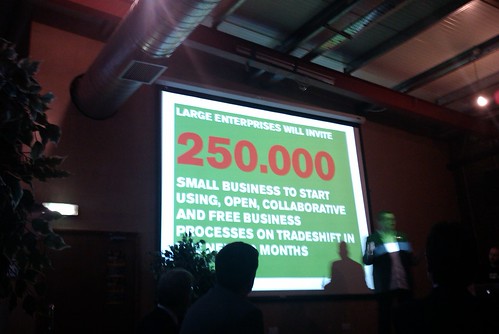
2000hrs – TradeShift founder Christian Lanng talked about the opportunity: 15 billion invoices each year, from 200 million small businesses in Europe, with about €64 billion spent on typing and retyping information into IT systems. It still costs €100 for a small business to send 100 invoices to a large supplier using electronic invoicing, he says, with many small businesses locked into using systems essentially aimed at larger companies.

The Tradeshift application is simple to use – just three buttons: dashboard, documents and business network – and also enables small businesses to send invoices to non-company clients (excellent for the many householders who are the life-blood of many repair and maintenance businesses in the SME sector of the construction industry).

The application is also built on an open platform, completely open for third party developers, with more than 20 developers already building tools to share data with the Tradeshift system (ERPly also has a presence at the event).

Observation

Update (11 June) – Talking after the event with a couple of attendees, I wondered if Tradeshift’s open approach might be attractive to some of the construction-specific platform developers who might want to add transaction capabilities to existing systems focused, for instance, on drawing/document collaboration and related processes. Just as Tradeshift is looking to replace paper-based transaction processes with electronic management, online construction project management solutions are eliminating the need for distribution of hard copy drawings and documents (and reducing use of email attachments). One might add customer order processing, transactions with suppliers and sub-contractors, and settlement of the final account to the capabilities that SME contractors, designers or project managers might want in addition to streamlined information management.


Permanent link to this article: http://extranetevolution.com/2010/06/tradeshift-launches-in-the-uk/

Aconex streamlines bid and tender management process

Australia-based construction collaboration technology vendor Aconex has today issued a news release regarding a platform upgrade streamlining its bid and tender management processes for construction, infrastructure and energy projects. This was something that was mentioned briefly when I did a telephone interview with Aconex co-founder and General Manager of Product Rob Phillpot last November (see Rob Phillpot on Aconex, APIs and acquisitions).

The company’s revamped bid and tender management module will increase competition in this space, with several of the UK-based Software-as-a-Service vendors (eg: 4Projects, Asite, BIW, Business Collaborator, CTSpace, Sarcophagus) all providing construction tender management tools alongside their document and drawing collaboration capabilities, and with some stand-alone tender applications also available (eg: the hardly used RICSeTendering.compost; and the soon-to-be-launched Australian SaaS application Tender.ly – post).

Permanent link to this article: http://extranetevolution.com/2010/06/aconex-streamlines-bid-and-tender-management-process/

Integrated Lifecycle Solutions

Former Constructware executives Scott Unger and Brian Moore are half-way towards their $1.5m equity funding target for a new business, Integrated Lifecycle Solutions – perhaps another sign that the US market for construction collaboration technologies is increasingly buoyant. The news (see TechJournalSouth article) follows a regulatory filing showing the team has so far raised $765,000 from five investors. The new company will apparently sell on-demand communication and collaboration software aimed at simplifying design, construction and facility project management.

I met Scott briefly at a Harvard University event in March 2006, soon after he had sold Constructware to Autodesk in a deal worth $46m (post) – roughly £27m then. He remained with Autodesk until late 2008, after which there was, for a while, some speculation that Autodesk would no longer be developing the product (see Constructware’s future questioned).

Scott founded Constructware in Alpharetta, Georgia in 1994, and his vision then of creating a communication standard across all phases of the design, construction and facility lifecycle clearly remains alive. Brian Moore also worked at Constructware, as vice president of product management and development, having worked with Scott at a software business, Emerging Solutions, during the 1990s.

Technorati Tags:

Permanent link to this article: http://extranetevolution.com/2010/06/integrated-lifecycle-solutions/

CTSpace talks about FusionLive

Last week I travelled to Brentford and the London offices of Sword CTSpace to learn more about the company’s FusionLive platform. After blogging about the product’s launch last month, I had been invited by business unit director John Pomeroy to meet some of the FusionLive team (including George Britton, Andre Gunter and Mathieu Pollet) and learn more about the company, its plans and applications.

On-premise and SaaS applications

John and I narrowly missed working together during the mid-1990s. He was at electronic document management system vendor Cimage just before it was acquired by my then employer Tarmac Professional Services, and I subsquently took on responsibility for over-seeing its PR and marketing outputs. I mention this because Cimage was acquired by Sword in 2004 and merged with CTSpace last year, and the Cimage (later Cimage Novasoft) EDMS, Fusion, remains part of Sword CTSpace’s product portfolio. John explained the ‘fit’:

FusionEnterprise is our on-premise solution. We are not a single solution provider; we can go and talk to a potential customer and match a solution to meet their need, whether it’s for an internally hosted system or for a Software-as-a-Service platform. Indeed, when we looked at the two platforms’ customer bases, we noticed some overlaps: organisations were deploying Fusion for internal collaboration and SaaS products when they needed to share information with a range of external supply chain companies.

“We also have some slick integration between the two systems, particularly as they share common approaches to content management, asset data, and workflows such as transmittals or technical queries.

“We are not just providing the same application either hosted by us or in-house. These are different versions designed to run as in-house and built to run on a customer’s existing IBM FileNet P8 or Microsoft SharePoint environments. There is no other vendor that provides this.”

I heard how the the parent Sword group (1785 staff, €180.6m revenues in 2009, 6% organic growth excluding acquisitions and dispositions) provides considerable support to its specialist subsidiaries. The latter can call upon expertise from:

  • Sword partners including Microsoft, Documentum, IBM, Oracle, Bentley Systems and Autodesk
  • vertical industry experts in fields such as banking or insurance
  • group services in customer relationship management; governance, regulation and compliance (GRC); and business process management, and
  • regional specialists located in different countries and continents.

The group also centralises expertise and support on areas like finance, hosting, and research and development. As a result, Sword CTSpace’s focus on process and project control for energy and construction customers could be enhanced by a much wider pool of knowledge, extending way beyond its core markets and main operational centres (US, UK, Germany, France, Dubai, Poland, plus a development centre in India).

Migration

Our meeting took place immediately after the weekend in which the final users of the former BuildOnline system were migrated to the new FusionLive platform. “We decided it was not feasible to continue to support two increasingly outdated products, or to upgrade them,” said Andre. “We opted instead for an aggressive route in which we migrated everyone to the new system.”

The process was planned and managed over some months. The team held extensive consultations with its key customers (“We have a very vocal user group – some more vocal than others!”) and sought to address any concerns about the changeover through workshops, distribution of training materials, discussion forums and explanatory videos. While there was inevitably some resistance to change, it appears most users were soon persuaded that FusionLive would be a significant improvement on the existing system.

However, the changeover was more than just a change of applications. Sword CTSpace took the opportunity to make significant changes to its system architecture. Upgrading the core Oracle database and centralising the application and data on new shared hosting facilities meant the same number of users could now be supported on a platform that needed 50% less hardware (hosting is provided by Cable & Wireless, with hosting centres in the UK, Dubai and on the US West Coast).

FusionLive

For the end-users, however, the most noticeable changes relate to the user interface (UI). For example, Mathieu showed me how drawing registers could be tailored to suit a user’s requirements by moving and resizing columns, grouping and prioritising items, and – courtesy of AJAX technologies – enabling multi-tasking with different panes open simultaneously within the FusionLive UI. As these features were being developed, they were discussed with users and the ‘look and feel’ owes much to users’ experiences of using Microsoft Outlook, Google Mail and search engines, he said (the consultation process apparently also threw up a lot of WIBNIs – short for ‘Wouldn’t it be nice if…’). Workspaces can also be customised to display particular images or customer branding, and dashboard views can aggregate information into helpful graphics such as bar charts rather than just lists.

Building on Microsoft Office integration capabilities developed for FusionEnterprise, an Outlook Integration application for FusionLive will be available later this year, along with other features. A ‘drag and drop’ workflow engine allowing users to create any kind of form and assign actions and people to its processing will be delivered in the autumn, Mathieu said, as will NEC3-compliant contract management capabilities and a weather gadget. (I couldn’t help but point out that these capabilities are things that some rival platforms have had for a while; my former employer BIW, for instance, has supported NEC process management since 2006 as well as Outlook integration.)

We talked about desktop gadgets and APIs (a recurring theme among vendors in recent months – see post re Aconex, Asite, 4Projects, etc). A CTSpace iPhone app is already in development by a third-party developer, and the API has also been used to create a single sign-on system for FusionLive and other cloud-computing tools. The potential to allow screen-sharing is also being explored.

Looking further forward

I asked if the Sword CTSpace team was planning investment in technologies to support building information modelling, BIM. Interest in BIM was “very low” in the UK, I was told, but there was some interest in the US, particularly among customers working in the oil and gas sector, which was more likely to take a long-term interest in the operation and management of the finished asset and so justify the additional expense of BIM, whereas most contractors don’t tend to look much beyond project delivery and handover.

In 2009, John told me, the Sword CTSpace business achieved revenues of €18m across all its applications, and employed 90 staff. The construction collaboration technology market in the UK – where the company has about 25 staff – was described by Sword CTSpace as “very tight, very competitive”. Eastern Europe and north Africa were “picking up”, and they thought the US market was also beginning to grow again (a view shared by Aconex this week and 4Projects earlier this month).

We also talked about building the industry business case for collaboration, which led us to discuss Sword CTSpace’s online Engineering Collaboration Community, launched last week (see my pwcom blog post, Sword’s collaborative community). This aims to be a neutral industry site, not specific to Sword CTSpace; I have registered with the site and may contribute further as the community grows.

Reaction

Having always held that the process of merger and acquisition among SaaS businesses poses particular challenges when it comes to managing the resulting product portfolio, it was interesting to talk to a company that had – as I put it last month – ‘grasped the nettle’ and decided to compel users to migrate to a new SaaS platform. This migration will, I think, have been attractive to many users. For a start, the business sought feedback on the migration process and on the application users would be moving to, and to most users the resulting application will have represented a significant step forward (as opposed to a sideways step to a parallel system).

The user-configurable interface and the dashboard gadgets are changes in line with software developments elsewhere. Today’s web users are increasingly able to configure and customise the applications they use, even combining different applications in a single view, and while some construction collaboration technologies have often adopted a modular approach (allowing users to select what modules to display on their desktop, for example), they haven’t so far allowed such fine degrees of control such as the ability to change the sequence or size of columns in views of data, or to multi-task.

Sword CTSpace claims to be unique in offering both SaaS and on-premise AEC solutions (its approach is different to Unit4 Collaboration Software, formerly Business Collaborator, which offers a core application in both flavours). SaaS purists might contest the logic of such a dual approach, but the legacy knowledge behind the different solutions, the apparent overlap between the two principal alternatives and the considerable shared resources available to their integrated development makes this twin-track approach commercially sensible. The company could conceivably see the SaaS solution used to deliver a client’s project or programme of works involving an extensive network of external partners, and then enable the client to switch to an on-premise solution when it requires mainly internal use of the data created during delivery (recognising that many firms still prefer to retain key data in-house).

Permanent link to this article: http://extranetevolution.com/2010/05/ctspace-talks-about-fusionlive/

Load more